
Puck, 1878-07-24 · page 6 of 16
Puck — July 24, 1878 — page 6: what you’re looking at
What you’re looking at
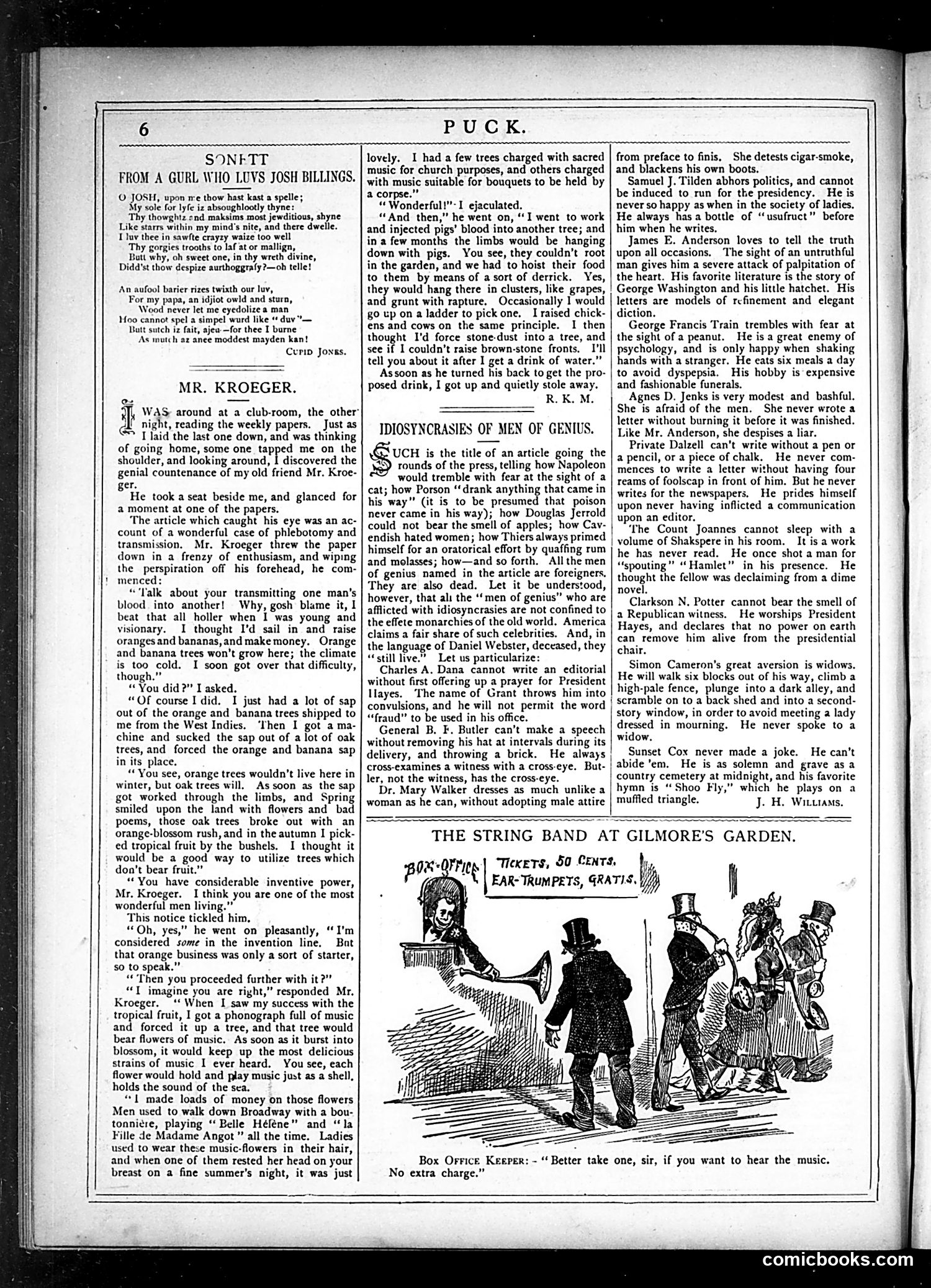
This page contains three distinct sections: **"Sonnet from a Gurl Who Luv's Josh Billings"** and **"Mr. Kroeger"** are literary pieces with no political content—they appear to be humorous fiction columns typical of Puck's entertainment coverage. **"Idiosyncrasies of Men of Genius"** is a satirical commentary mocking famous men's peculiar habits. It references figures like Napoleon, Douglas Jerrold, and Daniel Webster, pointing out their odd behaviors and contradictions—how supposedly great men often have petty or absurd personal quirks. The satire suggests that "genius" doesn't exempt people from being ridiculous. **"The String Band at Gilmore's Garden"** is a cartoon showing a street musician offering music for "50 Cents, Ear-Trumpets Gratis"—a joke about forcing unwilling audiences to listen to bad street music while profiting from their discomfort.
📄 Transcribed text from this page (OCR, searchable)
Machine-transcribed from the original scan — historical spelling and the odd misread are preserved.
PUCK. SONFTT FROM A GURL WHO LUVS JOSH BILLINGS. © JOSH, upon me thow hast kast a spelle; My sole for lyfe iz absoughlootly thyne: Thy thowghiz end maksims most jewditious, shyne Like starrs within my mind’s nite, and there dwelle. Tluy thee in sawfte crayzy waize too well Thy gorgies trooths to laf at or mallign, Butt why, oh sweet one, in thy wreth divine, Didd’st thow despize aurthoggrafy?—oh telle! An aufool barier rizes twixth our luv, For my papa, an idjiot owld and sturn, Wood never let me eyedolize a man Moo cannot spel a simpel wurd like ** duv"— Butt sutch iz fait, ajea-—for thee I burne As mutch az anee moddest mayden kan! Curtp Joss. MR. KROEGER. 2 $ at night, reading the weekly papers. Just as I laid the last one down, and was thinking of going home, some one tapped me on the shoulder, and looking around, I discovered the genial countenance of my old friend Mr. Kroe- er. g He took a seat beside me, and glanced for a moment at one of the papers. The article which caught his eye was an ac- count of a wonderful case of phlebotomy and transmission. Mr. Kroeger threw the paper down in a frenzy of enthusiasm, and wiping the perspiration off his forehead, he com- menced: “Talk about your transmitting one man’s blood into another! Why, gosh blame it, 1 beat that all holler when I was young and visionary. I thought I'd sail in and raise oranges and bananas, and make money. Orange and banana trees won't grow here; the climate is too cold. I soon got over that difficulty, though.” “You did?” I asked. “Of course I did. I just had a lot of sap out of the orange and banana trees shipped to me from the West Indies. ‘Then I got a ma- chine and sucked the sap out of a lot of oak trees, and forced the orange and banana sap in its place. “You see, orange trees wouldn’t live here in winter, but oak trees will. As soon as the sap got worked through the limbs, and Spring smiled upon the land with flowers and bad poems, those oak trees broke out with an orange-blossom rush, and in the autumn I pick- ed tropical fruit by the bushels. I thought it would be a good way to utilize trees which don't bear fruit.” “You have considerable inventive power, Mr. Kroeger. I think you are one of the most wonderful men living.” This notice tickled him, “Oh, yes,” he went on pleasantly, “I'm considered some in the invention line, Bat that orange business was only a sort of starter, so to speak.” “Then you proceeded further with it?” “T imagine you are right,” responded Mr. Kroeger.‘ When I saw my success with the tropical fruit, I got a phonograph full of music and forced it up a tree, and that tree would bear flowers of music. As soon as it burst into blossom, it would keep up the most delicious strains of music I ever heard. You see, each flower would hold and play music just as a shell, holds the sound of the sea. “1 made loads of money on those flowers Men used to walk down Broadway with a bou- tonnicre, playing “Belle Héléne” and “la Fille de Madame Angot” all the time. Ladies used to wear these music-flowers in their hair, and when one of them rested her head on your breast on a fine summer's night, it was just WAS around at a club-room, the other’ lovely. I had a few trees charged with sacred music for church purposes, and others charged with music suitable for bouquets to be held by a corpse.” “ Wonderful!”*I ejaculated. “And then,” he went on, “I went to work and injected pigs’ blood into another tree; and in a few months the limbs would be hanging down with pigs. You see, they couldn’t root in the garden, and we had to hoist their food to them by means of a sort of derrick. Yes, they would hang there in clusters, like grapes, and grunt with rapture, Occasionally I would go up on a ladder to pick one, I raised chick- ens and cows on the same principle. I then thought I'd force stone-dust into a tree, and see if I couldn’t raise brown-stone fronts. I'll tell you about it after I get a drink of water.” Assoon as he turned his back to get the pro- posed drink, I got up and quietly stole away, R.K. M. IDIOSYNCRASIES OF MEN OF GENIUS. UCH is the title of an article going the 8) rounds of the press, telling how Napoleon would tremble with fear at the sight of a cat; how Porson “drank anything that came in his way” (it is to be presumed that poison never came in his way); how Douglas Jerrold could not bear the smell of apples; how Cav- | endish hated women; how Thiers always primed himself for an oratorical effort by quaffing rum and molasses; how—and so forth. All the men of genius named in the article are foreigners, They are also dead. Let it be understood, however, that ali the ‘men of genius” who are afflicted with idiosyncrasies are not confined to the effete monarchies of the old world. America claims a fair share of such celebrities. And, in the language of Daniel Webster, deceased, they “still live.” Let us particularize: Charles A. Dana cannot write an editorial without first offering up a prayer for President Ilayes. The name of Grant throws him into convulsions, and he will not permit the word “fraud” to be used in his office. General B. F. Butler can’t make a speech without removing his hat at intervals during its delivery, and throwing a brick. He always | cross-examines a witness with a cross-eye. But- | ler, not the witness, has the cross-eye. | Dr. Mary Walker dresses as much unlike a woman as he can, without adopting male attire from preface to finis, She detests cigar-smoke, and blackens his own boots. Samuel J. Tilden abhors politics, and cannot be induced to run for the presidency. He is never so happy as when in the society of ladies, He always has a bottle of “usufruct” before him when he writes. James E. Anderson loves to tell the truth upon all occasions. The sight of an untruthful man gives him a severe attack of palpitation of the heart. His favorite literature is the story of George Washington and his little hatchet. His letters are models of refinement and elegant diction. George Francis Train trembles with fear at the sight of a peanut. He is a great enemy of psychology, and is only happy when shaking hands with a stranger. He eats six meals a day to avoid dyspepsia. His hobby is expensive and fashionable funerals. Agnes D. Jenks is very modest and bashful. She is afraid of the men. She never wrote a letter without burning it before it was finished. Like Mr. Anderson, she despises a liar. Private Dalzell can't write without a pen or a pencil, or a piece of chalk. He never com- mences to write a letter without having four reams of foolscap in front of him. But he never writes for the newspapers. He prides himself upon never having inflicted a communication upon an editor. | ‘The Count Joannes cannot sleep with a | volume of Shakspere in his room. It is a work he has never read. He once shot a man for “spouting” “Hamlet” in his presence. He thought the fellow was declaiming from a dime novel. Clarkson N, Potter cannot bear the smell of a Republican witness. He worships President Hayes, and declares that no power on earth can remove him alive from the presidential chair. Simon Cameron's great aversion is widows. He will walk six blocks out of his way, climb a high-pale fence, plunge into a dark alley, and { scramble on to a back shed and into a second- story window, in order to avoid meeting a lady dressed in mourning. He never spoke to a widow. Sunset Cox never made a joke. He can't abide 'em. He is as solemn and grave as a country cemetery at midnight, and his favorite hymn is “Shoo Fly,” which he plays on a muffled triangle. J. H. Witttams. Box Orrice Keeper: - ‘‘ Better take No extra charge.” THE STRING BAND AT GILMORE’S GARDEN. ThexeTs, 50 CENTS, EAR- TRUMPETS, GRATIS. b one, sir, if you want to hear the music. comicbooks.com