
Puck, 1878-07-24 · page 7 of 16
Puck — July 24, 1878 — page 7: what you’re looking at
What you’re looking at
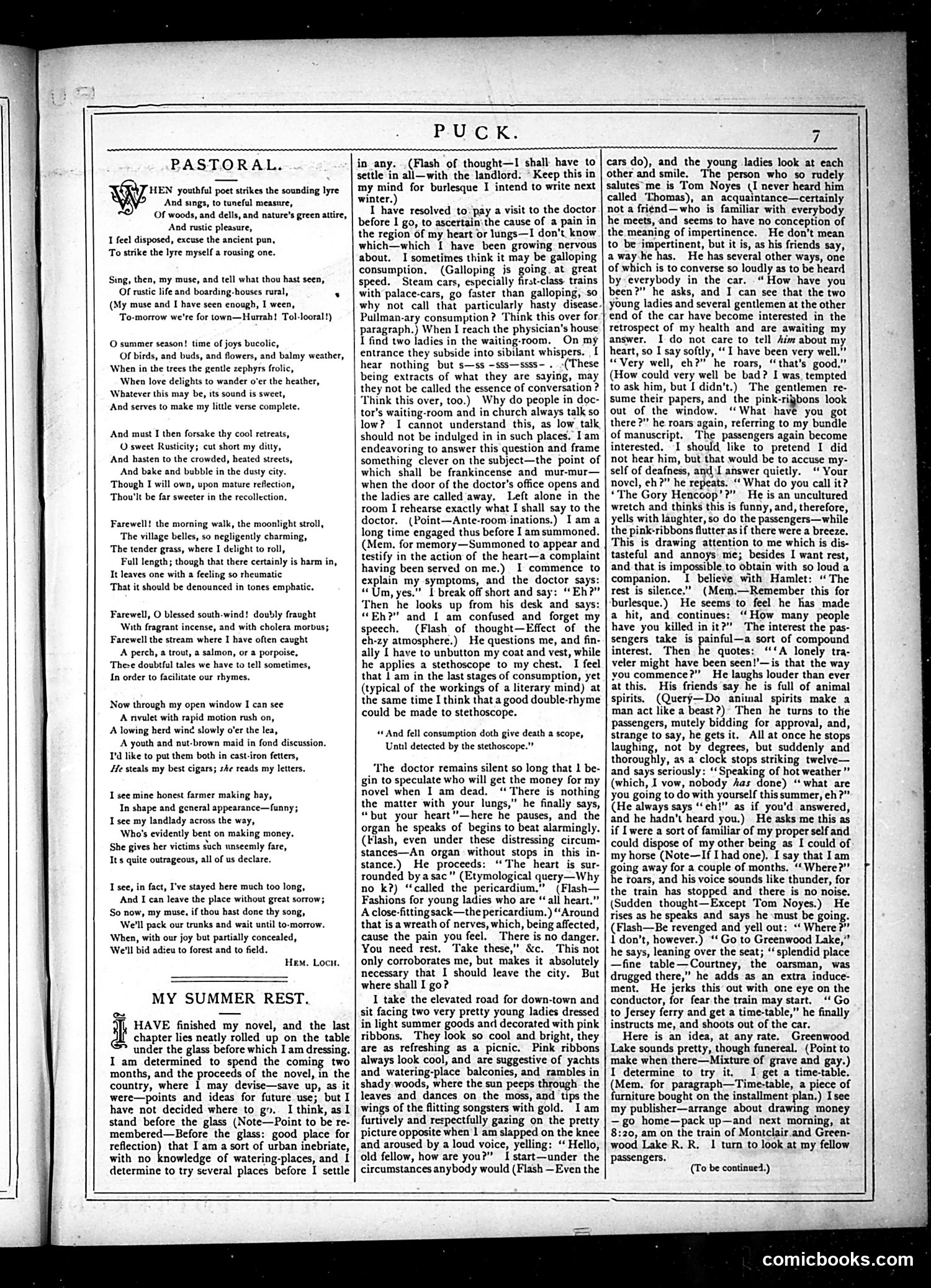
This page contains two literary pieces rather than political cartoons: 1. **"Pastoral"** — A poem by Hem. Loch satirizing romantic notions of rural summer life. It mocks the disconnect between idealized country living and actual discomforts (heat, insects, noise). 2. **"My Summer Rest"** — A humorous essay about an author finishing a novel. It satirizes the writer's pretensions about finding peaceful places to work and his encounters with intrusive, gossipy people at a doctor's office who demand details about his book. Both pieces use social satire typical of Puck's style—mocking middle-class pretensions and human foibles rather than targeting specific political figures. The humor relies on relatable frustrations with polite society's nosiness and the gap between expectations and reality.
📄 Transcribed text from this page (OCR, searchable)
Machine-transcribed from the original scan — historical spelling and the odd misread are preserved.
PUCK. 7 PASTORAL. HEN youthful poet strikes the sounding lyre And sings, to tuneful measure, Of woods, and dells, and nature’s green attire, And rustic pleasure, I feel disposed, excuse the ancient pun, To strike the lyre myself a rousing one. Sing, then, my muse, and tell what thou hast seen, Of rustic life and boarding-houses rural, (My muse and I have seen enough, I ween, To-morrow we're for town—Hurrah! Tol-looral!) O summer season! time of joys bucolic, Of birds, and buds, and flowers, and balmy weather, When in the trees the gentle zephyrs frolic, When love delights to wander o'er the heather, Whatever this may be, its sound is sweet, And serves to make my little verse complete. And must I then forsake thy cool retreats, O sweet Rusticity; cut short my ditty, ‘And hasten to the crowded, heated streets, ‘And bake and bubble in the dusty city. Though I will own, upon mature reflection, Thou'lt be far sweeter in the recollection, Farewell! the morning walk, the moonlight stroll, The village belles, so negligently charming, The tender grass, where I delight to roll, Fall length; though that there certainly is harm in, It leaves one with a feeling so rheumatic That it should be denounced in tones emphatic. Farewell, O blessed south-wind! doubly fraught With fragrant incense, and with cholera morbus; Farewell the stream where I have often caught A perch, a trout, a salmon, or a porpoise, ‘These doubtful tales we have to tell sometimes, In order to facilitate our rhymes, Now through my open window I can see A nvulet with rapid motion rush on, A lowing herd wind slowly o'er the lea, ‘A youth and nut-brown maid in fond discussion. T'd like to put them both in cast-iron fetters, He steals my best cigars; she reads my letters, I see mine honest farmer making hay, In shape and general appearance—funny; I see my landlady across the way, ‘Who's evidently bent on making money. She gives her victims such unseemly fare, It's quite outrageous, all of us declare. I see, in fact, I've stayed here much too long, And I can leave the place without great sorrow; So now, my muse, if thou hast done thy song, We'll pack our trunks and wait until to-morrow. When, with our joy but partially concealed, We'll bid adieu to forest and to field. Hes. Locn. MY SUMMER REST. HAVE finished my novel, and the last chapter lies neatly rolled up on the table under the glass before which I am dressing. two I I am determined to spend the comin; months, and the proceeds of the novel, in the country, where 1 may devise—save up, as it were—points and ideas for future use; but I have not decided where to go. I think, as 1 stand before the glass (Note—Point to be re- membered—Before the glass: good place for reflection) that I am a sort of urban inebriate, with no knowledge of watering-places, and I determine to try several places before I settle in any. (Flash of thought—I shall- have to settle in all—with the landlord. “Keep this in my mind for burlesque I intend to write next winter.) I have resolved to-pay a visit to the doctor before 1 go, to ascertain\the cause of a pain in the region of my heart or lungs—I don’t know which—which I have been growing nervous I sometimes think it may be galloping consumption. (Galloping js going. at great speed. Steam cars, especially first-class. trains with palace-cars, go faster than galloping, so why not call that particularly hasty disease.| Puilman-ary consumption? ‘Think this over for paragraph.) When I reach the physician's house I find two ladies in the waiting-room. On my entrance they subside into sibilant whispers. , [ hear nothing but s—ss -sss—ssss- . -(These being extracts of what they are saying, may they not be called the essence of conversation ? ‘Think this over, too.) Why do people in doc- tor’s waiting-room and in church always talk so low? I cannot understand this, as low talk, should not be indulged in in such places. I am endeavoring to answer this question and frame something clever on the subject—the point of which shall be frankincense and mur-mur— when the door of the doctor's office opens and the ladies are called away. Left alone in the room I rehearse exactly what I shall say to the doctor. (Point—Ante-room-inations.) I ama long time engaged thus before I am summoned. (Mem. for memory—Summoned to appear and testify in the action of the heart—a complaint having been served on me.) I commence to explain my symptoms, and the doctor says: “Um, yes.” | break off short and say: “Eh?” ‘Then he looks up from his desk and says: “Eh?” and I am confused and forget my speech. (Flash of thought—Effect of the eh-zy atmosphere.) He questions me, and fin- ally I have to unbutton my coat and vest, while he applies a stethoscope to my chest. I feel that 1 am in the last stages of consumption, yet (typical of the workings of a literary mind) at the same time I think that a good double-rhyme could be made to stethoscope. «And fell consumption doth give death a scope, Until detected by the stethoscope.”” ‘The doctor remains silent so long that 1 be- gin to speculate who will get the money for my novel when I am dead. “ There is nothing the matter with your lungs,” he finally says, “but your heart”—here he pauses, and the organ he speaks of begins to beat alarmingly. (Flash, even under these distressing circum- stances—An organ without stops in this in- stance.) He proceeds: ‘The heart is sur- rounded by a sac” (Etymological query—Why no k?) “called the pericardium.” Fashions for young ladies who ar A close-fitting sack—the pericardium.) “Around that is a wreath of nerves, which, being affected, cause the pain you feel. There is no danger. You need rest. Take these,” &c. This not only corroborates me, but makes it absolutely necessary that I should leave the city. But where shall I go? 1 take the elevated road for down-town and sit facing two very pretty young ladies dressed in light summer goods and decorated with pink ribbons. They look so cool and bright, they are as refreshing as a picnic. Pink ribbons always look cool, and are suggestive of yachts and watering-place balconies, and rambles in shady woods, where the sun peeps through the leaves and dances on the moss, and tips the wings of the flitting songsters with gold. Iam furtively and respectfully gazing on the pretty picture opposite when | am slapped on the knee and aroused by a loud voice, yelling: ‘Hello, old fellow, how are you?” I start—under the circumstances anybody would (Flash —Even the cars do), and the young ladies look at each other and smile. The person who so rudely salutes*me is Tom Noyes (I never heard him called Thomas), an acquaintance—certainly not a friend—who is familiar with everybody he meets, and seems to have no conception of the meaning of impertinence. He don’t mean to be impertinent, but it is, as his friends say, a way-he has. He has several other ways, one of which is to converse so loudly as to be heard. by- everybody in the car. “How have you been?” he asks, and I can see that the two young ladies and several gentlemen at the other end of the car have become interested in the retrospect of my health and are awaiting my answer. I do not care to tell Aim about my heart, so I say softly, ‘I have been very well.”” “Very well, ch?” he roars, “that's good.” (How could very well be bad? I was, tempted to ask him, but I didn't.) The gentlemen re- sume their papers, and the pink-rigbons look out of the window. ‘What have you got there ?” he roars again, referring to my bundle of manuscript. The passengers again become interested. I should like to pretend I did not hear him, but that would be to accuse my- self of deafness, and I answer quietly. ‘“ Your novel, eh?” he repeats. “‘ What do you call it? “The Gory Hencoop’?” He is an uncultured wretch and thinks this is funny, and, therefore, yells with laughter, so do the passengers—while the pink-ribbons flutter as if there were a breeze. This is drawing attention to me which is dis- tasteful and annoys me; besides I want rest, and that is impossible to obtain with so loud a companion. I believe with Hamlet: “The rest is silence.” (Mem.—Remember this for burlesque.) He seems to feel he has made a hit, and continues: “How many people have you killed in it?” The interest the pas- sengers take is painful—a sort of compound interest. Then he quotes: ‘“‘A lonely tra- veler might have been seen!’—is that the way you commence?” He laughs louder than ever at this, His friends say he is full of animal spirits. (Query—Do animal spirits make a man act like a beast?) Then he turns to the passengers, mutely bidding for approval, and, strange to say, he gets it. All at once he stops laughing, not by degrees, but suddenly and thoroughly, as a clock stops striking twelve— and says seriously: “Speaking of hot weather” (which, I vow, nobody Aas done) “what are you going to do with yourself this summer, eh?” (He always says ‘‘eh!" as if you'd answered, and he hadn't heard you.) He asks me this as if I were a sort of familiar of my proper self and could dispose of my other being as I could of my horse (Note—If Ihad one). I say that Iam going away for a couple of months. “Where?” he roars, and his voice sounds like thunder, for the train has stopped and there is no noise. (Sudden thought—Except Tom Noyes.) He rises as he speaks and says he must be going. (Flash—Be revenged and yell out: “‘ Where?” I don’t, however.) “Go to Greenwood Lake,” he says, leaning over the seat; ‘splendid place —fine table—Courtney, the oarsman, was drugged there,” he adds as an extra induce- ment. He jerks this out with one eye on the conductor, for fear the train may start. ‘‘Go to Jersey ferry and get a time-table,” he finally instructs me, and shoots out of the car. Here is an idea, at any rate. Greenwood Lake sounds pretty, though funereal. (Point to make when there—Mixture of grave and gay.) I determine to try it. I get a time-table. (Mem, for paragraph—Time-table, a piece of furniture bought on the installment plan.) Isee my publisher—arrange about drawing money —go home—pack up—and next morning, at 8:20, am on the train of Montclair and Green- wood Lake R. R. 1 turn to look at my fellow passengers. (To be continued.) comicbooks.com