
Puck, 1878-07-24 · page 3 of 16
Puck — July 24, 1878 — page 3: what you’re looking at
What you’re looking at
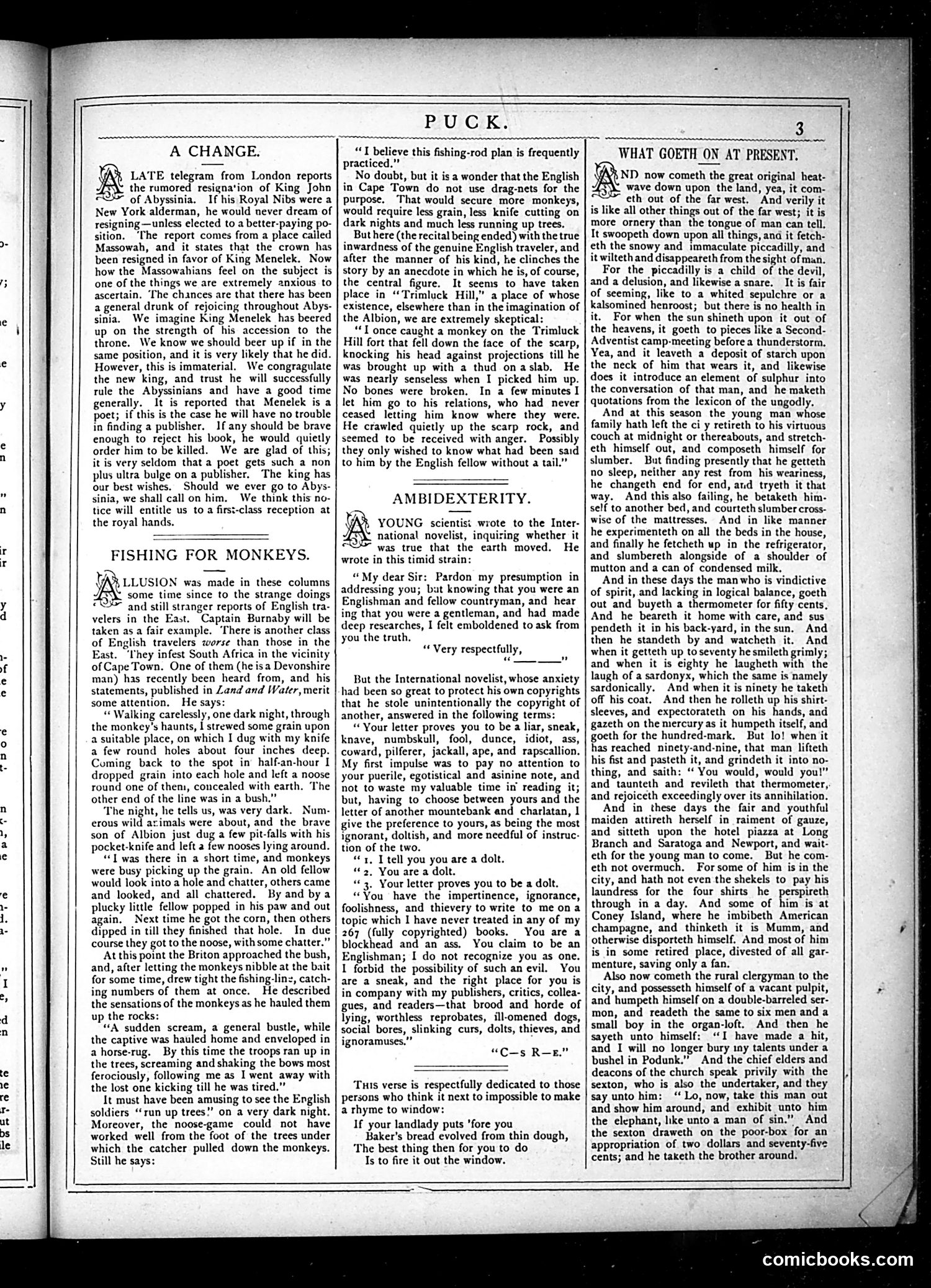
This page contains three satirical pieces: 1. **"A Change"** mocks British politics regarding King John of Abyssinia and the Menelek succession issue. The satire suggests the English press, which initially doubted Menelek's legitimacy, now supports him for the throne—a flip-flop presented as opportunistic. 2. **"Fishing for Monkeys"** ridicules an alleged English traveler's claim of capturing monkeys using unconventional methods in Africa. The piece satirizes tall tales and exaggerated expedition reports common in Victorian travel narratives. 3. **"Ambidexterity"** is a lengthy letter mocking a scientist who plagiarized another novelist's work, then offered transparently absurd justifications—calling the victim a "dolt" and claiming independent invention of identical ideas. It's satire on academic dishonesty and shameless denial. All three target Victorian-era pretension and hypocrisy.
📄 Transcribed text from this page (OCR, searchable)
Machine-transcribed from the original scan — historical spelling and the odd misread are preserved.
A CHANGE. LATE telegram from London reports the rumored resignation of King John «© of Abyssinia. If his Royal Nibs were a New York alderman, he would never dream of resigning —unless elected to a better-paying po- sition. ‘The report comes from a place cailed Massowah, and it states that the crown has been resigned in favor of King Menelek. Now how the Massowahians feel on the subject is one of the things we are extremely anxious to ascertain. The chances are that there has been a general drunk of rejoicing throughout Abys- sinia. We imagine King Menelek has beered up on the strength of his accession to the throne. We know we should beer up if in the same position, and it is very likely that he did. However, this is immaterial. We congragulate the new king, and trust he will successfully rule the Abyssinians and have a good time generally. It is reported that Menelek is a poet; if this is the case he will have no trouble in finding a publisher. If any should be brave enough to reject his book, he would quietly order him to be killed. We are glad of this; it is very seldom that a poet gets such a non plus ultra bulge on a publisher. The king has our best wishes. Should we ever go to Abys- sinia, we shall call on him. We think this no- tice will entitle us to a first-class reception at the royal hands. FISHING FOR MONKEYS. JRuwsiox was made in these columns some time since to the strange doings «Sand still stranger reports of English tra- velers in the East. Captain Burnaby will be taken as a fair example. There is another class of English travelers worse than those in the East. ‘hey infest South Africa in the vicinity of Cape Town. One of them (he isa Devonshire man) has recently been heard from, and his statements, published in Land and Water, merit some attention, He says: “Walking carelessly, one dark night, through the monkey's haunts, 1 strewed some grain upon a suitable place, on which I dug with my knife a few round holes about four inches deep. Coming back to the spot in’ half-an-hour I dropped grain into each hole and left a noose round one of them, concealed with earth. The other end of the line was in a bush.” ‘The night, he tells us, was very dark. Num- erous wild arimals were about, and the brave son of Albion just dug a few pit-falls with his pocket-knife and left a few nooses lying around. “I was there in a short time, and monkeys were busy picking up the grain. An old fellow would look into a hole and chatter, others came and looked, and all chattered. By and by a plucky little fellow popped in his paw and out again. Next time he got the corn, then others dipped in till they finished that hole. In due course they got to the noose, with some chatter.” At this point the Briton approached the bush, and, after letting the monkeys nibble at the bait for some time, drew tight the fishing-linz, catch- ing numbers of them at once. He described the sensations of the monkeys as he hauled them up the rocks: “A sudden scream, a general bustle, while the captive was hauled home and enveloped in a horse-rug. By this time the troops ran up in the trees, screaming and shaking the bows most ferociously, following me as I went away with the lost one kicking till he was tired.” It must have been amusing to see the English soldiers “run up trees!” on a very dark night. Moreover, the noose-game could not have worked well from the foot of the trees under which the catcher pulled down the monkeys. Still he says: PUCK. 3 “I believe this fishing-rod plan is frequently practiced.” __ No doubt, but it is a wonder that the English in Cape Town do not use drag-nets for the purpose, That would secure more monkeys, would require less grain, less knife cutting on dark nights and much less running up trees. __Buthere (the recital being ended) with the true inwardness of the genuine English traveler, and after the manner of his kind, he clinches the story by an anecdote in which he is, of course, the central figure. It seems to have taken place in “Trimluck Hill,” a place of whose existence, elsewhere than in the imagination of the Albion, we are extremely skeptical: “T once caught a monkey on the Trimluck Hill fort that fell down the face of the scarp, knocking his head against projections till he was brought up with a thud onaslab. He was nearly senseless when I picked him up. No bones were broken. In a few minutes I let him go to his relations, who had never ceased letting him know where they were. He crawled quietly up the scarp rock, and seemed to be received with anger. Possibly they only wished to know what had been said to him by the English fellow without a tail.” RR national novelist, inquiring whether it = was true that the earth moved. He wrote in this timid strain: “My dear Sir: Pardon my presumption in addressing you; but knowing that you were an Englishman and fellow countryman, and hear ing that you were a gentleman, and had made deep researches, I felt emboldened to ask from you the truth. AMBIDEXTERITY. YOUNG scientisi wrote to the Inter- “ Very respectfully, But the International novelist, whose anxiety had been so great to protect his own copyrights that he stole unintentionally the copyright of another, answered in the following terms: “Your letter proves you to be a liar, sneak, knave, numbskull, fool, dunce, idiot, ass, coward, pilferer, jackall, ape, and rapscallion. My first impulse was to pay no attention to your puerile, egotistical and asinine note, and not to waste my valuable time in’ reading it; but, having to choose between yours and the letter of another mountebank and charlatan, 1 give the preference to yours, as being the most ignorant, doltish, and more needful of instruc- tion of the two. “1, [tell you you are a dolt. “2, You are a dolt. “3. Your letter proves you to be a dolt. “You have the impertinence, ignorance, foolishness, and thievery to write to me ona topic which I have never treated in any of my 267 {fally copyrighted) books. You are a blockhead and an ass. You claim to be an Englishman; I do not recognize you as one. I forbid the possibility of such an evil. You are a sneak, and the right place for you is in company with my publishers, critics, collea- gues, and readers—that brood and horde of lying, worthless reprobates, ill-omened dogs, social bores, slinking curs, dolts, thieves, and ignoramuses.”” “C—s R-£.” ‘Tis verse is respectfully dedicated to those persons who think it next to impossible to make a rhyme to window: If your landlady puts "fore you Baker's bread evolved from thin dough, The best thing then for you to do Is to fire it out the window. WHAT GOETH_ON AT PRESENT. ND now cometh the great original heat- wave down upon the land, yea, it com- eth out of the far west. And verily it is like all other things out of the far west; it is more ornery than the tongue of man can tell. It swoopeth down upon all things, and it fetch- eth the snowy and immaculate piccadilly, and it wilteth and disappeareth from the sight of man. For the piccadilly is a child of the devil, and a delusion, and likewise a snare. It is fair of seeming, like to a whited sepulchre or a kalsomined henroost; but there is no health in it. For when the sun shineth upon it out of the heavens, it goeth to pieces like a Second- Adventist camp-meeting before a thunderstorm, Yea, and it leaveth a deposit of starch upon the neck of him that wears it, and likewise does it introduce an element of sulphur into the conversation of that man, and he maketh quotations from the lexicon of the ungodly. And at this season the young man whose family hath left the ci y retireth to his virtuous couch at midnight or thereabouts, and stretch- eth himself out, and composeth himself for slumber. But finding presently that he getteth no sleep, neither any rest from his weariness, he changeth end for end, and tryeth it that way. And this also failing, he betaketh him- self to another bed, and courteth slumber cross- wise of the mattresses. And in like manner he experimenteth on all the beds in the house, and finally he fetcheth up in the refrigerator, and slumbereth alongside of a shoulder of mutton and a can of condensed milk, And in these days the man who is vindictive of spirit, and lacking in logical balance, goeth out and buyeth a thermometer for fifty cents, And he beareth it home with care, and sus pendeth it in his back-yard, in the sun. And then he standeth by and watcheth it. And when it getteth up to seventy he smileth grimly; and when it is eighty he laugheth with the laugh of a sardonyx, which the same is namely sardonically. And when it is ninety he taketh off his coat, And then he rolleth up his shirt- sleeves, and expectorateth on his hands, and gazeth on the mercury as it humpeth itself, and goeth for the hundred-mark, But lo! when it has reached ninety-and-nine, that man lifteth his fist and pasteth it, and grindeth it into no- thing, and saith: “‘ You would, would you!” and taunteth and revileth that thermometer, and rejoiceth exceedingly over its annihilation. And in these days the fair and youthful maiden attireth herself in raiment of gauze, and sitteth upon the hotel piazza at Long Branch and Saratoga and Newport, and wait- eth for the young man to come. But he com- eth not overmuch, For some of him is in the city, and hath not even the shekels to pay his laundress for the four shirts he perspireth through in a day. And some of him is at Coney Island, where he imbibeth American champagne, and thinketh it is Mumm, and otherwise disporteth himself. And most of him is in some retired place, divested of all gar- menture, saving only a fan. Also now cometh the rural clergyman to the city, and possesseth himself of a vacant pulpit, and humpeth himself on a double-barreled ser- mon, and readeth the same to six men and a small boy in the organ-loft. And then he sayeth unto himself: “I have made a hit, and I will no longer bury iny talents under a bushel in Podunk.” And the chief elders and deacons of the church speak privily with the sexton, who is also the undertaker, and they say unto him: “‘ Lo, now, take this man out and show him around, and exhibit unto him the elephant, like unto a man of sin.” And the sexton draweth on the poor-box for an appropriation of two dollars and seventy-five cents; and he taketh the brother around. ‘a comicbooks.com