
Puck, 1878-07-24 · page 12 of 16
Puck — July 24, 1878 — page 12: what you’re looking at
What you’re looking at
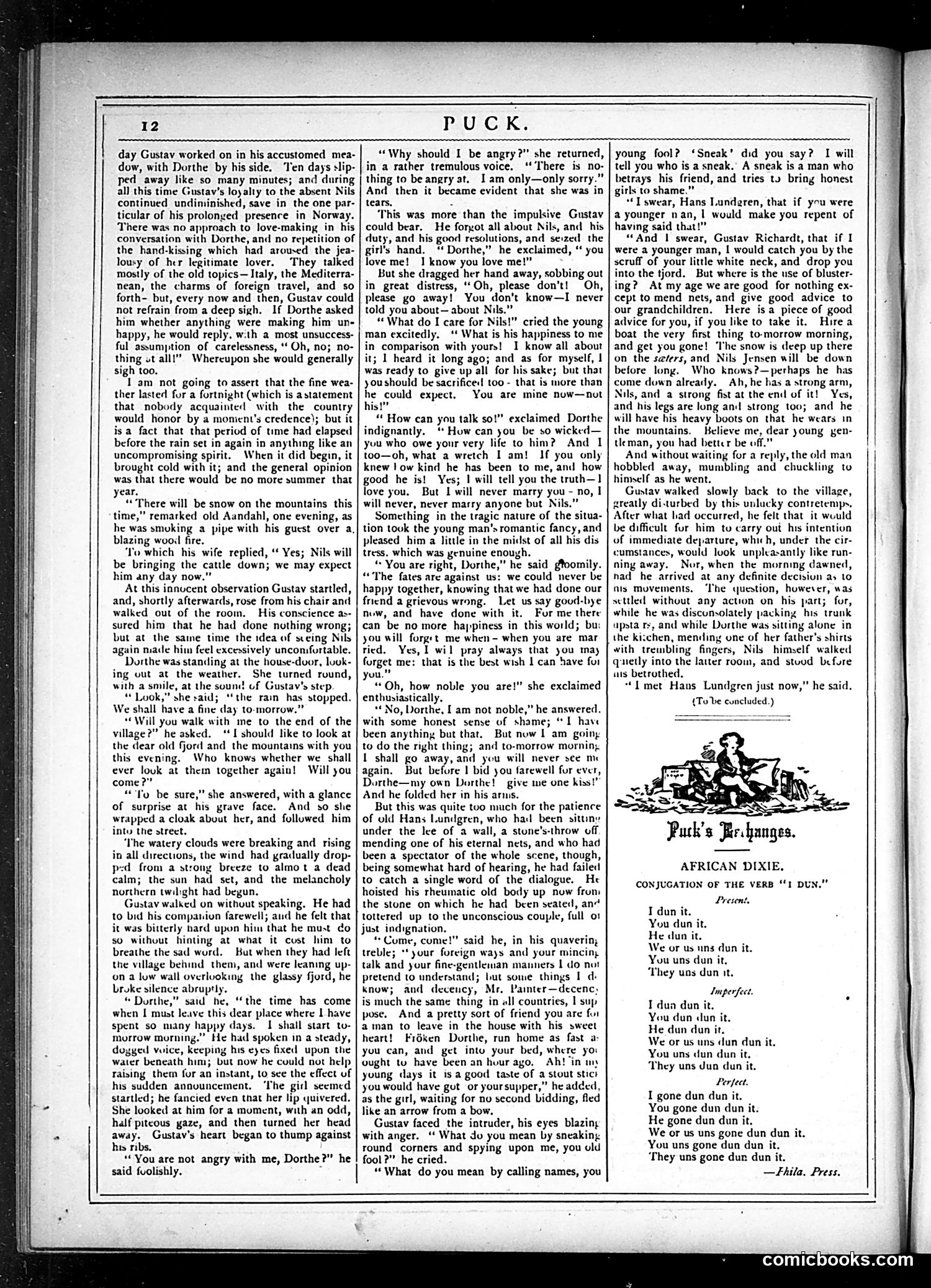
This page contains the conclusion of a serialized story about romantic conflict between Gustav and Dorthe (a Scandinavian couple). The narrative focuses on Gustav's jealousy over Dorthe's flirtation with a man named Nils, culminating in Gustav's decision to leave and never return. Below the story is a short comic section titled "Puck's Exchanges: African Dixie" — a humorous poem playing on dialect humor, where "I dun it" is conjugated through various forms as wordplay. The page is primarily **literary content rather than political satire**. It represents Puck's broader editorial approach of mixing serialized domestic fiction with light comedic verse, rather than focusing exclusively on political cartoons. The Scandinavian setting and names suggest appeal to immigrant readership.
📄 Transcribed text from this page (OCR, searchable)
Machine-transcribed from the original scan — historical spelling and the odd misread are preserved.
12 PUCK. day Gustav worked on in his accustomed mea- dow, with Dorthe by his side. ‘Ten days slip- ped away like so many minutes; and during all this time Gustav’s loyalty to the absent Nils continued undiminished, save in the one par- ticular of his prolonged presence in Norway. ‘There was no approach to love-making in his conversation with Dorthe, and no repetition of the hand-kissing which had aroused the jea- lousy of her legitimate lover. They talked mostly of the old topics— Italy, the Mediterra- nean, the charms of foreign travel, and so forth- but, every now and then, Gustav could not refrain from a deep sigh. 1f Dorthe asked him whether anything were making him un- happy, he would reply, w:th a most unsuccess- ful assumption of carelessness, ‘‘ Oh, no; no- thing ut all!” Whereupon she would generally sigh too. 1 am not going to assert that the fine wea- ther lasted fur a fortnight (which is a statement that nobody acquainted with the country would honor by a monient’s credence); but it isa fact that that period of time had elapsed before the rain set in again in anything like an uncompromising spirit. When it did begin, it brought cold with it; and the general opinion was that there would be no more summer that year, “There will be snow on the mountains this time,” remarked old Aandahl, one evening, as he was smoking a pipe with his guest over a, blazing wooil fire. ‘To which his wife replied, ‘* Yes; Nils will be bringing the cattle down; we may expect him any day now.” At this innucent observation Gustav startled, and, shortly afterwards, rose from his chair and walked out of the room. His conscience as- sured him that he had done nothing wrong; but at the same time the idea of seing Nils again made him feel excessively uncomfortable. Dorthe was standing at the house-duor, luok- ing out at the weather. She turned round, with a smile, at the sound of Gustav's step. “Look,” she said; “the rain has stopped. We shall have a fine day to-morrow.” “Will you walk with me to the end of the village?” he asked. ‘1 should like to look at the dear old fjord and the mountains with you this evening. Who knows whether we shall ever louk at them together again! Will you come?” “To be sure,” she answered, with a glance of surprise at his grave face. And so she wrapped a cloak about her, and followed him intu the street. ‘he watery clouds were breaking and rising in all directions, the wind had gradually drop- pd from a strong breeze to almot a dead calm; the sun had set, and the melancholy northero twibght had begun, Gustav walked on without speaking, He had to bid his companion farewell; and he felt that it was bitterly hard upon him that he must do so without hinting at what it cust him to breathe the sad word. But when they had left the village behind them, and were leaning up- on a luw wall overluoking the glassy fjord, he broke silence abruptly. © Dorthe,” said he, ‘the time has come when I must leave this dear place where 1 have spent so many happy days. I shall start to- morrow morning.” He had spoken in a steady, dogged voice, keeping his eyes fixed upon the water beneath him; but now he could not help raising them for an instant, to see the effect of his sudden announcement, ‘The girl seemed startled; he fancied even that her lip quivered. She looked at him for a moment, with an odd, half piteous yaze, and then turned her head away. Gustav’s heart began to thump against his ribs, “You are not angry with me, Dorthe?” he said fuolishly. z “Why should I be angry?” she returned, in a rather tremulous voice. “There is no- thing to be angry at. I am only—only sorry.” And then it became evident that she was in tears. 5 ‘This was more than the impulsive Gustav could bear. He forgot all about Nils, and his duty, and his good resolutions, and seized the girl’s hand. “ Dorthe,” he exclaimed, ‘ you love me! I know you love me!” But she dragged her hand away, sobbing out in great distress, ‘Oh, please don’t! Oh, please go away! You don’t know—I never told you about— about Nils.” “What do I care for Nils!” cried the young man excitedly. ‘* What is his happiness to me comparison with yours! I know all about it; 1 heard it long ago; and as for myself, 1 was ready to give up all for his sake; but that youshould be sacrificed too - that is more than he could expect. You are mine now—not his!” “ How can you talk sol” exclaimed Dorthe indignantly. * How can you be so wicked— you who owe your very life to him? And 1 too—oh, what a wretch I am! If you only knew | ow kind he has been to me, and how good he is! Yes; | will tell you the truth—1 love you. But 1 will never marry you - no, I will never, never marry anyone but Nils.” Something in the tragic nature of the situa- tion touk the young man’s romantic fancy, and pleased him a little in the midst of all his dis tress, which was genuine enough, * You are right, Dorthe,” he said gtoomily. “The fates are against us: we could never be happy together, knowing that we had done our friend a grievous wrong. Let us say goud-hye new, and have done with it. Fur me there can be no more happiness in this world; bu: you will forget me when- when you are mar ried. Yes, I wil pray always that you may furget me: that is the best wish 1 can have for ou.” “Oh, how noble you are!" she exclaimed enthusiastically, ** No, Dorthe, [ am not noble,” he answered. with some honest sense of shame; “1 have been anything but that, But now 1 am going to do the right thing; and to-morrow mornin, I shall go away, and you will never sce me again, But before 1 bid you farewell fur ever, Dorthe—my own Dorthe! give me one kiss!” And he folded her in his arms. But this was quite too much for the patience of old Hans Lundgren, who had been situny under the lee of a wall, a stone’s-throw off. mending one of his eternal nets, and who had been a spectator of the whole scene, though, being somewhat hard of hearing, he had failed to catch a single word of the dialogue. He hoisted his rheumatic old body up now fron the stone on which he had been seated, an tottered up to the unconscious couple, full ot just indignation. “Come, come!” said he, in his quaverin, treble; ** your foreign ways and your mincin, talk and your fine-gentleman manners | do not pretend to understand; but some things 1 de know; and decency, Mr, Painter—decenc; is much the same thing in all countries, | sup pose. And a pretty sort of friend you are fur aman to leave in the house with his sweet heart! Fréken Dorthe, run home as fast a- you can, and get into your bed, where yor ought tu have been an hour ago, Ah! in my young days it is a good taste of a stout stict you would have got or yoursupper,” he added, as the girl, waiting for no second bidding, fled like an arrow from a bow, Gustav faced the intruder, his eyes blazing with anger. ‘ What do you mean by sneaking round corners and spying upon me, you old fool?" he cried. “What do you mean by calling names, you young fool? ‘Sneak’ did you say? I will tell you who is a sneak.’ A sneak is a man who betrays his friend, and tries to bring honest girls to shame.” “‘T swear, Hans Lundaren, that if you were a younger nan, | would make you repent of having said that!” “And | swear, Gustav Richardt, that if I were a younger man, | would catch you by the scruff of your little white neck, and drop you into the tjord. But whcre is the use of bluster- ing? At my age we are good for nothing ex- cept to mend nets, and give good advice to our grandchildren. Here isa piece of good advice for you, if you like to take it. Hire a boat the very first thing to-morrow morning, and get you gone! ‘I'he snow is deep up there on the seers, and Nils Jensen will be down before long. Who knows?—perhaps he has come down already. Ah, he has a strong arm, Nils, and a strong fist at the end of it! Yes, and his legs are long ani! strong too; and he will have his heavy boots on that he wears in the moun . Believe me, dear young yen- tleman, you had better be off." And without waiting for a reply, the old man hobbled away, mumbling and chuckling to himself as he went. Gustav walked slowly back to the village, greatly disturbed by this unlucky contretemps. After what had occurred, he felt that it would be difficult. fur him to carry out his intention of immediate departure, which, undef the cir- cumstances, would look’ unpleasantly like run- ning away. Nor, when the morning dawned, nad he arrived at any definite decision ay to fis movements. ‘The question, however, was settled without any action on his part; for, while he was discunsolately packing bis trunk upsta rs, and while Dorthe was sitting alone in the kizchen, mending one of her father’s shirts with trembling fingers, Nils himself walked quietly into the latter room, and stuod before ais betrothed, “Lmet Hans Lundgren just now,” he said. {To Ve concluded.) OR hanges. AFRICAN DIXIE, CONJUGATION OF THE VERB ‘I DUN." Present. I dun it. You dun it. He dun it. We or us uns dun it. You uns dun it. ‘They uns dun it. Imperfect. I dua dun it. You dun dun it. He dun dun it, We or us uns dun dun it, You uns dun dun it. ‘They uns dun dun it. Perfect. I gone dun dun it. You gone dun dun it. He gone dun dun it. We or us uns gone dun dun it. You uns gone dun dun it. ‘They uns gone dur dun it. —Fhila, Press. comicbooks.com