
A complete issue · 16 pages · 1878
Puck — June 12, 1878
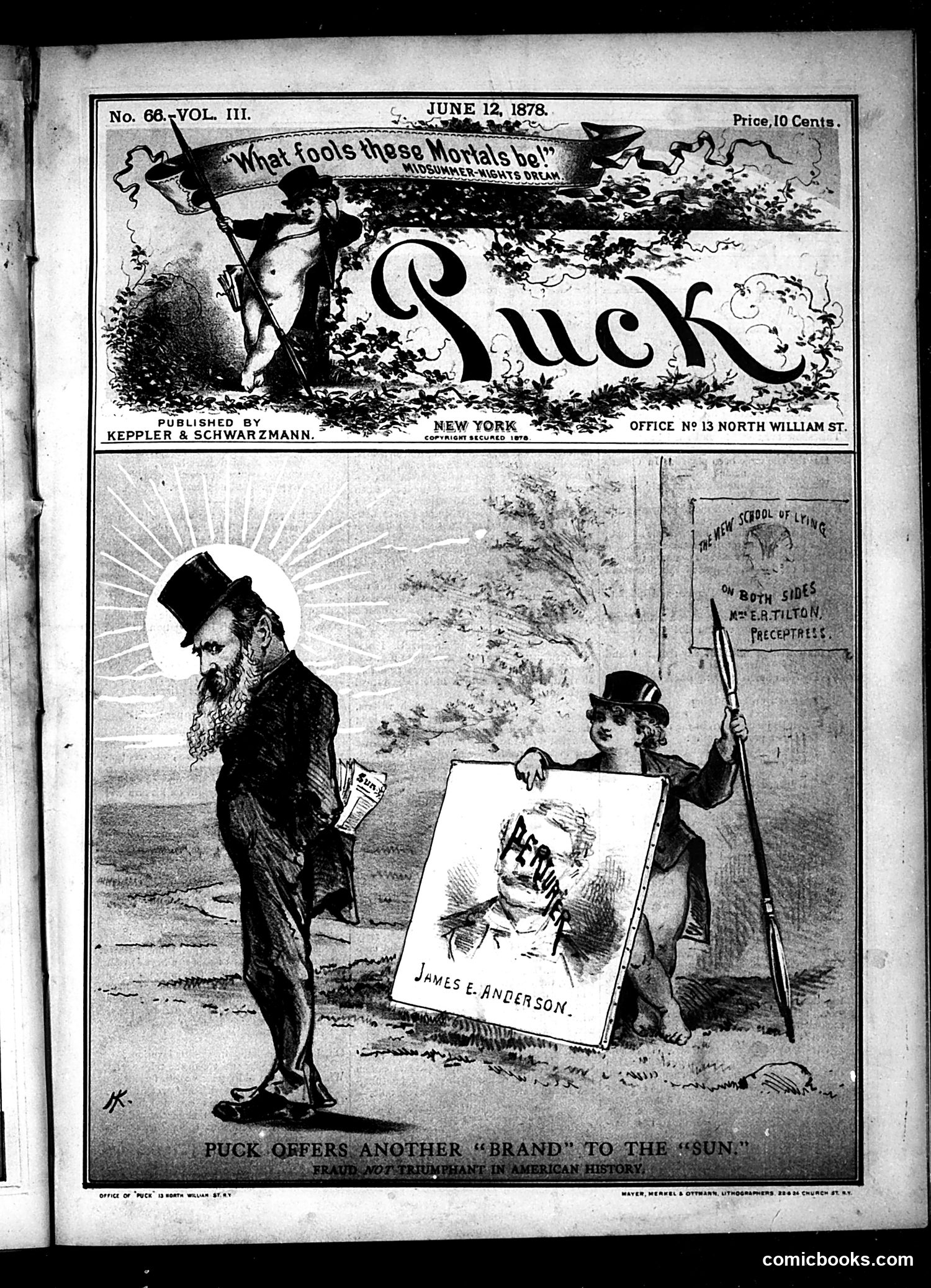
This satirical cartoon mocks what appears to be a religious or philosophical movement. A bearded, halo'd figure (labeled with text suggesting spiritual authority) stands beside a child-like character presenting a portrait of "James E. Anderson." The caption reads "PUCK OFFERS ANOTHER 'BRAND' TO THE 'SUN'"—likely referencing a rival publication. The "New School of Living" sign visible in the background suggests criticism of unconventional teachings. The satire appears to target either fraudulent spiritual teachers or dubious philosophical movements gaining American popularity. The halo-crowned figure's bewildered expression and the child's presentation of Anderson's portrait imply Puck viewed these movements as foolish or exploitative. Without additional historical context, the specific target remains unclear.
This page from *Puck* contains primarily **text articles and humor pieces rather than political cartoons**. The main sections include: 1. **"Cartoons"** - A humorous poem mocking Dana (likely a newspaper editor) and theatrical farce 2. **"A Typical English Humorist"** - Commentary on English humor and cat-related jokes 3. **"The Height of Absurdity"** - Satirizing Mr. A.H. Scales, a Southern congressman, regarding Civil War claims about North Carolina soldiers 4. **"The Shoemaker"** - A sentimental piece celebrating the shoemaker's dignity and honest work The page also includes **"Puckerings"** (short satirical quips) and advertising. The most substantive satire targets congressional absurdity regarding post-Civil War military disputes, though specific historical context remains unclear without additional documentation.
This page contains several satirical articles rather than cartoons. The main pieces critique: 1. **"To Whom It May Concern"** - A proposal to establish government-funded "poets' homes" where writers could live productively. The satire mocks the notion that poets need special institutional support, suggesting they'd become idle and dependent rather than creative. 2. **"Wise and Foolish Virgins"** - Critiques a poem about "wise and foolish virgins" in rural cooperatives, dismissing it as vapid moralizing disguised as poetry. The piece sarcastically praises the poem's attempt at profundity. 3. **"An Outrage"** - Denounces wealthy patrons who claim credit for supporting poets while actually stifling their independence through patronage. The satire targets pretentious literary culture and hypocrisy surrounding artistic patronage.
This page contains three literary pieces rather than political cartoons: "Midnight" (a poem), "Mr. Kroeger's Microphone" (a humorous anecdote about a man who constructs a microphone and experiments with it), and "The Sea-Side" (an essay discussing the origins and history of seaside resorts). The content appears to be general entertainment rather than political satire. "Mr. Kroeger's Microphone" uses gentle humor describing a friend's eccentric experiments amplifying sound through a homemade device. "The Sea-Side" discusses ancient Greek and Roman references to seaside practices and their modern revival. No political figures, current events, or social commentary requiring historical context are evident on this page. It represents Puck's literary rather than satirical-cartoon content.
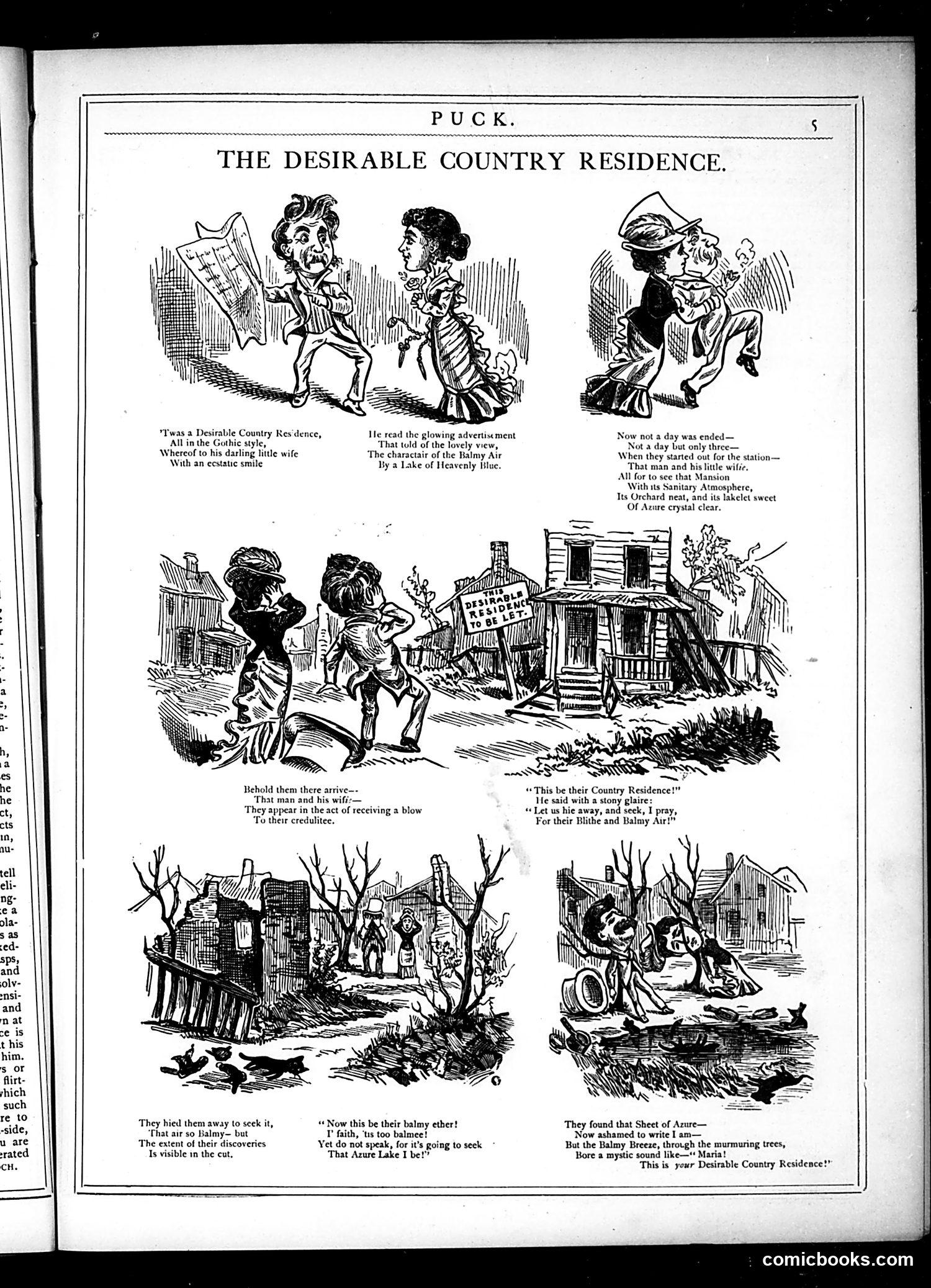
This satirical comic strip mocks the aspirations of middle-class city dwellers seeking rural retreats. A couple, enchanted by glowing advertisements promising a "Balmy Air" and "Lake of Heavenly Blue," purchase what appears to be a ramshackle country property. The humor escalates through successive panels: their "desirable residence" proves dilapidated; neighbors appear hostile; the advertised lake is a muddy swamp; and the "murmuring trees" produce only eerie sounds. The satire targets both deceptive real-estate marketing (common then as now) and the naive romanticism of urbanites seeking pastoral escape. The comic illustrates how idealized advertisements contrast starkly with disappointing reality—a theme of enduring relevance to property buyers.
This page contains two separate pieces of satire: **"I Used to Say"** (left column) is a nostalgic poem by K.K. Munkittrick reflecting on youthful romantic and naive statements the author once made, contrasting past idealism with present cynicism. **"A Proposed Police Improvement"** (center/right) is a satirical essay by a policeman named Peter Killum critiquing the treatment of police officers. Killum argues that if surgeons were treated as poorly as police—blamed for deaths despite best efforts, disrespected publicly, and denied basic resources—the profession would be intolerable. The piece sarcastically suggests absurd alternatives like converting cemeteries into casinos as solutions to public dissatisfaction with policing. **"Portia's Address to Newspaper Boys"** (right column) offers humorous advice to young newsboys about maintaining professional integrity and humor in journalism. The page primarily contains text-based humor rather than prominent visual cartoons.
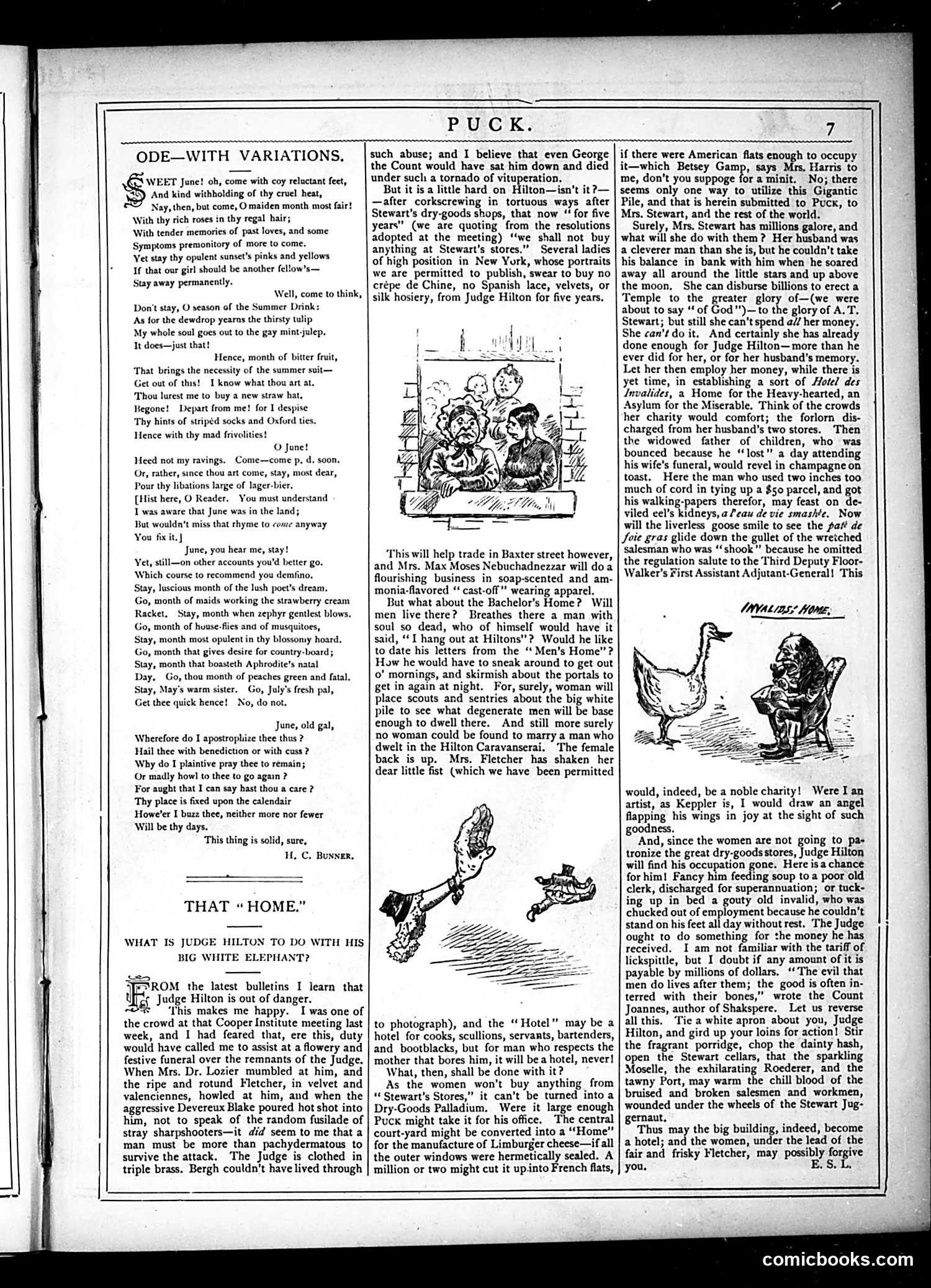
This page contains satirical commentary on Judge Hilton, a wealthy New York businessman. The main article, "That 'Home,'" mocks Hilton's plans to establish a charitable institution or hotel for destitute individuals. The satire targets Hilton's hypocrisy: while he publicly champions charitable causes, the text questions whether he'd genuinely help the poor or merely use the project for self-aggrandizement. References to his "big white elephant" suggest the venture is impractical or wasteful. The cartoons feature caricatured figures (likely representing Hilton and associates) in various scenes. The satirical tone suggests Puck is skeptical of Hilton's philanthropic motives, viewing them as publicity stunts rather than genuine concern for vulnerable populations. The humor relies on readers' familiarity with Hilton's prominence and public statements about charity.
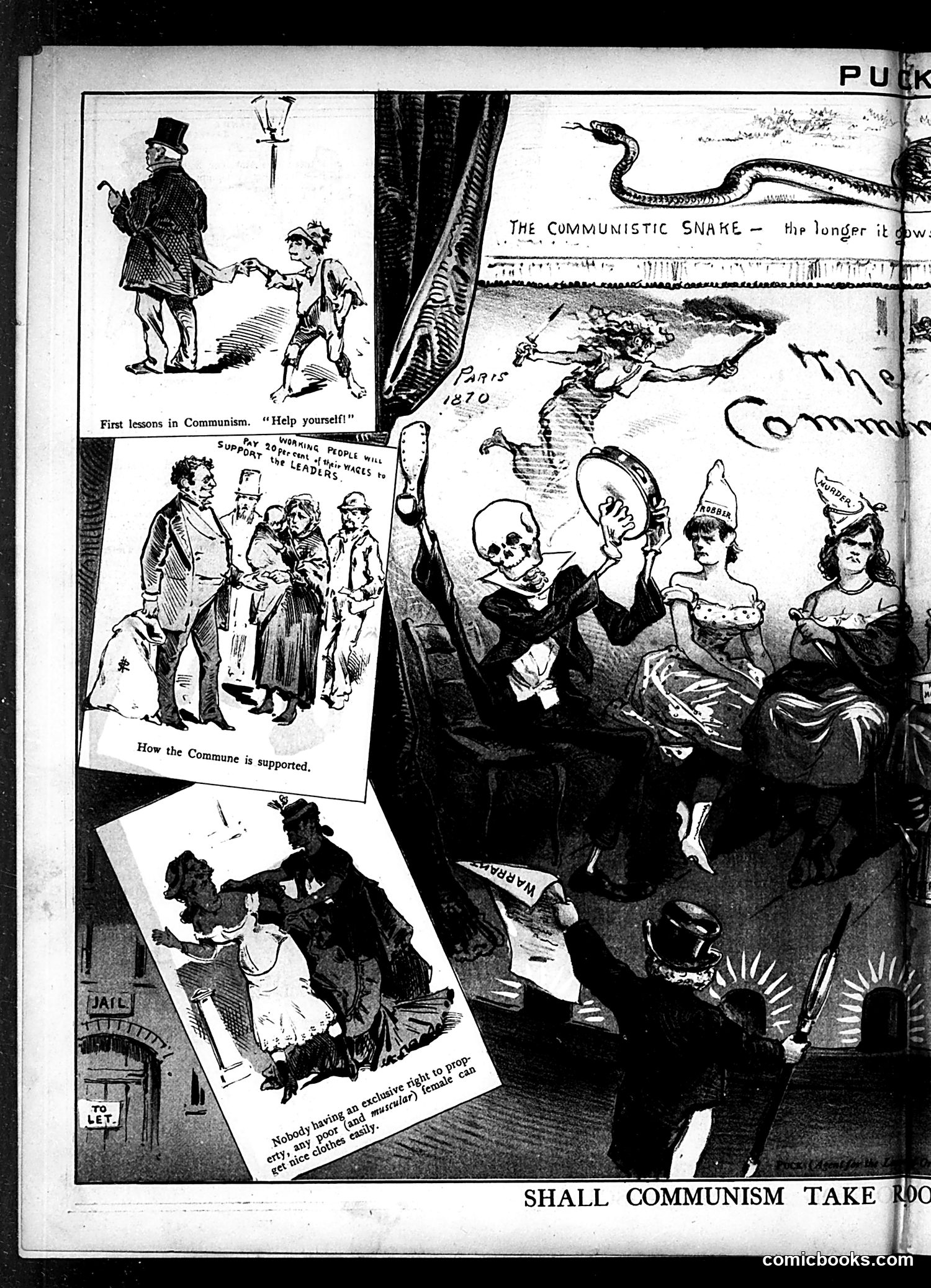
This page presents anti-communist propaganda through multiple cartoons attacking the Paris Commune of 1870. **Top panel**: "First lessons in Communism" shows an adult instructing a child to steal ("Help yourself"), satirizing communism as theft. **Middle section**: "How the Commune is supported" depicts figures providing money to communists, suggesting financial manipulation. **Bottom panel**: Shows violence and chaos, with text stating "Nobody has an exclusive right to property (see particular) under Communism" — sarcastically mocking communist ideology as justifying lawlessness. **Right side**: "The Communistic Snake" depicts the movement as a dangerous serpent growing longer. The overall message equates communism with criminality, violence, and social disorder. This reflects American elite anxieties following the 1870 Paris uprising, portraying the ideology as inherently destructive rather than engaging substantive critique.
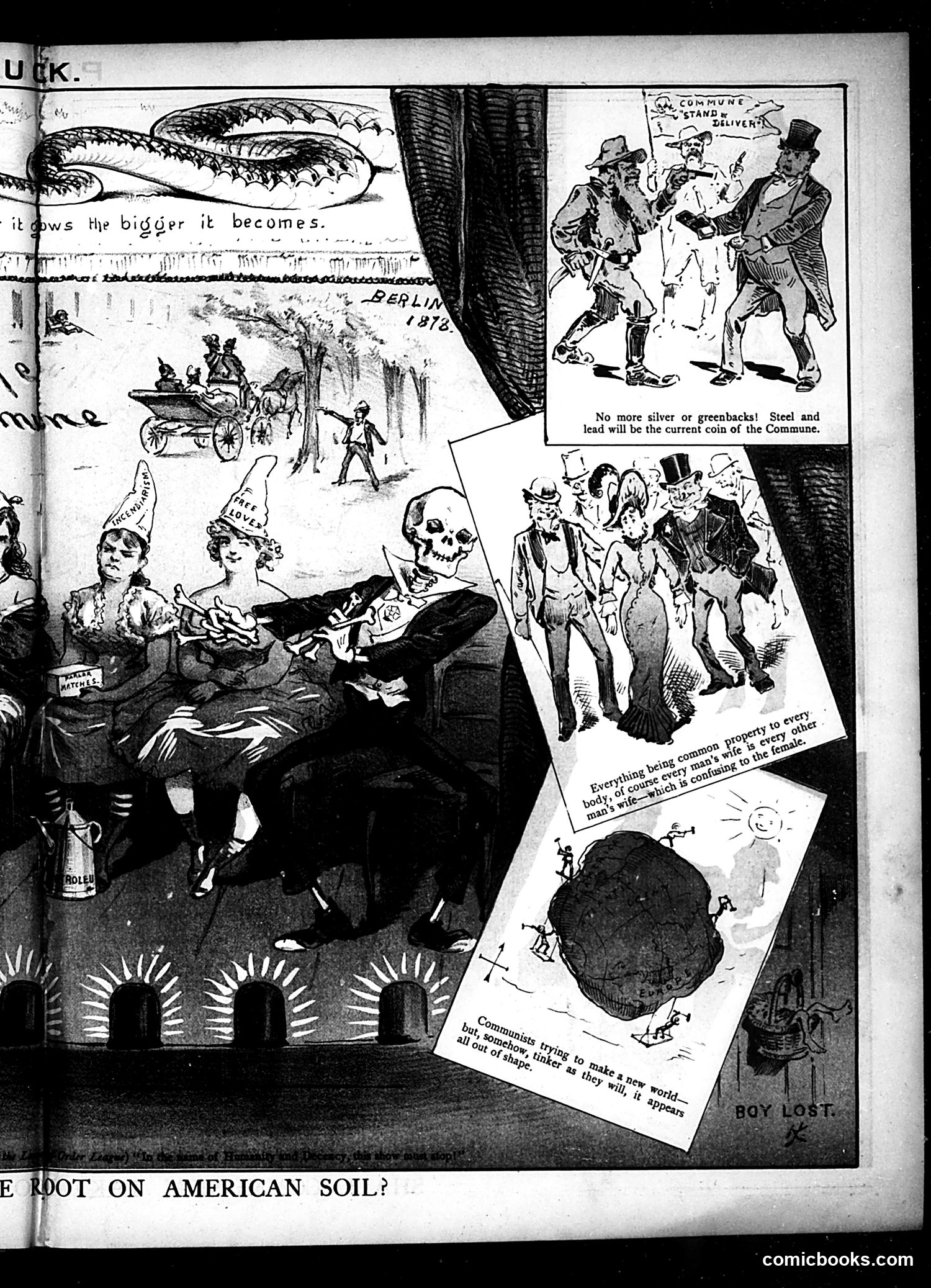
This page satirizes the Paris Commune of 1871 and its potential influence on America. The central large illustration shows Death entertaining women with skeletal imagery, representing the violent chaos of the Commune. The smaller panels mock Commune ideology: one depicts figures announcing "Steel and lead will be the current coin of the Commune" (mocking economic restructuring), while another shows communards attempting to remake the world, depicted as incompetent. The title "THE RED BOOT ON AMERICAN SOIL?" expresses American anxiety about radical European politics spreading to the United States. The cartoon warns that adopting Commune principles would bring violence and destruction to America. This reflects post-Civil War American fears of socialist and anarchist movements gaining traction domestically.
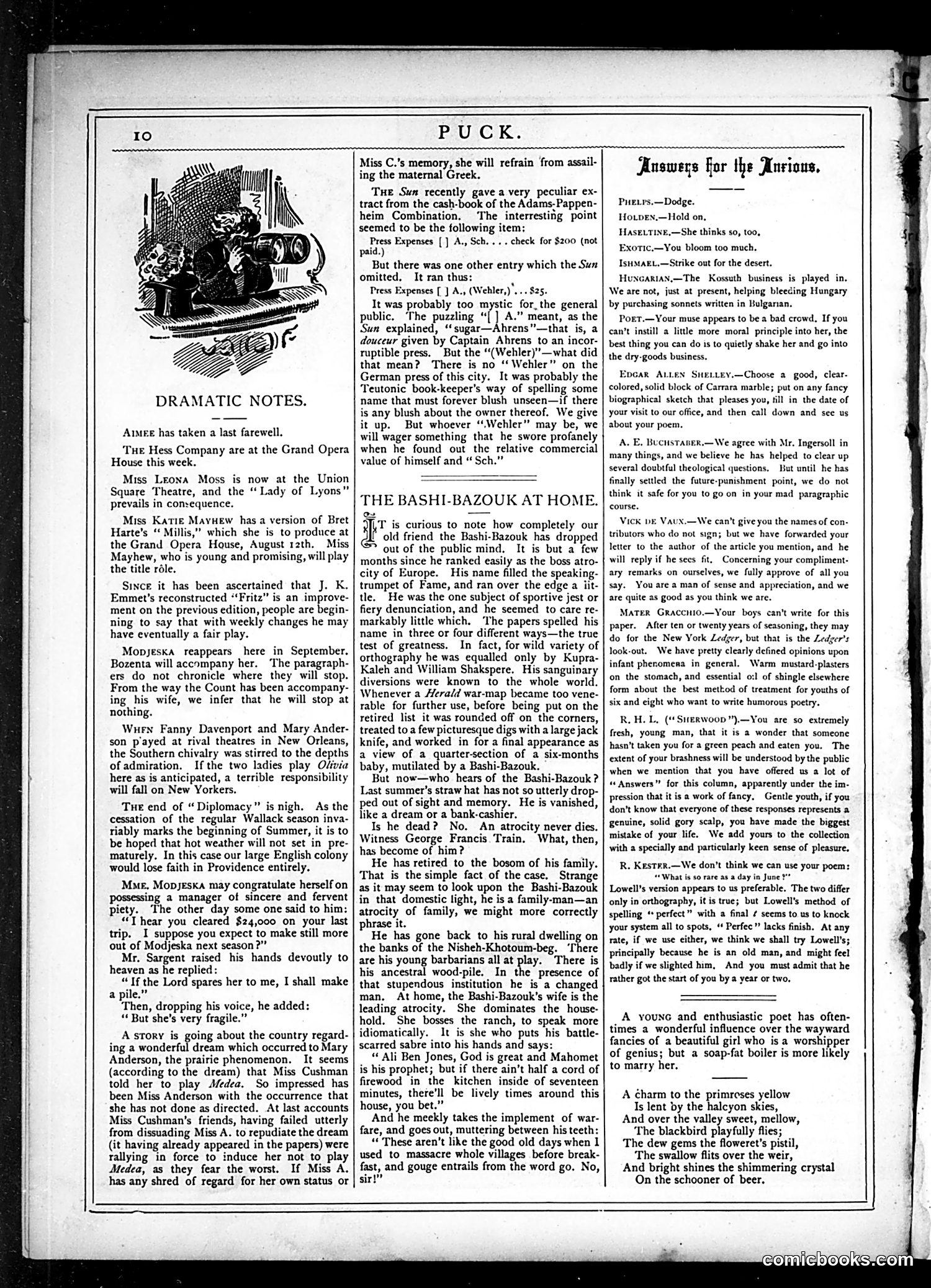
This page from *Puck* magazine contains theatrical and literary commentary rather than political cartoons. The "Dramatic Notes" section discusses recent stage productions and performers, including references to Aimee (apparently a notable performer taking a final bow) and various theater companies at venues like the Grand Opera House. The cartoon illustration appears to show a theatrical or dramatic scene, though specific characters are unclear from the image alone. The right column, "Answers for the Curious," provides humorous responses to reader questions on miscellaneous topics—a common *Puck* feature mixing entertainment gossip with satire. This page exemplifies *Puck's* broader cultural commentary beyond politics, focusing on New York theater and social life of the era.
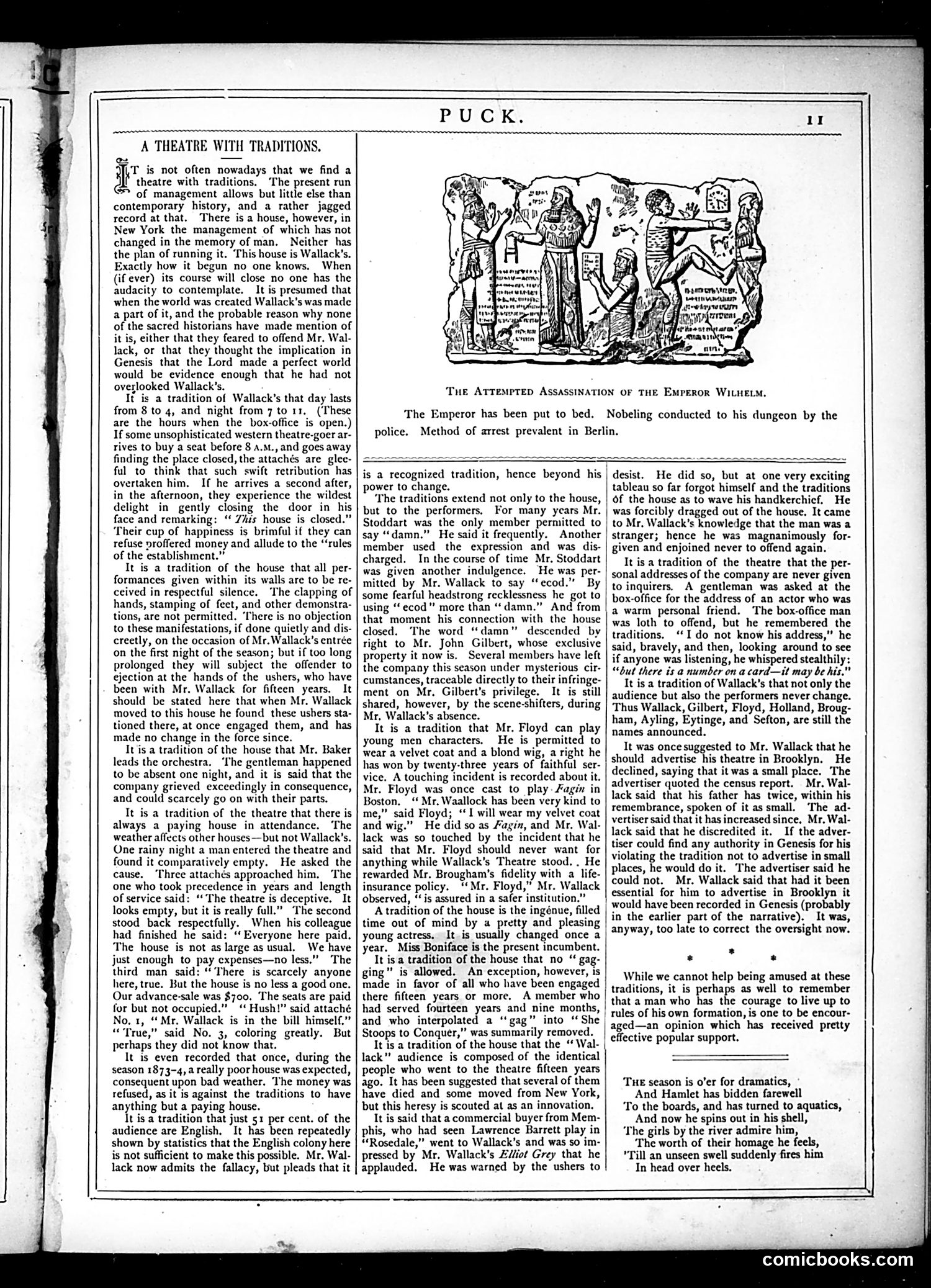
This page contains an article titled "A Theatre with Traditions" about Wallack's Theatre in New York, accompanied by a single illustration labeled "The Attempted Assassination of the Emperor Wilhelm." The illustration appears to depict a historical assassination attempt, showing multiple figures in what seems to be a period German setting. However, the image quality makes it difficult to determine the specific historical event referenced or identify particular individuals. The article itself focuses on theatrical traditions and management practices at Wallack's rather than political commentary. The relationship between the illustration and the main article text is unclear from this page layout. Without additional context about the publication date or clearer image resolution, I cannot definitively explain the satirical intent or modern relevance of the Wilhelm illustration.
This page is primarily **text, not a cartoon**. It's the continuation of a serialized story titled "Mrs. Fitzgerald" by Francis Barrett, credited as author of "Two Knaves and a Queen." The narrative concerns a woman whose husband has abandoned her and their child. The story explores themes of poverty, charity, and social judgment in what appears to be Victorian-era Britain (references to London, Oxford Street, and British customs). Key plot points include Mary's financial struggles, her failed attempts to find her husband, and interactions with a man named George Montey who shows her kindness. The text emphasizes period attitudes toward marital abandonment, women's economic vulnerability, and class distinctions. This is **serialized fiction rather than political satire**—typical content for Puck magazine's entertainment section.
This page is primarily **text-based content**, not political cartoons. It contains a serialized story about a woman named Mary Fitzgerald and her troubled marriage to George Montey, exploring themes of loneliness, fidelity, and domestic disappointment. The small illustrated section titled **"Puck's Briefings"** contains brief satirical quips about contemporary topics—including references to hymn changes at the White House, a citizen complaining about his girl, and jokes about Serbian crowds and St. Louis directories. The **political/social satire is minimal** on this page. Rather than cartooning, Puck here uses short witty commentary and a serialized narrative to entertain readers about middle-class relationship anxieties—typical of the magazine's mixed content approach combining visual and written humor.
This page is primarily **advertising and notices** rather than political satire or editorial cartoons. The dominant content includes: - Large advertisements for **Apollinaris Natural Mineral Water** ("The Queen of Table Waters"), emphasizing health benefits with endorsements from doctors and public figures - **Frederick de Bary & Co.** (the distributor), located in New York - Various business ads: furniture makers, compressed yeast, photographers, dental services, and a book binder - Small news items and social commentary excerpts from various newspapers There are **no identifiable political cartoons** on this page. The only illustrated content is a portrait head (accompanying the Apollinaris ad) and decorative business logos. This appears to be a typical interior page from Puck's magazine format, balancing editorial content with commercial advertisements that subsidized publication.
This is primarily an **advertising and announcements page** rather than political satire. The main content includes: **Key Announcements:** - Puck's new "General Designing Office" featuring cartoonist Joseph Keppler, offering illustration services - Promotional notices for Puck's 1878 Almanac (15 cents) - Patent covers for filing Puck (priced $1.00) **Advertisements:** Numerous product endorsements including Friedrichshall Bitterwaters, printing inks, tailoring services, hats, and champagne. **Notable:** The page demonstrates how 19th-century satirical magazines sustained themselves through advertising revenue. While Keppler's involvement suggests quality cartooning content elsewhere in the magazine, this particular page is commercial rather than editorial in nature.
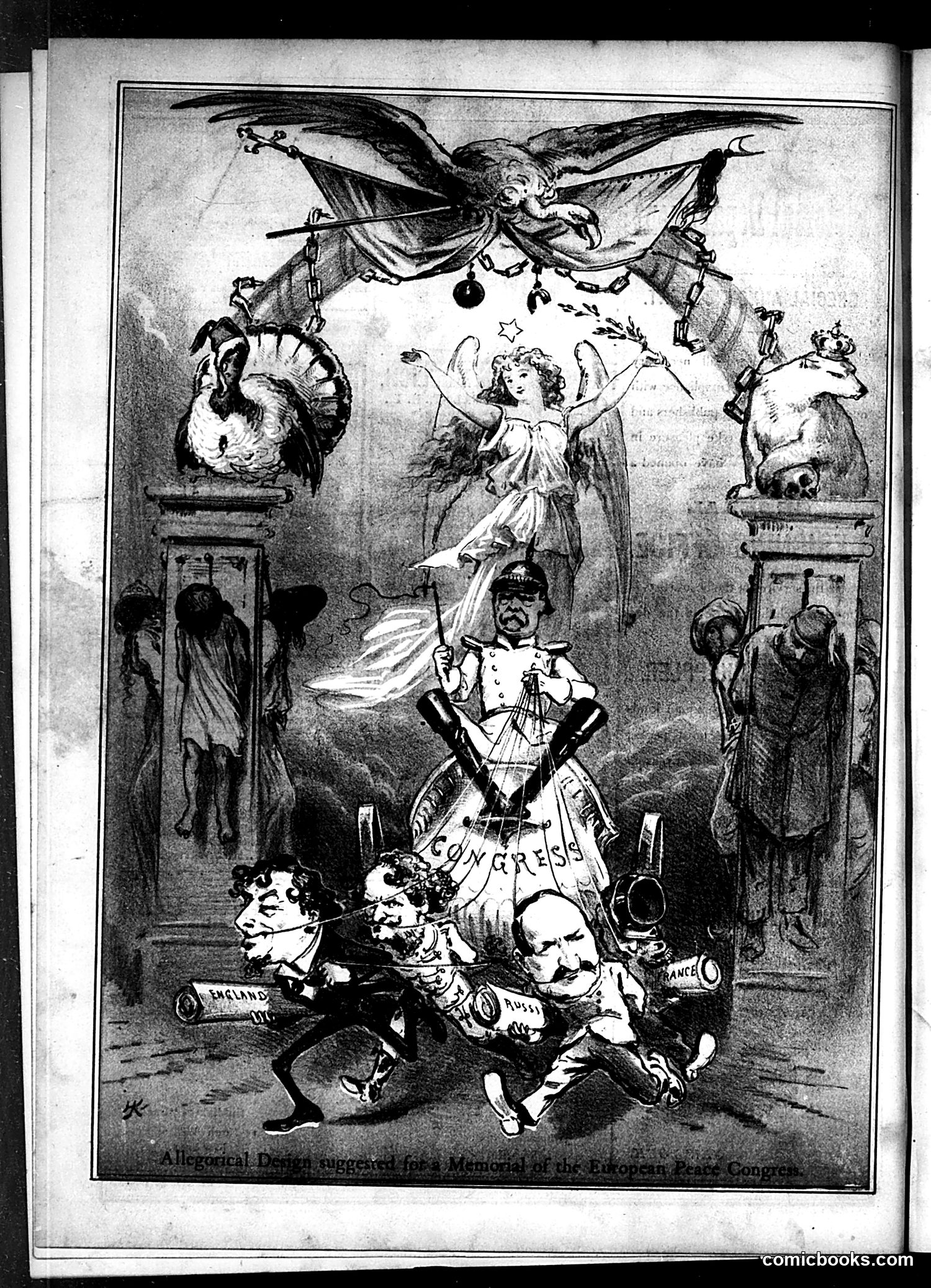
This allegorical design appears to reference a "Memorial of the European Peace Congress." At the center stands a winged angelic figure (Peace) elevated above the scene. Below her, three caricatured figures in military dress—labeled with "ENGLAND," "FRANCE," and appearing to include German representation—are depicted in a subservient or struggling position, seemingly pulling or supporting the Peace monument. The winged demon or devil figure at the top and the columned pedestals with animal figures suggest competing national interests and powers. The surrounding observers (shown as silhouettes) witness this political theater. The satire appears to critique the diplomatic efforts toward peace in Europe, suggesting that national military powers cynically manipulate peace efforts for their own advantage, rather than genuinely pursuing it. The composition ironically elevates Peace while showing worldly powers literally supporting her from below.