
Puck, 1878-06-12 · page 12 of 16
Puck — June 12, 1878 — page 12: what you’re looking at
What you’re looking at
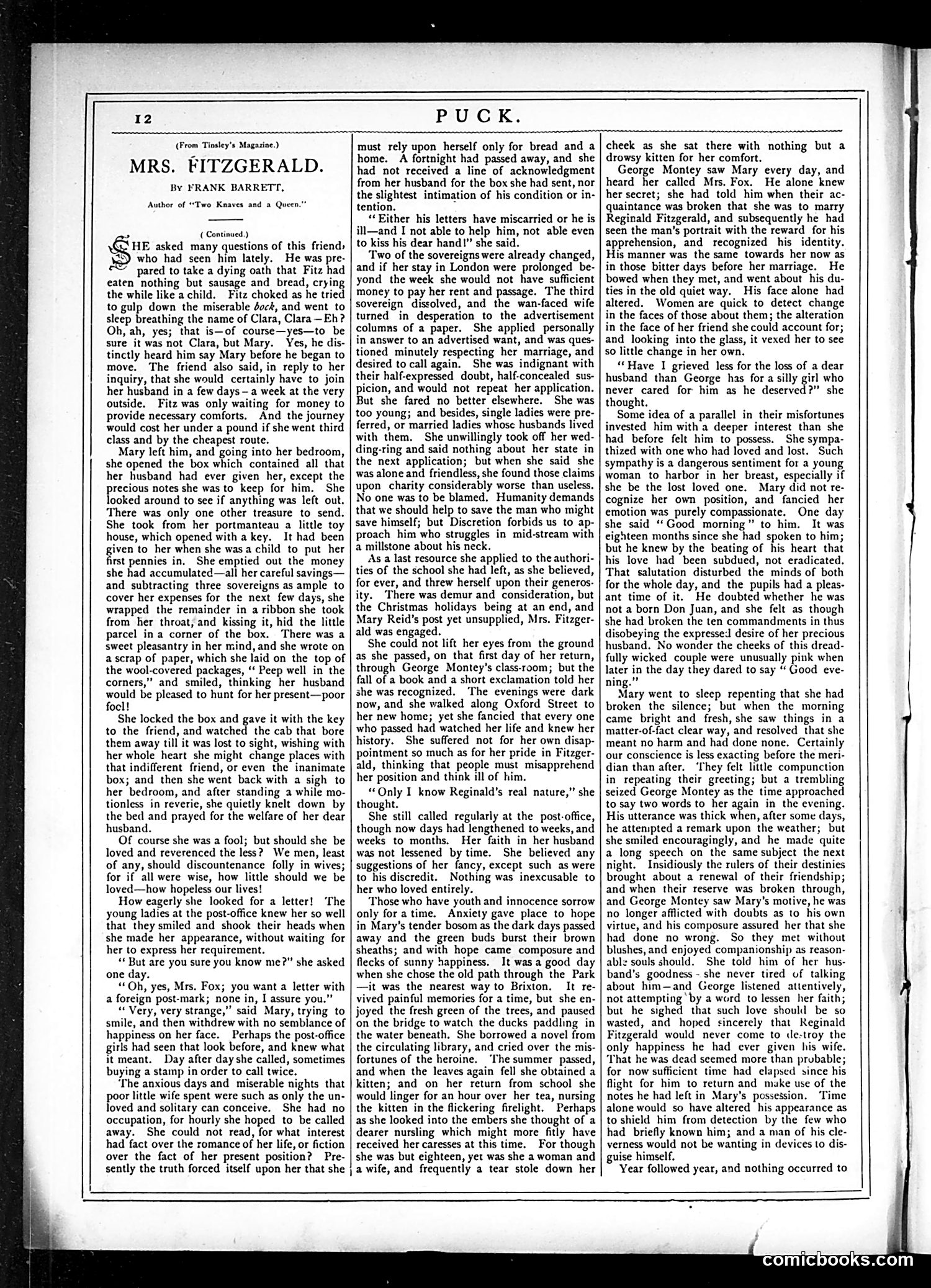
This page is primarily **text, not a cartoon**. It's the continuation of a serialized story titled "Mrs. Fitzgerald" by Francis Barrett, credited as author of "Two Knaves and a Queen." The narrative concerns a woman whose husband has abandoned her and their child. The story explores themes of poverty, charity, and social judgment in what appears to be Victorian-era Britain (references to London, Oxford Street, and British customs). Key plot points include Mary's financial struggles, her failed attempts to find her husband, and interactions with a man named George Montey who shows her kindness. The text emphasizes period attitudes toward marital abandonment, women's economic vulnerability, and class distinctions. This is **serialized fiction rather than political satire**—typical content for Puck magazine's entertainment section.
📄 Transcribed text from this page (OCR, searchable)
Machine-transcribed from the original scan — historical spelling and the odd misread are preserved.
12 PUCK. (From Tinsley’s Magazine.) MRS. FITZGERALD. By FRANK BARRETT, Author of “Two Knaves and a Queen.” 4 ( Continued.) HE asked many questions of this friend» <s) who had seen him lately. He was pre- pared to take a dying oath that Fitz had eaten nothing but sausage and bread, crying the while like a child. Fitz choked as he tried to gulp down the miserable dock, and went to sleep breathing the name of Clara, Clara —Eh? Oh, ah, yes; that is—of course—yes—to be sure it was not Clara, but Mary. Yes, he dis- tinctly heard him say Mary before he began to move. The friend also said, in reply to her inquiry, that she would certainly have to join her husband in a few days —a week at the very outside. Fitz was only waiting for money to provide necessary comforts. And the journey would cost her under a pound if she went third class and by the cheapest route. Mary left him, and going into her bedroom, she opened the box which contained all that her husband had ever given her, except the precious notes she was to keep for him. She looked around to see if anything was left out. There was only one other treasure to send. She took from her portmanteau a little toy house, which opened with a key. It had been given to her when she was a child to put her first pennies in. She emptied out the money she had accumulated—all her careful savings— and subtracting three sovereigns as ample to cover her expenses for the next few days, she wrapped the remainder in a ribbon she took from her throat, and kissing it, hid the little parcel in a corner of the box. There was a sweet pleasantry in her mind, and she wrote on a scrap of paper, which she laid on the top of the wool-covered packages, ““ Peep well in the corners,” and smiled, thinking her husband would be pleased to hunt for her present—poor focl! She locked the box and gave it with the key to the friend, and watched the cab that bore them away till it was lost to sight, wishing with her whole heart she might change places with that indifferent friend, or even the inanimate box; and then she went back with a sigh to her bedroom, and after standing a while mo- tionless in reverie, she quietly knelt down by the bed and prayed for the welfare of her dear husband. Of course she was a fool; but should she be loved and reverenced the less? We men, least of any, should discountenance folly in wives; for if all were wise, how little should we be loved—how hopeless our lives! How eagerly she looked for a letter! The young ladies at the post-office knew her so well that they smiled and shook their heads when she made her appearance, without waiting for her to express her requirement. “But are you sure you know me?” she asked one day. “Oh, yes, Mrs. Fox; you want a letter with a foreign post-mark; none in, I assure you.” “ Very, very strange,” said Mary, trying to smile, and then withdrew with no semblance of happiness on her face. Perhaps the post-office girls had seen that look before, and knew what it meant. Day after day she called, sometimes buying a stamp in order to call twice. ‘The anxious days and miserable nights that poor little wife spent were such as only the un- loved and solitary can conceive. She had no occupation, for hourly she hoped to be called away. She could not read, for what interest had fact over the romance of her life, or fiction over the fact of her present position? Pre- must rely upon herself only for bread and a home. A fortnight had passed away, and she had not received a line of acknowledgment from her husband for the box she had sent, nor the slightest intimation of his condition or in- tention. ‘Either his letters have miscarried or he is ill—and I not able to help him, not able even to kiss his dear hand!” she said. Two of the sovereigns were already changed, and if her stay in London were prolonged be- yond the week she would not have sufficient money to pay her rent and passage. The third sovereign dissolved, and the wan-faced wife turned in desperation to the advertisement columns of a paper. She applied personally in answer to an advertised want, and was ques- tioned minutely respecting her marriage, and desired to call again. She was indignant with their half-expressed doubt, half-concealed sus- picion, and would not repeat her application. But she fared no better elsewhere. She was too young; and besides, single ladies were pre- ferred, or married ladies whose husbands lived with them. She unwillingly took off her wed- ding-ring and said nothing about her state in the next application; but when she said she was alone and friendless, she found those claims upon charity considerably worse than useless. No one was to be blamed. Humanity demands that we should help to save the man who might save himself; but Discretion forbids us to ap- proach him who struggles in mid-stream with a millstone about his neck. ‘As a last resource she applied to the authori- ties of the school she had left, as she believed, for ever, and threw herself upon their generos- ity. ‘There was demur and consideration, but the Christmas holidays being at an end, and Mary Reid’s post yet unsupplied, Mrs. Fitzger- ald was engaged. She could not lift her eyes from the ground as she passed, on that first day of her return, through George Montey’s class-room; but the fall of a book and a short exclamation told her she was recognized. ‘The evenings were dark now, and she walked along Oxford Street to her new home; yet she fancied that every one who passed had watched her life and knew her history. She suffered not for her own disap- pointment so much as for her pride in Fitzger- ald, thinking that people must misapprehend her position and think ill of him. “Only I know Reginald’s real nature,” she thought. She still called regularly at the post-office, though now days had lengthened to weeks, and weeks to months. Her faith in her husband was not lessened by time. She believed any suggestions of her fancy, except such as were to his discredit. Nothing was inexcusable to her who loved entirely. ‘Those who have youth and innocence sorrow only foratime. Anxiety gave place to hope in Mary’s tender bosom as the dark days passed away and the green buds burst their brown sheaths; and with hope came composure and flecks of sunny happiness. It was a good day when she chose the old path through the Park —it was the nearest way to Brixton. It re- vived painful memories for a time, but she en- joyed the fresh green of the trees, and paused on the bridge to watch the ducks paddling in the water beneath, She borrowed a novel from the circulating library, and cried over the mis- fortunes of the heroine. ‘he summer passed, and when the leaves again fell she obtained a kitten; and on her return from school she would linger for an hour over her tea, nursing the kitten in the flickering firelight. Perhaps as she looked into the embers she thought of a dearer nursling which might more fitly have received her caresses at this time. For though she was but eighteen, yet was she a woman and sently the truth forced itself upon her that she | a wife, and frequently a tear stole down her cheek as she sat there with nothing but a drowsy kitten for her comfort. Cenige Montey saw Mary every day, and heard her called Mrs. Fox. He alone knew her secret; she had told him when their ac- quaintance was broken that she was to marry Reginald Fitzgerald, and subsequently he had seen the man’s portrait with the reward for his apprehension, and recognized his identity. His manner was the same towards her now as in those bitter days before her marriage. He bowed when they met, and went about his du- ties in the old quiet way. His face alone had altered. Women are quick to detect change in the faces of those about them; the alteration in the face of her friend she could account for; and looking into the glass, it vexed her to see so little change in her own. “Have I grieved less for the loss of a dear husband than George has for a silly girl who never cared for him as he deserved?” she thought. Some idea of a parallel in their misfortunes invested him with a deeper interest than she had before felt him to possess. She sympa- thized with one who had loved and lost. Such sympathy is a dangerous sentiment for a young woman to harbor in her breast, especially if she be the lost loved one. Mary did not re- cognize her own position, and fancied her emotion was purely compassionate. One day she said ‘Good morning” to him. It was eighteen months since she had spoken to him; but he knew by the beating of his heart that his love had been subdued, not eradicated. That salutation disturbed the minds of both for the whole day, and the pupils had a pleas- ant time of it. He doubted whether he was not a born Don Juan, and she felt as though she had broken the ten commandments in thus disobeying the expressed desire of her precious husband. No wonder the cheeks of this dread- fully wicked couple were unusually pink when later in the day they dared to say “ Good eve- ning.” Mary went to sleep repenting that she had broken the silence; but when the morning came bright and fresh, she saw things in a matter-of-fact clear way, and resolved that she meant no harm and had done none. Certainly our conscience is less exacting before the meri- dian than after. ‘They felt little compunction in repeating their greeting; but a trembling seized George Montey as the time approached to say two words to her again in the evening. His utterance was thick when, after some days, he attempted a remark upon the weather; but she smiled encouragingly, and he made quite a long speech on the same subject the next night. Insidiously the rulers of their destinies brought about a renewal of their friendship; and when their reserve was broken through, and George Montey saw Mary’s motive, he was no longer afflicted with doubts as to his own virtue, and his composure assured her that she had done no wrong. So they met without blushes, and enjoyed companionship as reason- able souls should. She told him of her hus- band’s goodness - she never tired of talking about him—and George listened attentively, not attempting ‘by a word to lessen her faith; but he sighed that such love should be so wasted, and hoped sincerely that Reginald Fitzgerald would never come to «e-troy the only happiness he had ever given his wife. ‘That he was dead seemed more than probable; for now sufficient time had elapsed since his flight for him to return and make use of the notes he had left in Mary’s possession. ‘Time alone would so have altered his appearance as to shield him from detection by the few who had briefly known him; and a man of his cle- verness would not be wanting in devices to dis- guise himself. Year followed year, and nothing occurred to