
Puck, 1878-06-12 · page 4 of 16
Puck — June 12, 1878 — page 4: what you’re looking at
What you’re looking at
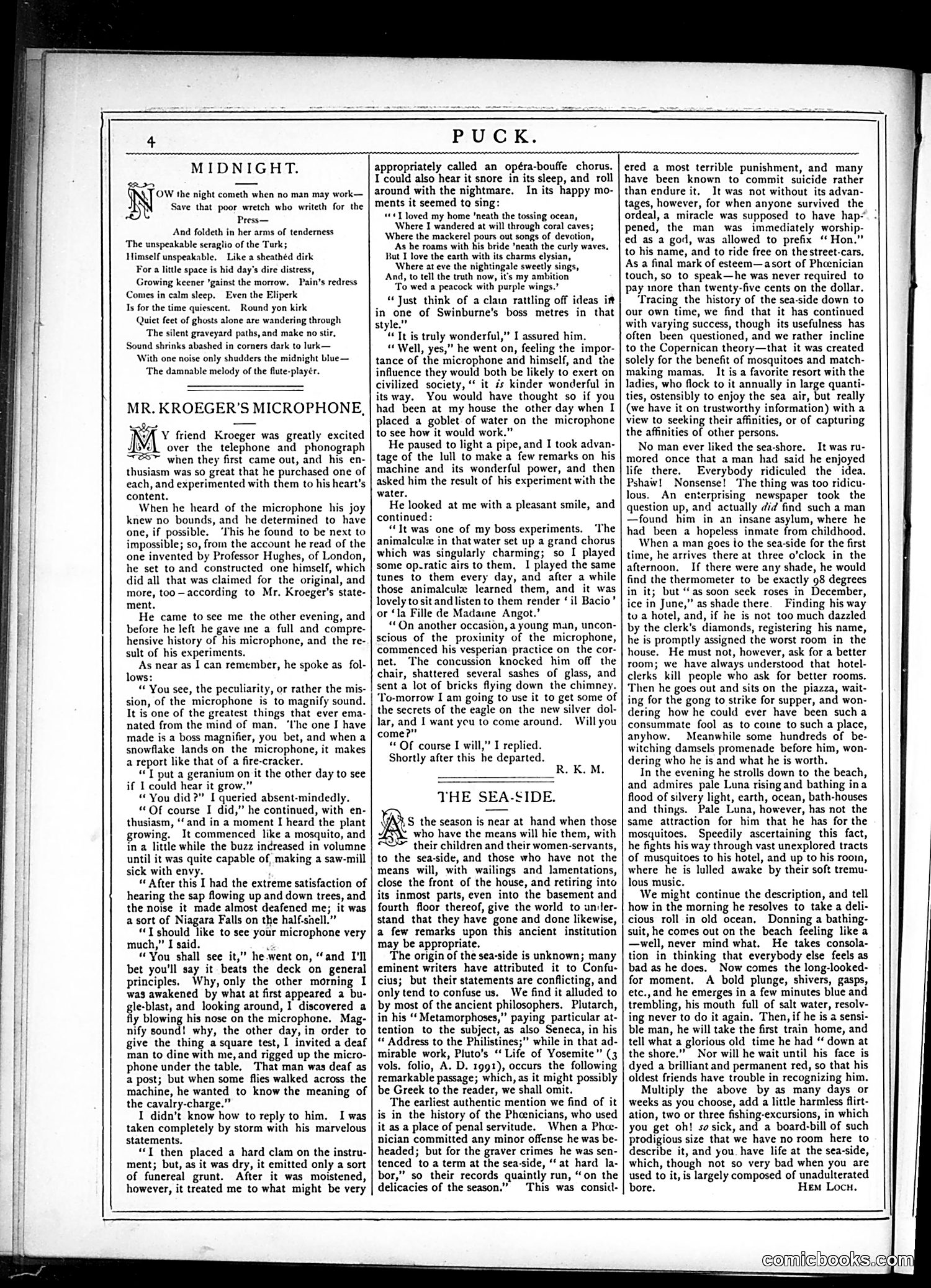
This page contains three literary pieces rather than political cartoons: "Midnight" (a poem), "Mr. Kroeger's Microphone" (a humorous anecdote about a man who constructs a microphone and experiments with it), and "The Sea-Side" (an essay discussing the origins and history of seaside resorts). The content appears to be general entertainment rather than political satire. "Mr. Kroeger's Microphone" uses gentle humor describing a friend's eccentric experiments amplifying sound through a homemade device. "The Sea-Side" discusses ancient Greek and Roman references to seaside practices and their modern revival. No political figures, current events, or social commentary requiring historical context are evident on this page. It represents Puck's literary rather than satirical-cartoon content.
📄 Transcribed text from this page (OCR, searchable)
Machine-transcribed from the original scan — historical spelling and the odd misread are preserved.
PUCK. MIDNIGHT. appropriately called an opéra-bouffe chorus. | cred a most terrible punishment, and many I could also hear it snore in its sleep, and roll | have been known to commit suicide rather N™ the night cometh when no man may work— | around with the nightmare, In its happy mo- | than endure it. It was not without its advan- ments it seemed to sing: tages, however, for when anyone survived the «««1 loved my home ‘neath the tossing ocean, ordeal, a miracle was supposed to have hap- | Where I wandered at will through coral caves; pened, the man was immediately worship- Where the mackerel pours out songs of devotion, ed as ‘a god, was allowed to prefix “ Hon.” As he roams with his bride ‘neath the curly waves. | 15 pj Mad ioriden : But I love the earth with its charms elysian, ‘0 his name, and to ride free on thestreet-cars. ‘Where at eve the nightingale sweetly sings, As a final mark of esteem—asort of Phoenician And, to tell the truth now, it’s my ambition touch, so to speak—he was never required to To wed a peacock with purple wings.’ pay more than twenty-five cents on the dollar. “Just think of a clain rattling off ideas it ‘Tracing the history of the sea-side down to in one of Swinburne’s boss metres in that | our own time, we find that it has continued style.” with varying success, though its usefulness has “Tt is truly wonderful,” I assured him. often been questioned, and we rather incline “Well, yes,” he went on, feeling the impor- | to the Copernican theory—that it was created tance of the microphone and himself, and the | solely for the benefit of mosquitoes and match- influence they would both be likely to exert on | making mamas. It is a favorite resort with the ee ais civilized society, “ it is kinder wonderful in | ladies, who flock to it annually in large quanti- its way. You would have thought so if you | ties, ostensibly to enjoy the sea air, but really MR. KROEGER’S MICROPHONE, | had been at my house the other day when I | (we have it on trustworthy information) with a placed a goblet of water on the microphone | view to seeking their affinities, or of capturing the affinities of other persons. Save that poor wretch who writeth for the Press— And foldeth in her arms of tenderness The unspeakable seraglio of the Turk; Himself unspeakable. Like a sheathéd dirk For a little space is hid day's dire distress, Growing keener ’gainst the morrow. Pain’s redress Comes in calm sleep. Even the Eliperk Is for the time quiescent. Round yon kirk Quiet feet of ghosts alone are wandering through The silent graveyard paths, and make no stir, Sound shrinks abashed in corners dark to lurk— With one noise only shudders the midnight blue— The damnable melody of the flute-playér. J over the telephone and phonograph “eS when they first came out, and his en- thusiasm was so great that he purchased one of each, and experimented with them to his heart's content. When he heard of the microphone his joy knew no bounds, and he determined to have one, if possible. ‘This he found to be next to impossible; so, from the account he read of the one invented by Professor Hughes, of London, he set to and constructed one himself, which did all that was claimed for the original, and more, too—according to Mr. Kroeger’s state- ment. He came to see me the other evening, and before he left he gave ine a full and compre- hensive history of his microphone, and the re- sult of his experiments. As near as I can remember, he spoke as fol- lows: “ You see, the peculiarity, or rather the mis- sion, of the microphone is to magnify sound. It is one of the greatest things that ever ema- nated from the mind of man. ‘he one J have made is a boss magnifier, you bet, and when a snowflake lands on the microphone, it makes a report like that of a fire-cracker. «T put a geranium on it the other day to see if 1 could hear it grow.” “You did?” I queried absent-mindedly. ‘© Of course I did,” he continued, with en- thusiasm, ‘(and in a moment I heard the plant rowing. It commenced like a mosquito, and in a little while the buzz increased in volumne until it was quite capable of, making a saw-mill sick with envy. “ After this I had the extreme satisfaction of hearing the sap flowing up and down trees, and the noise it made almost deafened me; it was a sort of Niagara Falls on the half-snell.” “I should like to see your microphone very much,” I said. é “You shall see it,” he.went on, “and I'll bet you'll say it beats the deck on general principles. Why, only the other morning I was awakened by what at first appeared a bu- gle-blast, and looking around, I discovered a fly blowing his nose on the microphone. Mag- nify sound! why, the other day, in order to give the thing a square test, I invited a deaf man to dine with me, and rigged up the micro- phone under the table, ‘That man was deaf as a post; but when some flies walked across the machine, he wanted to know the meaning of the cavalry-charge.” I didn’t know how to reply to him. I was taken completely by storm with his marvelous statements. “I then placed a hard clam on the instru- ment; but, as it was dry, it emitted only a sort M friend Kroeger was greatly excited | to see how it would work,” UsVe He paused to light a pipe, and I took advan- tage of the lull to make a few remarks on his asked him the result of his experiment with the continued: “It was one of my boss experiments. ‘The animalculz in that water set up a grand chorus which was singularly charming; so I played some op.ratic airs to them, I played the same tunes to them every day, and after a while those animalcule learned them, and it was lovely to sit and listen to them render ‘il Bacio’ or ‘la Fille de Madaine Angot.’ “On another occasion, a young man, uncon- scious of the proximity of the microphone, commenced his vesperian practice on the cor- net. The concussion knocked him off the chair, shattered several sashes of glass, and sent a lot of bricks flying down the chimney. ‘To-morrow I am going to use it to get some of the secrets of the eagle on the new silver dol- lar, and I want yeu to come around. Will you come?” “ OF course I will,” I replied. Shortly after this he departed. _R.K.M. THE SEA-SIDE. 2S the season is near at hand when those who have the means will hie them, with © their children and their women-servants, to the sea-side, and those who have not the means will, with wailings and lamentations, close the front of the house, and retiring into its inmost parts, even into the basement and fourth floor thereof, give the world to uniler- stand that they have gone and done likewise, a few remarks upon this ancient institution may be appropriate. The origin of the sea-side is unknown; many eminent writers have attributed it to Confu- cius; but their statements are conflicting, and only tend to confuse us. We find it alluded to by most of the ancient philosophers. Plutarch, in his “‘ Metamorphoses,” paying particular at- tention to the subject, as also Seneca, in his “ Address to the Philistines;” while in that ad- mirable work, Pluto's ‘ Life of Yosemite” (3 vols. folio, A. D. 1991), occurs the following remarkable passage; which, as it might possibly be Greek to the reader, we shall omit. The earliest authentic mention we find of it is in the history of the Phoenicians, who used it as a place of penal servitude. When a Phae- nician committed any minor offense he was be- headed; but for the graver crimes he was sen- tenced to a term at the sea-side, ‘at hard la- bor,” so their records quaintly run, “on the machine and its wonderful power, and then | life there. No man ever liked the sea-shore. It was ru- mored once that a man had said he enjoyed Everybody ridiculed the idea. Pshaiw! Nonsense! ‘The thing was too ridicu- water. . . lous. An enterprising newspaper took the He looked at me with a pleasant smile, and | question up, and actually did find such a man —found him in an insane asylum, where he had been a hopeless inmate from childhood. When a man goes to the sea-side for the first time, he arrives there at three o'clock in the afternoon, If there were any shade, he would find the thermometer to be exactly 98 degrees in it; but ‘as soon seek roses in December, ice in June,” as shade there. Finding his way to a hotel, and, if he is not too much dazzled by the clerk's diamonds, registering his name, he is promptly assigned the worst room in the house. He must not, however, ask for a better room; we have always understood that hotel- clerks kill people who ask for better rooms. Then he goes out and sits on the piazza, wait- ing for the gong to strike for supper, and won- dering how he could ever have been sucha consummate fool as to coine to such a place, anyhow. Meanwhile some hundreds of be- witching damsels promenade before him, won- dering who he is and what he is worth, In the evening he strolls down to the beach, and admires pale Luna rising and bathing ina flood of silvery light, earth, ocean, bath-houses and things. Pale Luna, however, has not the same attraction for him that he has for the mosquitoes. Speedily ascertaining this fact, he fights his way through vast unexplored tracts of musquitoes to his hotel, and up to his rooin, where he is lulled awake by their soft tremu- lous music. We might continue the description, and tell how in the morning he resolves to take a deli- cious roll in old ocean, Donning a bathing- suit, he comes out on the beach feeling like a —well, never mind what. He takes consola- tion in thinking that everybody else feels as bad as he does. Now comes the long-looked- for moment. A bold plunge, shivers, gasps, etc.,and he emerges in a few minutes blue and trembling, his mouth full of salt water, resolv- ing never to do it again. Then, if he is a sensi- ble man, he will take the first train home, and tell what a glorious old time he had “ down at the shore.” Nor will he wait until his face is dyed a brilliant and permanent red, so that his oldest friends have trouble in recognizing him. Multiply the above by as many days or weeks as you choose, add a little harmless flirt- ation, two or three fishing-excursions, in which you get oh! so sick, and a board-bill of such prodigious size that we have no room here to describe it, and you. have life at the sea-side, which, though not so very bad when you are used to it, is largely composed of unadulterated of funereal grunt. After it was moistened, however, it treated me to what might be very delicacies of the season.” This was consid- bore. Hem Loc, comichooks. om