
Puck, 1878-06-12 · page 6 of 16
Puck — June 12, 1878 — page 6: what you’re looking at
What you’re looking at
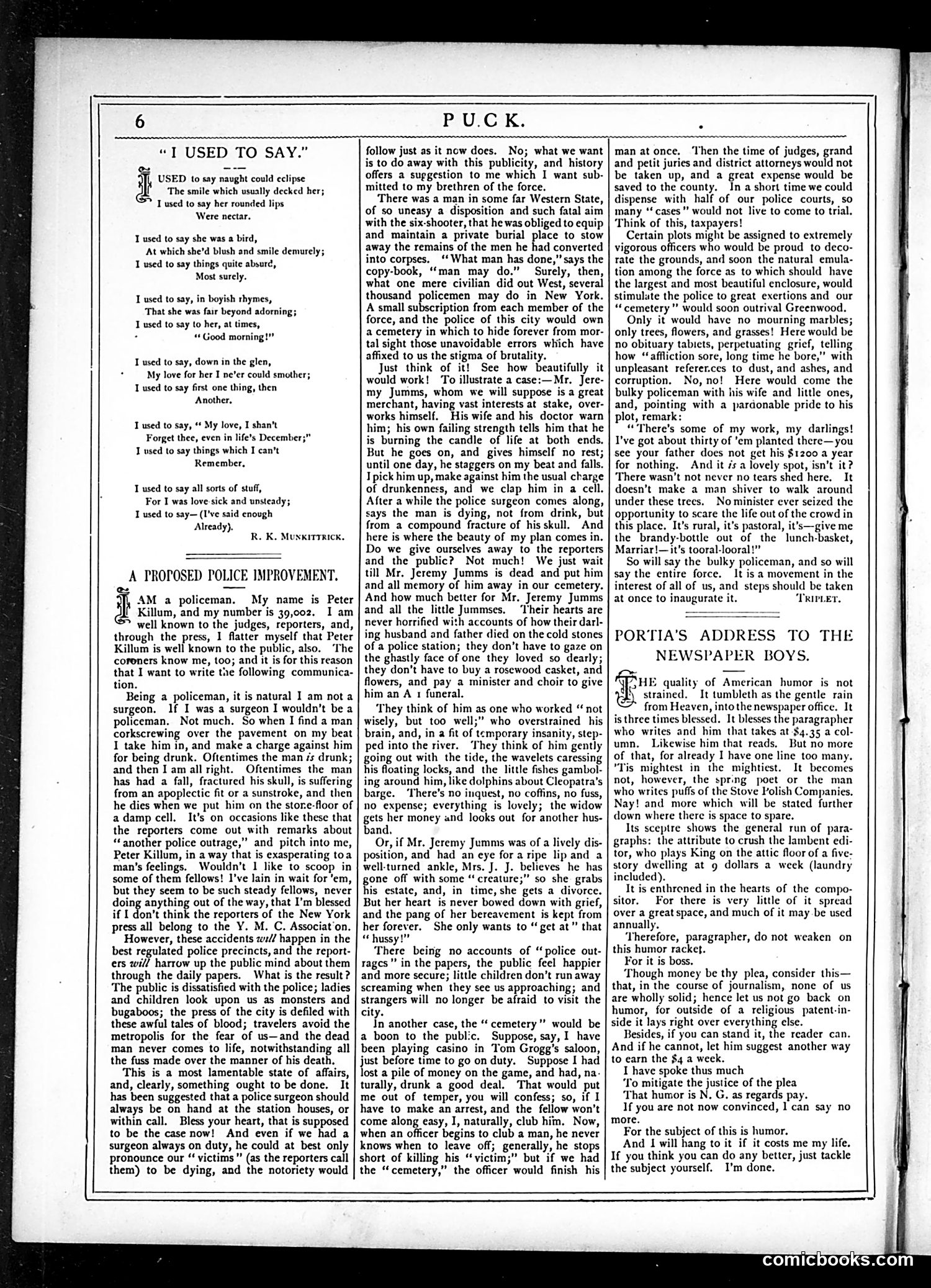
This page contains two separate pieces of satire: **"I Used to Say"** (left column) is a nostalgic poem by K.K. Munkittrick reflecting on youthful romantic and naive statements the author once made, contrasting past idealism with present cynicism. **"A Proposed Police Improvement"** (center/right) is a satirical essay by a policeman named Peter Killum critiquing the treatment of police officers. Killum argues that if surgeons were treated as poorly as police—blamed for deaths despite best efforts, disrespected publicly, and denied basic resources—the profession would be intolerable. The piece sarcastically suggests absurd alternatives like converting cemeteries into casinos as solutions to public dissatisfaction with policing. **"Portia's Address to Newspaper Boys"** (right column) offers humorous advice to young newsboys about maintaining professional integrity and humor in journalism. The page primarily contains text-based humor rather than prominent visual cartoons.
📄 Transcribed text from this page (OCR, searchable)
Machine-transcribed from the original scan — historical spelling and the odd misread are preserved.
PUCK. “I USED TO SAY.” f USED to say naught could eclipse The smile which usually decked her; T used to say her rounded lips Were nectar. T used to say she was a bird, At which she'd blush and smile demurely; I used to say things quite absurd, Most surely. I used to say, in boyish rhymes, ‘That she was fair beyond adorning; I used to say to her, at times, : “Good morning!” I used to say, down in the glen, My love for her I ne’er could smother; T used to say first one thing, then Another. I used to say, “ My love, I shan't Forget thee, even in life's December; I used to say things which I can’t Remember, I used to say all sorts of stuff, For I was love sick and unsteady; I used to say— (I've said enough Already). R. K. Munkitrrick. A PROPOSED POLICE IMPROVEMENT. AM a policeman. My name is Peter Killum, and my number is 39,002. 1 am well known to the judges, reporters, and, through the press, I flatter myself that Peter Killum is well known to the public, also. The coroners know me, too; and it is for this reason that I want to write the following communica- tion. Being a policeman, it is natural 1 am not a surgeon. If I was a surgeon I wouldn't be a policeman. Not much. So when I find a man corkscrewing over the pavement on my beat I take him in, and make a charge against him for being drunk. Oftentimes the man is drunk; and then I am all right. Oftentimes the man has had a fall, fractured his skull, is suffering from an apoplectic fit or a sunstroke, and then he dies when we put him on the stone-floor of a damp cell, It’s on occasions like these that the reporters come out with remarks about “another police outrage,” and pitch into me, Peter Killum, in a way that is exasperating toa man’s feelings. Wouldn't 1 like to scoop in some of them fellows! I’ve lain in wait for'em, but they seem to be such steady fellows, never doing anything out of the way, that I’m blessed if I don’t think the reporters of the New York press all belong to the Y. M. C. Associat’on. However, these accidents z#/ happen in the best regulated police precincts, and the report- ers ‘will harrow up the public mind about them through the daily papers. What is the result? The public is dissatisfied with the police; ladies and children look upon us as monsters and bugaboos; the press of the city is defiled with these awful tales of blood; travelers avoid the metropolis for the fear of us—and the dead man never comes to life, notwithstanding all the fuss made over the manner of his death. This is a most lamentable state of affairs, and, clearly, something ought to be done. It has been suggested that a police surgeon should always be on hand at the station houses, or within call. Bless your heart, that is supposed to be the case now! And even if we had a surgeon always on duty, he could at best only pronounce our “‘ victims” (as the reporters call them) to be dying, and the notoriety would follow just as it now does. No; what we want is to do away with this publicity, and history offers a suggestion to me which I want sub- mitted to my brethren of the force. There was a man in some far Western State, of so uneasy a disposition and such fatal aim with the six-shooter, that he was obliged to equip and maintain a private burial place to stow away the remains of the men he had converted into corpses. ‘What man has done,” says the copy-book, ‘‘man may do.” Surely, then, what one mere civilian did out West, several thousand policemen may do in New York. A small subscription from each member of the force, and the police of this city would own a cemetery in which to hide forever from mor- tal sight those unavoidable errors which have affixed to us the stigma of brutality. Just think of it! See how beautifully it would work! To illustrate a case:—Mr. Jere- my Jumms, whom we will suppose is a great merchant, having vast interests at stake, over- works himself. His wife and his doctor warn him; his own failing strength tells him that he is burning the candle of life at both ends. But he goes on, and gives himself no rest; until one day, he staggers on my beat and falls. Ipick him up, make against him the usual charge of drunkenness, and we clap him in a cell. After a while the police surgeon comes along, says the man is dying, not from drink, but from a compound fracture of his skull. And here is where the beauty of my plan comes in, Do we give ourselves away to the reporters and the public? Not much! We just wait till Mr, Jeremy Jumms is dead and put him and all memory of him away in our cemetery. And how much better for Mr. Jeremy Jumms and all the little Jummses, ‘heir hearts are never horrified with accounts of how their darl- ing husband and father died on the cold stones of a police station; they don’t have to gaze on the ghastly face of one they loved so dearly; they don’t have to buy a rosewood casket, and flowers, and pay a minister and choir to give him an A 1 funeral. ‘They think of him as one who worked “ not wisely, but too well;” who overstrained his brain, and, in a fit of temporary insanity, step- ped into the river. ‘They think of him gently going out with the tide, the wavelets caressing his floating locks, and the little fishes gambol- ing around him, like dolphins about Cleopatra's barge. ‘There's no inquest, no coffins, no fuss, no expense; everything is lovely; the widow gets her money and looks out for another hus- and. Or, if Mr. Jeremy Jumms was of a lively dis- position, and had an eye for a ripe lip and a well-turned ankle, Mrs. J. J. believes he has ‘one off with some “creature;” so she grabs jis estate, and, in time, she gets a divorce. But her heart is never bowed down with grief, and the pang of her bereavement is kept from her forever. She only wants to “get at” that “ hussy!” There being no accounts of “police out- rages” in the papers, the public feel happier and more secure; little children don’t run away screaming when they see us approaching; and strangers will no longer be afraid to visit the city. in another case, the “ cemetery” would be a boon to the public. Suppose, say, I have been playing casino in Tom Grogg’s saloon, just before time to go on duty. Suppose I had lost a pile of money on the game, and had, na- turally, drunk a good deal. That would put me out of temper, you will confess; so, if I have to make an arrest, and the fellow won't come along easy, I, naturally, club him. Now, when an officer begins to club a man, he never knows when to leave off; generally, he stops short of killing his ‘‘victim;” but if we had the “cemetery,” the officer would finish his man at once. ‘Then the time of judges, grand and petit juries and district attorneys would not be taken up, and a great expense would be saved to the county. In a short time we could dispense with half of our police courts, so many “‘cases" would not live to come to trial. ‘Think of this, taxpayers! Certain plots might be assigned to extremely vigorous officers who would be proud to deco- rate the grounds, and soon the natural emula- tion among the force as to which should have the largest and most beautiful enclosure, would stimulate the police to great exertions and our “cemetery” would soon outrival Greenwood. Only it would have no mourning marbles; only trees, flowers, and grasses! Here would be no obituary tabiets, perpetuating grief, telling how “‘affliction sore, long time he bore,” with unpleasant referer.ces to dust, and ashes, and corruption. No,no! Here would come the bulky policeman with his wife and little ones, and, pointing with a pardonable pride to his plot, remark: “There's some of my work, my darlings! I've got about thirty of ‘em planted there—you see your father does not get his $1200 a year for nothing. And it /s a lovely spot, isn't it? There wasn’t not never no tears shed here. It doesn’t make a man shiver to walk around under these trees. No minister ever seized the opportunity to scare the life out of the crowd in this place. It’s rural, it's pastoral, it’s—give me the brandy-bottle out of the lunch-basket, Marriar!— it’s tooral-looral!” So will say the bulky policeman, and so will say the entire force. It is a movement in the interest of all of us, and steps should be taken at once to inaugurate it. “TRIPLET. PORTIA’S ADDRESS TO THE NEWSPAPER BOYS. CHE quality of American humor is not re strained. It tumbleth as the gentle rain > from Heaven, into the newspaper office. It is three times blessed. It blesses the paragrapher who write: 1 him that takes at $4.35 a col- umn. Likewise him that reads. But no more of that, for already I have one line too many. 'Tis mightest in the mightiest. It becomes not, however, the spring poet or the man who writes puffs of the Stove Polish Companies. Nay! and more which will be stated further down where there is space to spare, Its sceptre shows the general run of para- graphs: the attribute to crush the lambent edi- tor, who plays King on the attic floor of a five- story dwelling at 9 dollars a week (laundry included). It is enthroned in the hearts of the compo- sitor. For there is very little of it spread over a great space, and much of it may be used annually. ‘Therefore, paragrapher, do not weaken on this humor racket. For it is boss. Though money be thy plea, consider this— that, in the course of journalism, none of us are wholly solid; hence let us not go back on humor, for outside of a religious patent-in- side it lays right over everything else. Besides, if you can stand it, the reader can. And if he cannot, let him suggest another way to earn the $4 a week, I have spoke thus much ‘To mitigate fhe jusilee of the plea ‘That humor is N. G. as regards pay. If you are not now convinced, 1 can say no more. For the subject of this is humor. And 1 will hang to it if it costs me my life. If you think you can do any better, just tackle the subject yourself. I'm done.