
Puck, 1878-06-12 · page 11 of 16
Puck — June 12, 1878 — page 11: what you’re looking at
What you’re looking at
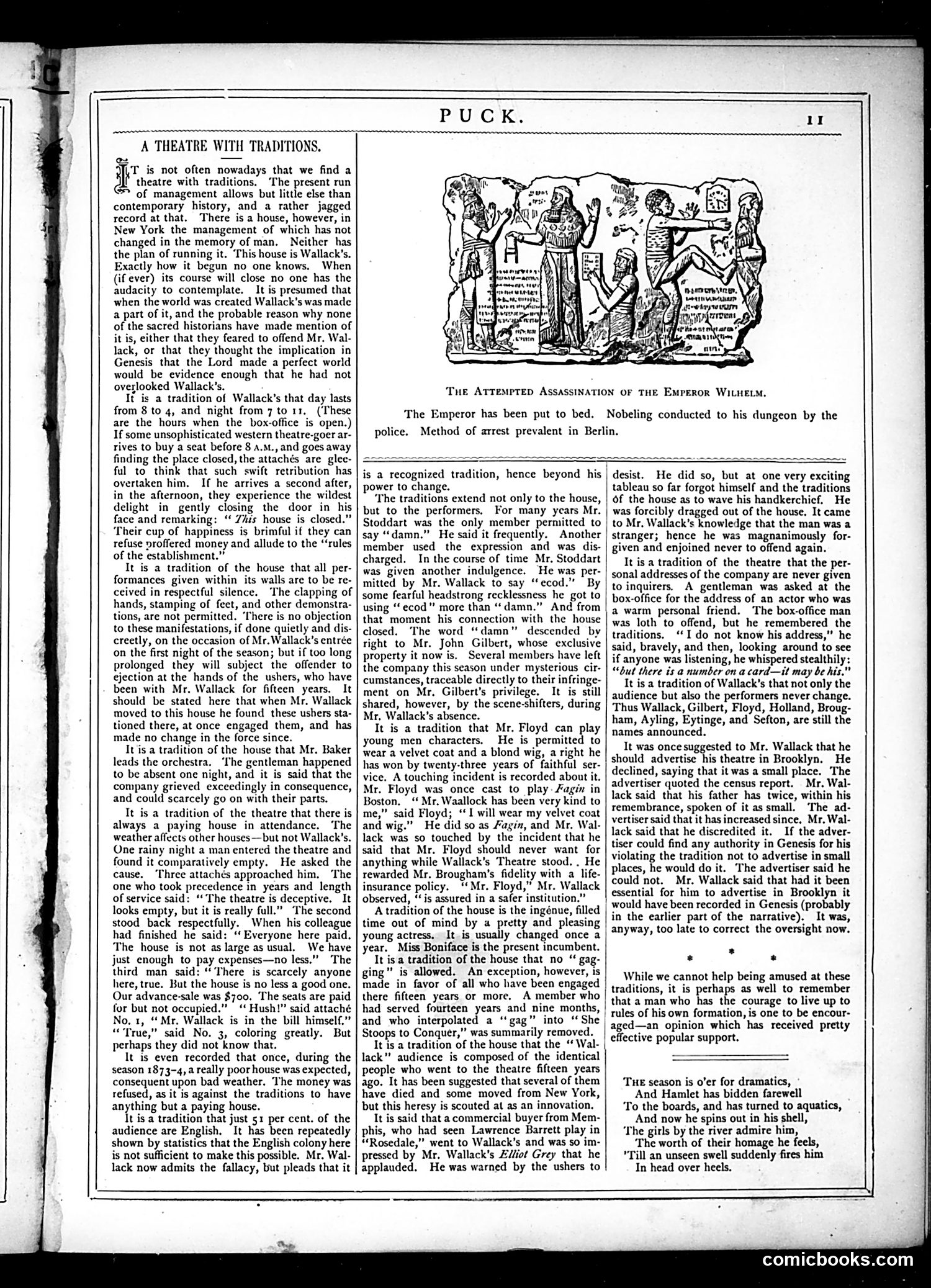
This page contains an article titled "A Theatre with Traditions" about Wallack's Theatre in New York, accompanied by a single illustration labeled "The Attempted Assassination of the Emperor Wilhelm." The illustration appears to depict a historical assassination attempt, showing multiple figures in what seems to be a period German setting. However, the image quality makes it difficult to determine the specific historical event referenced or identify particular individuals. The article itself focuses on theatrical traditions and management practices at Wallack's rather than political commentary. The relationship between the illustration and the main article text is unclear from this page layout. Without additional context about the publication date or clearer image resolution, I cannot definitively explain the satirical intent or modern relevance of the Wilhelm illustration.
📄 Transcribed text from this page (OCR, searchable)
Machine-transcribed from the original scan — historical spelling and the odd misread are preserved.
A THEATRE WITH TRADITIONS. a aaa aI, is not often nowadays that we find a theatre with traditions, The present run “> of management allows but little else than contemporary history, and a rather jagged record at that. There is a house, however, in New York the management of which has not changed in the memory of man. Neither has the plan of running it. This house is Wallack’s. Exactly how it begun no one knows. When (if ever) its course will close no one has the audacity to contemplate. It is presumed that when the world was created Wallack’s was made a part of it, and the probable reason why none of the sacred historians have made mention of it is, either that they feared to offend Mr. Wal- lack, or that they thought the implication in Genesis that the Lord made a perfect world would be evidence enough that he had not overlooked Wallack’s. It is a tradition of Wallack’s that day lasts from 8 to 4, and night from 7 to 11. (‘These are the hours when the box-office is open.) If some unsophisticated western theatre-goer ar- rives to buy a seat before 8 a.st., and goes away finding the place closed, the attachés are glee- ful to think that such swift retribution has overtaken him. If he arrives a second after, in the afternoon, they experience the wildest delight in gently closing the door in his face and remarking: ‘ ZZzs house is closed.” ‘Their cup of happiness is brimful if they can refuse proffered money and allude to the ‘rules of the establishment.” It is a tradition of the house that all per- formances given within its walls are to be re- ceived in respectful silence. The clapping of hands, stamping of feet, and other demonstra- tions, are not permitted. ‘There is no objection to these manifestations, if done quietly and dis- creetly, on the occasion of Mr.Wallack’s entrée on the first night of the season; but if too long prolonged they will subject the offender to ejection at the hands of the ushers, who have been with Mr, Wallack for fifteen years. It should be stated here that when Mr. Wallack moved to this house he found these ushers sta- tioned there, at once engaged them, and has made no change in the force since. It is a tradition of the house that Mr, Baker leads the orchestra. ‘I'he gentleman happened to be absent one night, and it is said that the company grieved exceedingly in consequence, and could scarcely go on with their parts. It is a tradition of the theatre that there is always a paying house in attendance. The weather affects other houses—but not Wallack’s. One rainy night a man entered the theatre and found it comparatively empty. He asked the cause. ‘Three attaches approached him. The one who took precedence in years and length of service said: ‘The theatre is deceptive. It looks empty, but it is really full.” ‘The second stood back ‘respectfully. When his colleague had finished he said: “Everyone here paid. The house is not as large as usual. We have just enough to pay expenses—no less.” The third man said: “There is scarcely anyone here, true. But the house is no less a good one. Our advance-sale was $700. ‘The seats are paid for but not occupied.” ‘* Hush!” said attaché No. 1, ‘Mr. Wallack is in the bill himself.” “True,” said No. 3, coloring greatly. But perhaps they did not know that. It is even recorded that once, during the season 1873-4, a really poor house was expected, consequent upon bad weather. ‘The money was refused, as it is against the traditions to have anything but a paying house. It is a tradition that just 51 per cent. of the audience are English, It has been repeatedly shown by statistics that the English colony here is not sufficient to make this possible. Mr. Wal- lack now admits the fallacy, but pleads that it Tue ATTEMPTED ASSASSINATION OF THE EMPEROR WILHELM, The Emperor has been put to bed. police. Nobeling conducted to his dungeon by the Method of arrest prevalent in Berlin. is a recognized tradition, hence beyond his power to change. ‘The traditions extend not only to the house, | but to the performers, For many years Mr. Stoddart was the only member permitted to | Another | say “damn.” He said it frequently. member used the expression and was dis- charged. In the course of time Mr. Stoddart was given another indulgence. He was per- mitted by Mr. Wallack to say ‘“ecod.” some fearful headstrong recklessness he got to | using “ ecod” more than “damn.” And from that moment his connection with the house closed. ‘The word ‘‘damn” descended by right to Mr. John Gilbert, whose exclusive property it now is. Several members have left the company this season under mysterious cir- cumstances, traceable directly to their infringe- ment on Mr, Gilbert's privilege. It is still shared, however, by the scene-shifters, during Mr, Wallack’s absence. It is a tradition that Mr. Floyd can play young men characters. He is permitted to wear a velvet coat and a blond wig, a right he has won by twenty-three years of faithful ser- vice. A touching incident is recorded about it. Mr. Floyd was once cast to play. Fagin in Boston. |“ Mr. Waallock has been very kind to me,” said Floyd; ‘1 will wear my velvet coat and wig.” He did so as Fagin, and Mr. Wal- lack was so touched by the incident that he said that Mr. Floyd should never want for anything while Wailack’s ‘Theatre stood. . He rewarded Mr. Brougham’s fidelity with a life- insurance policy. ‘Mr. Floyd,” Mr. Wallack observed, ‘is assured in a safer institution.” A tradition of the house is the ingénue, filled time out of mind by a pretty and pleasing young actress. It is usually changed once a year. Miss Boniface is the present incumbent. It is a tradition of the house that no “ gag- ging” is allowed. An exception, however, is made in favor of all who have been engaged there fifteen years or more. A member who had served fourteen years and nine months, | and who interpolated a “gag” into “She Stoops to Conquer,” was summarily removed. It is a tradition of the house that the ‘ Wal- lack” audience is composed of the identical people who went to the theatre fifteen years ago. It has been suggested that several of them have died and some moved from New York, but this heresy is scouted at as an innovation, It is said that a commercial buyer from Mem- phis, who had seen Lawrence Barrett play in “Rosedale,” went to Wallack’s and was so im- pressed by Mr. Wallack’s Z/iot Grey that he applauded. He was warned by the ushers to By | desist. He did so, but at one very exciting tableau so far forgot himself and the traditions Of the house as to wave his handkerchicf. He was forcibly dragged out of the house, It came to Mr, Wallack’s knowledge that the man was a stranger; hence he was magnanimously for- given and enjoined never to offend again. It is a tradition of the theatre that the per- sonal addresses of the company are never given | to inquirers. A gentleman was asked at the box-office for the address of an actor who was a warm personal friend. The box-office man was loth to offend, but he remembered the traditions. ‘I do not know his address," he said, bravely, and then, looking around to see if anyone was listening, he whispered stealthily: “but there is a number on a card—it may be his.” It is a tradition of Wallack's that not only the audience but also the performers never change. Thus Wallack, Gilbert, Floyd, Holland, Broug- ham, Ayling, Eytinge, and Sefton, are still the names announced. It was once suggested to Mr. Wallack that he should advertise his theatre in Brooklyn, He declined, saying that it was a small place. ‘The advertiser quoted the census report. Mr. Wal- lack said that his father has twice, within his remembrance, spoken of it as small. ‘The ad- vertiser said that it has increased since, Mr. Wal- lack said that he discredited If the adver- tiser could find any authority in Genesis for his violating the tradition not to advertise in small places, he would do it. The advertiser said he could not. Mr. Wallack said that had it been essential for him to advertise in Brooklyn it would have been recorded in Genesis (probably in the earlier part of the narrative). It was, anyway, too late to correct the oversight now. * * * While we cannot help being amused at these traditions, it is perhaps as well to remember that a man who has the courage to live up to tules of his own formation, is one to be encour- aged—an opinion which has received pretty effective popular support. THE season is o'er for dramatics, And Hamlet has bidden farewell To the boards, and has turned to aquatics, And now he spins out in his shell, ‘The girls by the river admire him, ‘The worth of their homage he feels, ‘Till an unseen swell suddenly fires him In head over heels. comicbooks.com