
Puck, 1878-06-12 · page 10 of 16
Puck — June 12, 1878 — page 10: what you’re looking at
What you’re looking at
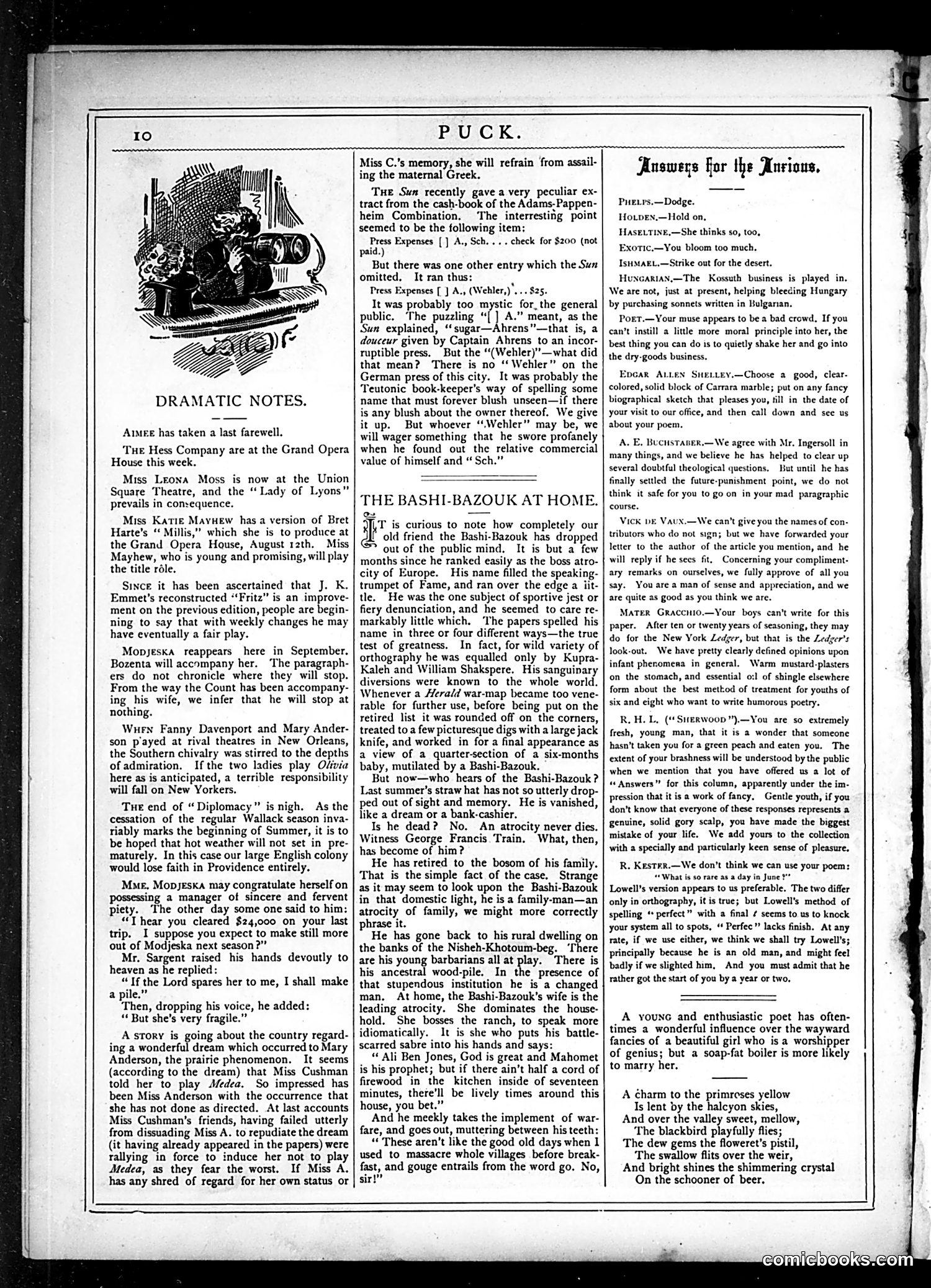
This page from *Puck* magazine contains theatrical and literary commentary rather than political cartoons. The "Dramatic Notes" section discusses recent stage productions and performers, including references to Aimee (apparently a notable performer taking a final bow) and various theater companies at venues like the Grand Opera House. The cartoon illustration appears to show a theatrical or dramatic scene, though specific characters are unclear from the image alone. The right column, "Answers for the Curious," provides humorous responses to reader questions on miscellaneous topics—a common *Puck* feature mixing entertainment gossip with satire. This page exemplifies *Puck's* broader cultural commentary beyond politics, focusing on New York theater and social life of the era.
📄 Transcribed text from this page (OCR, searchable)
Machine-transcribed from the original scan — historical spelling and the odd misread are preserved.
PUCK. DRAMATIC NOTES. Autee has taken a last farewell. Tue Hess Company are at the Grand Opera House this week. Miss Leona Moss is now at the Union Square Theatre, and the “Lady of Lyons” prevails in consequence. Miss Katie Mavuew has a version of Bret Harte’s “Millis,” which she is to produce at the Grand Opera House, August 12th. Miss Mayhew, who is young and promising, will play the title rdle. Since it has been ascertained that J. K. Emmet’s reconstructed “Fritz” is an improve- ment on the previous edition, people are begin- ning to say that with weekly changes he may have eventually a fair play. Mopyjeska reappears here in September. Bozenta will accompany her. ‘The paragraph- ers do not chronicle where they will stop. From the way the Count has been accompany- ing his wife, we infer that he will stop at nothing. Wuew Fanny Davenport and Mary Ander- son p'ayed at rival theatres in New Orleans, the Southern chivalry was stirred to the depths ofadmiration. Ifthe two ladies play Olivia here as is anticipated, a terrible responsibility will fall on New Yorkers. Tue end of “Diplomacy” is nigh. As the cessation of the regular Wallack season inva- riably marks the beginning of Summer, it is to be hoped that hot weather will not set in pre- maturely. In this case our large English colony would lose faith in Providence entirely. Mme. Mopjeska may congratulate herself on possessing a manager of sincere and fervent piety. The other day some one said to him: “T hear you cleared $24,000 on your last trip. I suppose you expect to make still more out of Modjeska next season?” Mr. Sargent raised his hands devoutly to heaven as he replied: “ If the Lord spares her to me, I shall make a pile.” Then, dropping his voice, he added: “But she’s very fragile.” A story is going about the country regard- ing a wonderful dream which occurred to Mary Anderson, the prairie phenomenon. It seems (according to the dream) that Miss Cushman told her to play Afedea. So impressed has been Miss Anderson with the occurrence that she has not done as directed. At last accounts Miss Cushman’s friends, having failed utterly from dissuading Miss A. to repudiate the dream (it having already appeared in the papers) were rallying in force to induce her not to play Medea, as they fear the worst. If Miss A. has any shred of regard for her own status or Miss C.’s memory, she will refrain from assail- ing the maternal Greek. Tue Sun recently gave a very peculiar ex- tract from the cash-book of the Adams-Pappen- heim Combination. ‘The interresting point seemed to be the following item: Press Expenses [] A., Sch. . . . check for $200 (not paid.) But there was one other entry which the Sun omitted, It ran thus: Press Expenses [ } A., (Wehler,)', .. $25. It was probably too mystic forthe general public. ‘The puzzling “{] A.” meant, as the Sun explained, ‘“ sugar—Ahrens”—that is, a douceur given by Captain Ahrens to an incor- ruptible press. But the “(Wehler)”—what did that mean? There is no ‘‘Wehler” on the German press of this city. It was probably the Teutonic book-keeper’s way of spelling some name that must forever blush unseen—if there is any blush about the owner thereof. We give it up. But whoever “.Wehler” may be, we will wager something that he swore profanely when he found out the relative commercial value of himself and “ Sch."”” THE BASHI-BAZOUK AT HOME. as — i, is curious to note how completely our if old friend the Bashi-Bazouk has dropped out of the public mind. It is but a few months since he ranked easily as the boss atro- city of Europe. His name filled the speak trumpet of Fame, and ran over the edge a tle. He was the one subject of sportive jest or fiery denunciation, and he seemed to care re- markably little which, ‘The papers spelled his name in three or four different ways—the true test of greatness. In fact, for wild variety of orthography he was equalled only by Kupra- Kaleh and William Shakspere. His sanguinary diversions were known to the whole world. Whenever a Hera/d war-map became too vene- rable for further use, before being put on the retired list it was rounded off on the corners, treated to a few picturesque digs with a large jack knife, and worked in for a final appearance as a view of a quarter-section of a six-months baby, mutilated by a Bashi-Bazouk. But now—who hears of the Bashi-Bazouk ? Last summer’s straw hat has not so utterly drop- ped out of sight and memory. He is vanished, like a dream or a bank-cashier. Is he dead? No. An atrocity never dies. Witness George Francis Train. What, then, has become of him? He has retired to the bosom of his family. That is the simple fact of the case. Strange as it may seem to look upon the Bashi-Bazouk in that domestic light, he is a family-man—an atrocity of family, we might more correctly phrase it. He has gone back to his rural dwelling on the banks of the Nisheh-Khotoum-beg. ‘There are his young barbarians all at Play. There is his ancestral wood-pile. In the presence of that stupendous institution he is a changed man, At home, the Bashi-Bazouk's wife is the leading atrocity. She dominates the house- hold. She bosses the ranch, to speak more idiomatically. It is she who puts his battle- scarred sabre into his hands and says: “ Ali Ben Jones, God is great and Mahomet is his prophet; but if there ain’t half a cord of firewood in the kitchen inside of seventeen minutes, there'll be lively times around this house, you bet.” ‘And he meekly takes the implement of war- fare, and goes out, muttering between his teeth: “These aren't like the good old days when 1 used to massacre whole villages before break- fast, and gouge entrails from the word go. No, sir!” Answers for the Anrious, Howpex.—Hold on, ‘She thinks so, too, You bloom too much. Strike out for the desert, The Kossuth business is played in. We are not, just at present, helping bleeding Hungary by purchasing sonnets written in Bulganan, Port.—Your muse appears to be a bad crowd, If you can't instill a little more moral principle into her, the best thing you can do is to quietly shake her and go into the dry-goods business. EDGAR ALLEN SHELLEY.—Choose a good, clear- colored, solid block of Carrara marble; put on any fancy biographical sketch that pleases you, till in the date of your visit to our office, and then call down and see us about your poem. A. E, Bucustaner.—We agree with Mr. Ingersoll in many things, and we believe he has helped to clear up several doubtful theological questions, ut until he has finally settled the future-punishment point, we do not think it safe for you to go on in your mad paragraphic course. Vick pe VAUx.—We can’t give you the names of con- tributors who do not sign; but we have forwarded your letter to the author of the article you mention, and he will reply if he secs fit, Concerning your compliment- ary remarks on ourselves, we fully approve of all you say. You are a man of sense and appreciation, and we are quite as good as you think we are. MATER Graccito.—Your boys can't write for this paper. After ten or twenty years of seasoning, they may do for the New York Ledger, but that is the Ledger's look-out. We have pretty clearly defined opinions upon infant phenomena in general. Warm mustard-plasters on the stomach, and essential 0:1 of shingle elsewhere form about the best metkod of treatment for youths of six and eight who want to write humorous poetry. R.H.L, (#Siterwoop"),—You are so extremely fresh, young man, that it is a wonder that someone hasn't taken you for a green peach and eaten you. The extent of your brashness will be understood by the public when we mention that you have offered us a lot of “Answers” for this column, apparently under the im- pression that it is a work of fancy, Gentle youth, if you don't know that everyone of these responses represents a genuine, solid gory scalp, you have made the biggest mistake of your life, We add yours to the collection with a specially and particularly keen sense of pleasure, R. Kester.—We don’t think we can use your poem: «What is so rare as a day in June?" Lowell's version appears to us preferable. The two differ only in orthography, it is true; but Lowell’s method of spelling “perfect” with a final ¢ seems to us to knock your system all to spots, “ Perfec” lacks finish. At any rate, if we use either, we think we shall try Lowell's; principally because he is an old man, and might feel badly if we slighted him, And you must admit that he rather got the start of you by a year or two, A younc and enthusiastic poet has often- times a wonderful influence over the wayward fancies of a beautiful girl who is a worshipper of genius; but a soap-fat boiler is more likely to marry her, A Charm to the primroses yellow Is lent by the halcyon skies, And over the valley sweet, mellow, ‘The blackbird playfully flies; The dew gems the floweret’s pistil, The swallow flits over the weir, And bright shines the shimmering crystal On the schooner of beer.