
Puck, 1878-06-12 · page 3 of 16
Puck — June 12, 1878 — page 3: what you’re looking at
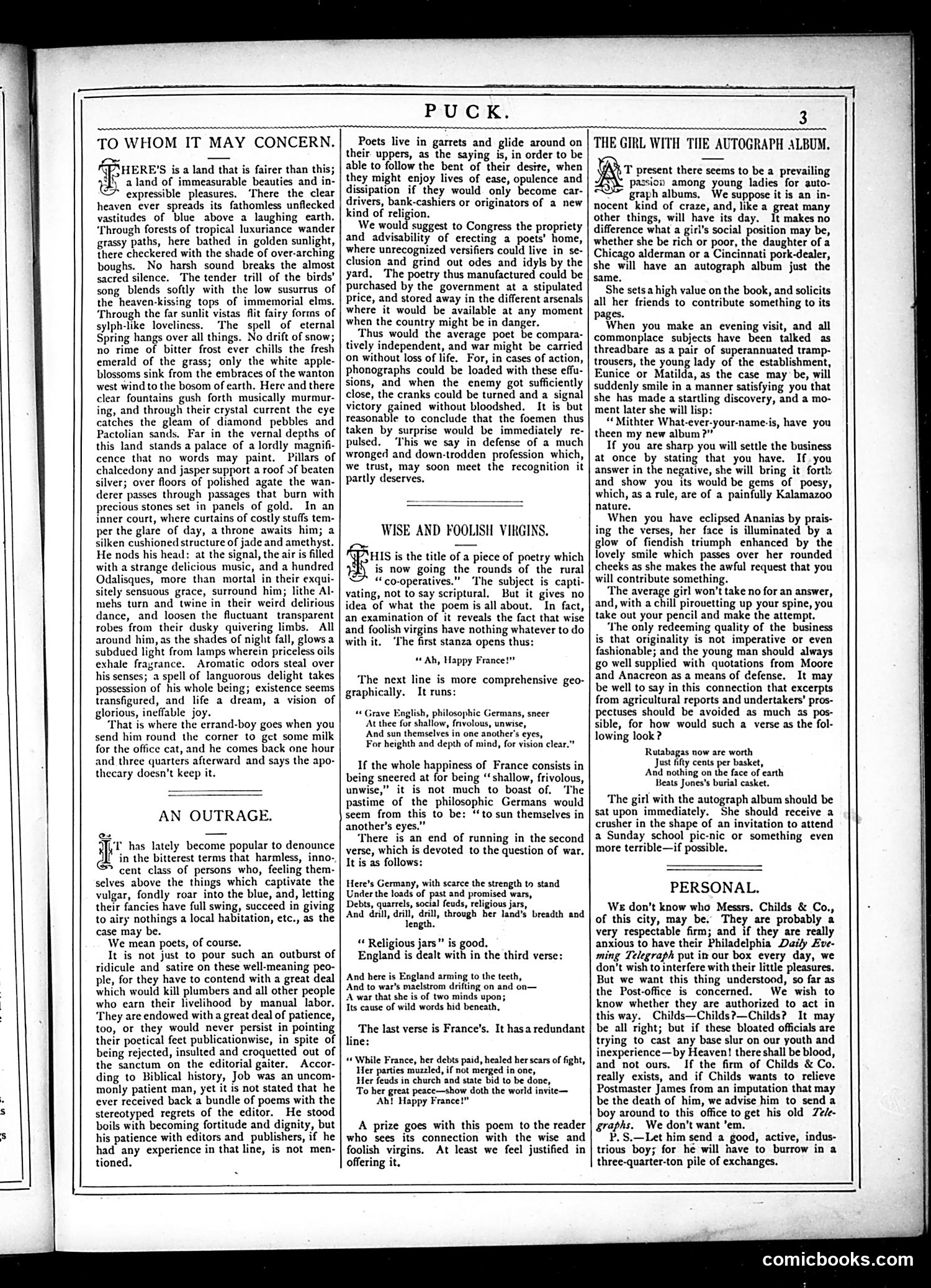
What you’re looking at
This page contains several satirical articles rather than cartoons. The main pieces critique: 1. **"To Whom It May Concern"** - A proposal to establish government-funded "poets' homes" where writers could live productively. The satire mocks the notion that poets need special institutional support, suggesting they'd become idle and dependent rather than creative. 2. **"Wise and Foolish Virgins"** - Critiques a poem about "wise and foolish virgins" in rural cooperatives, dismissing it as vapid moralizing disguised as poetry. The piece sarcastically praises the poem's attempt at profundity. 3. **"An Outrage"** - Denounces wealthy patrons who claim credit for supporting poets while actually stifling their independence through patronage. The satire targets pretentious literary culture and hypocrisy surrounding artistic patronage.
📄 Transcribed text from this page (OCR, searchable)
Machine-transcribed from the original scan — historical spelling and the odd misread are preserved.
PUCK. 3 TO WHOM IT MAY CONCERN. APSHERE'S is a land that is fairer than this; reay a land of immeasurable beauties and in- expressible pleasures. ‘There the clear heaven ever spreads its fathomless unflecked vastitudes of blue above a laughing earth. ‘Through forests of tropical luxuriance wander grassy paths, here bathed in golden sunlight, there checkered with the shade of over-arching boughs. No harsh sound breaks the almost sacred silence. The tender trill of the birds’ song blends softly with the low susurrus of the heaven-kissing tops of immemorial elms. ‘Through the far sunlit vistas flit fairy forms of sylph-like loveliness. ‘The spell of eternal Spring hangs over all things. No drift of snow; no rime of bitter frost ever chills the fresh emerald of the grass; only the white apple- blossoms sink from the embraces of the wanton west wind to the bosom of earth. Here and there clear fountains gush forth musically murmur- ing, and through their crystal current the eye catches the gleam of diamond pebbles and Pactolian sands, Far in the vernal depths of this land stands a palace of a lordly magnifi- cence that no words may paint. Pillars of chalcedony and jasper support a roof of beaten silver; over floors of polished agate the wan- derer passes through passages that burn with precious stones set in panels of gold. In an inner court, where curtains of costly stuffs tem- per the glare of day, a throne awaits him; a silken cushioned structure of jade and amethyst. He nods his head: at the signal, the air is filled with a strange delicious music, and a hundred Odalisques, more than mortal in their exqui- sitely sensuous grace, surround him; lithe Al- mehs turn and twine in their weird delirious dance, and loosen the fluctuant transparent robes from their dusky quivering limbs. All around him, as the shades of night fall, glows a subdued light from lamps wherein priceless oils exhale fragrance. Aromatic odors steal over his senses; a spell of languorous delight takes possession of his whole being; existence seems transfigured, and life a dream, a vision of glorious, ineffable joy. ‘That is where the errand-boy goes when you send him round the corner to gct some milk for the office cat, and he comes back one hour and three quarters afterward and says the apo- thecary doesn’t keep it. AN OUTRAGE. es — 2 has lately become popular to denounce Bl in the bitterest terms that harmless, inno- cent class of persons who, feeling them- selves above the things which captivate the vulgar, fondly roar into the blue, and, letting their fancies have full swing, succeed in giving to airy nothings a local habitation, etc., as the case may be. We mean poets, of course. It is not just to pour such an outburst of ridicule and satire on these well-meaning peo- ple, for they have to contend with a great deal which would kill plumbers and all other people who earn their livelihood by manual labor. ‘They are endowed with a great deal of patience, too, or they would never persist in pointing their poetical feet publicationwise, in spite of being rejected, insulted and croquetted out of the sanctum on the editorial gaiter. Accor- ding to Biblical history, Job was an uncom- monly patient man, yet it is not stated that he ever received back a bundle of poems with the stereotyped regrets of the editor. He stood boils with becoming fortitude and dignity, but his patience with editors and publishers, if he had any experience in that line, is not men- Poets live in garrets and glide around on their uppers, as the saying is, in order to be able to follow the bent of their desite, when they might enjoy lives of ease, opulence and dissipation if they would only become car- drivers, bank-cashiers or originators of a new kind of religion. We would suggest to Congress the propriety and advisability of erecting a poets’ home, where unrecognized versifiers could live in se- clusion and grind out odes and idyls by the yard. The poetry thus manufactured could be purchased by the government at a stipulated price, and stored away in the different arsenals where it would be available at any moment when the country might be in danger. Thus would the average poet be compara- tively independent, and war might be carried on without loss of life. For, in cases of action, phonographs could be loaded with these effu- sions, and when the enemy got sufficiently close, the cranks could be turned and a signal victory gained without bloodshed. It is but reasonable to conclude that the foemen thus taken by surprise would be immediately re- pulsed. © ‘This we say in defense of a much wronged and down-trodden profession which, we trust, may soon meet the recognition it partly deserves, WISE AND FOOLISH VIRGINS. HIS is the title of a piece of poetry which Sy is now going the rounds of the rural “co-operatives.” ‘The subject is capti- vating, not to say scriptural, But it gives no idea of what the poem is all about. In fact, an examination of it reveals the fact that wise and foolish virgins have nothing whatever to do with it. ‘The first stanza opens thus: “Ah, Happy France!” The next line is more comprehensive geo- graphically, It runs: « Grave English, philosophic Germans, sneer At thee for shallow, fnvolous, unwise, And sun themselves in one another's eyes, For heighth and depth of mind, for vision clear.” If the whole happiness of France consists in being sneered at for being ‘shallow, frivolous, unwise,” it is not much to boast of. The pastime of the philosophic Germans would seem from this to be: ‘to sun themselves in another's eyes.” ‘There is an end of running in the second verse, which is devoted to the question of war. It is as follows: Here’s Germany, with scarce the strength to stand Under the loads of past and promised wars, Debts, quarrels, social feuds, religious jars, And drill, drill, drill, through her land’s breadth and length. “ Religious jars” is good. England is dealt with in the third verse: And here is England arming to the teeth, ‘And to war's maelstrom drifting on and on— ‘A war that she is of two minds upon; Its cause of wild words hid beneath, ‘The last verse is France's. It hasa redundant line: “« While France, her debts paid, healed her scars of fight, Her parties muzzled, if not merged in one, Her feuds in church and state bid to be done, To her great peace—show doth the world invite— ‘Ah! Happy France!” A prize goes with this poem to the reader who sees its connection with the wise and tioned. foolish virgins. At least we feel justified in graphs. THE GIRL WITH TIE AUTOGRAPH ALBUM. T present there seems to be a prevailing passion among young ladies for auto- graph albums, We suppose it is an in- nocent kind of craze, and, like a great many other things, will have its day. It makes no difference what a girl's social position may be, whether she be rich or poor, the daughter of a Chicago alderman or a Cincinnati pork-dealer, she will have an autograph album just the same. She sets a high value on the book, and solicits all her friends to contribute something to its pages. When you make an evening visit, and all commonplace subjects have been talked as threadbare asa pair of superannuated tramp- trousers, the young lady of the establishment, Eunice or Matilda, as the case may be, will suddenly smile in a manner satisfying you that she has made a startling discovery, and a mo- ment later she will lisp: “‘Mithter What-ever-your-name-is, have you theen my new album?” If you are sharp you will settle the business at once by stating that you have. If you answer in the negative, she will bring it forth and show you its would be gems of poesy, which, as a rule, are of a painfully Kalamazoo nature. When you have eclipsed Ananias by prais- ing the verses, her face is illuminated by a glow of fiendish triumph enhanced by the lovely smile which passes over her rounded cheeks as she makes the awful request that you will contribute something. The average girl won’t take no for an answer, and, with a chill pirouetting up your spine, you take out your pencil and make the attempt. ‘The only redeeming quality of the business is that originality is not imperative or even fashionable; and the young man should always go well supplied with quotations from Moore and Anacreon as a means of defense. It may be well to say in this connection that excerpts from agricultural reports and undertakers’ pros- pectuses should be avoided as much as pos- sible, for how would such a verse as the fol- lowing look ? Rutabagas now are worth Just fifty cents per basket, And nothing on the face of earth Beats Jones’s burial casket. The girl with the autograph album should be sat upon immediately. She should receive a crusher in the shape of an invitation to attend a Sunday school pic-nic or something even more terrible—if possible. PERSONAL. We don’t know who Messrs. Childs & Co., of this city, may be. They are probably a very respectable firm; and if they are really anxious to have their Philadelphia Datly Eve- ming Telegraph put in our box every day, we don't wish to interfere with their little pleasures. But we want this thing understood, so far as the Post-office is concerned. We wish to know whether they are authorized to act in this way. Childs—Childs?—Childs?_ It may be all right; but if these bloated officials are trying to cast any base slur on our youth and inexperience—by Heaven! there shall be blood, and not ours. If the firm of Childs & Co. really exists, and if Childs wants to relieve Postmaster James from an imputation that may be the death of him, we advise him to senda boy around to this office to get his old 7Ze/e- We don’t want ’em. P. S.—Let him send a good, active, indus- trious boy; for he will nave to burrow in a offering it. three-quarter-ton pile of exchanges. comicbooks.com