
Puck, 1878-06-12 · page 13 of 16
Puck — June 12, 1878 — page 13: what you’re looking at
What you’re looking at
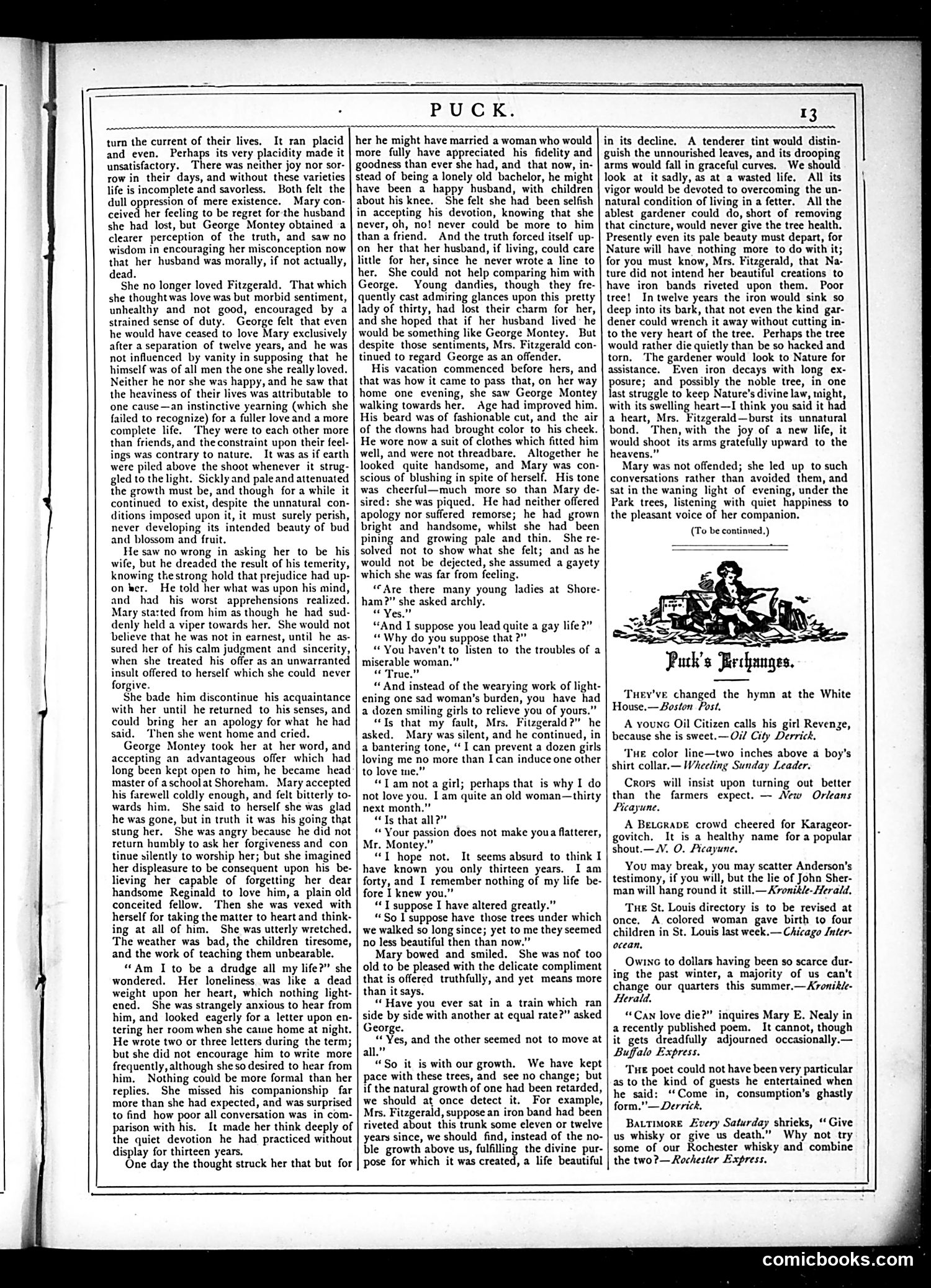
This page is primarily **text-based content**, not political cartoons. It contains a serialized story about a woman named Mary Fitzgerald and her troubled marriage to George Montey, exploring themes of loneliness, fidelity, and domestic disappointment. The small illustrated section titled **"Puck's Briefings"** contains brief satirical quips about contemporary topics—including references to hymn changes at the White House, a citizen complaining about his girl, and jokes about Serbian crowds and St. Louis directories. The **political/social satire is minimal** on this page. Rather than cartooning, Puck here uses short witty commentary and a serialized narrative to entertain readers about middle-class relationship anxieties—typical of the magazine's mixed content approach combining visual and written humor.
📄 Transcribed text from this page (OCR, searchable)
Machine-transcribed from the original scan — historical spelling and the odd misread are preserved.
turn the current of their lives, It ran placid and even. Perhaps its very placidity made it unsatisfactory. ‘There was neither joy nor sor- row in their days, and without these varieties life is incomplete and savorless. Both felt the dull oppression of mere existence. Mary con- Sided Wer feeling to be regret for the husband she had lost, but George Montey obtained a clearer perception of the truth, and saw no wisdom in encouraging her misconception now that her husband was morally, if not actually, dead. She no longer loved Fitzgerald. That which she thought was love was but morbid sentiment, unhealthy and not good, encouraged by a strained sense of duty. George felt that even he would have ceased to love Mary exclusively after a separation of twelve years, and he was not influenced by vanity in supposing that he himself was of all men the one she really loved. Neither he nor she was happy, and he saw that the heaviness of their lives was attributable to one cause —an instinctive yearning (which she failed to recognize) for a fuller love and a more complete life. ‘They were to each other more than friends, and the constraint upon their feel- ings was contrary to nature. It was as if earth were piled above the shoot whenever it strug- gled to the light. Sickly and pale and attenuated the growth must be, and though for a while it continued to exist, despite the unnatural con- ditions imposed upon it, it must surely perish, never developing its intended beauty of bud and blossom and fruit. He saw no wrong in asking her to be his wife, but he dreaded the result of his temerity, knowing the strong hold that prejudice had up- on ker. He told her what was upon his mind, and had his worst apprehensions realized. Mary stazted from him as though he had sud- denly held a viper towards her. She would not believe that he was not in earnest, until he as- sured her of his calm judgment and sincerity, when she treated his offer as an unwarranted insult offered to herself which she could never forgive. She bade him discontinue his acquaintance with her until he returned to his senses, and could bring her an apology for what he had said. ‘Then she went home and cried. George Montey took her at her word, and accepting an advantageous offer which had long been kept open to him, he became head master of aschoolat Shoreham. Mary accepted his farewell coldly enough, and felt bitterly to- wards him. She said to herself she was glad he was gone, but in truth it was his going that stung her. She was angry because he did not return humbly to ask her forgiveness and con tinue silently to worship her; but she imagined her displeasure to be consequent upon his be- lieving her capable of forgetting her dear handsome Reginald to love him, a plain old conceited fellow. Then she was vexed with herself for taking the matter to heart and think- ing at all of him, She was utterly wretched. The weather was bad, the children tiresome, and the work of teaching them unbearable. “Am I to be a drudge all my life?” she wondered. Her loneliness was like a dead weight upon her heart, which nothing light- ened. She was strangely anxious to hear from him, and looked eagerly for a letter upon en- tering her room when she came home at night. He wrote two or three letters during the term; but she did not encourage him to write more frequently, although she so desired to hear from him. Nothing could be more formal than her replies. She missed his companionship far more than she had expected, and was surprised to find how poor all conversation was in com- parison with his. {ft made her think deeply of the quiet devotion he had practiced without display for thirteen years. 13 her he might have married a woman who would more fully have appreciated his fidelity and goodness than ever she had, and that now, in- stead of being a lonely old bachelor, he might have been a happy husband, with children about his knee. She felt she had been selfish in accepting his devotion, knowing that she never, oh, no! never could be more to him than a friend. And the truth forced itself up- on her that her husband, if living, could care little for her, since he never wrote a line to her. She could not help comparing him with George. Young dandies, though they fre- quently cast admiring glances upon this pretty lady of thirty, had lost their charm for her, and she hoped that if her husband lived he would be something like George Montey. But despite those sentiments, Mrs. Fitzgerald con- tinued to regard George as an offender. His vacation commenced before hers, and that was how it came to pass that, on her way home one evening, she saw George Montey walking towards her. Age had improved him. His beard was of fashionable cut, and the air of the downs had brought color to his cheek. He wore now a suit of clothes which fitted him well, and were not threadbare. Altogether he looked quite handsome, and Mary was con- scious of blushing in spite of herself. His tone was cheerful—much more so than Mary de- sired: she was piqued. He had neither offered apology nor suffered remorse; he had yrown bright and handsome, whilst she had been pining and growing pale and thin, She re- solved not to show what she felt; and as he would not be dejected, she assumed a gayety which she was far from feeling. “Are there many young ladies at Shore- ham?” she asked archly. Yes," “And I suppose you lead quite a gay life?” “Why do you suppose that ?” “ You haven't to listen to the troubles of a miserable woman.” “True.” “ And instead of the wearying work of light- ening one sad woman's burden, you have had a dozen smiling girls to relieve you of yours.” “Ts that my fault, Mrs. Fitzgerald?” he asked. Mary was silent, and he continued, in a bantering tone, ‘I can prevent a dozen girls loving me no more than I can induce one other to love me.” “Tam not a girl; perhaps that is why I do not love you. I am quite an old woman—thirty next month.” “Ts that all?” “ Your passion does not make youa flatterer, Mr. Montey.”” “T hope not. It seems absurd to think I have known you only thirteen years. I am forty, and I remember nothing of my life be- fore I knew you.” “T suppose I have altered greatly.” So I suppose have those trees under which we walked so long since; yet to me they seemed no less beautiful then than now.” Mary bowed and smiled. She was nof too old to be pleased with the delicate compliment that is offered truthfully, and yet means more than it says. “Have you ever sat in a train which ran side by side with another at equal rate?” asked George. “Yes, and the other seemed not to move at all.” “So it is with our growth. We have kept pace with these trees, and see no change; but if the natural growth of one had been retarded, we should at once detect it. For example, Mrs. Fitzgerald, suppose an iron band had been riveted about this trunk some eleven or twelve years since, we should find, instead of the no- ble growth above us, fulfilling the divine pur- in its decline, A tenderer tint would distin- guish the unnourished leaves, and its crosping: arms would fall in graceful curves. We shoul look at it sadly, as at a wasted life. All its vigor would be devoted to overcoming the un- natural condition of living in a fetter. All the ablest gardener could do, short of removing that cincture, would never give the tree health, Presently even its pale beauty must depart, for Nature will have nothing more to do with it; for you must know, Mrs. Fitzgerald, that Na- ture did not intend her beautiful creations to have iron bands riveted upon them. Poor tree! In twelve years the iron would sink so deep into its bark, that not even the kind gar- dener could wrench it away without cutting in- to the very heart of the tree. Perhaps the tree would rather die quietly than be so hacked and torn, The gardener would look to Nature for assistance. Even iron decays with long ex- posure; and possibly the noble tree, in one last struggle to keep Nature's divine law, might, with its swelling heart—I think you said it had a heart, Mrs. Fitzgerald—burst its unnatural bond. Then, with the joy of a new life, it would shoot its arms gratefully upward to the heavens.” Mary was not offended; she led up to such conversations rather than avoided them, and sat in the waning light of evening, under the Park trees, listening with quiet happiness to the pleasant voice of her companion. (To be continned,) Tuey've changed the hymn at the White House.—Boston Post, A youn Oil Citizen calls his girl Revenge, because she is sweet.—Oil City Derrick. Tue color line—two inches above a boy's shirt collar.— Wheeling Sunday Leader. Crops will insist upon turning out better than the farmers expect. — Mew Orleans Picayune, A Betcrape crowd cheered for Karageor- govitch, It is a healthy name for a popular shout.—WV. O. Picayune, You may break, you may scatter Anderson's testimony, if you will, but the lie of John Sher- man will hang round it still.—Avonikle-Herald. Tue St. Louis directory is to be revised at once. A colored woman gave birth to four children in St. Louis last week.— Chicago Inter- ocean, Owine to dollars having been so scarce dur- ing the past winter, a majority of us can't change our quarters this summer.—Kronikie- Herald. “Can love die?” inquires Mary E. Nealy in arecently published poem. It cannot, though it gets dreadfully adjourned occasionally.— Buffalo Express. ‘Tue poet could not have been very particular as to the kind of guests he entertained when he said: ‘Come in, consumption’s ghastly form.” —Derrick, Battimore Every Saturday shrieks, ‘Give us whisky or give us death.” Why not try some of our Rochester whisky and combine One day the thought struck her that but for pose for which it was created, a life beautiful the two?— Rochester Express. eee OOS SSeS comicbooks.com