
A complete issue · 16 pages · 1878
Puck — May 1, 1878
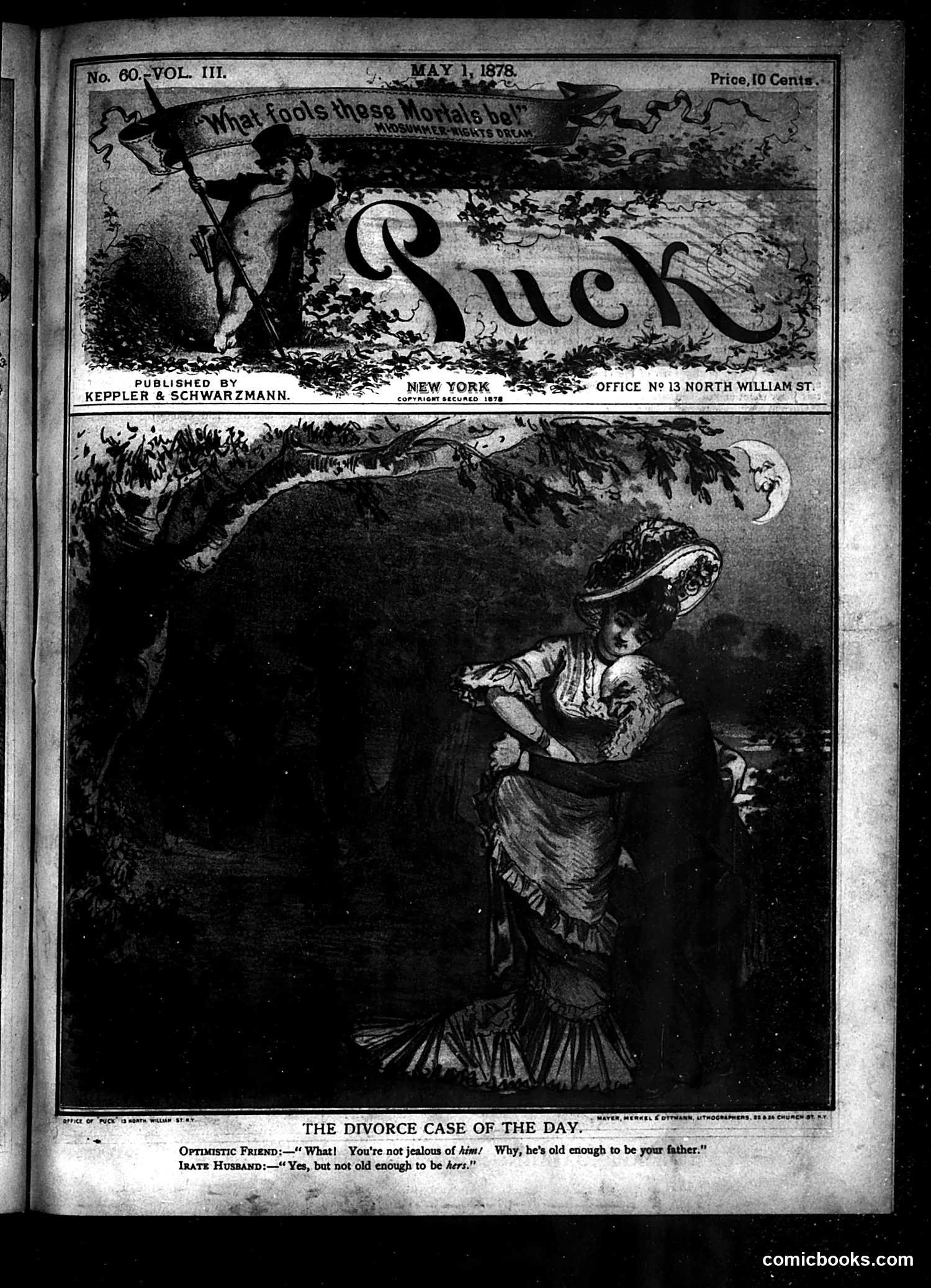
This page satirizes divorce proceedings of the era through "The Divorce Case of the Day." The main illustration depicts a nighttime scene with a woman in elaborate dress confronting a man, while a child observes. The caption presents dialogue between an "Optimistic Friend" and an "Irate Husband"—the friend suggests the husband isn't old enough to be the child's father, implying infidelity as grounds for divorce. The satire mocks both marital infidelity and the social scandal surrounding divorce in Victorian America. The theatrical staging and dramatic moonlit setting parody sensational newspaper coverage of high-profile divorce cases that captivated public attention. The humor targets the husband's predicament and society's fascination with marital dissolution during this period.
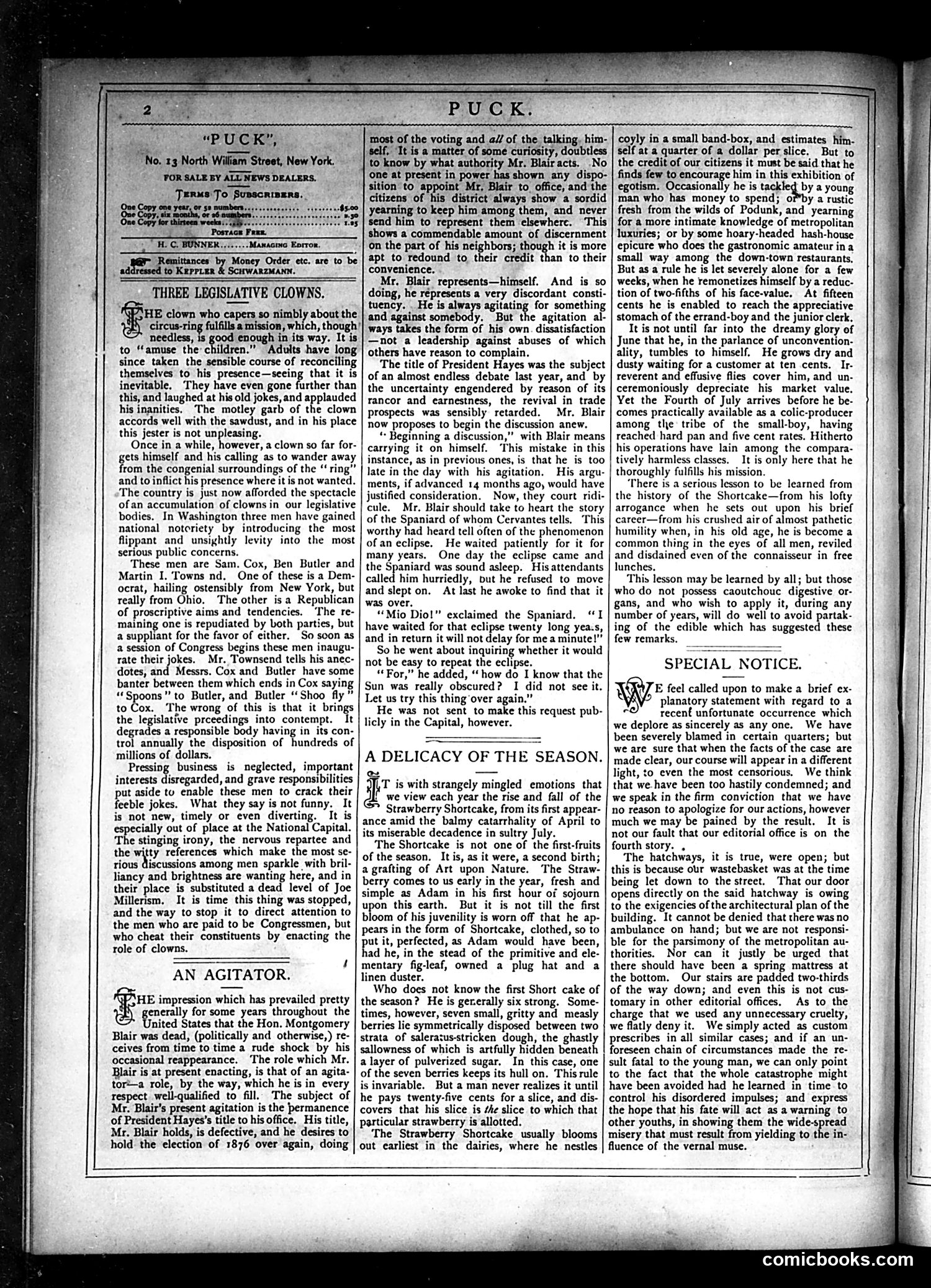
This page contains three distinct articles critiquing American political figures and social behavior: **"Three Legislative Clowns"** attacks three congressmen (Sam Cox, Uen Butler, and Martin F. Tupper) for their "flippant and unseemly levity" during serious legislative sessions. The piece argues their disruptive behavior degrades congressional proceedings and damages public respect for government. **"An Agitator"** appears to criticize Mr. Blair's political agitation regarding President Hayes's administration, suggesting Blair is self-serving and creating unnecessary controversy rather than genuinely addressing systemic abuses. The remaining articles discuss seasonal food topics (strawberries, shortcake) and respond to criticism about previous editorial stances. Overall, the page emphasizes Puck's role as a satirical watchdog holding politicians accountable for conduct unbecoming their office.
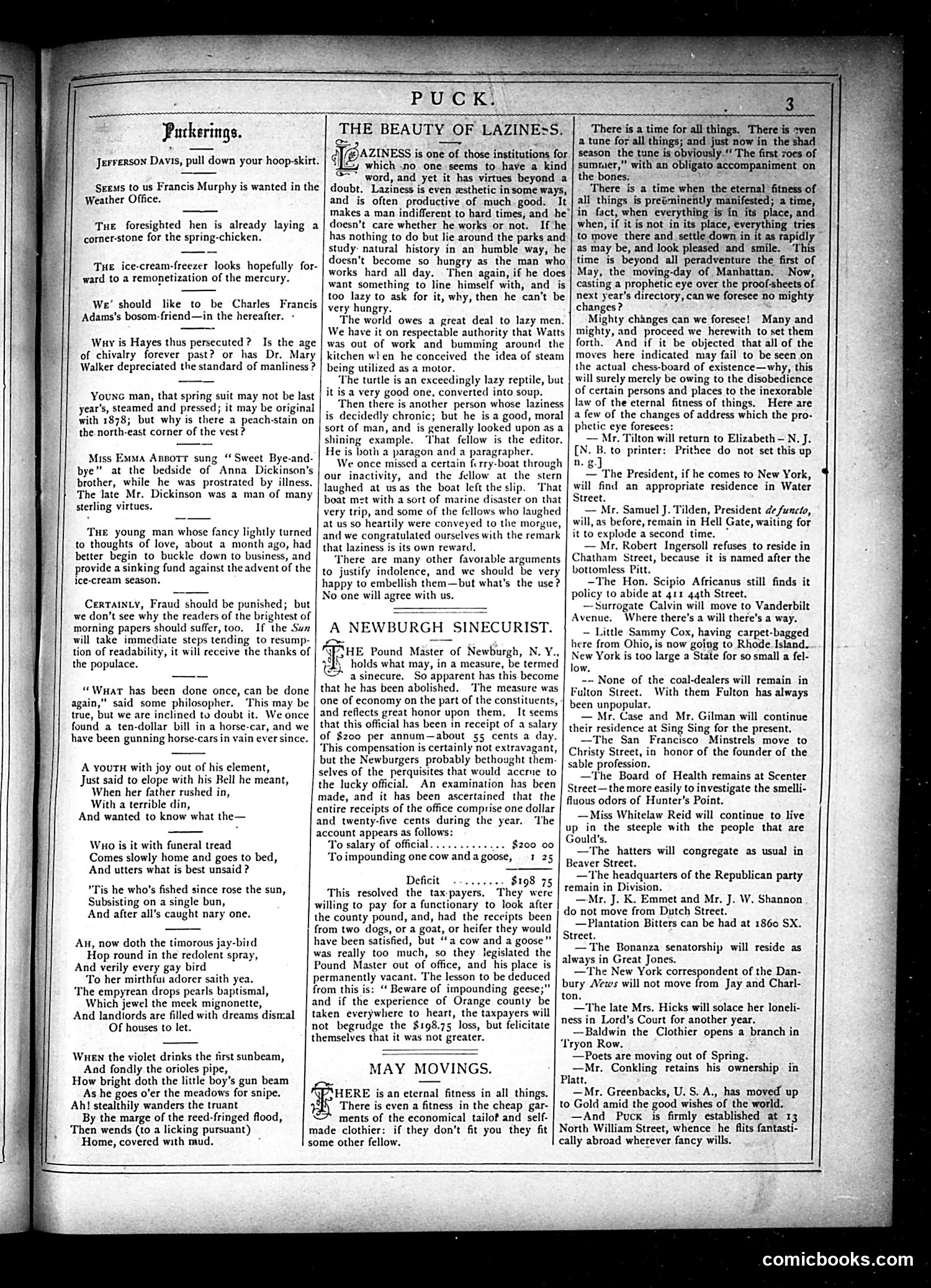
This page contains primarily **humor items and social commentary** rather than illustrated cartoons. The content includes: **"Puckerings"** - Short satirical jabs at contemporary figures and issues, including Jefferson Davis (likely the Confederate leader), Francis Murphy (appears to be a public figure), and references to laziness and social manners. **"The Beauty of Laziness"** - A philosophical piece defending idleness and questioning the Protestant work ethic, suggesting lazy men possess respectable authority. **"A Newburgh Sinecurist"** - Satire on government inefficiency, mocking a Pound Master whose position exists merely to justify a salary while performing minimal work—a critique of bureaucratic waste. **"May Movings"** - Brief notes on relocations and social changes. The page exemplifies Puck's approach: witty written satire targeting American social pretensions, government corruption, and labor attitudes rather than visual caricature.
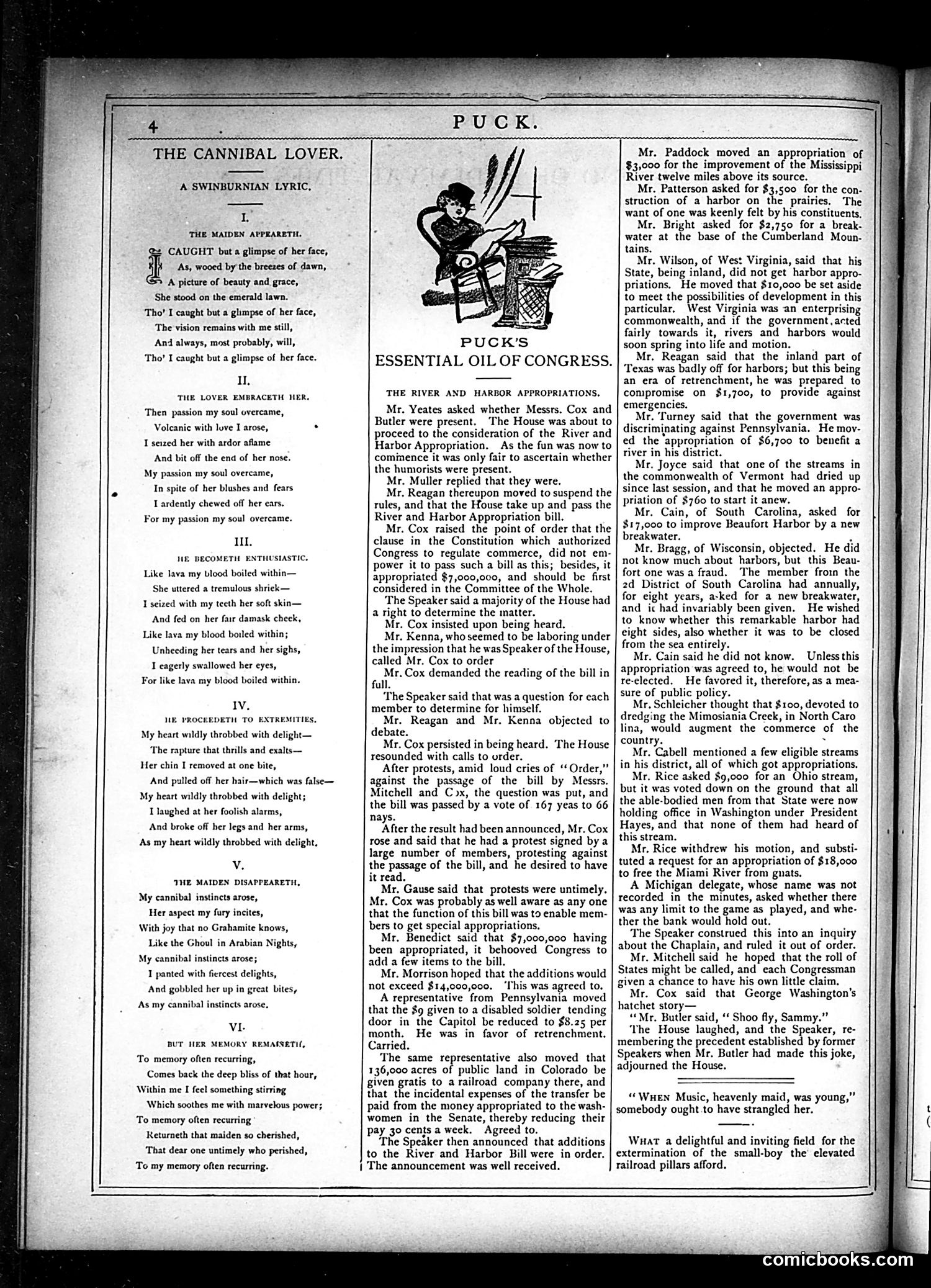
This page combines a poem titled "The Cannibal Lover" (left) with political satire (right). The cartoon depicts Congress as a cannibal consuming itself—represented by a grotesque figure gnawing on a chair leg labeled "PUCK'S ESSENTIAL OIL OF CONGRESS." The accompanying text discusses congressional debates over River and Harbor appropriations bills. Representatives argue about funding for various regional improvements (Mississippi navigation, harbors, breakwaters). The satire suggests Congress engages in wasteful "pork barrel" spending and self-interested regional advocacy—essentially devouring public resources. The "cannibal" metaphor critiques how legislators prioritize narrow local interests over national welfare, consuming taxpayer money for marginal improvements benefiting specific districts. This remains recognizable modern political satire about congressional inefficiency and regional favoritism.
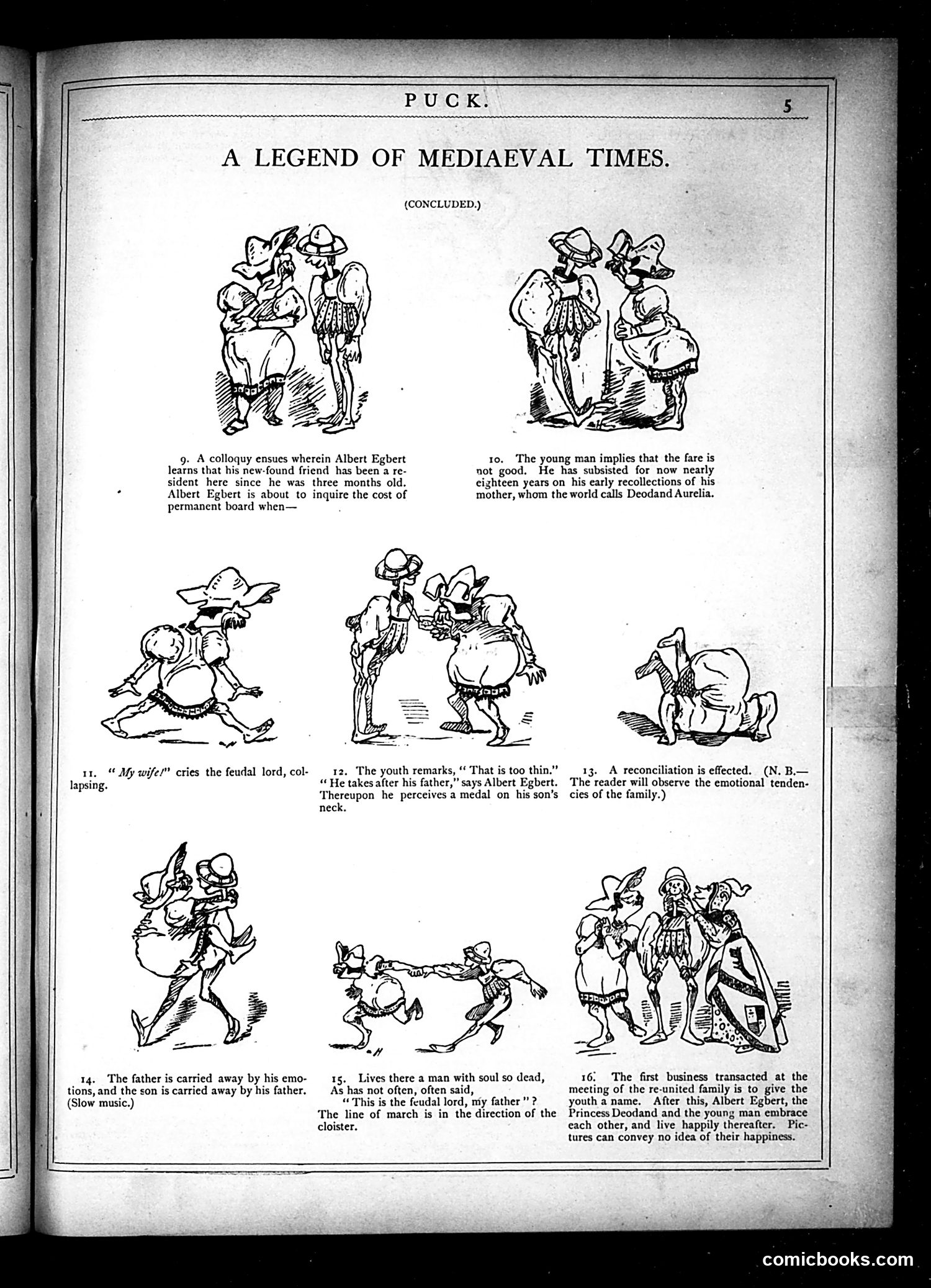
This is a humorous serialized story told through sequential illustrations, not political satire. The narrative follows Albert Egbert, a young man seeking his fortune in medieval times. The sequence depicts: a colloquy about his residency (panel 9), complaints about poor food (10), a confrontation with his father (12), emotional family drama (14), and ultimately reconciliation with the help of a feudal lord and princess (16). The satire appears gentle rather than political—mocking pretentious medieval romance conventions and the overwrought emotional displays of period narratives. The crude drawings and exaggerated poses parody the melodrama typical of medieval legends, offering comedic relief through absurdist family dysfunction portrayed in pseudo-historical dress.
This page contains a ballad poem by R. K. Munkittrick titled "A Ballad" (featuring "Marguerite with the violet eyes"), followed by an interview-format article titled "How to Restore the Navy: Interview with Secretary Thompson." The interview is satirical commentary on naval readiness. An elderly sea dog named Putty advocates for restoring America's navy through practical measures. Secretary Thompson responds to questions about naval administration, bureaucracy, and ship maintenance. The satire appears to target inefficiency in naval bureaucratic systems—multiple bureaus (Equipment, Yards, Construction, Engineering) with overlapping authority that hinder rather than help naval operations. The piece likely reflects Progressive Era concerns about governmental waste and the need for naval modernization during this period of American imperial expansion.
This page contains **three distinct text articles**, not political cartoons. The main pieces are: 1. **"The Polonius Family"** — A literary analysis examining characters from *Hamlet*, debating whether Polonius was alive or dead and discussing family dynamics. 2. **"A Romance of Despair"** — A short fictional narrative about a woman at Niagara Falls contemplating suicide after romantic rejection. 3. **"Answers for the Anxious"** — An advice column addressing reader questions on various topics. **No political cartoons appear on this page.** The content is primarily satirical fiction and humor writing typical of Puck's literary material, rather than visual satire or caricature. The page demonstrates the magazine's format of mixing literary commentary with humorous advice columns.
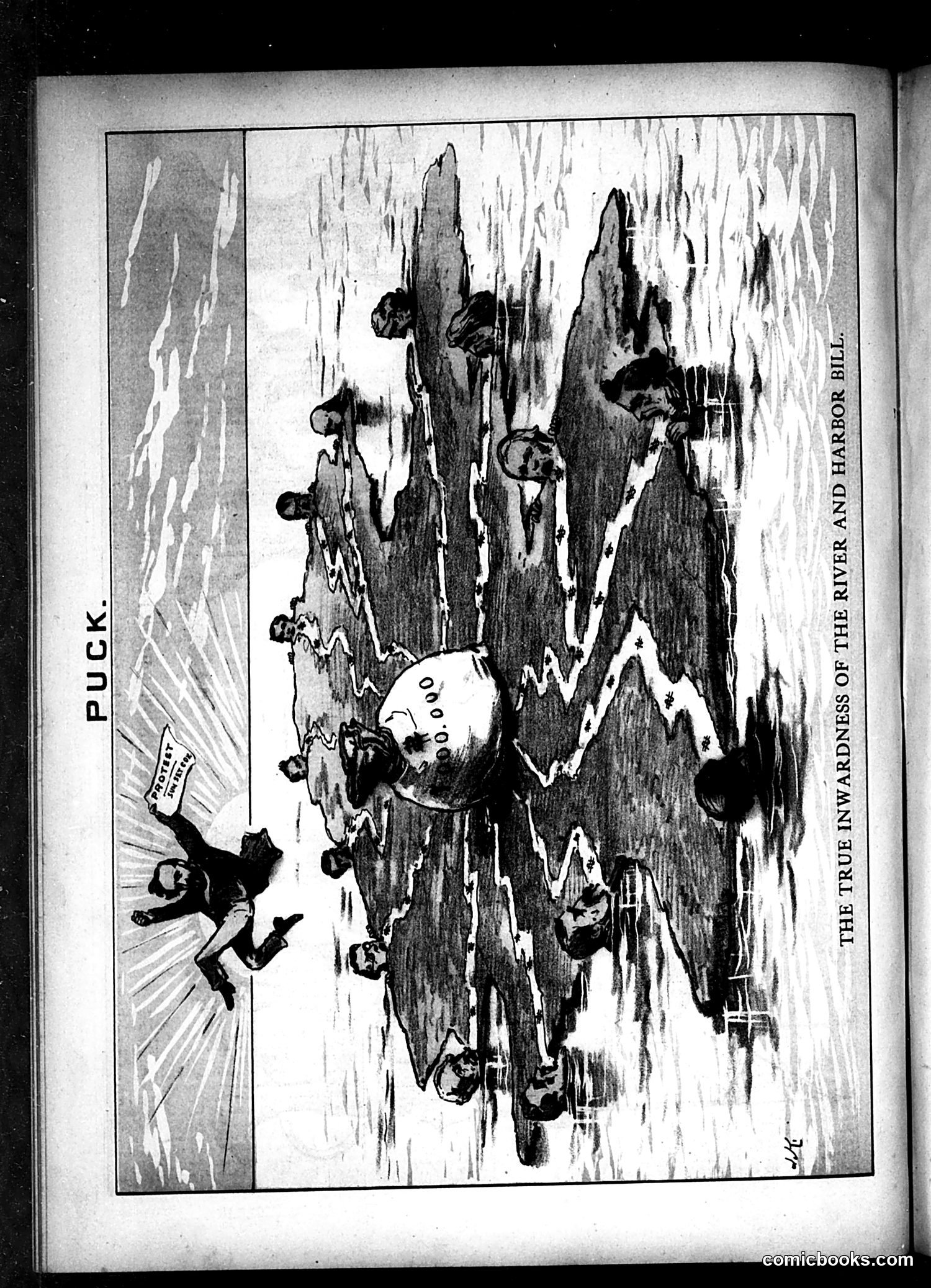
This political cartoon satirizes the "Puck" magazine's critique of a Rivers and Harbors Bill. The image shows a figure labeled "PUCK" (left side) observing what appears to be corrupt politicians or special interests literally fighting over or dividing up resources represented by a large circular object (possibly money or appropriations). The cartoon's title suggests the bill's "true inwardness"—its hidden reality beneath public justification. Rather than genuine infrastructure improvement, the satire depicts politicians squabbling over funds for self-interested projects. The chaotic scene with multiple figures grasping and competing illustrates Puck's argument that such bills were vehicles for pork-barrel spending and political favoritism rather than legitimate public works.
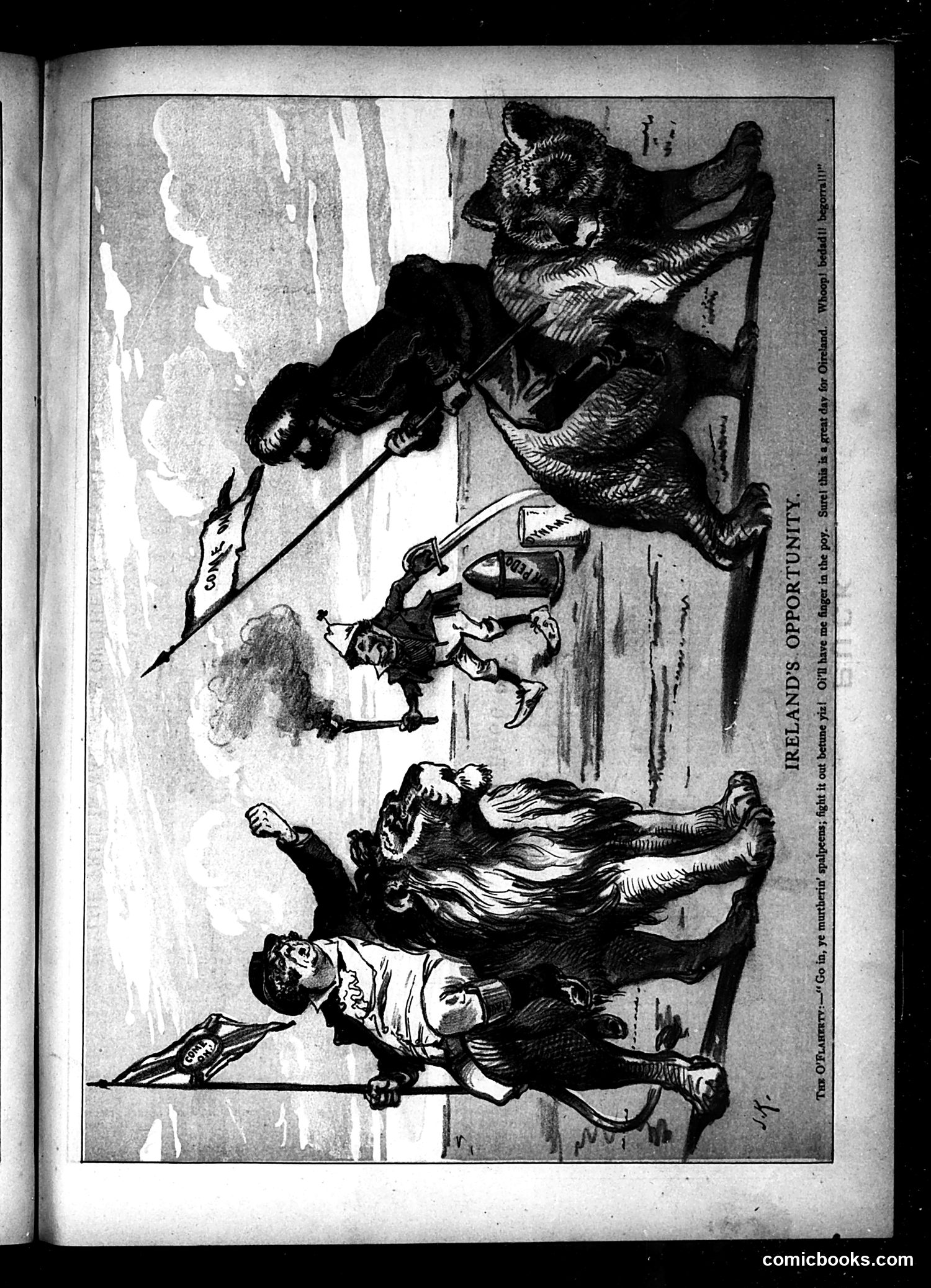
This cartoon depicts the Irish Question—a major 19th-century political issue. The image shows: **Upper figure**: A large bear (likely representing Russia or a foreign power) menacing Ireland **Lower figures**: Irish characters, one appearing to be a soldier or political figure, confronting or defending against this threat **The satire**: The title "Ireland's Opportunity" suggests that Ireland's political struggles or independence movements might be leveraged by or aligned with foreign powers seen as threats to Britain. This reflects contemporary anxieties about Irish nationalism potentially destabilizing the British Empire through alliances with rival powers. The cartoon satirizes both Irish independence ambitions and British fears of foreign intervention in Irish affairs—a recurring theme in Puck's American perspective on Anglo-Irish tensions during this period.
This page contains two sections: "What He Knew About Farming" (a humorous essay) and "Dramatic Notes" (theater reviews and announcements). The farming essay satirizes urban ignorance of agricultural practices. A city dweller describes his comical attempts at farming—misunderstanding basic concepts like crop growth rates, vegetable development, and animal husbandry. The humor targets upper-class inexperience; he mentions "rich city people" wasting money on unsuccessful rural ventures, suggesting Puck's audience would find city folk's agricultural naiveté amusing. "Dramatic Notes" reviews contemporary theater, mentioning specific plays and performers. It references productions at venues like Wallack's Theatre and the Park Theatre, providing entertainment commentary for readers. The page primarily serves as humor and cultural commentary rather than political satire.
This page presents "The Late Lamented," a comedy-story adapted from French playwright O. Feuillet by H.C. Bunner. The text is a theatrical dialogue featuring characters including Champlleury, Julie, Frontin, and Lisette discussing a nobleman's return from Algeria. The satire appears to mock French aristocratic pretensions and romantic entanglements. References to "the Spanish Court" and detailed descriptions of elaborate courtly ceremonies suggest ridicule of European nobility's affected manners. Frontin's cynical observations about domination and the contrast between noble posturing and crude reality underscore the comedy. The piece satirizes the gap between aristocratic self-image and actual behavior—particularly regarding honor, romantic relationships, and social hierarchy. The dialogue format allows characters to expose each other's vanities and hypocrisies through witty exchanges typical of Puck's satirical approach.
This page from *Puck* contains dialogue from "The Marine Binocular," a serialized story by Richard Dowling. The visible portion shows characters discussing a murder mystery—specifically, how an old man's body was concealed and money hidden in a room with loose floorboards and gaps between floor and ceiling. The text reveals plot details about detectives investigating the crime, with characters debating the murderer's identity and methods. One character (Bracken) proposes examining the room more thoroughly and disguising himself to infiltrate the victim's circle. **This is literary fiction, not political satire.** No political figures or social commentary appears on this page. It's a straightforward mystery narrative presented as serialized entertainment in *Puck's* pages.
This page contains primarily **text content rather than political cartoons**. The left column continues a narrative story about a detective investigating a counterfeiting operation, featuring descriptions of pursuing suspects through a mansion and discovering evidence of counterfeit currency. The right column, titled "**Puck's Burlesque**," contains brief satirical items mocking contemporary topics and figures: - Theater reviews and entertainment gossip - Jabs at Plymouth Church and Singer Adelaide Phillips - Commentary on Colonel Delancey Kane as a hackman - References to General Grant, William Pattterson, Edison, and other public figures of the era These items use wordplay and ironic commentary typical of Puck's satirical style, though without accompanying illustrations on this particular page. The content targets both high society and popular culture figures.
This page is primarily **advertising and miscellaneous content** rather than political satire. The dominant features are: 1. **Large advertisements** for Apollinaris Natural Mineral Water and Hunyadi János (a natural aperient/laxative), featuring endorsements from European professors and doctors 2. **Frederick de Bary & Co.** pharmaceutical advertisement 3. **Otto Stiehl's Glass Letter Co.** advertisement with decorative border artwork 4. **Left column text** containing brief satirical items about various topics (billiards, postage stamps, church singing, etc.), typical of Puck's "miscellaneous humor" sections The right-side **cartoon illustration** appears decorative but its specific satirical meaning is unclear without clearer detail. The page functions as a revenue-generating mix of ads and filler humor rather than focused political commentary.
This page is primarily **advertising and announcements** rather than political cartoons. The main content includes: - **Puck's Pictorial Department announcement**: The magazine announces opening a general designing office with cartoonist Joseph Keppler employed to create illustrations and lithographic portraits for theatrical productions and other clients. - **Various advertisements**: For businesses including Friedrichshall Bitterwater, gentlemen's hats, printing inks, a tailor, watches/jewelry, champagne, and other goods typical of 1870s New York commerce. - **Back matter notices**: Information about obtaining Puck's Almanac for 1878 and patent filing covers. The page demonstrates how 19th-century satirical magazines generated revenue through extensive advertising while promoting their own artistic services and products.
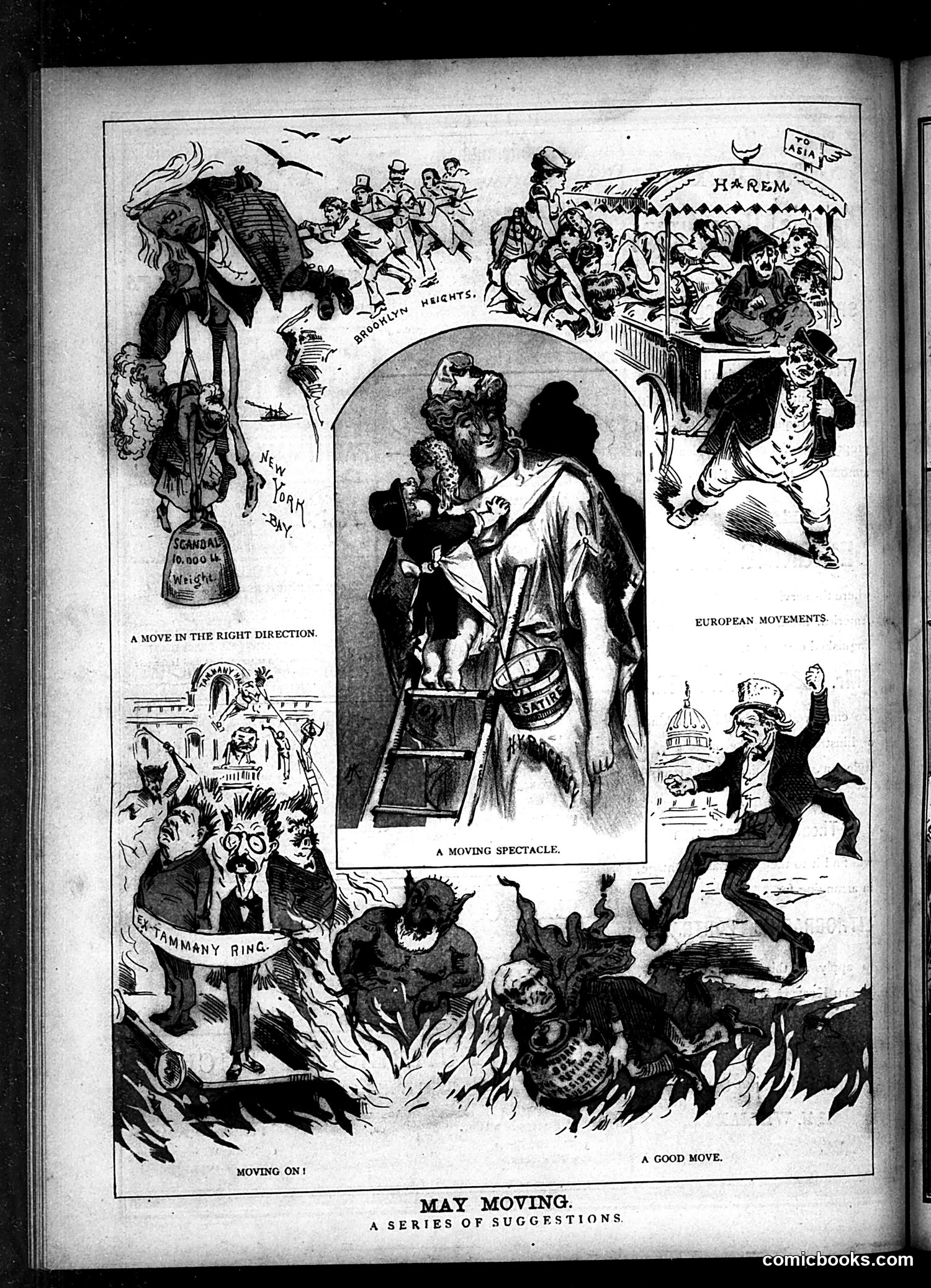
This Puck satirical page mocks the chaos of May 1st moving day in New York City—historically when many tenants relocated. The central image shows a woman frantically managing children and belongings while eviction looms. Surrounding vignettes ridicule various moving-day disasters: "A Move in the Right Direction" shows an elephant carrying chaos; "European Movements" depicts the harem and other spectacles; "A Tammany Ring" references Tammany Hall political corruption; and "A Good Move" shows devils celebrating chaos. The satire targets both the bedlam of mass relocation and, likely, Tammany Hall's role in New York's housing/tenant disputes. The cartoon suggests moving day creates mayhem while political machines exploit it, presenting "moving" as both literal displacement and political maneuvering.