
Puck, 1878-05-01 · page 6 of 16
Puck — May 1, 1878 — page 6: what you’re looking at
What you’re looking at
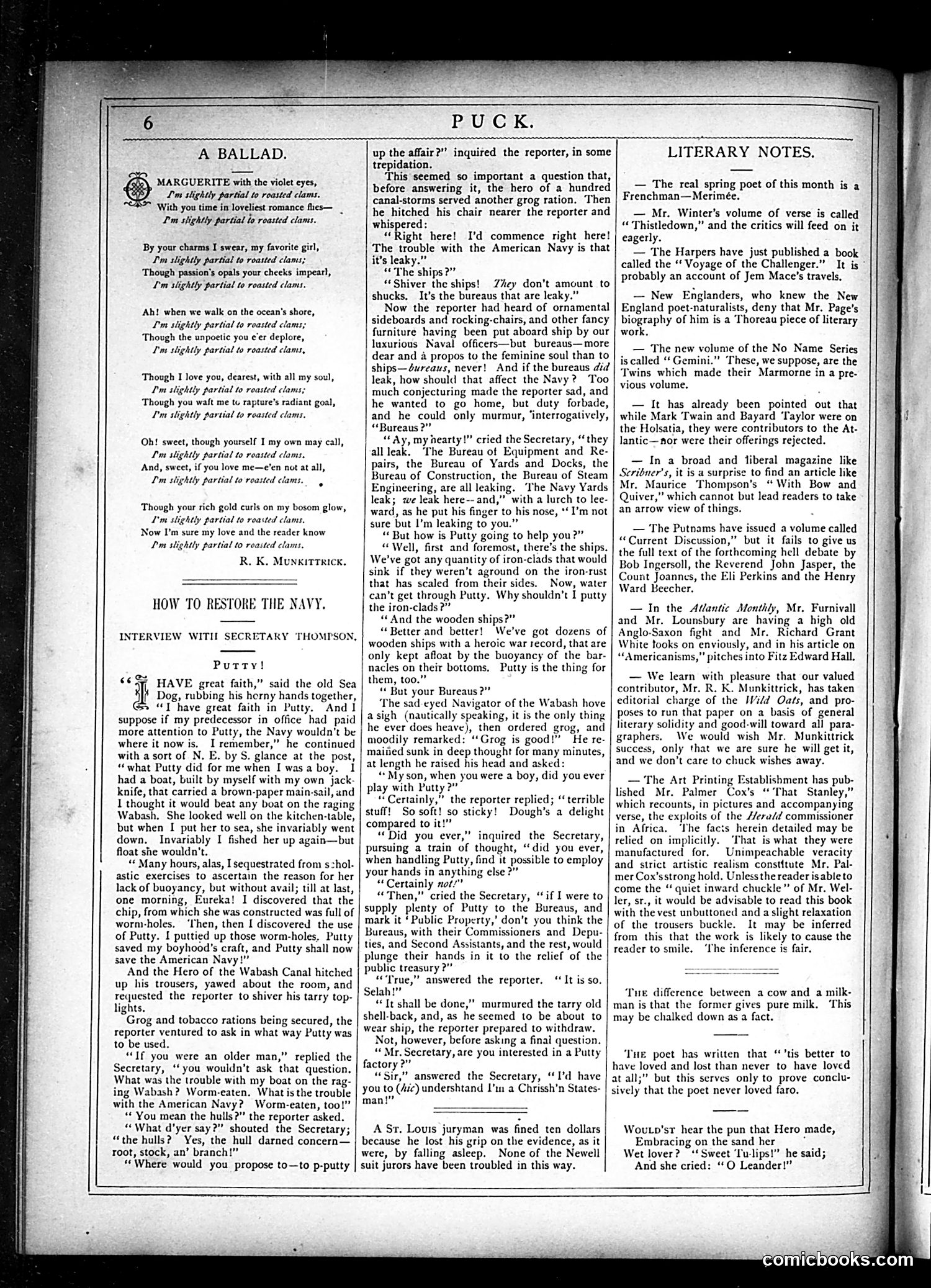
This page contains a ballad poem by R. K. Munkittrick titled "A Ballad" (featuring "Marguerite with the violet eyes"), followed by an interview-format article titled "How to Restore the Navy: Interview with Secretary Thompson." The interview is satirical commentary on naval readiness. An elderly sea dog named Putty advocates for restoring America's navy through practical measures. Secretary Thompson responds to questions about naval administration, bureaucracy, and ship maintenance. The satire appears to target inefficiency in naval bureaucratic systems—multiple bureaus (Equipment, Yards, Construction, Engineering) with overlapping authority that hinder rather than help naval operations. The piece likely reflects Progressive Era concerns about governmental waste and the need for naval modernization during this period of American imperial expansion.
📄 Transcribed text from this page (OCR, searchable)
Machine-transcribed from the original scan — historical spelling and the odd misread are preserved.
PUCK. A BALLAD. MARGUERITE with the violet eyes, Lm slightly partial to roasted clams. With you time in loveliest romance fies— Pm slightly partial fo roasted clams. © By your charms I swear, my favorite girl, Pm slightly partial to roasted clams; ‘Though passion’s opals your cheeks impearl, L'm slightly partial to roasted clams. Ah! when we walk on the ocean's shore, Lm slightly partial to roasted clams; ‘Though the unpoetic you e’er deplore, I'm slightly partial to roasted clams, Though I love you, dearest, with all my soul, Pm slightly partial to roasted clams; Though you waft me to rapture’s radiant goal, L'm slightly partial to reasted clams, Oh! sweet, though yourself I my own may call, Lm slightly partial to roasted clams, And, sweet, if you love me—e'en not at all, Pm slightly partial to reasted clams. ‘Though your rich gold curls on my bosom glow, I'm slightly partial t0 reasted clams. Now I’m sure my love and the reader know Pm slightly partial to roasted clams. R. K. Munkittrick. HOW TO RESTORE THE NAVY. INTERVIEW WITH SECRETARY THOMPSON, Purty! HAVE great faith,” said the old Sea Dog, rubbing his horny hands together, “T have great faith in Putty. And 1 “ce iI a suppose if my predecessor in office had paid more attention to Putty, the Navy wouldn't be where it now is. I remember,” he continued with a sort of N. E. by S. glance at the post, ‘what Putty did for me when I wasa boy. I had a boat, built by myself with my own jack. knife, that carried a brown-paper main-sail, and I thought it would beat any boat on the raging Wabash, She looked well on the kitchen-table, but when I put her to sea, she invariably went down. Invariably I fished her up again—but float she wouldn't. “ Many hours, alas, I sequestrated from s:hol- astic exercises to ascertain the reason for her lack of buoyancy, but without avail; till at last, one morning, Eureka! I discovered that the chip, from which she was constructed was full of worm-holes. ‘hen, then I discovered the use of Putty. I puttied up those worm-holes, Putty saved my boyhood’ craft, and Putty shall now save the American Navy!” And the Hero of the Wabash Canal hitched up his trousers, yawed about the room, and requested the reporter to shiver his tarry top- lights. ‘Grog and tobacco rations being secured, the reporter ventured to ask in what way Putty was to be used. “If you were an older man,” replied the Secretary, ‘‘ you wouldn't ask that question. What was the trouble with my boat on the rag- ing Wabash? Worm-eaten. What isthe trouble with the American Navy? Worm-eaten, too!” “You mean the hulls?” the reporter asked. “What d'yer say?” shouted the Secretary; “the hulls? Yes, the hull darned concern— root, stock, an’ branch!” “Where would you propose to—to p-putty up the affair?” inquired the reporter, in some trepidation. This seemed so important a question that, before answering it, the hero of a hundred canal-storms served another grog ration. Then he hitched his chair nearer the reporter and whispered: “Right here! I'd commence right here! The trouble with the American Navy is that it’s leaky.” “The ships?” ‘Shiver the ships! Z%ey don't amount to shucks. It’s the bureaus that are leaky.” Now the reporter had heard of ornamental sideboards and rocking-chairs, and other fancy furniture having been put aboard ship by our luxurious Naval officers—but bureaus—more dear and a propos to the feminine soul than to ships—éureaus, never! And if the bureaus did leak, how should that affect the Navy? Too much conjecturing made the reporter sad, and he wanted to go home, but duty forbade, and he could only murmur, ‘interrogatively, “Bureaus ?”” “ Ay, my hearty!” cried the Secretary, “they all leak. ‘The Bureau of Equipment and Re- pairs, the Bureau of Yards and Docks, the Bureau of Construction, the Bureau of Steam Engineering, are all leaking. ‘he Navy Yards leak; we leak here-- and,” with a lurch to lee- ward, as he put his finger to his nose, “I’m not sure but I'm leaking to you.” “ But how is Putty going to help you?” “Well, first and foremost, there’s the ships. We've got any quantity of iron-clads that would sink if they weren't aground on the iron-rust that has scaled from their sides. Now, water can’t get through Putty. Why shouldn’t I putty the iron-clads ?” “And the wooden ships?” “ Better and better! We've got dozens of wooden ships with a heroic war record, that are only kept afloat by the buoyancy of the bar- | nacles on their bottoms. Putty is the thing for them, too.” “ But your Bureaus ?” ‘The sad-eyed Navigator of the Wabash hove asigh (nautically speaking, it is the only thing he ever does heave), then ordered grog, and moodily remarked: “Grog is good!” He re- maiied sunk in deep thought for many minutes, at length he raised his head and asked: “ Myson, when you were a boy, did you ever play with Putty?” “Certainly,” the reporter replied; ‘terrible stuff! So soft! so sticky! Dough’s a delight compared to it!” “Did you ever,” inquired the Secretary, pursuing a train of thought, “did you ever, when handling Putty, find it possible to employ your hands in anything else ?” “Certainly not?” “Then,” cried the Secretary, ‘if I were to supply plenty of Putty to the Bureaus, and mark it ‘Public Property,’ don’t you think the Bureaus, with their Commissioners and Depu- ties, and Second Assistants, and the rest, would plunge their hands in it to the relief of the public treasury ?” “True,” answered the reporter. Selah!” “It shall be done,” murmured the tarry old shell-back, and, as he seemed to be about to wear ship, the reporter prepared to withdraw, Not, however, before asking a final question. “Mr. Secretary, are you interested in a Putty factory?” “Sir,” answered the Secretary, “I’d have you to (Aic) undershtand I'm a Chrissh’n States- man!” “It is so. A Sr, Louis juryman was fined ten dollars because he lost his grip on the evidence, as it were, by falling asleep. None of the Newell suit jurors have been troubled in this way. LITERARY NOTES. — The real spring poet of this month is a Frenchman—Merimée. — Mr. Winter’s volume of verse is called “ Thistledown,” and the critics will feed on it eagerly. — The Harpers have just published a book called the “ Voyage of the Challenger.” It is probably an account of Jem Mace’s travels, — New Englanders, who knew the New England poet-naturalists, deny that Mr. Page's biography of him is a ‘Thoreau piece of literary work, — The new volume of the No Name Series is called “Gemini.” ‘These, we suppose, are the Twins which made their Marmorne in a pre- vious volume, — It has already been pointed out that while Mark Twain and Bayard ‘Taylor were on the Holsatia, they were contributors to the At- lantic—nor were their offerings rejected. — In a broad and tiberal magazine like Scribner's, it is a surprise to find an article like Mr. Maurice Thompson's “ With Bow and Quiver,” which cannot but lead readers to take an arrow view of things. — The Putnams have issued a volume called “Current Discussion,” but it fails to give us the full text of the forthcoming hell debate by Bob Ingersoll, the Reverend John Jasper, the Count Joannes, the Eli Perkins and the Henry Ward Beecher. — In the Adantic Monthly, Mr. Furnivall and Mr. Lounsbury are having a high old Anglo-Saxon fight and Mr. Richard Grant White tooks on enviously, and in his article on “Americanisms,” pitches into Fitz Edward Hall. — We learn with pleasure that our valued contributor, Mr. R. K. Munkittrick, has taken editorial charge of the Mild Oats, and pro- poses to run that paper on a basis of general literary solidity and good-will toward all para- graphers. We would wish Mr. Munkittrick success, only that we are sure he will get it, and we don’t care to chuck wishes away. — The Art Printing Establishment has pub- lished Mr. Palmer Cox’s ‘That Stanley,” which recounts, in pictures and accompanying verse, the exploits of the Hera/d commissioner in Afric ‘The facts herein detailed may be relied on implicitly, ‘That is what they were manufactured for. Unimpeachable veracity and strict artistic realism constitute Mr. Pal- mer Cox’sstrong hold. Unless the reader isableto come the “ quiet inward chuckle” of Mr. Wel- ler, sr., it would be advisable to read this book with the vest unbuttoned and a slight relaxation of the trousers buckle. It may be inferred from this that the work is likely to cause the reader to smile. ‘he inference is fair, ‘Tue difference between a cow and a milk- man is that the former gives pure milk. ‘This may be chalked down asa fact. ‘Tue poet has written that ‘’tis better to have loved and lost than never to have loved at all; but this serves only to prove conclu- sively that the poet never loved faro. Woutp'st hear the pun that Hero made, Embracing on the sand her Wet lover? ‘Sweet ‘T'u-lips!” he said; And she cried: ‘‘O Leander!”