
Puck, 1878-05-01 · page 11 of 16
Puck — May 1, 1878 — page 11: what you’re looking at
What you’re looking at
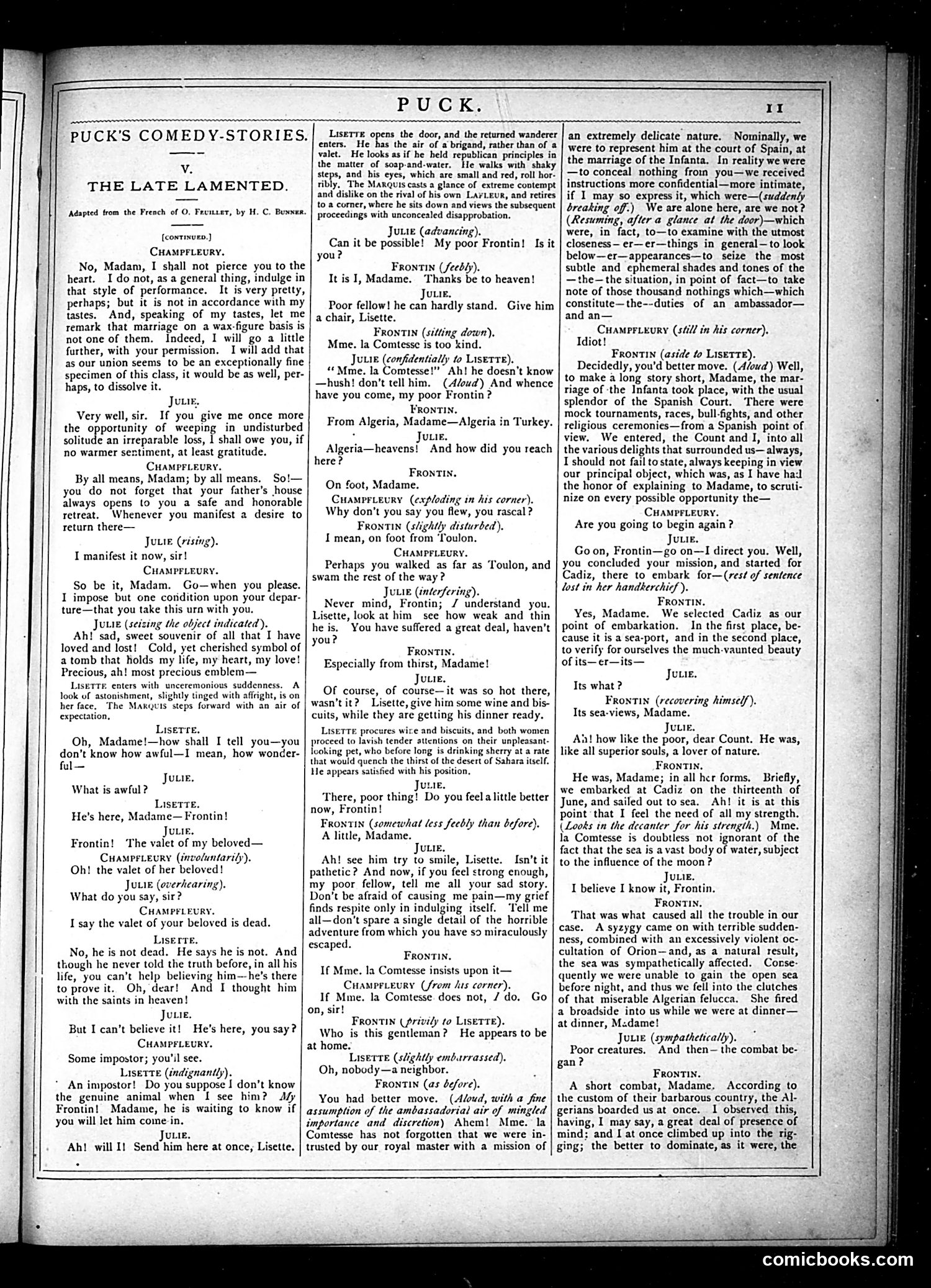
This page presents "The Late Lamented," a comedy-story adapted from French playwright O. Feuillet by H.C. Bunner. The text is a theatrical dialogue featuring characters including Champlleury, Julie, Frontin, and Lisette discussing a nobleman's return from Algeria. The satire appears to mock French aristocratic pretensions and romantic entanglements. References to "the Spanish Court" and detailed descriptions of elaborate courtly ceremonies suggest ridicule of European nobility's affected manners. Frontin's cynical observations about domination and the contrast between noble posturing and crude reality underscore the comedy. The piece satirizes the gap between aristocratic self-image and actual behavior—particularly regarding honor, romantic relationships, and social hierarchy. The dialogue format allows characters to expose each other's vanities and hypocrisies through witty exchanges typical of Puck's satirical approach.
📄 Transcribed text from this page (OCR, searchable)
Machine-transcribed from the original scan — historical spelling and the odd misread are preserved.
PUCK. iI PUCK’S COMEDY-STORIES. v. THE LATE LAMENTED. Adapted from the French of O, Fevuzer, by H. C, Buxwer. [contixven.) CHAMPFLEURY. No, Madam, I shall not pierce you to the heart. I do not, as a general thing, indulge in that style of performance. It is very pretty, perhaps; but it is not in accordance with my tastes. And, speaking of my tastes, let me remark that marriage on a wax-figure basis is not one of them. Indeed, I will go a little farther, with your permission. I will add that as our union seems to be an exceptionally fine specimen of this class, it would be as well, per- haps, to dissolve it. Juu Very well, sir. If you give me once more the opportunity of weeping in undisturbed solitude an irreparable loss, 1 shall owe you, if no warmer sextiment, at least gratitude. CHAMPFLEURY. By all means, Madam; by all means. So!— you do not forget that your father’s house always opens to you a safe and honorable retreat. Whenever you manifest a desire to return there— Juuie (rising). I manifest it now, sir! CHAMPFLEURY. So be it, Madam. Go—when you please. I impose but one condition upon your depar- ture—that you take this urn with you. Jurse (seizing the object indicated). Ah! sad, sweet souvenir of all that I have loved and lost! Cold, yet cherished symbol of atomb that holds my life, my heart, my love! Precious, ah! most precious emblem— LiseTTE, enters with unceremonious suddenness. A look of astonishment, slightly tinged with affright, is on her face, The Maxguis steps forward with an air of expectation, Lisetre. Oh, Madame!—how shall I tell you—you don’t know how awful—I mean, how wonder- ful— Juve. What is awful ? Lisette. He's here, Madame— Frontin! JuLie. Frontin! The valet of my beloved— Cuamprieury (involuntarily). Oh! the valet of her beloved! JuLie (overhearing). What do you say, sir? CHAMPFLEURY. I say the valet of your beloved is dead. Liserte. No, he is not dead. He says he is not. And though he never told the truth before, in all his life, you can’t help believing him—-he’s there to prove it. Oh, dear! And I thought him with the saints in heaven! Jui. But I can’t believe it! He's here, you say? CHAMPFLEURY, Some impostor; you'll see. Lisette (indignantly). An impostor! Do you suppose I don’t know the genuine animal when { see him? Afy Frontin! Madame, he is waiting to know if you will let him come-in. Juiie. Ah! will I! Send him here at once, Lisette. Liserre, opens the door, and the returned wanderer enters. He has the air of a brigand, rather than of a valet. He looks as if he held republican principles in the matter of soap-and-water, He walks with shaky steps, and his eyes, which are small and red, roll hor- ribly, The Marquis casts a glance of extreme contempt and dislike on the rival of his own LarLeur, and retires to a corner, where he sits down and views the subsequent proceedings with unconcealed disapprobation. Junie (advancing). Can it be possible! My poor Frontin! Is it you? Frontin (feeds). It is I, Madame. Thanks be to heaven! Juuie. Poor fellow! he can hardly stand. Give him a chair, Lisette. FRONTIN (silting down), Mme. la Comtesse is too kind. Jutie (confidentially to Lisette). “Mme. la Comtesse!” Ah! he doesn't know —hush! don’t tell him. (A/owd) And whence have you come, my poor Frontin ? FRoNtTr From Algeria, Madame— : ULIE. Algeria—heavensi And how did you reach here? Igeria in Turkey. FRoNTIN. On foot, Madame. Cuamprceury (exploding in his corner). Why don’t you say you flew, you rascal ? FRONTIN (slightly disturbed). I mean, on foot from ‘Toulon. CHAMPFLEURY. Perhaps you walked as far as Toulon, and swam the rest of the way ? Junie (interfering). Never mind, Frontin; / understand you. Lisette, look at him see how weak and thin he is, You have suffered a great deal, haven’t you? FRONTIN. Especially from thirst, Madame! Jutie. Of course, of course—it was so hot there, wasn’t it? Lisette, give him some wine and bis- cuits, while they are getting his dinner ready. LiseTTE procures wire and biscuits, and both women proceed to lavish tender attentions on their unpleasant- looking pet, who before long is drinking sherry at a rate that would quench the thirst of the desert of Sahara itself. He appears satisfied with his position, LIE. There, poor thing) Do you feel alittle better now, Frontin! Frontin (somewhat less feebly than before). A little, Madame. Jui. Ah! see him try to smile, Lisette. Isn't it pathetic? And now, if you feel strong enough, my poor fellow, tell me all your sad story. Don’t be afraid of causing me pain—my grief finds respite only in indulging itself. ‘Tell me all—don't spare a single detail of the horrible adventure from which you have so miraculously escaped. Frontin, If Mme. la Comtesse insists upon it— Cuamprceury (from sus corner). If Mme. la Comtesse does not, / do, Go on, sir! Frontin (privily to Lisette). Who is this gentleman? He appears to be at home. Liserre (slightly embarrassed). Oh, nobody—a neighbor. Frontin (as before). You had better move. (Aloud, with a fine assumption of the ambassadorial air of mingled importance and discretion) Ahem! Mme. la Comtesse has not forgotten that we were in- trusted by our royal master with a mission of an extremely delicate nature. Nominally, we were to represent him at the court of Spain, at the marriage of the Infanta. In reality we were —to conceal nothing from you—we received instructions more confidential—more intimate, if I may so express it, which were—(suddenly breaking off.) We are alone here, are we not? (Resuming, after a glance at the door)—which were, in fact, to—to examine with the utmost closeness— er—er—things in general—to look below—er—appearances—to seize the most subtle and ephemeral shades and tones of the —the—the situation, in point of fact—to take note of those thousand nothings which—which constitute—the--duties of an ambassador— and an— Cuamprceury (sti// in his corner), Idiot! Frontin (aside to Lisette). Decidedly, you'd better move. (A/oud) Well, to make a long story short, Madame, the mar- riage of ‘the Infanta took place, with the usual splendor of the Spanish Court. There were mock tournaments, races, bull-fights, and other religious ceremonies—from a Spanish point of view. We entered, the Count and J, into all the various delights that surrounded us— always, I should not fail to state, always keeping in view our principal object, which was, as I have had the honor of explaining to Madame, to scruti- nize on every possible opportunity the— CHAMPFLEURY. Are you going to begin again? Jui. Go on, Frontin—go on—I direct you. Well, you concluded your mission, and started for Cadiz, there to embark for—(rest of sentence lost in her handkerchief ). FRONTIN. Yes, Madame. We selected Cadiz as our point of embarkation. In the first place, be- cause it is a sea-port, and in the second place, to verify for ourselves the much-vaunted beauty of its—er—its— Jurie. Its what ? Frontin (recovering himsti). Its sea-views, Madame. ULIE, Aa! how like the poor, dear Count. He was, like all superior souls, a lover of nature. Frontin, He was, Madame; in all her forms, Briefly, we embarked at Cadiz on the thirteenth of June, and sailed out to sea. Ah! it is at this point that I feel the need of all my strength. (Looks in the decanter for his strength.) Mine. la Comtesse is doubtless not ignorant of the fact that the sea is a vast body of water, subject to the influence of the moon? Junie. I believe I know it, Frontin. FRoNTIN, That was what caused all the trouble in our case. A syzygy came on with terrible sudden- ness, combined with an excessively violent oc- cultation of Orion—and, as a natural result, the sea was sympathetically affected. Conse- quently we were unable to gain the open sea before night, and thus we fell into the clutches of that miserable Algerian felucca. She fired a broadside into us while we were at dinner— at dinner, Madame! JuLie (sympathetically). Poor creatures. And then—the combat be- gan? FRontin. A short combat, Madame. According to the custom of their barbarous country, the Al- gerians boarded us at once. 1 observed this, having, I may say, a great deal of presence of mind; and I at once climbed up into the rig- ging; the better to dominate, as it were, the = IT EE comicbooks.com