
Puck, 1878-05-01 · page 7 of 16
Puck — May 1, 1878 — page 7: what you’re looking at
What you’re looking at
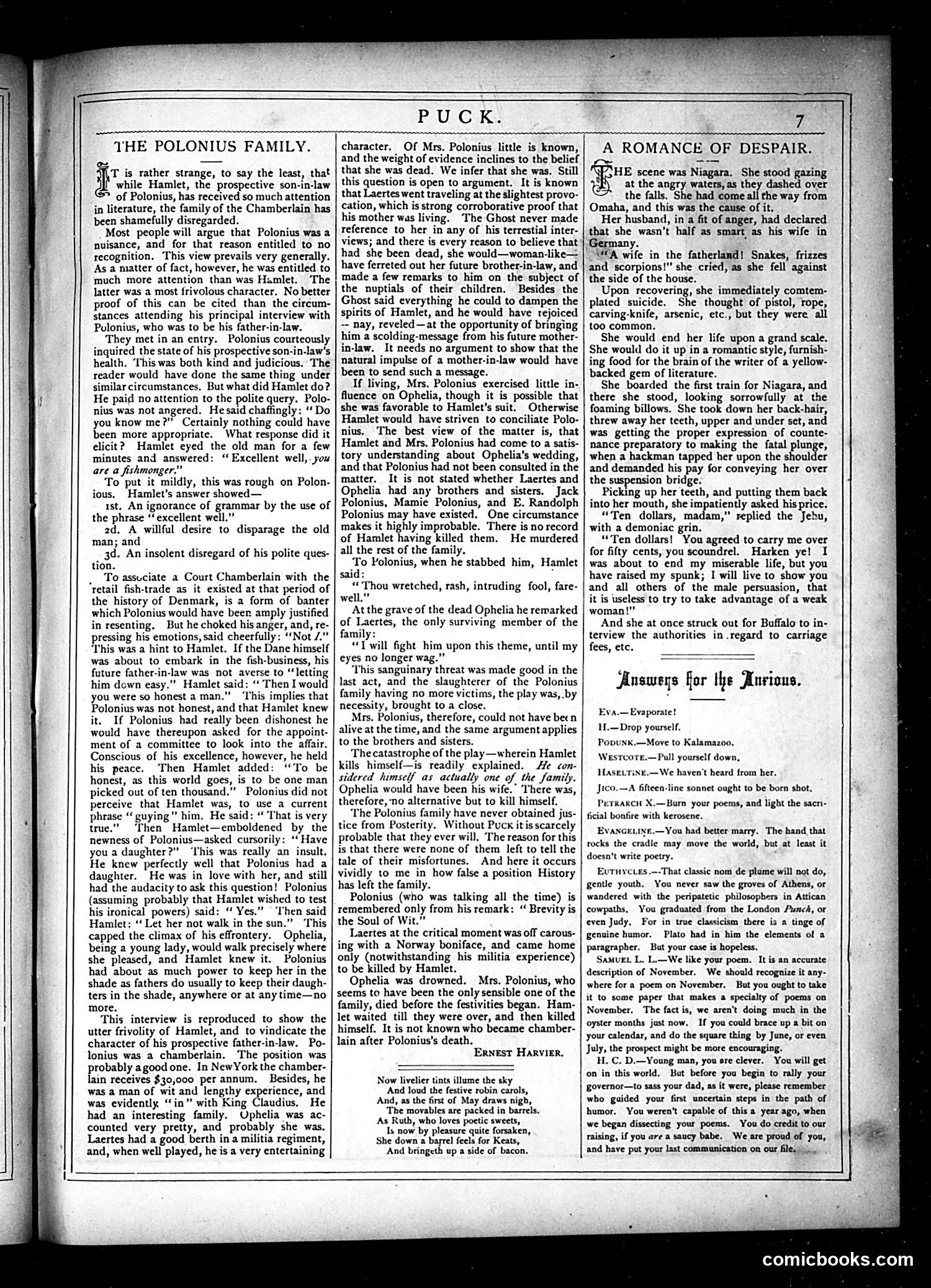
This page contains **three distinct text articles**, not political cartoons. The main pieces are: 1. **"The Polonius Family"** — A literary analysis examining characters from *Hamlet*, debating whether Polonius was alive or dead and discussing family dynamics. 2. **"A Romance of Despair"** — A short fictional narrative about a woman at Niagara Falls contemplating suicide after romantic rejection. 3. **"Answers for the Anxious"** — An advice column addressing reader questions on various topics. **No political cartoons appear on this page.** The content is primarily satirical fiction and humor writing typical of Puck's literary material, rather than visual satire or caricature. The page demonstrates the magazine's format of mixing literary commentary with humorous advice columns.
📄 Transcribed text from this page (OCR, searchable)
Machine-transcribed from the original scan — historical spelling and the odd misread are preserved.
PUCK. THE POLONIUS FAMILY. T is rather strange, to say the least, that while Hamlet, the prospective son-in-law of Polonius, has received so much attention in literature, the family of the Chamberlain has been shamefully disregarded. Most people will argue that Polonius was a nuisance, and for that reason entitled to no recognition. ‘This view prevails very generally. As a matter of fact, however, he was entitled to much more attention than was Hamlet. The latter was a most frivolous character. No better proof of this can be cited than the circum- stances attending his principal interview with Pulonius, who was to be his father-in-law. They met in an entry. Polonius courteously inquired the state of his prospective son-in-law’s health. ‘This was both kind and judicious. The reader would have done the same thing under similar circumstances, But what did Hamlet do? He paid no attention to the polite query. Polo- nius was not angered. He said chaffingly: ‘Do you know me?” Certainly nothing could have been more appropriate. What response did it elicit? Hamlet eyed the old man for a few minutes and answered: “Excellent well,. you are a fishmonger.” To put it mildly, this was rough on Polon- ious. Hamlet's answer showed— ist. An ignorance of grammar by the use of the phrase ‘‘ excellent well.” ad. A willful desire to disparage the old man; and 3d. An insolent disregard of his polite ques- tion. . To assuciate a Court Chamberlain with the retail fish-trade as it existed at that period of the history of Denmark, is a form of banter which Polonius would have been amply justified in resenting. But he choked his anger, and, re- pressing his emotions, said cheerfully: “Not /.” ‘This was a hint to Hamlet. If the Dane himself was about to embark in the fish-business, his future father-in-law was not averse to “letting him down easy.” Hamlet said: “ Then I would you were so honest a man.” ‘This implies that Polonius was not honest, and that Hamlet knew it. If Polonius had really been dishonest he would have thereupon asked for the appoint- ment of a committee to look into the affair. Conscious of his excellence, however, he held his peace. Then Hamlet added: ‘To be honest, as this world goes, is to be one man picked out of ten thousand.” Polonius did not perceive that Hamlet was, to use a current phrase “ guying” him. He said: “ That is very true.” Then Hamlet—emboldened by the newness of Polonius—asked cursorily: “Have you a daughter?” ‘This was really an insult. He knew perfectly well that Polonius had a daughter. He was in love with her, and still had the audacity to ask this question! Polonius (assuming probably that Hamlet wished to test his ironical powers) said: “ Yes.” ‘Then said Hamlet: ‘‘ Let her not walk in the sun.” This capped the climax of his effrontery. Ophelia, being a young lady, would walk precisely where she pleased, and Hamlet knew it. Polonius had about as much power to keep her in the shade as fathers do usually to keep their daugh- ters in the shade, anywhere or at any time—no more, This interview is reproduced to show the utter frivolity of Hamlet, and to vindicate the character of his prospective father-in-law. Po- lonius was a chamberlain. ‘The position was probably agood one. In NewYork the chamber- lain receives $30,000 per annum. Besides, he was a man of wit and lengthy experience, and was evidently “in” with King Claudius. He had an interesting family. Ophelia was ac- counted very pretty, and probably she was. Laertes had a good berth in a militia regiment, and, when well played, he is a very entertaining character. Of Mrs. Polonius little is known, and the weight of evidence inclines to the belief. that she was dead. We infer that she was. Still this question is open to argument. It is known that Laertes went traveling at the slightest provo- cation, which is strong corroborative proof that his mother was living. The Ghost never made reference to her in any of his terrestial inter- views; and there is every reason to believe that |) had she been dead, she would—woman-like— have ferreted out her future brother-in-law, and made a few remarks to him on the subject of the nuptials of their children. Besides the Ghost said everything he could to dampen the spirits of Hamlet, and he would have rejoiced — nay, reveled—at the opportunity of bringing him a scolding-message from his fature mother- in-law. It needs no argument to show that the natural impulse of a mother-in-law would have been to send such a mi e. If living, Mrs. Polonius exercised little in- fluence on Ophelia, though it is possible that she was favorable to Hamlet’s suit. Otherwise Hamlet would have striven to conciliate Polo- nius. The best view of the matter is, that Hamlet and Mrs. Polonius had come to a satis- tory understanding about Ophelia’s wedding, and that Polonius had not been consulted in the matter. It is not stated whether Laertes and Ophelia had any brothers and sisters. Jack Polonius, Mamie Polonius, and E, Randolph Polonius may have existed. One circumstance makes it highly improbable. ‘There is no record of Hamlet having killed them. He murdered all the rest of the family. ‘To Polonius, when he stabbed him, Hamlet said: . «Thou wretched, rash, intruding fool, fare- well.” Atthe grave of the dead Ophelia he remarked of Laertes, the only surviving member of the family: “Twill fight him upon this theme, until my eyes no longer wag.” ‘This sanguinary threat was made good in the last act, and the slaughterer of the Polonius family having no more victims, the play was, by necessity, brought to a close. Mrs. Polonius, therefore, could not have becn alive at the time, and the same argument applies to the brothers and sisters. ‘Thecatastrophe of the play—wherein Hamlet kills himself—is readily explained. He con- sidered himself as actually one of the family. Ophelia would have been his wife.” ‘There was, therefore, ‘no alternative but to kill himself. ‘The Polonius family have never obtained jus- tice from Posterity. Without Puck itis scarcely probable that they ever will, The reason for this is that there were none of them left to tell the tale of their misfortunes. And here it occurs vividly to me in how false a position History has left the family. Polonius (who was talking all the time) is remembered only from his remark: “ Brevity is the Soul of Wit.” Laertes at the critical moment was off carous- ing with a Norway boniface, and came home only (notwithstanding his militia experience) to be killed by Hamlet. Ophelia was drowned. Mrs. Polonius, who seems to have been the only sensible one of the family, died before the festivities began. Ham- let waited till they were over, and then killed himself. It is not known who became chamber- lain after Polonius’s death. Ernest Harvier. Now livelier tints illume the sky ‘And loud the festive robin carols, And, as the first of May draws nigh, The movables are packed in barrels. As Ruth, who loves poetic sweets, Is now by pleasure quite forsaken, 1 feels for Keats, up a side of bacon. She down a ‘And bringet A ROMANCE OF DESPAIR. — = HE scene was Niagara. She stood gazing yh, at the angry waters, as they dashed over the falls. She had come all the way from Omaha, and this was the cause of it, Her husband, in a fit of anger, had declared that she wasn’t half as smart as his wife in Ye \“©A wife in the fatherland! Snakes, frizzes and scorpions!” she cried, as she fell against the side of the house. Upon recovering, she immediately comtem- plated suicide. She thought of pistol, rope, carving-knife, arsenic, etc., but they were all too common, She would end her life upon a grand scale. She would do it up in a romantic style, furnish- ing food for the brain of the writer of a yellow- backed gem of literature. She boarded the first train for Niagara, and there she stood, looking sorrowfully at the foaming billows. She took down her back-hair, threw away her teeth, upper and under set, and was getting the proper expression of counte- nance preparatory to making the fatal plunge, when a hackman tapped her upon the shoulder and demanded his pay for conveying her over the suspension bridge. Picking up her teeth, and putting them back into her mouth, she deapatleney asked his price. “Ten dollars, madam,” replied the Jehu, with a demoniac grin. “Ten dollars! You agreed to carry me over for fifty cents, you scoundrel. Harken ye! I was about to end my miserable life, but you have raised my spunk; I will live to show you and all others of the male persuasion, that it is useless to try to take advantage of a weak woman!”" And she at once struck out for Buffalo to in- terview the authorities in .regard to carriage fees, etc. ‘ ; Answers for the Anrious. Eva.—Evaporate! H.—Drop yourself. Popunk.—Move to Kalamazoo. Westcore.—Pull yourself down, Hasevtine.—We haven't heard from her. Jico.—A fifteen-line sonnet ought to be born shot, PerRarcn X.—Burn your poems, and light the sacn- ficial bonfire with kerosene. Evance.ixe.—You had better marry. The hand that rocks the cradle may move the world, but at least it doesn’t write poetry. Evtnycves.—-That classic nom de plume will not do, gentle youth. You never saw the groves of Athens, or wandered with the peripatetic philosophers in Attican cowpaths, You graduated from the London Punch, or even Judy, For in true classicism there is a tinge of genuine humor. Plato had in him the elements of a paragrapher. But your case is hopeless. Samue. L. L.—We like your poem. It is an accurate description of November. We should recognize it any- where for a poem on November. But you ought to take it to some paper that makes a specialty of poems on November. The fact is, we aren't doing much in the oyster months just now. If you could brace up a bit on your calendar, and do the square thing by June, or even July, the prospect might be more encouraging. H. C. D.—Young man, you sre clever. You will get on in this world, But before you begin to rally your governor—to sass your dad, as it were, please remember who gaided your first uncertain steps in the path of humor. You weren't capable of this a year ago, when we began dissecting your poems. You do credit to our raising, if you are a saucy babe. We are proud of you, and have put your last communication on our file. comicbooks.com