
Puck, 1878-05-01 · page 2 of 16
Puck — May 1, 1878 — page 2: what you’re looking at
What you’re looking at
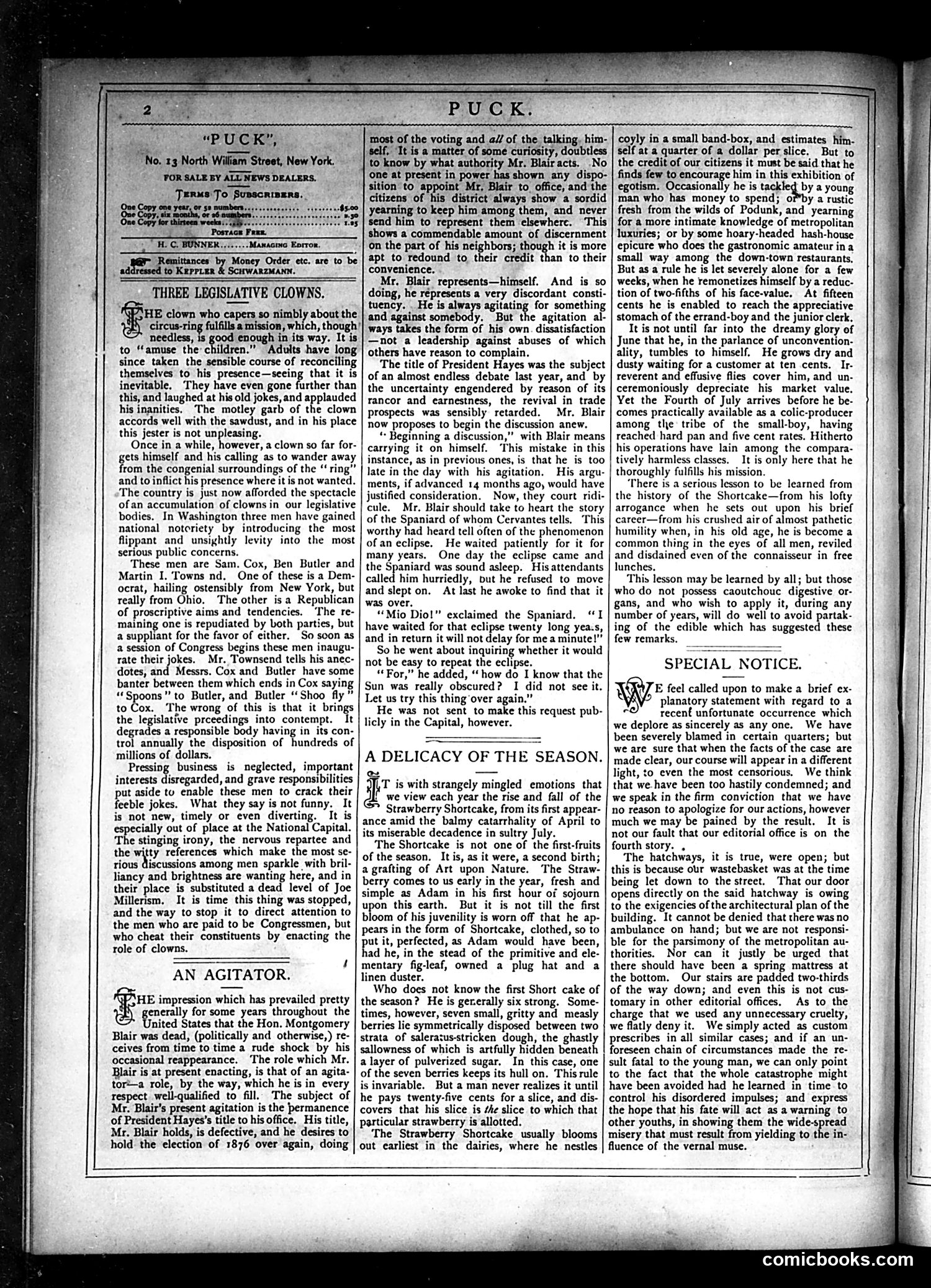
This page contains three distinct articles critiquing American political figures and social behavior: **"Three Legislative Clowns"** attacks three congressmen (Sam Cox, Uen Butler, and Martin F. Tupper) for their "flippant and unseemly levity" during serious legislative sessions. The piece argues their disruptive behavior degrades congressional proceedings and damages public respect for government. **"An Agitator"** appears to criticize Mr. Blair's political agitation regarding President Hayes's administration, suggesting Blair is self-serving and creating unnecessary controversy rather than genuinely addressing systemic abuses. The remaining articles discuss seasonal food topics (strawberries, shortcake) and respond to criticism about previous editorial stances. Overall, the page emphasizes Puck's role as a satirical watchdog holding politicians accountable for conduct unbecoming their office.
📄 Transcribed text from this page (OCR, searchable)
Machine-transcribed from the original scan — historical spelling and the odd misread are preserved.
“No. 13 North William Street, New York. FOR SALE BY ALL NEWS DEALERS. __ Terms To Susscrisers. Copy one year, or 52 numbers f Seema Postrace, ~ wC. ~-Manacina Eorron, “Remittances Money Order etc. are to be to Kaprier & ScHWARZMANN. THREE LEGISLATIVE CLOWNS. }HE clown who capers so stably abot the Siieae ung fale Siemon wh ich, though’! needless, is good enough in its way. It is to ‘amuse the children.” Adults have long since taken the sensible course of reconciling themselves to his presence—seeing that it is inevitable. They have even gone further than this, and laughed at his old jokes, and applauded his inanities. The motley garb of the clown accords well with the sawdust, and in his place this jester is not unplesting: Once in a while, however, a clown so far for- gets himself and his calling ‘as to wander away from the congenial surroundings of the “ring” and to inflict his presence where it is not wanted. ‘The country is just now afforded the spectacle ofan accumulation of clowns in our legislative bodies. In Washington three men have gained national noteriety by introducing the most flippant and unsightly levity into the most serious public concerns. These men are Sam. Cox, Ben Butler and Martin I. Towns nd. One of these is a Dem- ocrat, hailing ostensibly from New York, but really from Ohio. The other isa Republican of proscriptive aims and tendencies. ‘The re- maining one is repudiated by Loth parties, but a suppliant for the favor of either. So soon as a session of Congress begins these men inaugu- rate their jokes. Mr. Townsend tells his anec- dotes, and Messrs. Cox and Butler have some banter between them which ends in Cox saying “Spoons” to Butler, and Butler ‘Shoo fly” to Cox. The wrong of this is that it brings the legislative prceedings into contempt. It degrades a responsible body having in its con- trol annually the disposition of hundreds of millions of dollars. Pressing business is neglected, important interests disregarded, and grave responsibilities put aside tv enable these men to crack their feeble jokes. What they say is not funny, It is not new, timely or even diverting. It is especially out of place at the National Capital. The stinging irony, the nervous repartee and the witty references which make the most se- rious discussions among men sparkle with bril- liancy and brightness are wanting here, and in their place is substituted a dead level of Joe Millerism. It is time this thing was stopped, and the way to stop it to direct attention to the men who are paid to be Congressmen, but who cheat their constituents by enacting the role of clowns. AN AGITATOR. HE impression which has prevailed pretty enerally for some years throughout the nited States that the Hon. Montgomery Blair was dead, (politically and otherwise,) re- ceives from time to time a rude shock by his occasional reappearance. The role which Mr. Blair is at present enacting, is that of an agita- tort-a role, by the way, which he is in every respect well-qualified to fill. The subject of Mr. Blair's present agitation is the permanence ‘ of President Hayes’s title to his office. His title, Mr. Blair holds, is defective, and he desires to hold: the election of 1876 over again, doing most of the voting and a/of the talking, him- self, ‘It is a matter of some curiosity, doubtless to know by what authority Mr. Blairacts. No ‘one at present in power has shown any dispo- sition to a] it Mr, Blair to office, and the citizens’ of itrict always show a sordid yearning to keep him among them, and never send him to represent them elsewhere. This shows a commendable amount of discernment ‘on the part of his neighbors; though it is more apt to redound to their credit than to their convenience. Mr, Blair represents—himself. And is so doing, he represents a very discordant consti- tuency. . He is always agitating for something and against somebody. But the agitation al- ways takes the form of his own. dissatisfaction —not a leadership against abuses of which others have reason to complain. The title of President Hayes was the subject of an almost endless debate last year, and by the uncertainty engendered by reason of its rancor and earnestness, the revival in trade prospects was sensibly retarded. Mr. Blair now proposes to begin the discussion anew. “ Beginning a discussion,” with Blair means carrying it on himself. This mistake in this instance, as in previous ones, is that he is too late in the day with his agitation. His argu- ments, if advanced 14 months ago, would have justified consideration. Now, they court ridi- cule. Mr. Blair should take to heart the story of the Spaniard of whom Cervantes tells. This worthy had heard tell often of the phenomenon of an eclipse. He waited patiently for it for many years. One day the eclipse came and the Spaniard was sound asleep. His attendants called him hurriedly, but he refused to move and slept on. At last he awoke to find that it was over, “Mio Dio!” exclaimed the Spaniard. “1 have waited for that eclipse twenty long yea.s, and in return it will not delay for me a minute!” So he went about inquiring whether it would not be easy to repeat the eclipse. “For,” he added, ‘‘ how do I know that the Sun was really obscured? I did not see it. Let us try this thing “over again.” He was not sent to make this request pub- licly in the Capital, however. A DELICACY OF THE SEASON. yT is with strangely mingled emotions that { we view each year the rise and fall of the Strawberry Shortcake, from its first appear- ance amid the balmy catarrhality of April to its miserable decadence in sultry July. The Shortcake is not one of the first-fruits of the season. It is, as it were, a second birth; a grafting of Art upon Nature. The Straw- berry comes to us early in the year, fresh and simple as Adam in his first hour of sojourn upon this earth. But it is not till the first bloom of his juvenility is worn off that he ap- pears in the form of Shortcake, clothed, so to ut it, perfected, as Adam would have been, fad he, in the stead of the primitive and ele- mentary fig-leaf, owned a plug hat and a linen duster. Who does not know the first Short cake of the season? He is generally six strong. Some- times, however, seven small, gritty and measly berries lie symmetrically disposed between two strata of saleravus-stricken dough, the ghastl: sallowness of which is artfully hidden beneat! a layer of pulverized sugar. In this case, one of the seven berries keeps its hull on. This rule is invariable. But a man never realizes it until he pays twenty-five cents for a slice, and dis- covers that his slice is ¢he slice to which that articular strawberry is allotted. The Strawberry Shortcake usually blooms out earliest in the dairies, where he nestles coyly in a small band-box, and estimates him- self at a quarter of a dollar perslice. But to the credit of our citizens it must be said that he finds few to encourage him in this exhibition of egotism. Occasionally he is tackleg by a young man who has money to spend; omby a rustic fresh from the wilds of Podunk, and yearning for a more intimate knowledge of metropolitan luxuries; or by some hoary-headed hash-house epicure who does the gastronomic amateur ina small way among the down-town restaurants, But as a rule he is let severely alone for a few weeks, when he remonetizes himself by a reduc- tion of two-fifths of his face-value. At fifteen cents he is enabled to reach the appreciative stomach of the errand-boy and the junior clerk. It is not until far into the dreamy glory of June that he, in the parlance of unconvention- ality, tumbles to himself. He grows dry and dusty waiting for a customer at ten cents. Ir- reverent and effusive flies cover him, and un- ceremoniously depreciate his market value, Yet the Fourth of July arrives before he be- comes practically available as a colic-producer among the tribe of the small-boy, having reached hard pan and five cent rates. Hitherto his operations have lain among the compara- tively harmless classes. It is only here that he thoroughly fulfills his mission. ‘There is a serious lesson to be learned from the history of the Shortcake—from his lofty arrogance when he sets out upon his brief career—from his crushed air of almost pathetic humility when, in his old age, he is become a common thing in the eyes of all men, reviled and disdained even of the connaisseur in free lunches, This lesson may be learned by all; but those who do not possess caoutchouc digestive or- gans, and who wish to apply it, during any number of years, will do well to avoid partak- ing of the edible which has suggested these few remarks. SPECIAL NOTICE. E feel called upon to make a brief ex- P planatory statement with regard to a ie recent unfortunate occurrence which we deplore as sincerely as any one. We have been severely blamed in certain quarters; but we are sure that when the facts of the case are made clear, our course will appear in a different light, to even the most censorious. We think that we-have been too hastily condemned; and we speak in the firm conviction that we have no reason to apologize for our actions, however much we may be pained by the result. It is not our fault that our editorial office is on the fourth story. , ‘The hatchways, it is true, were open; but this is because our wastebasket was at the time being let down to the street. That our door opens directly on the said hatchway is owing to the exigencies of the architectural plan of the building. It cannot be denied that there was no ambulance on hand; but we are not responsi- ble for the parsimony of the metropolitan au- thorities. Nor can it justly be urged that there should have been a spring mattress at the bottom. Our stairs are padded two-thirds of the way down; and even this is not cus- tomary in other editorial offices, As to the charge that we used any unnecessary cruelty, we flatly deny it. We simply acted as custom prescribes in all similar cases; and if an un- foreseen chain of circumstances made the re- sult fatal to the young man, we can only point to the fact that the whole catastrophe might have been avoided had he learned in time to control his disordered impulses; and express the hope that his fate will act as a warning to other youths, in showing them the wide-spread misery that must result from yielding to the in- fluence of the vernal muse.