
A complete issue · 16 pages · 1878
Puck — April 24, 1878
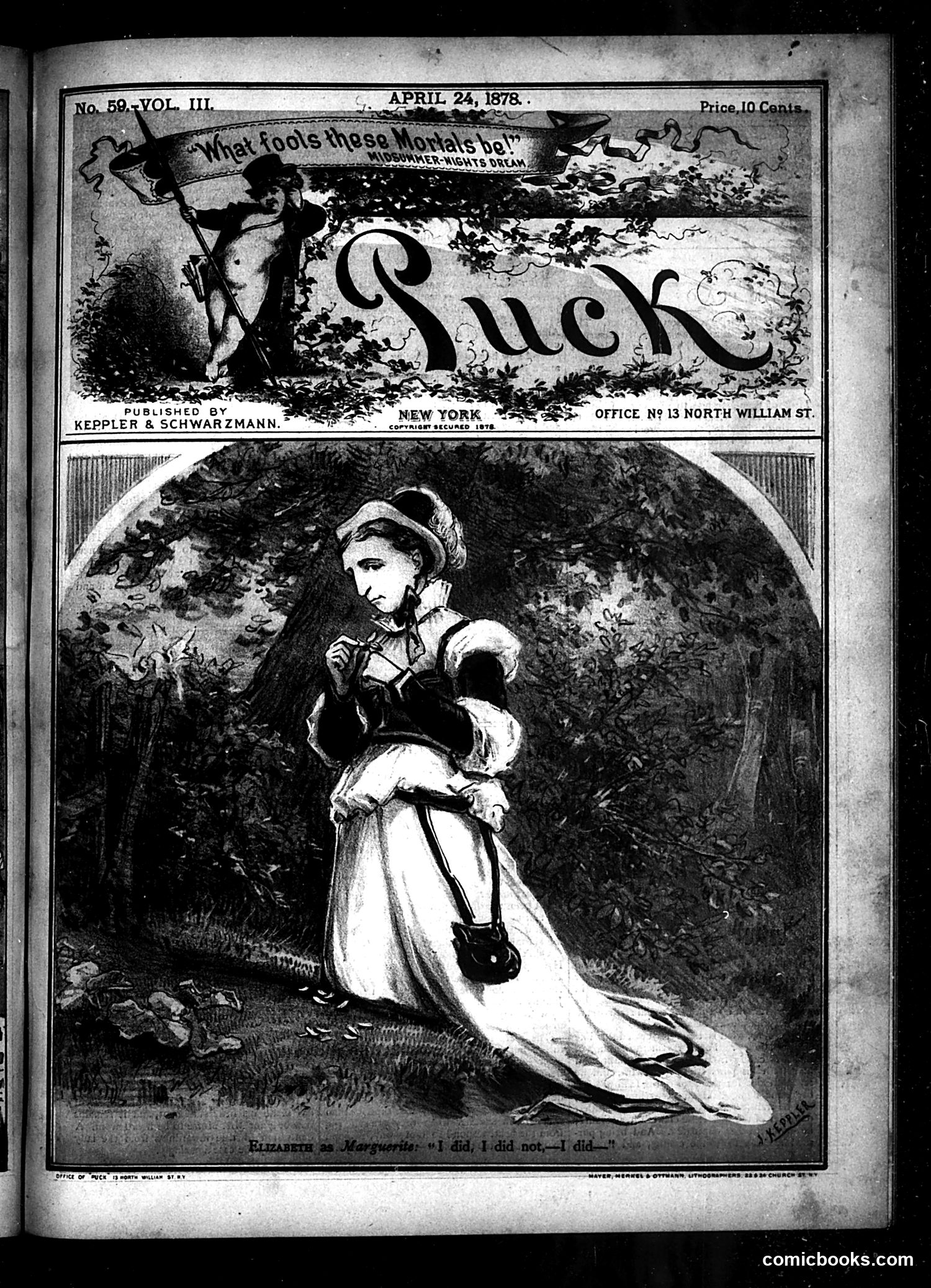
This page features a theatrical illustration captioned "Elizabeth as Marguerita: 'I did, I did not,—I did—'" The image shows a woman in period costume (headpiece, dark jacket, white flowing skirt) in an emotional pose, appearing to recite dramatic lines. The header asks "What fools these Mortals be!"—a Shakespeare quote suggesting satire about human folly. This likely references **Elizabeth as Marguerita**, possibly a theatrical production or actress of the era. The repeated, hesitant dialogue ("I did, I did not") mocks overwrought dramatic performance—a common Puck target. The satire appears directed at Victorian theatrical conventions and actors' melodramatic delivery rather than specific politics. The page satirizes the pretensions of stage acting.
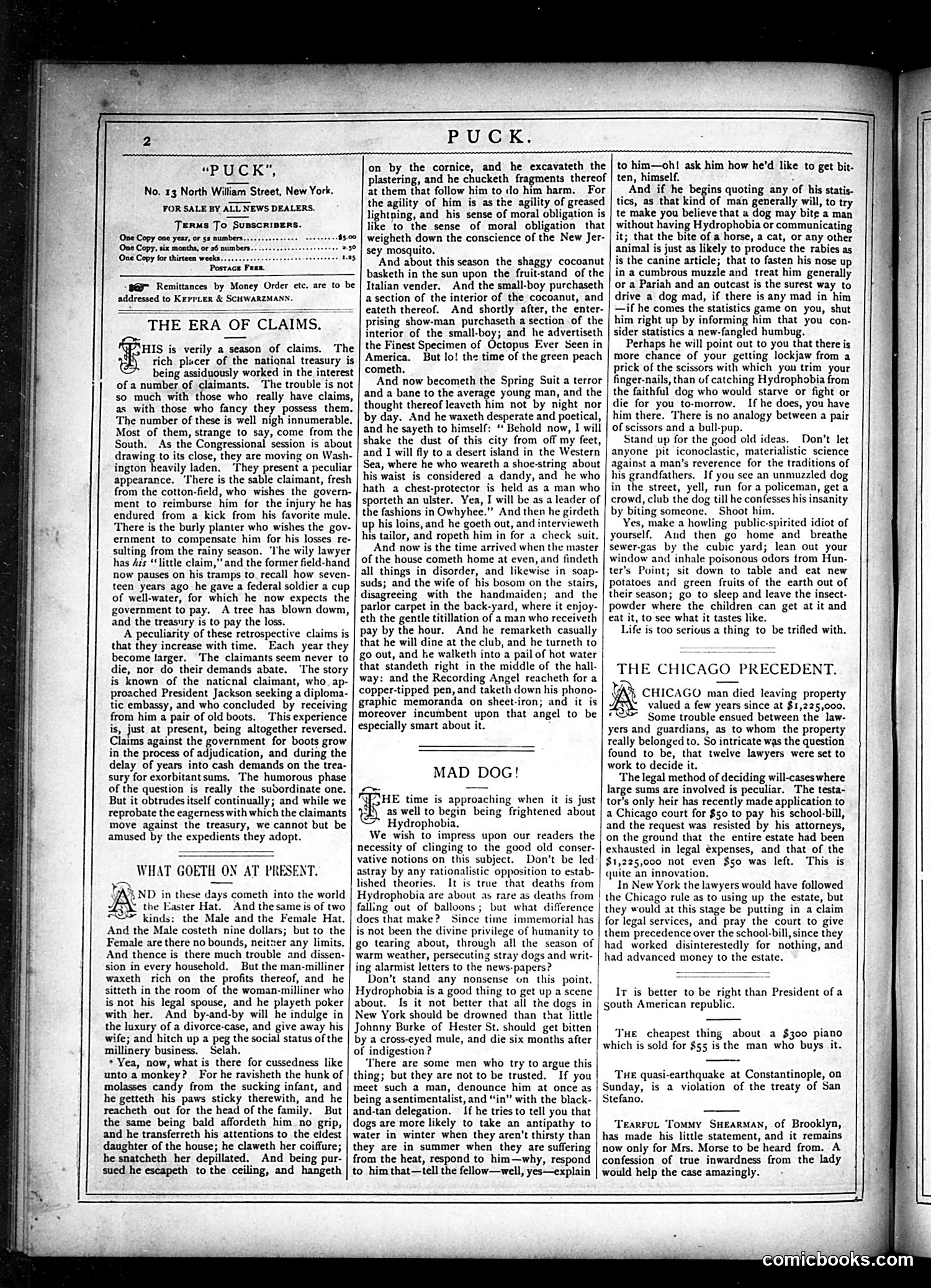
This page contains three distinct sections: subscription information, and three satirical articles titled "The Era of Claims," "What Goeth On at Present," and "Mad Dog!" The articles appear to be political/social commentary rather than visual cartoons. "The Era of Claims" discusses frivolous legal claims becoming increasingly common, satirizing those seeking government compensation. "What Goeth On at Present" mocks Easter fashions and social pretensions. "Mad Dog!" critiques fear-mongering about rabies and hydrophobia, arguing against killing stray dogs based on irrational panic. "The Chicago Precedent" discusses a will dispute involving substantial sums and legal expenses—likely a contemporary high-society controversy. The content reflects Puck's trademark satirical approach to contemporary social issues, though without visible political cartoons on this particular page.
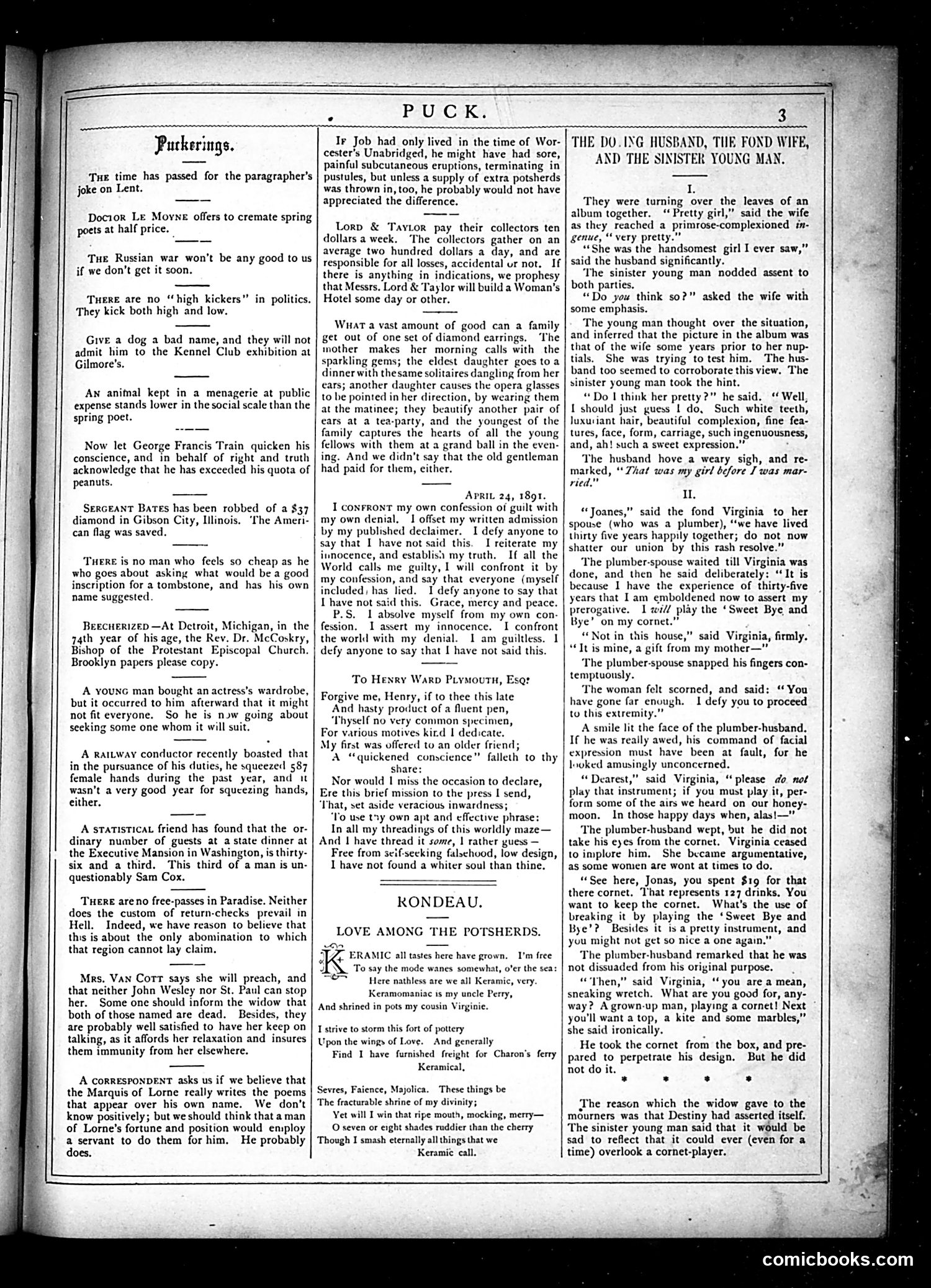
This page contains satirical commentary and short fiction rather than political cartoons. The "Puckerings" section offers brief social jabs: mocking high-kicking politicians, critiquing Lord & Taylor's billing practices, and satirizing wealthy families' ostentatious diamond jewelry displays. The main content is a serialized story titled "The Doting Husband, The Fond Wife, and the Sinister Young Man" (Part I-II), depicting domestic drama involving a plumber-husband, his wife Virginia, and a mysterious younger man who gives her a cornet. The narrative explores jealousy, suspicion, and marital tension through their escalating conflict over this seemingly innocent gift. A poem titled "Love Among the Potshards" and Henry Ward Beecher's response letter (addressing rumors about his conduct) appear at bottom—likely referencing the real Beecher scandal that consumed American media in the 1870s.
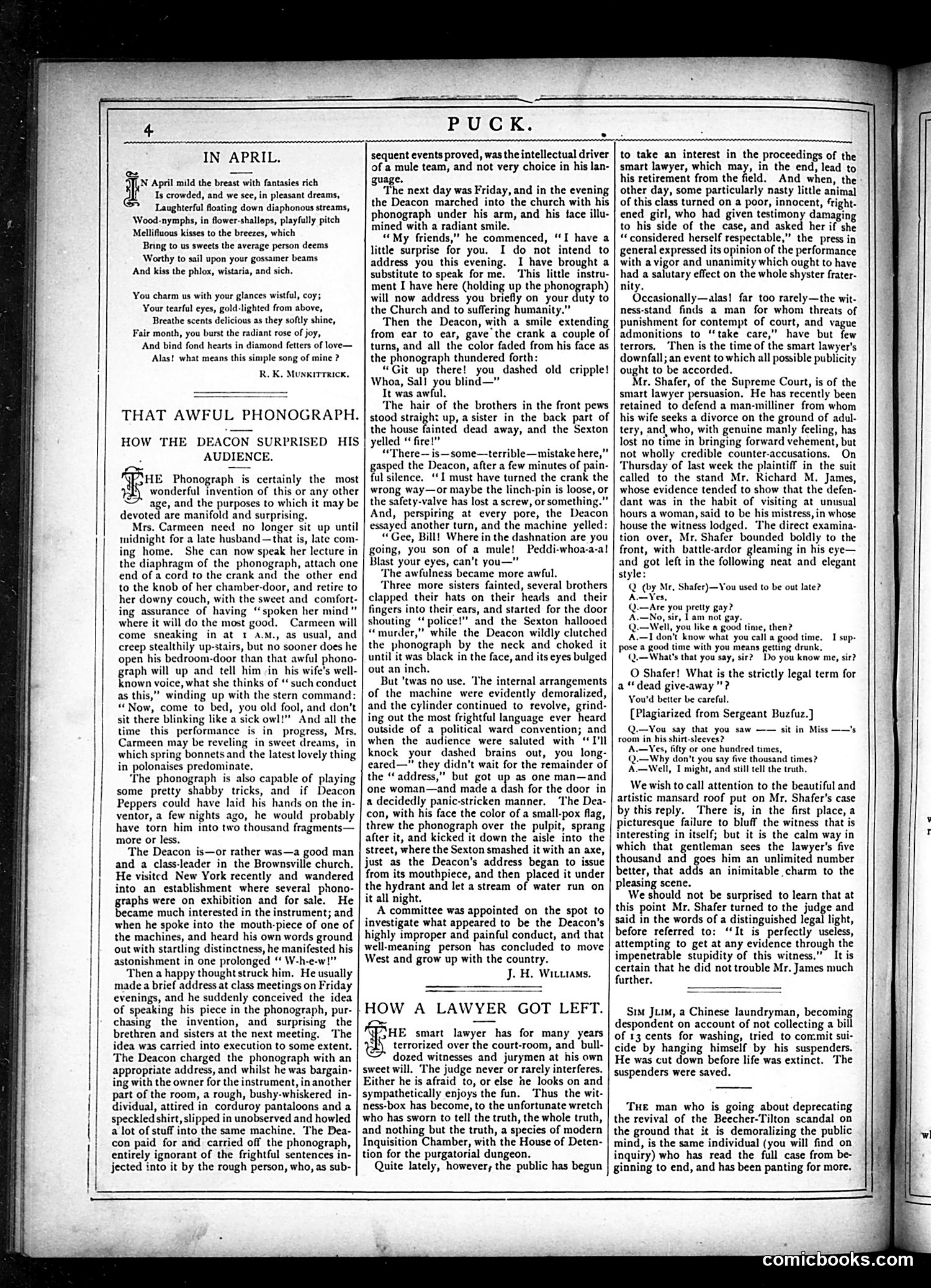
This page contains three distinct satirical pieces: 1. **"That Awful Phonograph"** - A humorous narrative about a Deacon who brings a phonograph to church. The joke centers on the machine malfunctioning catastrophically during his demonstration, with the cylinder producing increasingly bizarre and offensive sounds that horrify the congregation. The satire mocks both the Deacon's pride in the new technology and early phonographs' poor audio quality and unreliability. 2. **"How a Lawyer Got Left"** - A brief anecdote about a lawyer intimidated by courtroom witnesses and jurymen, ultimately losing his case due to his nervousness—satirizing overconfident legal practitioners brought down by circumstance. 3. **"Sir Jim"** - A short item about a Chinese laundryman's attempted suicide, focusing on the absurdity of the situation rather than social commentary. The page primarily satirizes technological pretension and professional incompetence through humor.
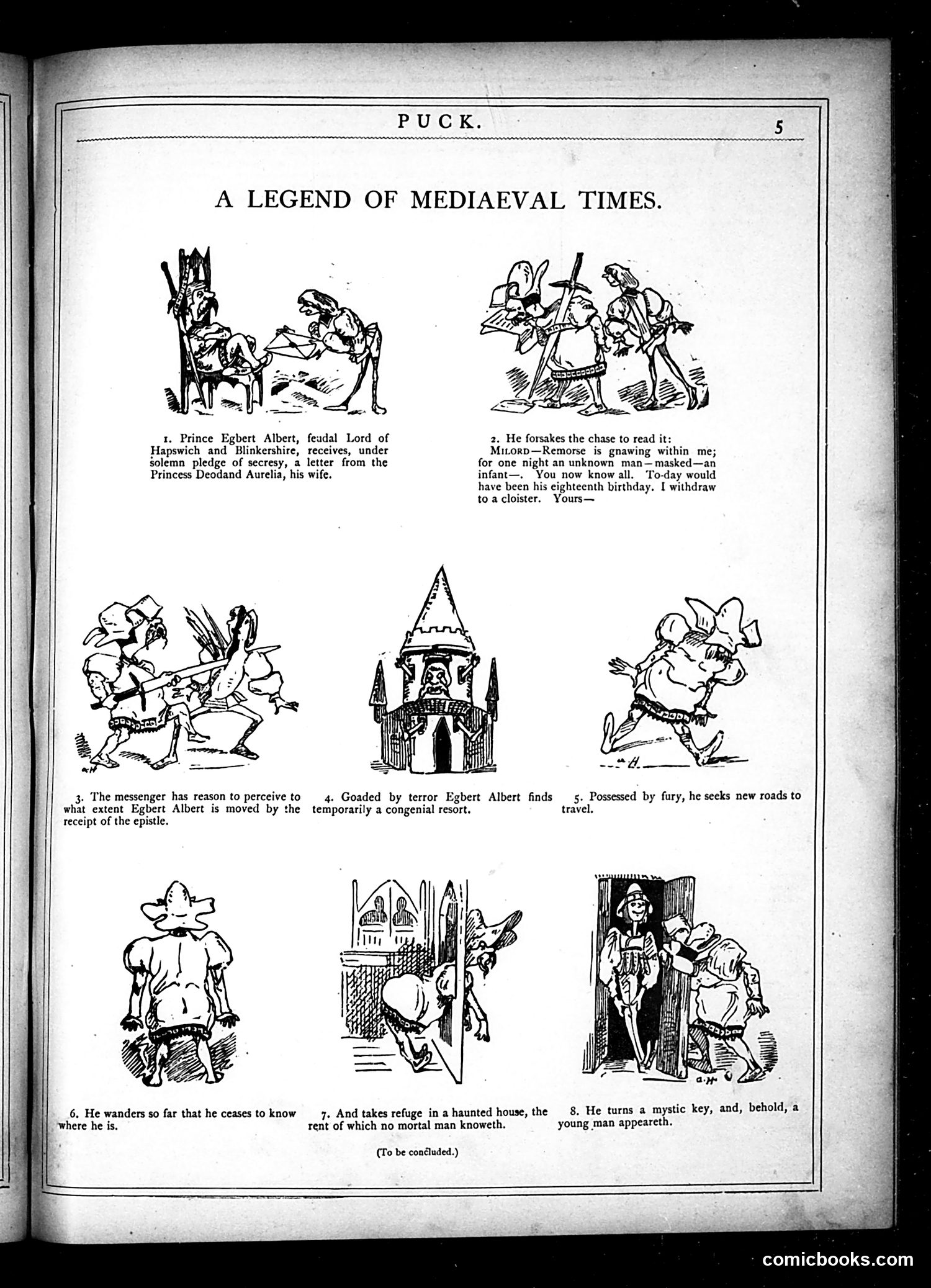
This is a satirical comic strip following Prince Egbert Albert through eight absurdist panels. The narrative appears to be a parody of romantic medieval tales: Egbert receives a mysterious letter from his wife, abandons hunting to read it, becomes emotionally distressed, seeks refuge in a magical castle, grows increasingly lost and disoriented, wanders until confused about his location, hides in a haunted house, and finally encounters a mysterious young man. The satire mocks overwrought Victorian melodrama and medieval romance fiction by subjecting an aristocratic protagonist to increasingly ridiculous supernatural and emotional circumstances. Without additional historical context, the specific political targets remain unclear, though the exaggerated emotional reactions and fantastical plot devices suggest mockery of popular serialized romantic fiction common to the era.
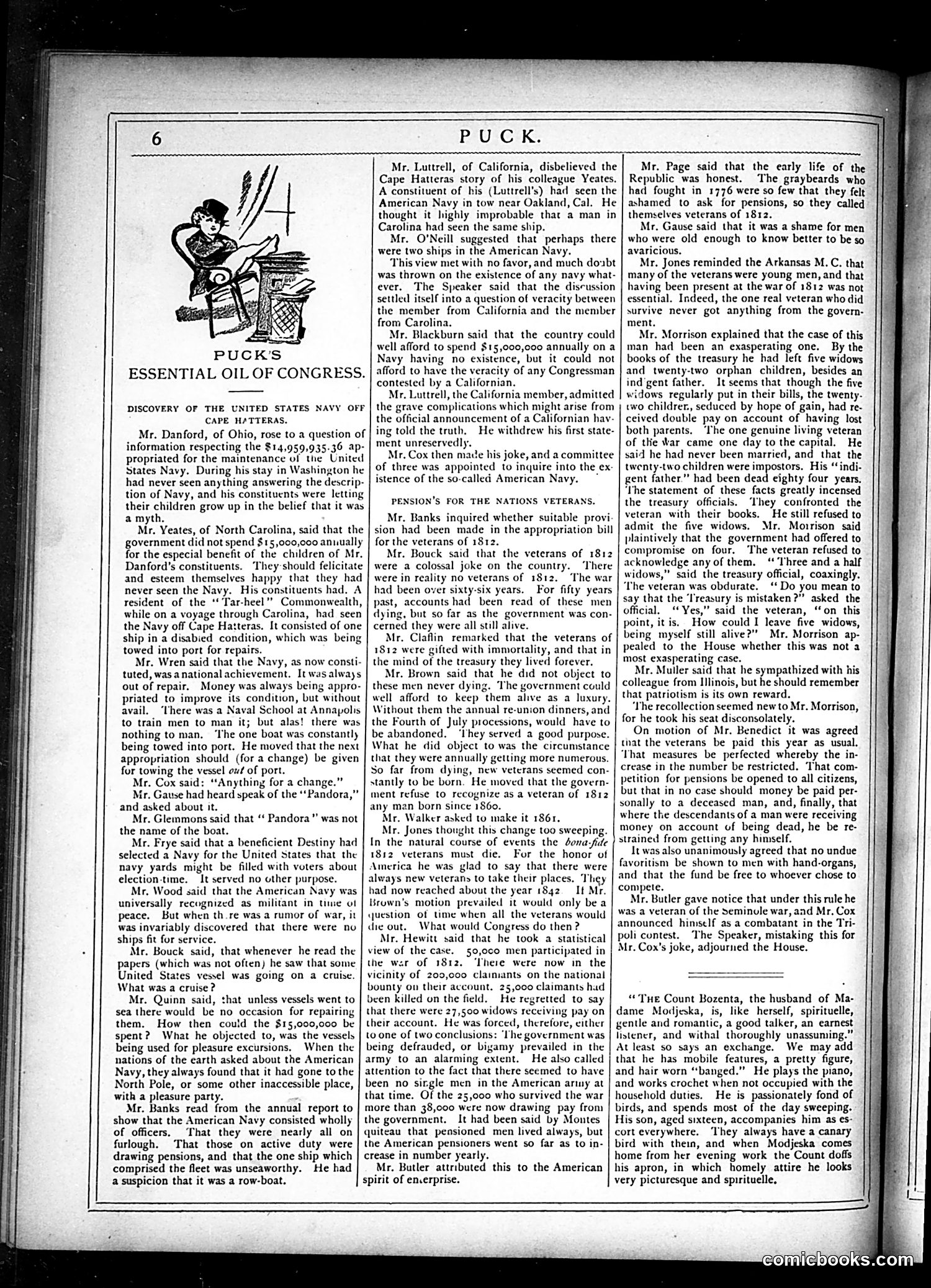
The cartoon depicts "Puck's Essential Oil of Congress" — a satirical mock-advertisement presenting Congress as a patent medicine. The figure shown appears to be a congressmember being "distilled" or processed. The accompanying text discusses Congressional debate over U.S. Navy maintenance funding and veterans' pensions from the War of 1812. Speakers argue about whether the government should spend $15,000 annually supporting aging veterans, with some calling them a "colossal joke" and debating their actual existence. The satire suggests that Congress itself — through its verbose debates and questionable decisions — is the real "medicine" or remedy being sold to the public. The implication is that Congressional rhetoric and dysfunction are the true subject worthy of ridicule, not the substantive policy questions being discussed.
This page contains **"The Truthful Biography of a Humorist,"** a biographical article about an unnamed humor writer. The piece is satirical, describing how the subject became a humorist through various life experiences—falling in love, becoming disillusioned, and developing a cynical wit. The right column features **"Answers for the Curious,"** a Q&A advice section addressing readers' questions about romance, writing, and social matters. **No political cartoons appear on this page.** The satire is literary rather than visual—mocking the pretensions of professional humorists who claim deep suffering inspires their comedy, while actually their wit stems from superficial observations and failed romantic ideals. The piece gently ridicules both the humorist's self-importance and readers' gullible admiration of such figures.
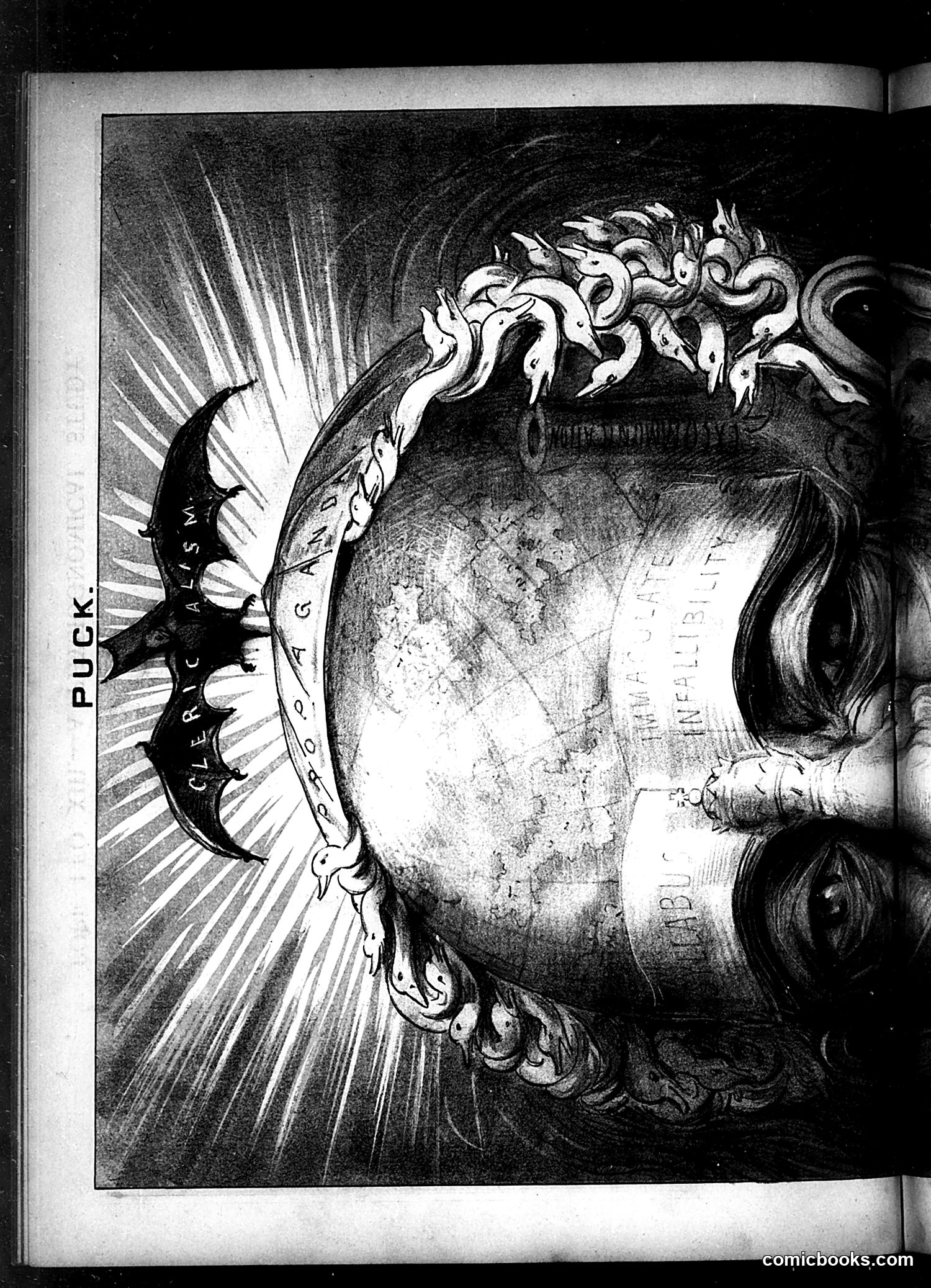
This appears to be a title page or cover illustration for *Puck* magazine labeled "PUCK" on the left side. The central image shows a large classical head or mask in profile, rendered in dramatic black and white with radiating light lines suggesting illumination or revelation. Ornate decorative serpents or snakes crown the top of the head, and what appears to be scrolled text or banners are visible on the face itself, though the specific text is difficult to read clearly in this reproduction. The artistic style—using classical imagery with serpents and dramatic lighting—suggests this likely represents a commentary on knowledge, wisdom, or perhaps hypocrisy (given the serpent symbolism). Without clearer text or additional context, the specific political or social target remains unclear, though the grandiose classical presentation suggests it may be satirizing pomposity or false authority.
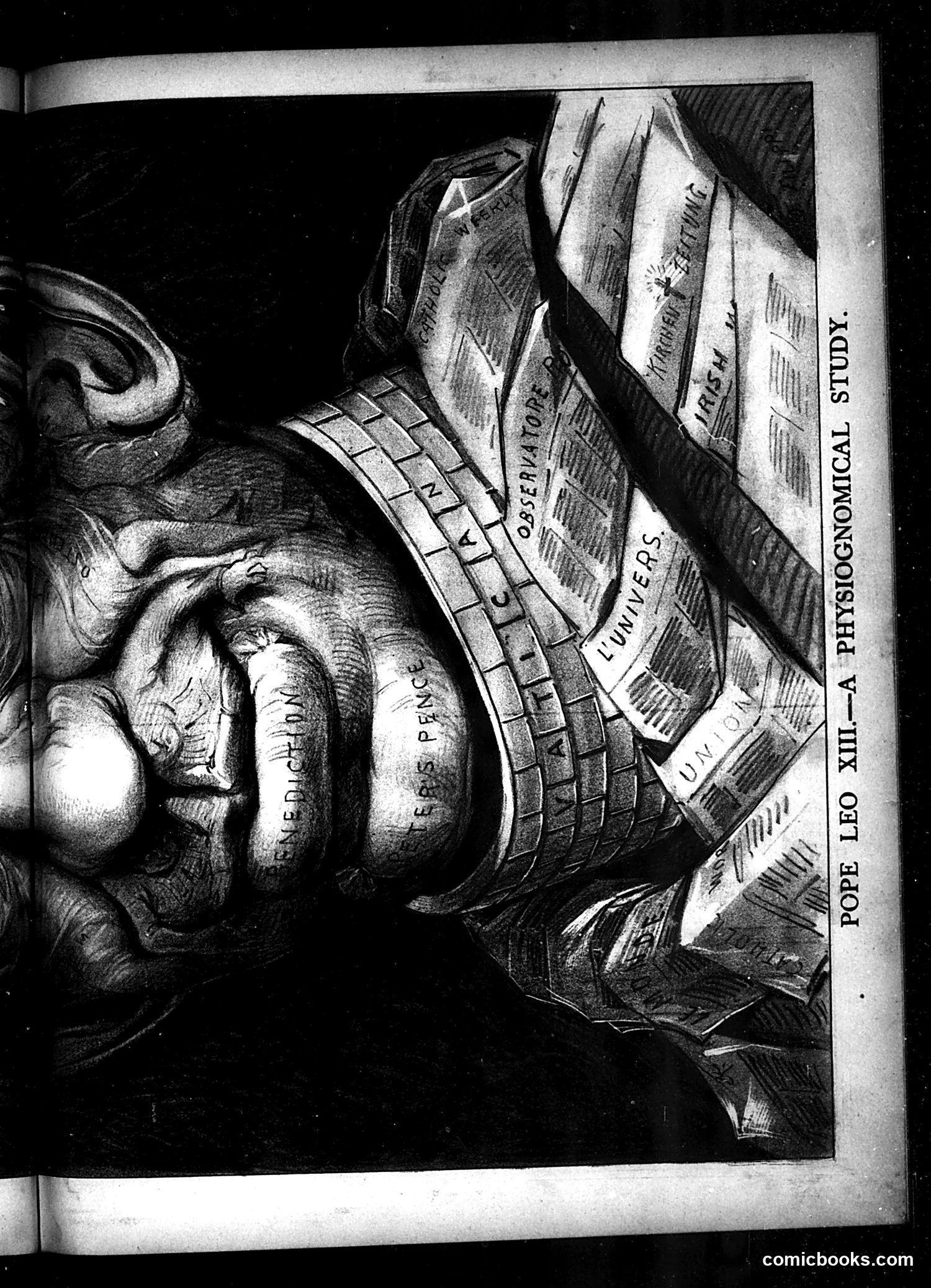
This appears to be a satirical physiognomical analysis of Pope Leo XIII, the late 19th-century pontiff. The cartoon uses exaggerated anatomical labeling to mock the Pope's facial features—identifying various parts of his head and face with pseudo-scientific precision typical of the period's pseudoscientific "physiognomy" movement, which claimed to read character from physical traits. The satire critiques both the Pope himself and the broader practice of physiognomical "study," which was popular but scientifically unfounded. The detailed, almost clinical approach to caricaturing his features lampoons both papal authority and the era's dubious scientific pretensions. Puck frequently used this kind of irreverent approach to religious and political figures.
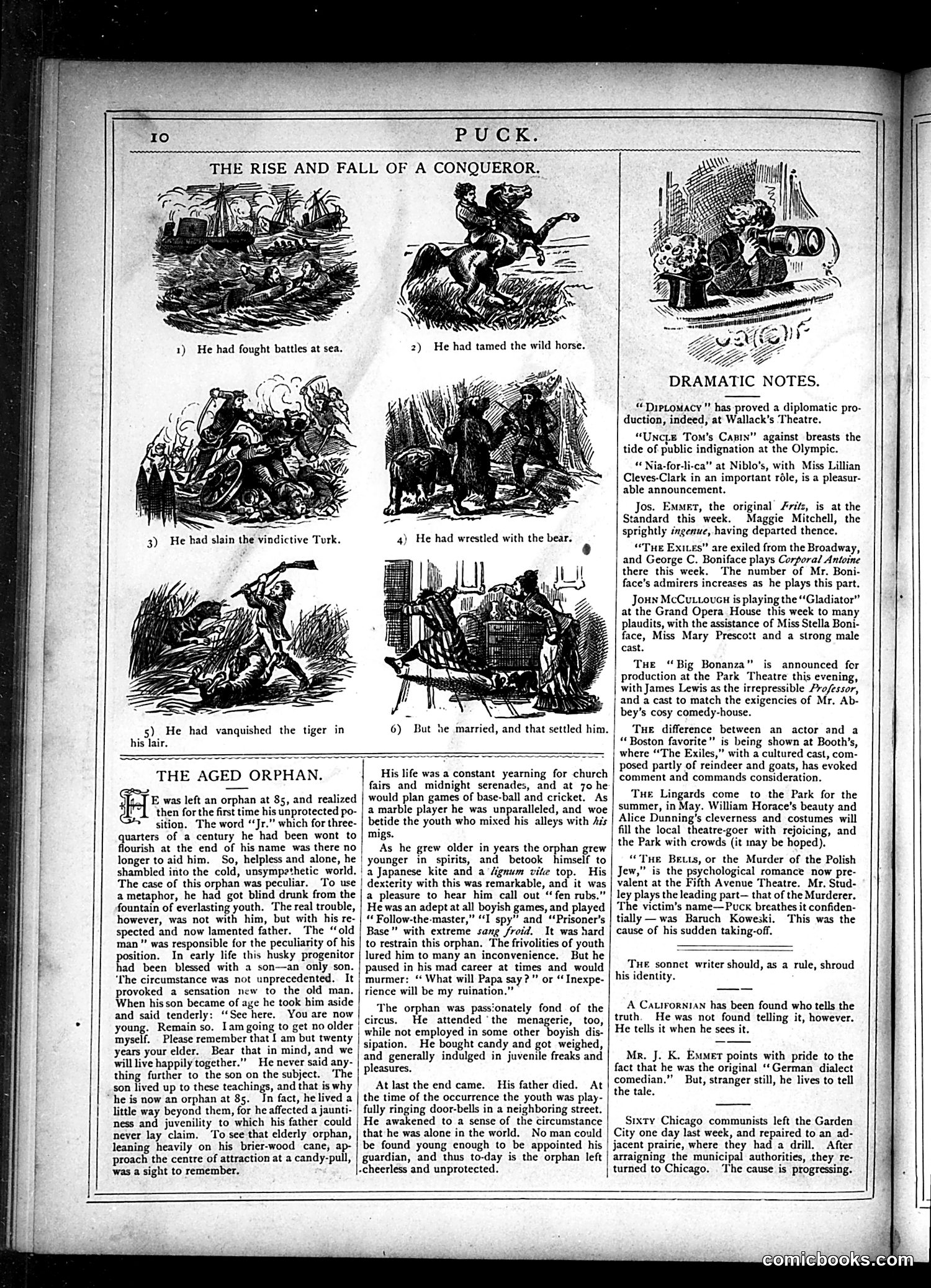
This six-panel satirical sequence depicts a military figure's trajectory from success to domestic subjugation. The panels show him: fighting naval battles, taming wild horses, slaying Turks, wrestling bears, vanquishing tigers, and finally—married, sitting henpecked at home with his wife. The satire mocks the notion that a man capable of conquering empires and dangerous beasts becomes utterly powerless within marriage. The final panel delivers the punchline: marriage "settled him," suggesting a wife represents the ultimate force no warrior can overcome. This reflects Victorian-era anxieties about masculine authority being undermined by matrimony—a common theme in Puck's humor targeting both military hubris and marital dynamics.
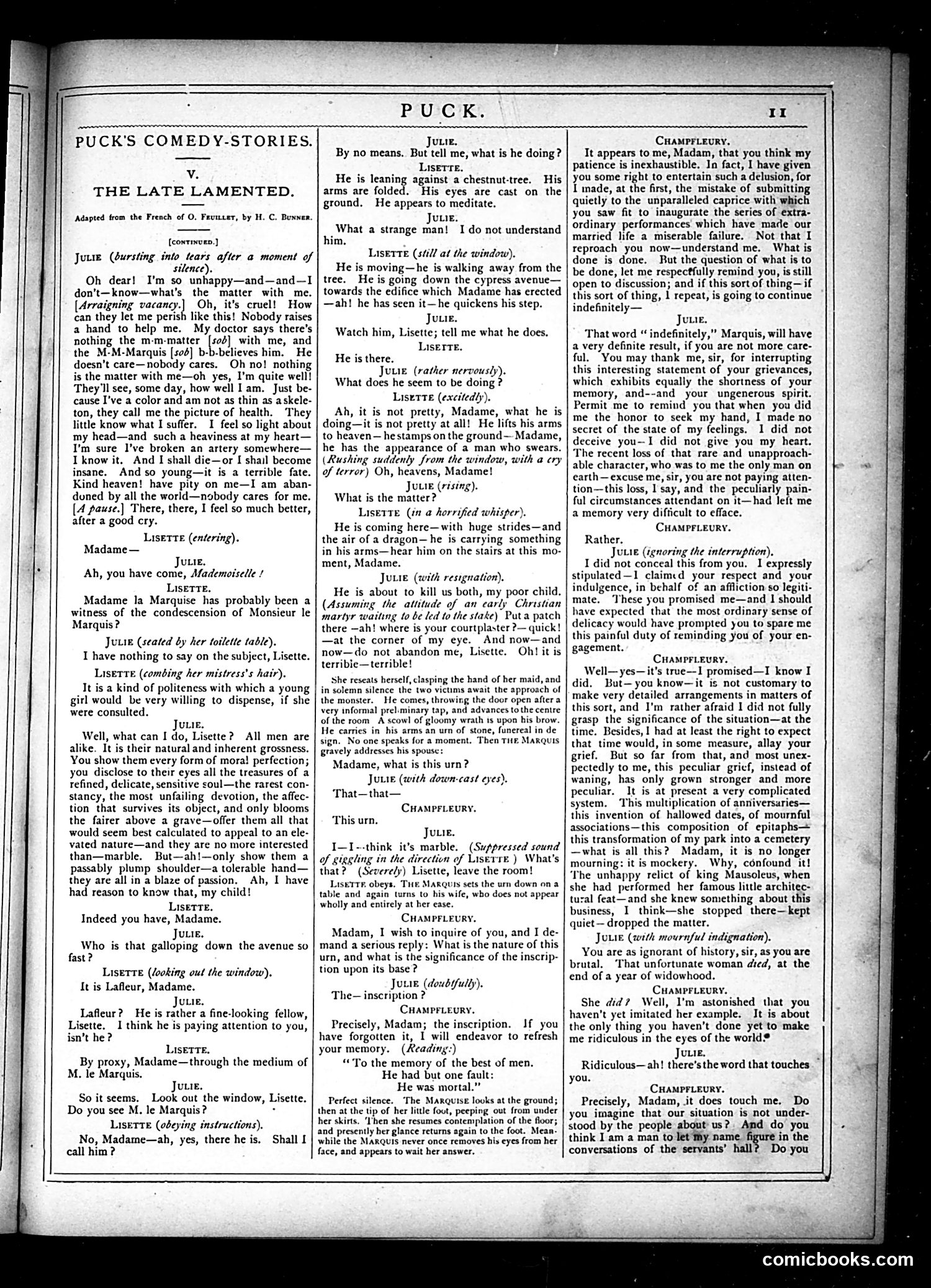
This page presents "The Late Lamented," a comedy-story adapted from French by H.C. Bunner. It's a theatrical dialogue—not a political cartoon—featuring characters including Julie, Lisette, a Marquis, and Chamfleury discussing romantic entanglements and social propriety. The humor derives from familiar theatrical tropes: misunderstandings about a gentleman leaning against a tree, concerns about propriety and reputation, and witty banter about class differences and marital prospects. References to "Madame la Marquise" and concerns about "moral perfection" reflect 19th-century social anxieties about appearance versus reality. This is **not political satire** but rather **entertainment journalism**—Puck publishing serialized comedic fiction for middle-class readers interested in sophisticated social comedy and romantic complications among upper-class characters.
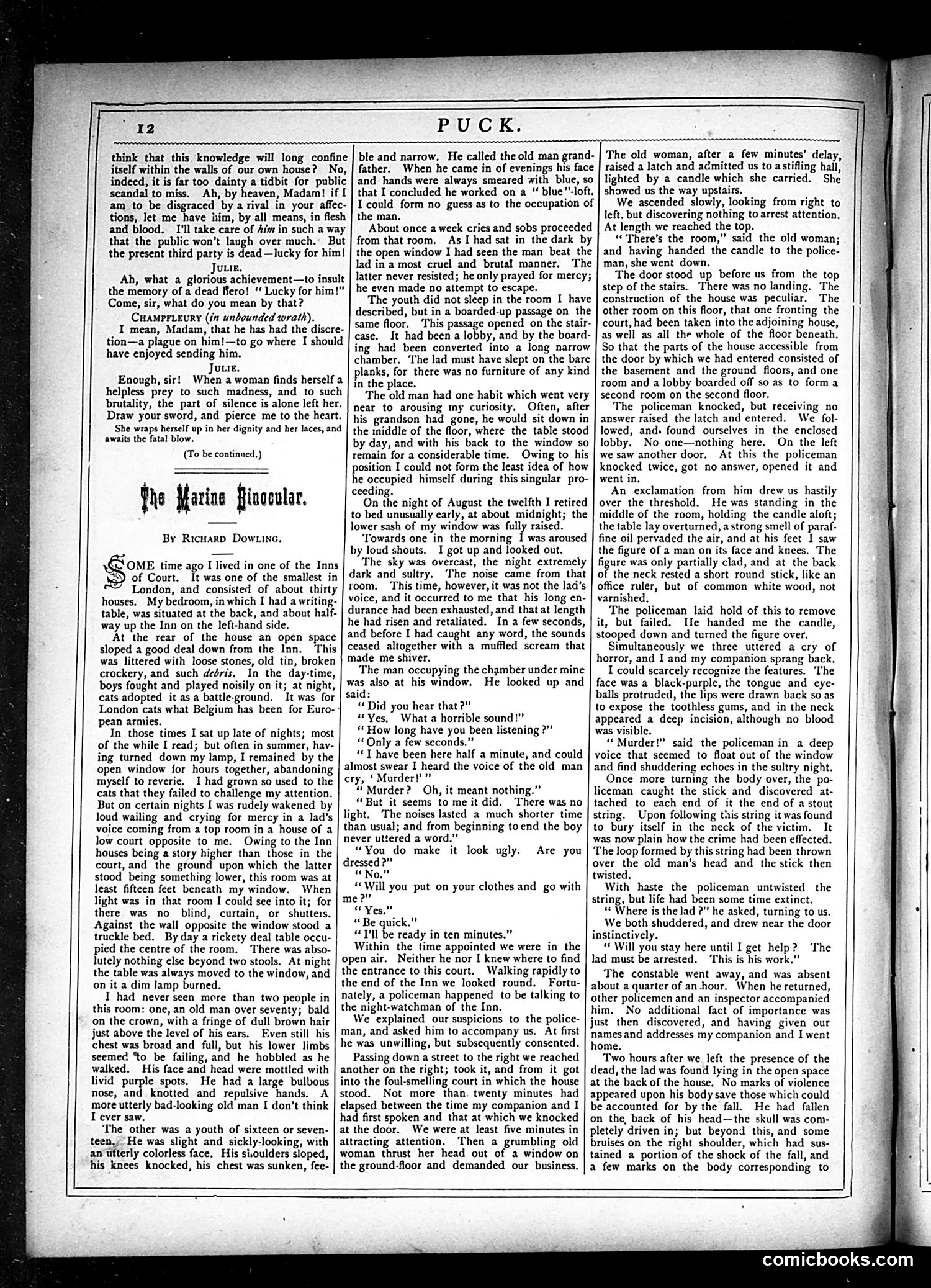
This page contains the beginning of a serialized short story rather than political satire. The narrative describes a narrator living in London's Inns of Court who investigates mysterious noises from a neighboring room—specifically a man's voice at night calling out disturbing phrases like "Murder!" and "Did you hear that?" The story involves the narrator contacting police to investigate the disturbances. A policeman accompanies him to discover the source. The tale appears to be a mystery/horror story playing on Victorian anxieties about urban life and the unknown residents of shared lodgings. This is straightforward fiction rather than political cartoon satire typical of Puck magazine.
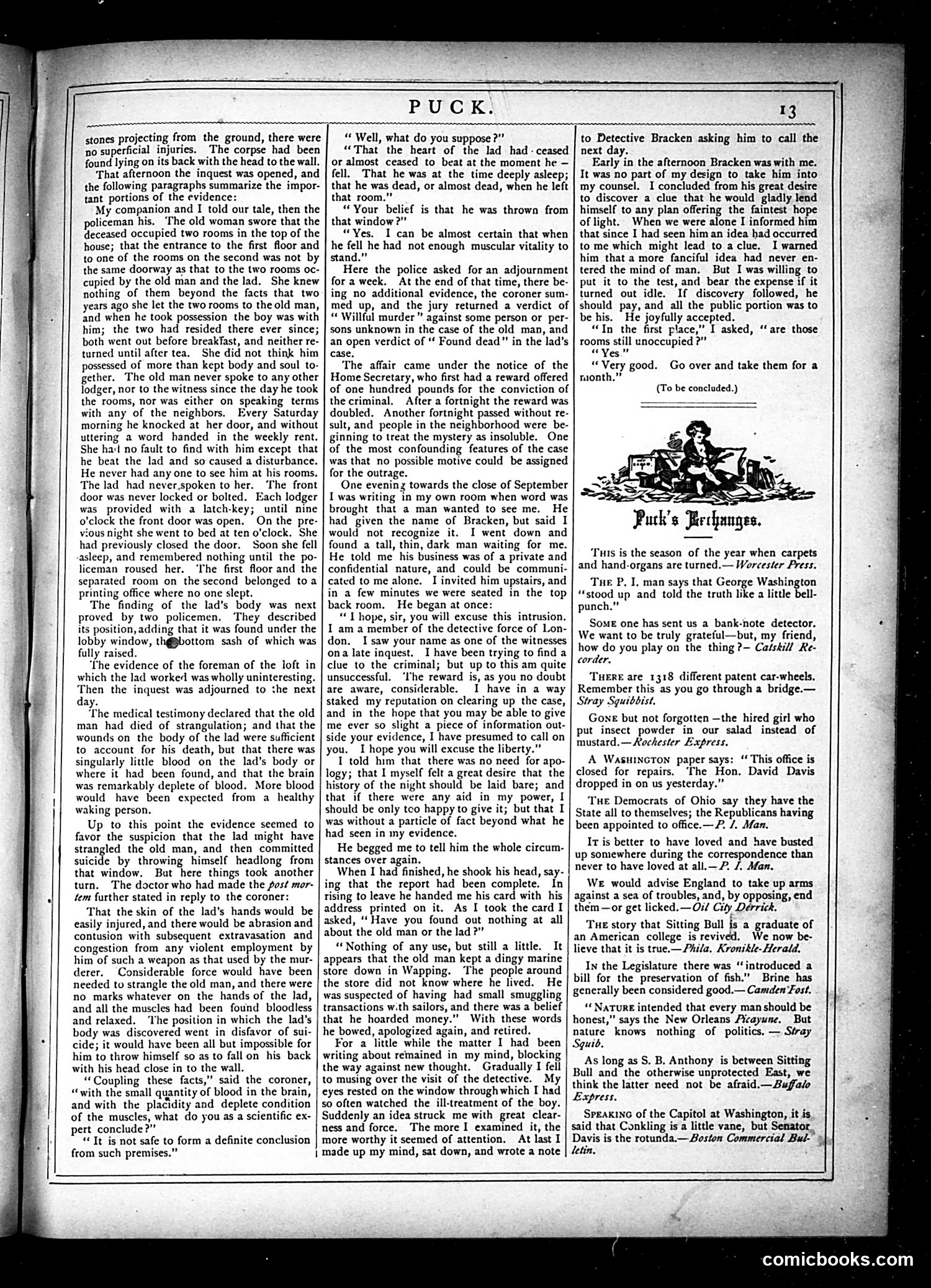
This page from *Puck* magazine consists primarily of text—a serialized detective story titled "A Detective's Dilemma"—rather than political cartoons. The narrative describes a murder investigation involving an old man found dead in mysterious circumstances. The only visible illustration is a small decorative vignette labeled "Puck's Bric-a-bracs," a satirical advice column featuring brief jokes and social commentary. These include quips about carpet cleaning, patent car-wheels, insect powder in salad, office repairs, and Republican politics—typical of *Puck's* light satirical tone mocking everyday absurdities and contemporary political figures. The page is primarily literary rather than visual satire.
This page is primarily a **title page and advertisement section** for Puck's "Pictorial Department," rather than containing political cartoons. The main content announces the opening of a "General Designing Office" headed by **Mr. Joseph Keppler**, who offers illustration services including "Lithographic Portraits" for theatrical and other purposes. The page emphasizes Keppler's skills and reasonable rates. The left column contains brief satirical commentary snippets from Puck's editorial section—short quips about various topics (agricultural reports, British lions, strikebreakers, etc.)—but these are isolated jokes rather than developed cartoons. The address is listed as **13 N. William St.**, the Puck Publishing Company's location. This represents Puck's self-promotion of its in-house artistic services rather than political satire directed outward.
This is primarily an **advertising and notices page** from Puck magazine (page 15), not a satirical cartoon page. The content includes ads for various 1870s products and services: compressed yeast, bitterwater, tailoring, portraits, printing inks, jewelry, and banking bonds. There is one editorial note: a mention of an illustration depicting the **"Mormon's Empty Pillow"** related to Brigham Young's death, which was published as a separate cartoon sheet available for purchase. The page also advertises **Puck's Almanac for 1878** (15 cents, "the most remarkable ever published") and offers back issues and patent filing covers for sale. The Mormon reference suggests contemporaneous anti-Mormon sentiment in American satirical media, though the actual cartoon is not reproduced here—only its availability is noted.
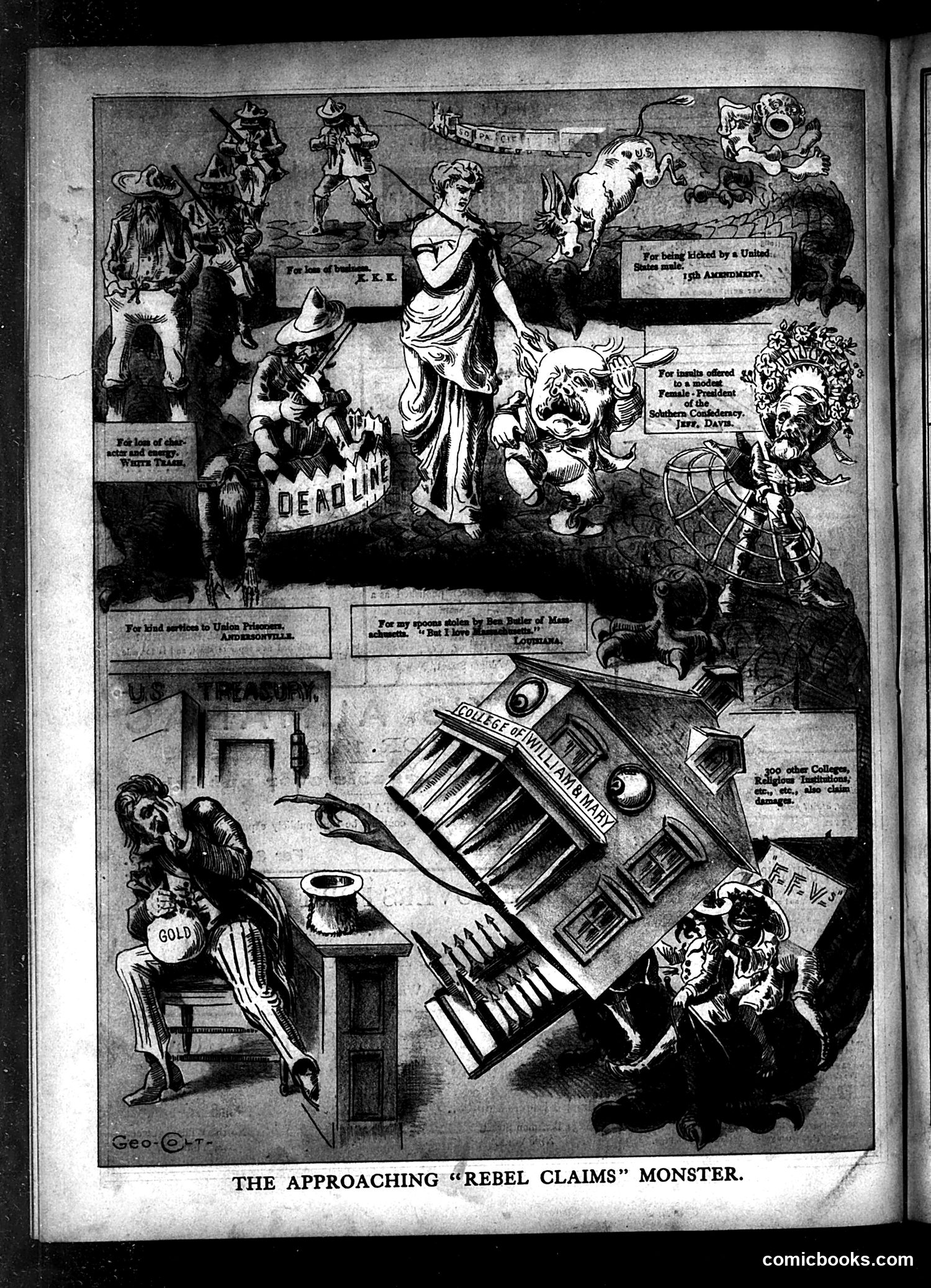
This political cartoon satirizes Southern claims for war reparations following the Civil War. The central female figure (Lady Liberty) stands surrounded by threatening figures representing various "rebel claims"—monetary demands from the defeated South. The monster-like building labeled "REBEL CLAIMS" dominates the lower portion, suggesting these demands are monstrous and threatening. Various caricatured figures around the composition appear to represent different groups making claims—some marked with text boxes referencing specific incidents or damages. The cartoon criticizes what the artist views as excessive or illegitimate Southern demands for compensation. The menacing imagery conveys that these claims pose a danger to the nation's stability and Lady Liberty herself, satirizing the controversy over Reconstruction-era reparations and Southern financial demands on the federal government.