
Puck, 1878-04-24 · page 6 of 16
Puck — April 24, 1878 — page 6: what you’re looking at
What you’re looking at
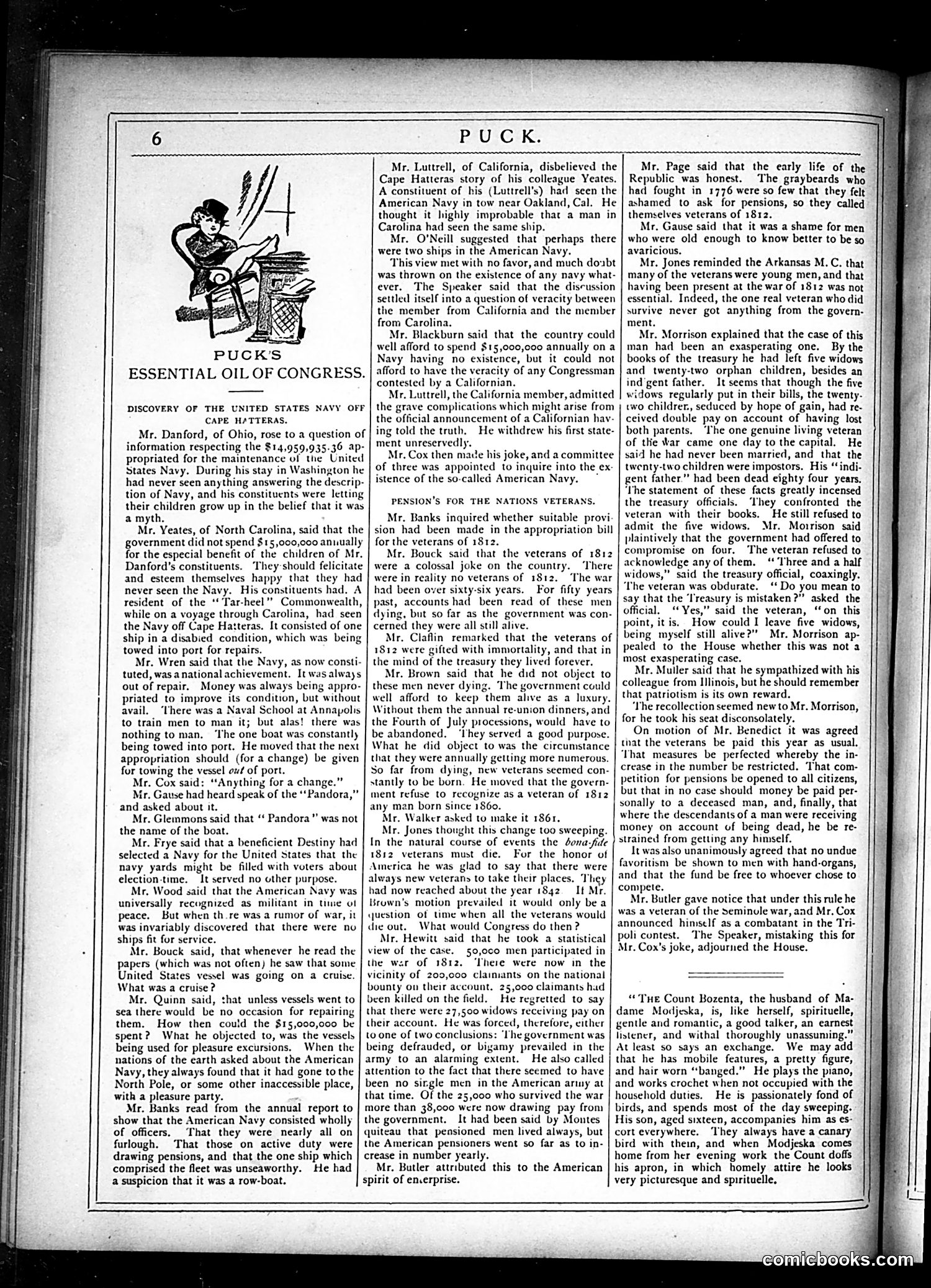
The cartoon depicts "Puck's Essential Oil of Congress" — a satirical mock-advertisement presenting Congress as a patent medicine. The figure shown appears to be a congressmember being "distilled" or processed. The accompanying text discusses Congressional debate over U.S. Navy maintenance funding and veterans' pensions from the War of 1812. Speakers argue about whether the government should spend $15,000 annually supporting aging veterans, with some calling them a "colossal joke" and debating their actual existence. The satire suggests that Congress itself — through its verbose debates and questionable decisions — is the real "medicine" or remedy being sold to the public. The implication is that Congressional rhetoric and dysfunction are the true subject worthy of ridicule, not the substantive policy questions being discussed.
📄 Transcribed text from this page (OCR, searchable)
Machine-transcribed from the original scan — historical spelling and the odd misread are preserved.
PUCK. ESSENTIAL OIL OF CONGRESS. DISCOVERY OF THE UNITED STATES NAVY OFF CAPE HATTERAS. Mr. Danford, of Ohio, rose to a question of information respecting the $14,959,935-36 ap- propriated for the maintenance of the United States Navy. During his stay in Washington he had never seen anything answering the descrip- tion of Navy, and his constituents were letting their children grow up in the belief that it was a myth, Mr. Yeates, of North Carolina, said that the government did not spend $15,000,000 anuually for the especial benefit of the children of Mr. Danford’s constituents. ‘They:should felicitate and esteem themselves happy that they had never seen the Navy. His constituents had. A resident of the ‘ Tar-heel’” Commonwealth, while on a voyage through Carolina, had seen the Navy off Cape Hatteras. It consisted of one ship in a disabied condition, which was being towed into port for repairs. Mr. Wren said that the Navy, as now consti- tuted, was a national achievement. It was always out of repair. Money was always being appro- priated to improve its condition, but without avail. ‘Ihere was a Naval School at Annapolis to train men to man it; but alas! there was nothing to man. ‘The one boat was constantly being towed into port. He moved that the next appropriation should (for a change) be given for towing the vessel of of port. Mr. Cox said: “Anything for a change.” Mr. Gause had heard speak of the “Pandora,” and asked about it. Mr. Glemmons said that ‘ Pandora" was not the name of the boat. Mr. Frye said that a beneficient Destiny had selected a Navy for the United States that the navy yards might be filled with voters about election-time. It served no other purpose. Mr, Wood said that the American Navy was universally recognized as militant in tine of peace. But when th.re was a rumor of war, it was invariably discovered that there were no ships fit for service. Mr. Bouck said, that whenever he read the papers (which was not often) he saw that some United States vessel was going on a cruise. What was a cruise? Mr. Quinn said, that unless vessels went to sea there would be no occasion for repairing them. How then could the $15,000,000 be spent? What he objected to, was the vessels being used for pleasure excursions. When the nations of the earth asked about the American Navy, they always found that it had gone tothe North Pole, or some other inaccessible place, with a pleasure party. Mr. Banks read from the annual report to show that the American Navy consisted wholly of officers, That they were nearly all on furlough. That those on active duty were drawing pensions, and that the one ship which comprised the fleet was unseaworthy. He had a suspicion that it was a row-boat. Mr. Luttrell, of California, disbelieved the Cape Hatteras story of his colleague Yeates. A constituent of his (Luttrell’s) had seen the American Navy in tow near Oakland, Cal. He thought it highly improbable that a man in Carolina had seen the same ship. Mr. O'Neill suggested that perhaps there were two ships in the American Navy. This view met with no favor, and much doubt was thrown on the existence of any navy what- ever. The Speaker said that the discussion settled itself into a question of veracity between the member from California and the member from Carolina. Mr. Blackburn said that the country could well afford to spend $15,000,000 annually on a Navy having no existence, but it could not afford to have the veracity of any Congressman contested by a Californian, Mr. Luttrell, the California member, admitted the grave complications which might arise from the official announcement of a Californian hav- ing told the truth, He withdrew his first state- ment unreservedly, Mr. Cox then made his joke, and a committee of three was appointed to inquire into the ex- istence of the so-called American Navy. ~ PENSION’S FOR THE NATIONS VETERANS. Mr. Banks inquired whether suitable provi sion had been made in the appropriation bill for the veterans of 1812. Mr. Bouck said that the veterans of 1812 were a colossal joke on the country. ‘There were in reality no veterans of 1812. ‘The war had been over sixty-six years. For fifty years past, accounts had been read of these men dying, but so far as the government was con- cerned they were all still alive. Mr, Claflin remarked that the veterans of 1812 were gifted with immortality, and that in the mind of the treasury they lived forever, Mr. Brown said that he did not object to these men never dying. The government could well afford to keep them alive as a luxury. ithout them the annual re-union dinners, and the Fourth of July processions, would have to be abandoned. ‘They served a good purpose. What he did object to was the circumstance that they were annually getting more numerous. So far from dying, new veterans seemed con- stantly to be born. He moved that the govern- ment refuse to recognize as a veteran of 1812 any man born since 1860. Mr. Walker asked to make it 1861. Mr. Jones thought this change too sweeping. In the natural course of events the dona-fide 1812 veterans must die. For the honor of America he was glad to say that there were always new veterans to take their places. They had now reached about the year 1832, If Mr. Brown's motion prevailed it would only be a question of time when all the veterans would die out, What would Congress do then ? Mr. Hewitt said that he took a statistical view of the case. 50,0c0 men participated in the war of 1812. ‘There were now in the vicinity of 200,000 claimants on the national bounty on their account, 25,000 claimants had been killed on the field. He regretted to say that there were 27,500 widows receiving pay on their account. He was forced, therefore, either to one of two conclusions: ‘The government was being defrauded, or bigamy prevailed in the army to an alarming extent. He also called attention to the fact that there seemed to have been no single men in the American army at that time. Of the 25,000 who survived the war more than 38,000 were now drawing pay from the government. It had been said by Montes quiteau that pensioned men lived always, but the American pensioners went so far as to in- crease in number yearly. Mr. Butler attributed this to the American spirit of enerprise. Mr. Page said that the early life of the Republic was honest. The graybeards who had fought in 1776 were so few that they felt ashamed to ask for pensions, so they called themselves veterans of 1812. Mr. Gause said that it was a shame for men who were old enough to know better to be so avaricious. Mr. Jones reminded the Arkansas M.C. that many of the veterans were young men, and that having been present at the war of 1812 was not essential. Indeed, the one real veteran who did survive never got anything from the govern- ment. Mr. Morrison explained that the case of this man had been an exasperating one. By the books of the treasury he had left five widows and twenty-two orphan children, besides an ind'gent father. It seems that though the five widows regularly put in their bills, the twenty. two childrer,, seduced by hope of gain, had re- ceived double pay on account of having lost both parents, ‘I'he one genuine living veteran of the War came one day to the capital. He said he had never been married, and that the twenty-two children were impostors. His ‘‘indi- gent father.” had been dead eighty four years, ‘lhe statement of these facts greatly incensed the treasury officials. ‘hey confronted the veteran with their books. He still refused to admit the five widows. Mr. Morrison said plaintively that the government had offered to compromise on four. The veteran refused to acknowledge any of them. “Three and a half widows,” said the treasury official, coaxingly. ‘The veteran was obdurate. ‘Do you mean to say that the ‘Treasury is mistaken?” asked the official. “Yes,” said the veteran, “on this point, it is. How could I leave five widows, being myself still alive?” Mr. Morrison ap- pealed to the House whether this was not a most exasperating case. Mr. Muller said that he sympathized with his colleague from Illinois, but he should remember that patriotism is its own reward. ‘The recollection seemed new to Mr. Morrison, for he took his seat disconsolately. On motion of Mr. Benedict it was agreed that the veterans be paid this year as usual. ‘That measures be perfected whereby the in- crease in the number be restricted. ‘That com- petition for pensions be opened to all citizens, but that in no case should money be paid per- sonally to a deceased man, and, finally, that where the descendants of a man were receiving money on account of being dead, he be re- strained from getting any himself. It was also unanimously agreed that no undue favoritism be shown to men with hand-organs, and that the fund be free to whoever chose to compete. Mr. Butler gave notice that under this rule he was a veteran of the Seminole war, and Mr. Cox announced himself as a combatant in the Tri- poli contest. The Speaker, mistaking this for Mr. Cox's joke, adjourned the House. “Tue Count Bozenta, the husband of Ma- dame Modjeska, like herself, spirituelle, gentle and romantic, a good talker, an earnest listener, and withal thoroughly unassuming.” At least so says an exchange. We may add that he has mobile features, a pretty figure, and hair worn “banged.” He plays the piano, and works crochet when not occupied with the household duties. He is passionately fond of birds, and spends most of the day sweeping. His son, aged sixteen, accompanies him as es- cort everywhere. ‘They always have a canary bird with thein, and when Modjeska comes home from her evening work the Count dofis his apron, in which homely attire he looks very picturesque and spirituelle,