
Puck, 1878-04-24 · page 4 of 16
Puck — April 24, 1878 — page 4: what you’re looking at
What you’re looking at
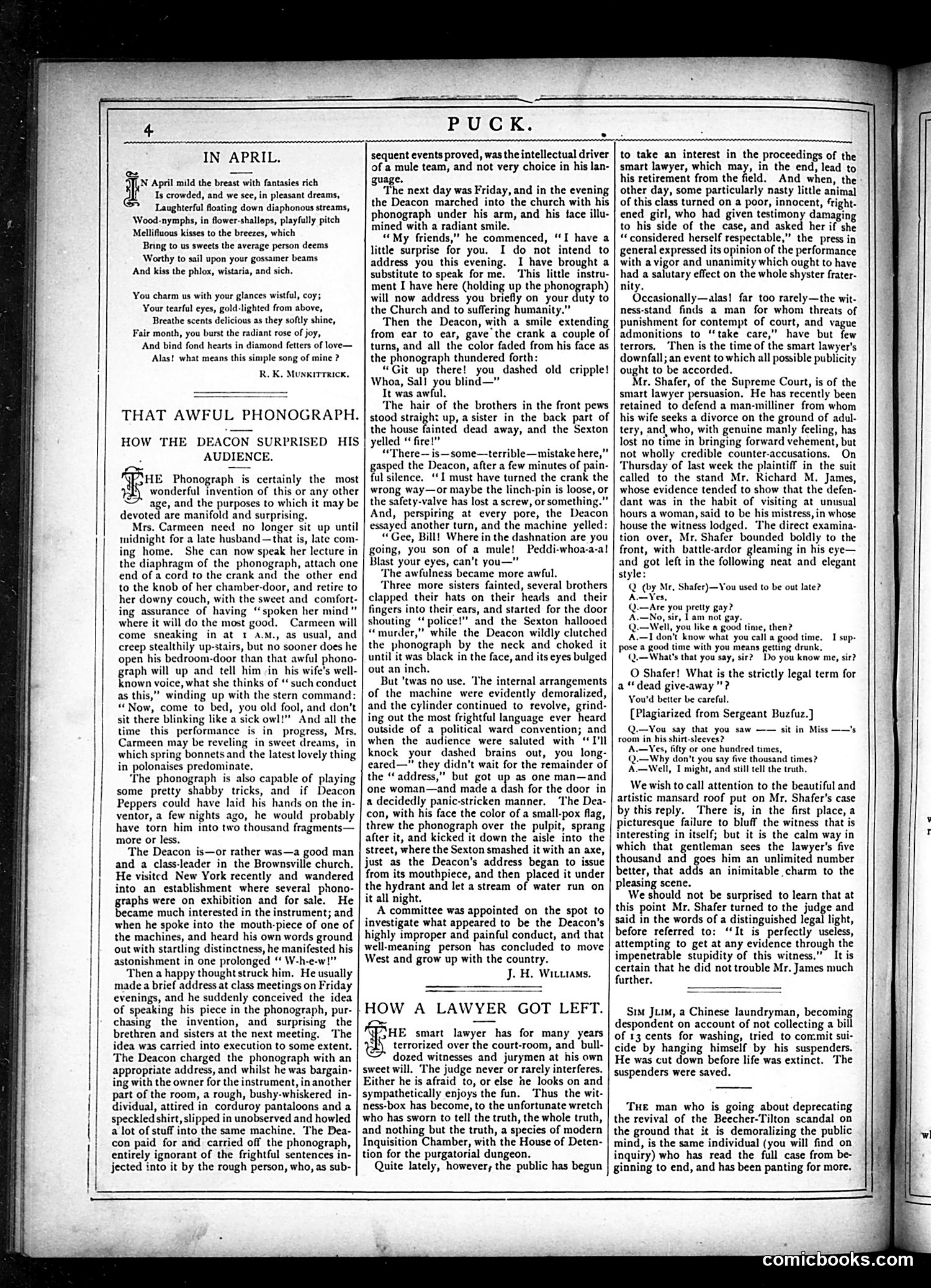
This page contains three distinct satirical pieces: 1. **"That Awful Phonograph"** - A humorous narrative about a Deacon who brings a phonograph to church. The joke centers on the machine malfunctioning catastrophically during his demonstration, with the cylinder producing increasingly bizarre and offensive sounds that horrify the congregation. The satire mocks both the Deacon's pride in the new technology and early phonographs' poor audio quality and unreliability. 2. **"How a Lawyer Got Left"** - A brief anecdote about a lawyer intimidated by courtroom witnesses and jurymen, ultimately losing his case due to his nervousness—satirizing overconfident legal practitioners brought down by circumstance. 3. **"Sir Jim"** - A short item about a Chinese laundryman's attempted suicide, focusing on the absurdity of the situation rather than social commentary. The page primarily satirizes technological pretension and professional incompetence through humor.
📄 Transcribed text from this page (OCR, searchable)
Machine-transcribed from the original scan — historical spelling and the odd misread are preserved.
PUCK. IN APRIL. N April mild the breast with fantasies rich Is crowded, and we sce, in pleasant dreams, Laughterful floating down diaphonous streams, ‘Wood-nymphs, in flower-shalleps, playfully pitch Mellifluous kisses to the breezes, which Bring to us sweets the average person deems Worthy to sail upon your gossamer beams And kiss the phlox, wistaria, and sich. You charm us with your glances wistful, coy; Your tearful eyes, gold-lighted from above, Breathe scents delicious as they softly shine, Fair month, you burst the radiant rose of joy, And bind fond hearts in diamond fetters of love— Alas! what means this simple song of mine ? R. K. Munxirrricx, THAT AWFUL PHONOGRAPH. HOW THE DEACON SURPRISED HIS AUDIENCE. \ HE Phonograph is certainly the most Ey wonderful invention of this or any other < age, and the purposes to which it may be devoted are manifold and surprising. Mrs, Carmeen need no longer sit up until midnight for a late husband —that is, late com- ing home. She can now speak her lecture in the diaphragm of the phonograph, attach one end of a cord to the crank and the other end to the knob of her chamber-door, and retire to her downy couch, with the sweet and comfort- ing assurance of having “spoken her mind” where it will do the most good. Carmeen will come sneaking in at 1 a.M., as usual, and creep stealthily up-stairs, but no sooner does he open his bedroom-door than that awful phono- graph will up and tell him in his wife's well- known voice, what she thinks of “ such conduct as this,” winding up with the stern command: “Now, come to bed, you old fool, and don't sit there blinking like a sick owl!” And all the time this performance is in progress, Mrs. Carmeen may be reveling in sweet dreams, in which spring bonnets and the latest lovely thing in polonaises predominate. The phonograph is also capable of playing some pretty shabby tricks, and if Deacon Peppers could have laid his hands on the in- ventor, a few nights ago, he would probably have torn him into two thousand fragments— more or less. The Deacon is—or rather was—a good man and a class-leader in the Brownsville church. He visited New York recently and wandered into an establishment where several phono- graphs were on exhibition and for sale. He became much interested in the instrument; and when he spoke into the mouth-piece of one of the machines, and heard his own words ground out with startling distinctness, he manifested his astonishment in one prolonged “ W-h-e-w!” ‘Then a happy thought struck him. He usually made a brief address at class meetings on Friday evenings, and he suddenly conceived the idea of speaking his piece in the phonograph, pur- chasing the invention, and surprising the brethren and sisters at the next meeting. The idea was carried into execution to some extent. The Deacon charged the phonograph with an appropriate address, and whilst he was bargain- ing with the owner for the instrument, in another part of the room, a rough, bushy-whiskered in- dividual, attired in corduroy pantaloons and a speckled shirt, slipped in unobserved and howled a lot of stuff into the same machine. The Dea- con paid for and carried off the phonograph, entirely ignorant of the frightful sentences in- jected into it by the rough person, who, as sub- sequent events proved, was the intellectual driver of a mule team, and not very choice in his lan- guage. The next day was Friday, and in the evening the Deacon marched into the church with his phonograph under his arm, and his face illu- mined with a radiant smile. “My friends,” he commenced, “I have a little surprise for you. I do not intend to address you this evening. I have brought a substitute to speak forme. This little instru- ment I have here (holding up the phonograph) will now address you briefly on your duty to the Church and to suffering humanity.” Then the Deacon, with a smile extending from ear to ear, gave the crank a couple of turns, and all the color faded from his face as the phonograph thundered forth: “Git up there! you dashed old cripple! Whoa, Sal! you blind—"” It was awful. The hair of the brothers in the front pews stood straight up, a sister in the back part of the house fainted dead away, and the Sexton yelled “fire!” “There—is—some—terrible—mistake here,” gasped the Deacon, after a few minutes of pain- ful silence, ‘I must have turned the crank the wrong way—or maybe the linch-pin is loose, or the safety-valve has lost a screw, or something.” And, perspiring at every pore, the Deacon essayed another turn, and the machine yelled: “Gee, Bill! Where in the dashnation are you going, you son of a mule! Peddi-whoa-a-al Blast your eyes, can’t you—"" ‘The awfulness became more awful. Three more sisters fainted, several brothers clapped their hats on their heads and their fingers into their ears, and started for the door shouting “police!” and the Sexton hallooed “murder,” while the Deacon wildly clutched the phonograph by the neck and choked it until it was black in the face, and its eyes bulged out an inch. But 'twas no use, The internal arrangements of the machine were evidently demoralized, and the cylinder continued to revolve, grind- ing out the most frightful language ever heard outside of a political ward convention; and when the audience were saluted with ‘I'll knock your dashed brains out, you long- eared—”" they didn’t wait for the remainder of the “address,” but got up as one man—and one woman—and made a dash for the door in a decidedly panic-stricken manner. ‘The Dea- con, with his face the color of a small-pox flag, threw the phonograph over the pulpit, sprang after it, and kicked it down the aisle into the street, where the Sexton smashed it with an axe, just as the Deacon’s address began to issue from its mouthpiece, and then placed it under the hydrant and let a stream of water run on it all night. A committee was appointed on the spot to investigate what appeared to be the Deacon’s highly improper and painful conduct, and that well-meaning person has concluded to move West and grow up with the country. J. H. Wituiams. HOW A LAWYER GOT LEFT. AHE smart lawyer has for many years terrorized over the court-room, and bull- dozed witnesses and jurymen at his own sweet will. The judge never or rarely interferes. Either he is afraid to, or else he looks on and sympathetically enjoys the fun. Thus the wit- ness-box has become, to the unfortunate wretch who has sworn to tell the truth, the whole truth, and nothing but the truth, a species of modern Inquisition Chamber, with the House of Deten- tion for the purgatorial dungeon. Quite lately, however, the public has begun to take an interest in the proceedings of the smart lawyer, which may, in the end, lead to his retirement from the field. And when, the other day, some particularly nasty little animal of this class turned on a poor, innocent, ‘right. ened girl, who had given testimony damaging to his side of the case, and asked her if she “considered herself respectable,” the press in general expressed its opinion of the performance with a vigor and unanimity which ought to have had a salutary effect on the whole shyster frater- nity. Occasionally—alas! far too rarely—the wit- ness-stand finds a man for whom threats of punishment for contempt of court, and vague admonitions to ‘take care," have but few terrors. ‘Then is the time of the smart lawyer's downfall; an event to which all possible publicity ought to be accorded. Mr. Shafer, of the Supreme Court, is of the smart lawyer persuasion. He has recently been retained to defend a man-milliner from whom his wife seeks a divorce on the ground of adul- tery, and who, with genuine manly feeling, has lost no time in bringing forward vehement, but not wholly credible counter-accusations. On ‘Thursday of last week the plaintiff in the suit called to the stand Mr. Richard M. James, whose evidence tended to show that the defen- dant was in the habit of visiting at unusual hours a woman, said to be his mistress, in whose house the witness lodged. The direct examina- tion over, Mr. Shafer bounded boldly to the front, with battle-ardor gleaming in his eye— and got left in the following neat and elegant style: Q (by Mr, Shafer)—You used to be out late? A—Yes. ‘Are you pretty gay? Xo, sir, Lam not gay. Well, you like a good time, then? A.—I don't know what you call a good time. pose a good time with you means getting drunk, (2.—What's that you say, sir? Do you know me, sir? O Shafer! What is the strictly legal term for a “dead give-away"? You'd better be careful. [Plagiarized from Sergeant Buzfuz.] Q.—You say that you saw —— sit in Miss —'s in his shirt-sleeves? ty or one hundred times, Q.—Why don’t you say five thousand times? A.—Well, I might, and still tell the truth, Tsup- We wish to call attention to the beautiful and artistic mansard roof put on Mr. Shafer’s case by this reply. There is, in the first place, a picturesque failure to bluff the witness that is interesting in itself; but it is the calm way in which that gentleman sees the lawyer's five thousand and goes him an unlimited number better, that adds an inimitable charm to the pleasing scene. We should not be surprised to learn that at this point Mr. Shafer turned to the judge and said in the words of a distinguished legal light, before referred to: ‘It is perfectly useless, attempting to get at any evidence through the impenetrable stupidity of this witness.” It is certain that he did not trouble Mr. James much further. Sim Jum, a Chinese laundryman, becoming despondent on account of not collecting a bill of 13 cents for washing, tried to commit sui- cide by hanging himself by his suspenders. He was cut down before life was extinct. The suspenders were saved. THE man who is going about deprecating the revival of the Beecher-Tilton scandal on the ground that it is demoralizing the public mind, is the same individual (you will find on inquiry) who has read the full case from be- ginning to end, and has been panting for more. Ccomicbooks.com |