
Puck, 1878-04-24 · page 7 of 16
Puck — April 24, 1878 — page 7: what you’re looking at
What you’re looking at
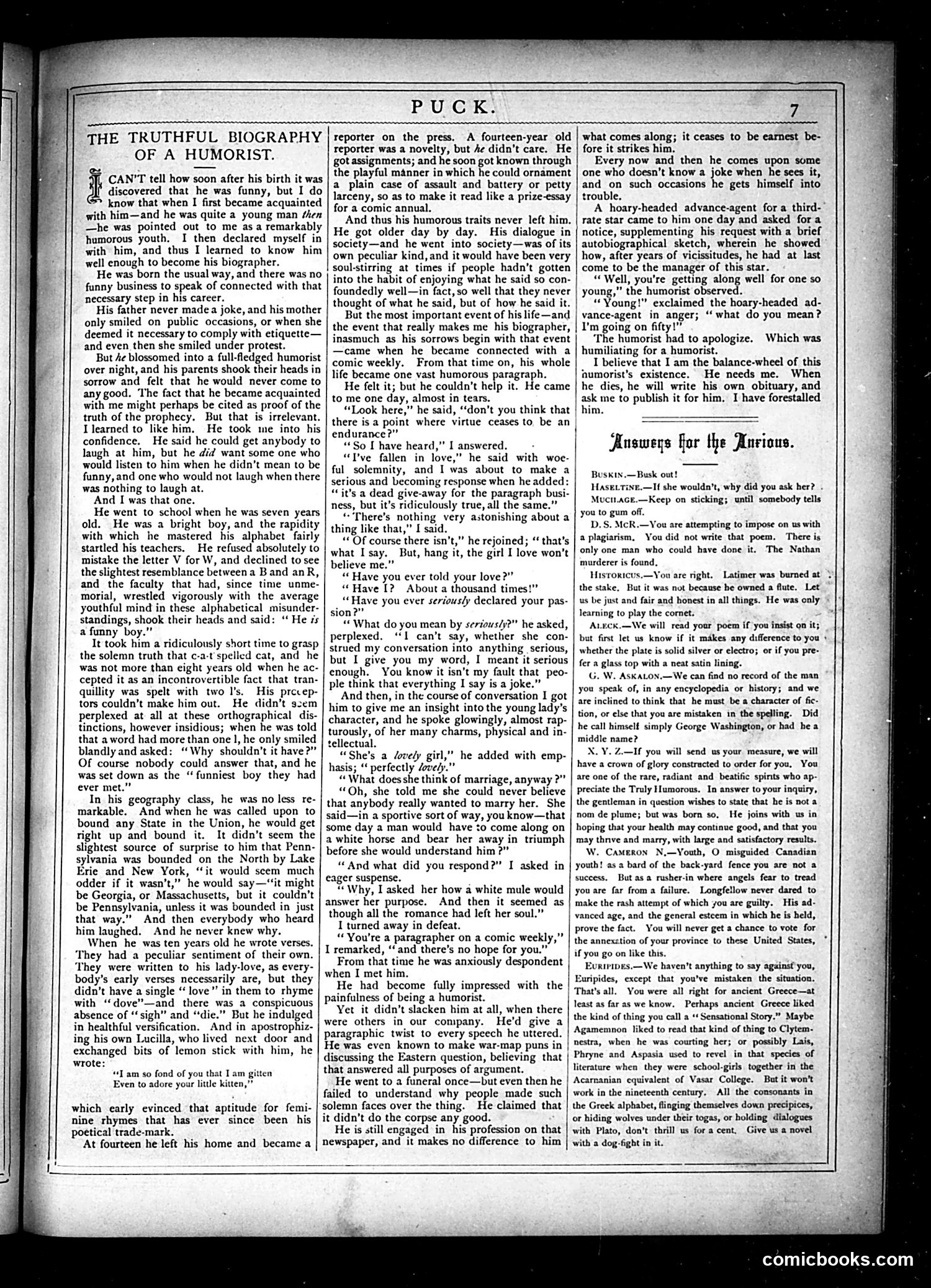
This page contains **"The Truthful Biography of a Humorist,"** a biographical article about an unnamed humor writer. The piece is satirical, describing how the subject became a humorist through various life experiences—falling in love, becoming disillusioned, and developing a cynical wit. The right column features **"Answers for the Curious,"** a Q&A advice section addressing readers' questions about romance, writing, and social matters. **No political cartoons appear on this page.** The satire is literary rather than visual—mocking the pretensions of professional humorists who claim deep suffering inspires their comedy, while actually their wit stems from superficial observations and failed romantic ideals. The piece gently ridicules both the humorist's self-importance and readers' gullible admiration of such figures.
📄 Transcribed text from this page (OCR, searchable)
Machine-transcribed from the original scan — historical spelling and the odd misread are preserved.
THE TRUTHFUL BIOGRAPHY OF A HUMORIST. CAN'T tell how soon after his birth it was discovered that he was funny, but I do > know that when I first became acquainted with him—and he was quite a young man then —he was pointed out to me asa remarkably humorous youth, I then declared myself in with him, and thus I learned to know him well enough to become his biographer. He was born the usual way, and there was no funny business to speak of connected with that necessary step in his career. His father never made a joke, and his mother only smiled on public occasions, or when she deemed it necessary to comply with etiquette— and even then she smiled under protest. But Ae blossomed into a full-fledged humorist over night, and his parents shook their heads in sorrow and felt that he would never come to any good. The fact that he became acquainted with me might perhaps be cited as proof of the truth of the prophecy. But that is irrelevant. I learned to like him. He took me into his confidence. He said he could get anybody to laugh at him, but he did want some one who would listen to him when he didn’t mean to be funny, and one who would not laugh when there was nothing to laugh at. And I was that one. He went to school when he was seven years old. He was a bright boy, and the rapidity with which he mastered his alphabet fairly startled his teachers. He refused absolutely to mistake the letter V for W, and declined to see the slightest resemblance between a Band anR, and the faculty that had, since time unme- morial, wrestled vigorously with the average youthful mind in these alphabetical misunder- standings, shook their heads and said: ‘ He #s a funny boy.” It took him a ridiculously short time to grasp the solemn truth that c-a-t spelled cat, and he was not more than eight years old when he ac- cepted it as an incontrovertible fact that tran- quillity was spelt with two I's. His prce tors couldn’t make him out. He didn’t 3. perplexed at all at these orthographical di tinctions, however insidious; when he was told that a word had more than one 1, he only smiled blandly and asked: “Why shouldn't it have?” Of course nobody could answer that, and he was set down as the “ funniest boy they had ever met.”” In his geography class, he was no less re- markable. And when he was called upon to bound any State in the Union, he would get right up and bound it. It didn’t seem the slightest source of surprise to him that Penn- sylvania was bounded on the North by Lake Erie and New York, ‘it would scem much odder if it wasn’t,” he would say—‘it might be Georgia, or Massachusetts, but it couldn’t be Pennsylvania, unless it was bounded in just that way.” And then everybody who heard him laughed. And he never knew why. When he was ten years old he wrote verses. They had a peculiar sentiment of their own. ‘They were written to his lady-love, as every- body’s early verses necessarily are, but they didn’t have a single “love” in them to rhyme with ‘‘dove’—and there was a conspicuous absence of “sigh” and “die.” But he indulged in healthful versification. And in apostrophiz- ing his own Lucilla, who lived next door and exchanged bits of lemon stick with him, he wrote: “1 am so fond of you that I am gitten Even to adore your little kitten,” which early evinced that aptitude for femi- nine rhymes that has ever since been his poetical trade-mark. At fourteen he left his home and became a reporter on the press, A fourteen-year old reporter was a novelty, but Ae didn’t care. He got assignments; and he soon got known through the playful manner in which he could ornament a plain case of assault and battery or petty larceny, so as to make it read like a prize-essay for a comic annual. And thus his humorous traits never left him. He got older day by day. His dialogue in society—and he went into society—was of its own peculiar kind, and it would have been very soul-stirring at times if people hadn't gotten into the habit of enjoying what he said so con- foundedly well—in fact, so well that they never thought of what he said, but of how he said it. | But the most important event of his life—and the event that really makes me his biographer, inasmuch as his sorrows begin with that event —came when he became connected with a comic weekly. From that time on, his whole life became one vast humorous paragraph. He felt it; but he couldn’t help it. He came to me one day, almost in tears. “Look here,” he said, ‘‘don’t you think that there is a point where virtue ceases to. be an endurance?” “So [ have heard,” I answered, ‘ “I’ve fallen in love,” he said with woe- ful solemnity, and I was about to make a serious and becoming response when he added: “it's a dead give-away for the paragraph busi- ness, but it’s ridiculously true, all the same.” “There's nothing very astonishing about a thing like that,” I said. “© Of course there isn’t, what I say. But, hang it, believe me.” “Have you ever told your love?” “Have [? About a thousand times!” “Have you ever seriously declared your pas- sion?” “What do you mean by serious/y?" he asked, perplexed. “I can’t say, whether she con- strued my conversation into anything serious, but I give you my word, I meant it serious enough. You know it isn’t my fault that peo- ple think that everything I say is a joke.” And then, in the course of conversation I got him to give me an insight into the young lady’s character, and he spoke glowingly, almost rap- turously, of her many charms, physical and in- tellectual. “She's a ovely girl,” he added with emp- hasis; “ perfectly éovely.” “What does she think of marriage, anyway ?” “Oh, she told me she could never believe that anybody really wanted to marry her. She said—in a sportive sort of way, you know—that some day a man would have to come along on awhite horse and bear her away in triumph before she would understand him ?” “And what did you respond?” I asked in eager suspense. “Why, I asked her how a white mule would answer her purpose. And then it seemed as though all the romance had left her soul.” I turned away in defeat. “You're a paragrapher on a comic weekly,” I remarked, “and there’s no hope for you.” From that time he was anxiously despondent when I met him. He had become fully impressed with the painfulness of being a humorist. Yet it didn’t slacken him at all, when there were others in our company. He'd give a paragraphic twist to every speech he uttered. he rejoined; “ that’s the girl I love won't He was even known to make war-map puns in | discussing the Eastern question, believing that that answered all purposes of argument. He went to a funeral once—but even then he failed to understand why people made such solemn faces over the thing. He claimed that | it didn’t do the corpse any good. He is still engaged in his profession on that newspaper, and it makes no difference to him what comes along; it ceases to be earnest be- fore it strikes him. Every now and then he comes upon some ‘one who doesn’t know a joke when he sees it, and on such occasions he gets himself into trouble, ‘A hoary-headed advance-agent for a third- rate star came to him one day and asked for a notice, supplementing his request with a brief autobiographical sketch, wherein he showed how, after years of vicissitudes, he had at last come to be the manager of this star. “Well, you're getting along well for one so young,” the humorist observed. “Young!” exclaimed the hoary-headed ad- vance-agent in anger; ‘what do you mean? I'm going on fifty!” ‘The humorist had to apologize. humiliating for a humorist. I believe that I am the balance-wheel of this fumorist’s existence. He needs me. When he dies, he will write his own obituary, and ask me to publish it for him, I have forestalled him. Which was Answers for the Anrious. Buskin.—Busk out! If she wouldn't, why did you ask her? . Muctt.aGe.—Keep on sticking; until somebody tells you to gum off, . S. McR.—You are attempting to impose on us with a plagiarism, You did not write that poem, There is only one man who could have done it. The Nathan murderer is found, Hisroxicus.—You are right. Latimer was burned at the stake, But it was not because he owned a flute. Let us be just and fair and honest in all things. He was only learning to play the cornet. ALzck.—We will read your poem if you insist on but first let us know if it makes any difference to you + whether the plate is solid silver or electro; or if you pre- fer a glass top with a neat satin lining. G. W. Askatox.—We can find no record of the man you speak of, in any encyclopedia or history; and we are inclined to think that he must be a character of fic- tion, or else that you are mistaken in the spelling. Did he call himself simply George Washington, or had he a middle name? X.Y. Z.—If you will send us your measure, we will have a crown of glory constructed to order for you. You are one of the rare, radiant and beatific spints who ap- preciate the Truly Humorous. In answer to your inquiry, the gentleman in question wishes to state that he is not a nom de plume; but was born so, He joins with us in hoping that your health may continue good, and that you may thnve and marry, with large and satisfactory results. W. Cameron N,—Youth, O misguided Canadian youth! asa bard of the back-yard fence you are not a success. But as a rusher-in where angels fear to tread you are far froma failure. Longfellow never dared to make the rash attempt of which you are guilty. His ad- vanced age, and the general esteem in which he is held, prove the fact. You will never get a chance to vote for the annexstion of your province to these United States, if you go on like this. Euriripes.—We haven't anything to say against you, Euripides, except that you've mistaken the situation. ‘That's all. You were all right for ancient Greece—at least as far as we know. Pethaps ancient Greece liked the kind of thing you call a ‘Sensational Story.” Maybe Agamemnon liked to read that kind of thing to Clytem- nestra, when he was courting her; or possibly Lais, Phryne and Aspasia used to revel in that species of literature when they were school-girls together in the Acarnanian equivalent of Vasar College. But it won't work in the nineteenth century, All the consonants in the Greek alphabet, flinging themselves down precipices, or hiding wolves under their togas, or holding dialogues with Plato, don’t thrill us fora cent, Give us a novel with a dog-fight in it. comicbooks.com