
Puck, 1878-04-24 · page 11 of 16
Puck — April 24, 1878 — page 11: what you’re looking at
What you’re looking at
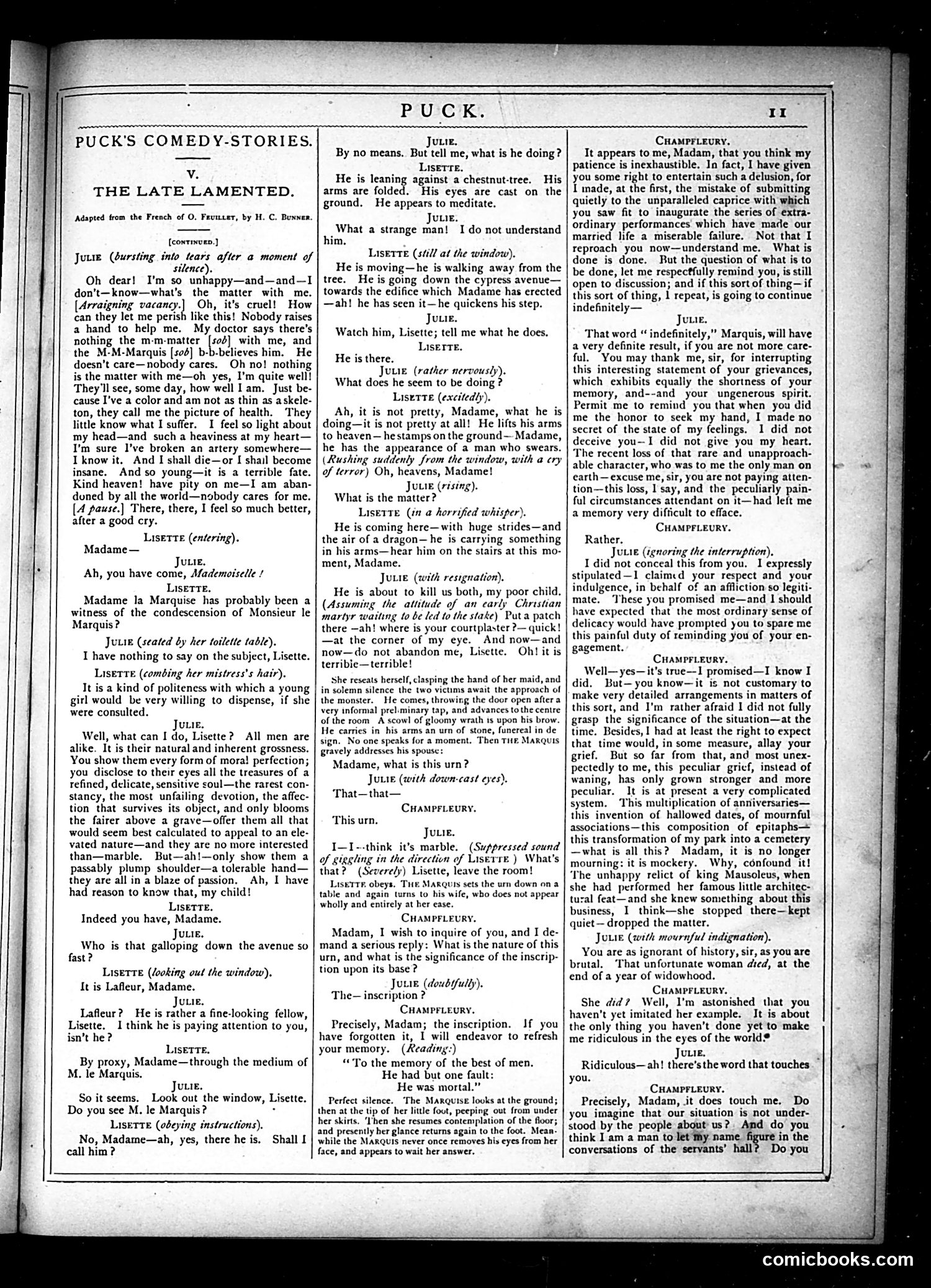
This page presents "The Late Lamented," a comedy-story adapted from French by H.C. Bunner. It's a theatrical dialogue—not a political cartoon—featuring characters including Julie, Lisette, a Marquis, and Chamfleury discussing romantic entanglements and social propriety. The humor derives from familiar theatrical tropes: misunderstandings about a gentleman leaning against a tree, concerns about propriety and reputation, and witty banter about class differences and marital prospects. References to "Madame la Marquise" and concerns about "moral perfection" reflect 19th-century social anxieties about appearance versus reality. This is **not political satire** but rather **entertainment journalism**—Puck publishing serialized comedic fiction for middle-class readers interested in sophisticated social comedy and romantic complications among upper-class characters.
📄 Transcribed text from this page (OCR, searchable)
Machine-transcribed from the original scan — historical spelling and the odd misread are preserved.
PUCK. PUCK’S COMEDY-STORIES. Vv. THE LATE LAMENTED. arms are folded. —= ground. He appears to meditate. ‘Adapted from the French of O. Fruuter, by H.C. Bunwer. [conrmven.] Juuie (bursting into tears after a moment of silence). Oh dear! I'm so unhappy—and—and—I | t don't—know—what’s the matter with me. | t [Arraigning vacancy] Oh, it’s cruel! How can they let me perish like this! Nobody raises a hand to help me. My doctor says there's nothing the m-m-matter wa bad with me, and the M-M-Marquis [so] b-b-believes him. He doesn’t care—nobady cares. Oh no! nothing is the matter with me—oh yes, I'm quite well! They'll see, some day, how well Iam. Just be- cause I’ve a color and am not as thin as askele- ton, they call me the picture of health. ‘They little know what I suffer. I feel so light about my head—and such a heaviness at my heart— I'm sure I’ve broken an artery somewhere— I know it. And I shall die—or I shail become | ( insane. And so young—it is a terrible fate. Kind heaven! have pity on me—I am aban- doned by all the world—nobody cares for me. [A pause.] There, there, I feel so much better, after a good cry. Lisette (entering). Madame— Juuie. Ah, you have come, Mademoiselle ! Lisette. Madame la Marquise has probably been a witness of the condescension of Monsieur le Marquis? Junie (seated by her toilette table). I have nothing to say on the subject, Lisette. Liserre (combing her mistress's hair). It is a kind of politeness with which a young girl would be very willing to dispense, if she were consulted. Junie. Well, what can I do, Lisette? All men are alike. It is their natural and inherent grossness. You show them every form of mora! perfection; you disclose to their eyes all the treasures of a refined, delicate, sensitive soul—the rarest con- stancy, the most unfailing devotion, the affec- tion that survives its object, and only blooms the fairer above a grave—offer them all that would seem best calculated to appeal to an ele- vated nature—and they are no more interested than—marble. But—ah!—only show them a passably plump shoulder—a tolerable hand— they are all in a blaze of passion. Ah, I have had reason to know that, my child! Lisette. Indeed you have, Madame. Jurie. Who is that galloping down the avenue so fast? Lisette (/ooking out the window). It is Lafleur, Madame. Jute. Lafleur? He is rather a fine-looking fellow, Lisette. I think he is paying attention to you, isn’t he? LiseETTE. By proxy, Madame—through the medium of M. le Marquis. Junie. So it seems. Look out the window, Lisette. Do you see M. le Marquis? Lisette (obeying instructions). No, Madame—ah, yes, there he is. call him ? Shall 1 him. —ah! he has seen it—he quickens his step. doing—it is not pretty at all! He lifts his arms to heaven—he stamps on the ground— Madame, he has the appearance of a man who swears. of terror) Oh, heavens, Madame! the air of a dragon—he is carrying something in his arms—hear him on the stairs at this mo- ment, Madame. Junie. By no means. But tell me, what is he doing? Liserre. against a chestnut-tree. His His eyes are cast on the He is leanin, Junie. What a strange man! I do not understand Lisette (stil/ at the window). He is moving—he is walking away from the ree. He is going down the cypress avenue— jowards the edifice which Madame has erected Junie. Watch him, Lisette; tell me what he does. Liserte. He is there. JuLie (rather nervously). What does he seem to be doing ? Lisette (excitedly). Ah, it is not pretty, Madame, what he is Rushing suddenly from the window, with a ery Juvie (rising). What is the matter? Lisette (in @ horrified whisper). He is coming here—with huge strides—and JuLie (with resignation). He is about to kill us both, my poor child. (Assuming the attitude of an early Christian martyr waiting to be led to the stake) Puta patch there —ah! where is your courtplaster ?— quick! —at the corner of my eye. And now—and now—do not abandon me, Lisette. Oh! it is terribie—terrible! She reseats herself, clasping the hand of her maid, and in solemn silence the two victims await the approach of the monster. He comes, throwing the door open after a very informal prel.minary tap, and advances tothe centre of the room A scowl! of gloomy wrath is upon his brow. He carries in his arms an urn of stone, funereal in de sign. No one speaks for a moment. Then THE MARQUIS gravely addresses his spouse: Madame, what is this urn? JuLtE (with down-cast eyes). That—that— Cuamprtevry, This urn. Junie. I—I--think it’s marble. (Suppressed sound of giggling in the direction of Liserre ) What's that? (Severely) Lisette, leave the room! Lise-rTF, obeys. JARQUIS sets the urn down on a table and again turns to his wife, who does not appear wholly and entirely at her ease. CHaMprLevry. Madam, I wish to inquire of you, and I de- mand a serious reply: What is the nature of this urn, and what is the significance of the inscrip- tion upon its base? Junie (doubtfully). The— inscription ? CHAMPFLEURY. Precisely, Madam; the inscription. If you have forgotten it, I will endeavor to refresh your memory. (Reading:) “To the memory of the best of men. He had but one fault: He was mortal.” Perfect silence. her skirts. ‘Ivhen she resumes contemplation of the floor; and presently her glance returns again to the foot. Mean- while the MARQUIS never once removes his eyes from her ‘The Marquise looks at the ground; then at the tip of her little foot, peeping out from under CHAMPFLEURY, It appears to me, Madam, that you think my patience is inexhaustible. In fact, I have given you some right to entertain such a delusion, for I made, at the first, the mistake of submitting quietly to the unparalleled caprice with which you saw fit to inaugurate the series of extra- ordinary performances which have made our married life a miserable failure. Not that I reproach you now—understand me. What is done is done. But the question of what is to be done, let me respectfully remind you, is still open to discussion; and if this sort of thing—if this sort of thing, 1 repeat, is going to continue indefinitely— Junie, That word “ indefinitely,” Marquis, will have a very definite result, if you are not more care- ful. “You may thank me, sir, for interrupting this interesting statement of your grievances, which exhibits equally the shortness of your memory, and--and your ungenerous spirit. Permit me to remind you that when you did me the honor to seek my hand, I made no secret of the state of my feelings. 1 did not deceive you-I did not give you my heart. The recent loss of that rare and unapproach- able character, who was to me the only man on earth—excuse me, sir, you are not paying atten- tion—this loss, I say, and the peculiarly pain- ful circumstances attendant on it—had left me a memory very difficult to efface. CHAMPFLEURY. Rather. Juiie (ignoring the interruption). I did’not conceal this from you. 1 expressly stipulated—1 claimed your respect and your indulgence, in behalf of an affliction so legiti- mate. These you promised me—and I should have expected that the most ordinary sense of delicacy would have prompted you to spare me this painful duty of reminding you of your en- gagement. CHAMPFLEURY. Well—yes—it's true—1 promised—I know I did. But—you know—it is not customary to make very detailed arrangements in matters of this sort, and I'm rather afraid I did not fully grasp the significance of the situation—at the time. Besides, 1 had at least the right to expect that time would, in some measure, allay your grief. But so far from that, and most unex- pectedly to me, this peculiar gricf, instead of waning, has only grown stronger and more peculiar. It is at present a very complicated system. This multiplication of anniversaries— this invention of hallowed dates, of mournful associations—this composition of epitaphs— this transformation of my park into a cemetery —what is all this? Madam, it is no longer mourning: it is mockery. Why, confound it! ‘The unhappy relict of king Mausoleus, when she had performed her famous little architec- tural feat—and she knew something about this business, I think—she stopped there—kept quiet — dropped the matter. JuLie (with mournful indignation). You are as ignorant of history, sir, as you are brutal. ‘That unfortunate woman ated, at the end of a year of widowhood. CamprLeury. She did? Well, I’m astonished that you haven't yet imitated her example. Jt is about the only thing you haven’t done yet to make me ridiculous in the eyes of the world? you. CHAMPFLEURY. Precisely, Madam, .it does touch me. Do you imagine that our situation is not under- stood by the people pee us?. And do Ma think I am a man to let thy name aes conversations of the servants’ hall face, and appears to wait her answer. Juuie. P Ridiculous—ah! there's the word that touches ” comicbooks. com