
Puck, 1878-04-24 · page 13 of 16
Puck — April 24, 1878 — page 13: what you’re looking at
What you’re looking at
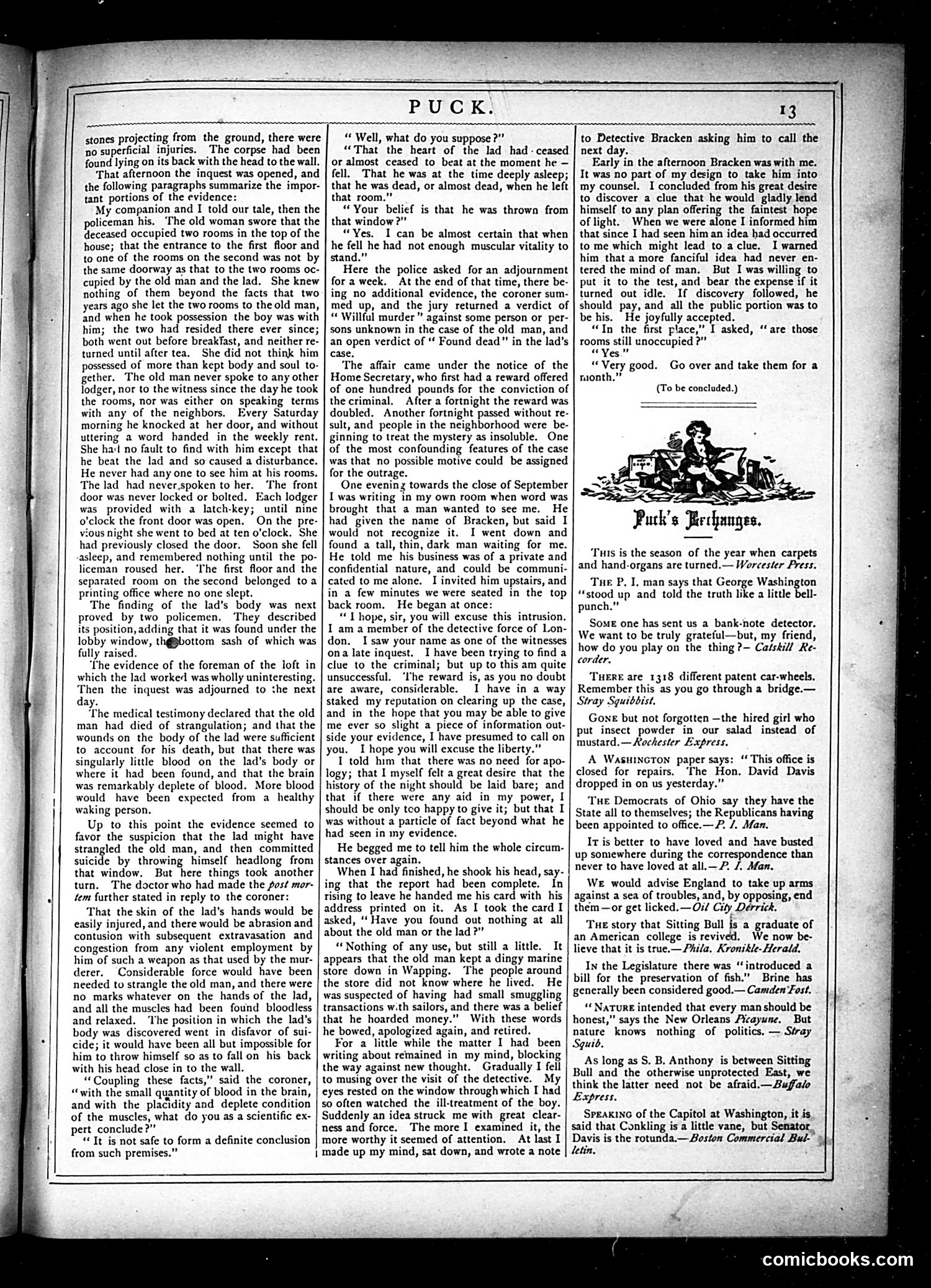
This page from *Puck* magazine consists primarily of text—a serialized detective story titled "A Detective's Dilemma"—rather than political cartoons. The narrative describes a murder investigation involving an old man found dead in mysterious circumstances. The only visible illustration is a small decorative vignette labeled "Puck's Bric-a-bracs," a satirical advice column featuring brief jokes and social commentary. These include quips about carpet cleaning, patent car-wheels, insect powder in salad, office repairs, and Republican politics—typical of *Puck's* light satirical tone mocking everyday absurdities and contemporary political figures. The page is primarily literary rather than visual satire.
📄 Transcribed text from this page (OCR, searchable)
Machine-transcribed from the original scan — historical spelling and the odd misread are preserved.
PUCK. 13 stones projecting from the ground, there were no superficial injuries. The corpse had been found lying on its back with the head to the wall. ‘That afternoon the inquest was opened, and the following paragraphs summarize the impor- tant portions of the evidence: My companion and I told our tale, then the policeman his. The old woman swore that the deceased occupied two rooms in the top of the house; that the entrance to the first floor and to one of the rooms on the second was not by the same doorway as that to the two rooms oc- cupied by the old man and the lad. She knew nothing of them beyond the facts that two years ago she let the two rooms to the old man, and when he took possession the boy was with him; the two had resided there ever since; both went out before breakfast, and neither re- turned until after tea. She did not think him possessed of more than kept body and soul to- gether. The old man never spoke to any other lodger, nor to the witness since the day he took the rooms, nor was either on speaking terms with any of the neighbors. Every Saturday morning he knocked at her door, and without uttering a word handed in the weekly rent. She hal no fault to find with him except that he beat the lad and so caused a disturbance. He never had any one to see him at his rooms. The lad had never.spoken to her. The front door was never locked or bolted. Each lodger was provided with a latch-key; until nine o'clock the front door was open. On the pre- vious night she went to bed at ten o’clock. She had previously closed the door. Soon she fell asleep, and remembered nothing until the po- liceman roused her. ‘The first floor and the separated room on the second belonged toa printing office where no one slept. The finding of the lad’s body was next proved by two policemen. They described its position, adding that it was found under the lobby window, thgbottom sash of which was fully raised. ‘The evidence of the foreman of the loft in which the lad worked was wholly uninteresting. aper the inquest was adjourned to the next jay. ‘The medical testimony declared that the old man had died of strangulation; and that the wounds on the body of the lad were sufficient to account for his death, but that there was singularly little blood on the lad’s body or where it had been found, and that the brain was remarkably deplete of blood. More blood would have been expected from a healthy waking person. Up to this point the evidence seemed to favor the suspicion that the lad might have straneea the old man, and then committed suicide by throwing himself headlong from that window. But here things took another turn, The doctor who had made the post mor- tem further stated in reply to the coroner: That the skin of the lad’s hands would be easily injured, and there would be abrasion and contusion with subsequent extravasation and congestion from any violent employment by him of such a weapon as that used by the mur- derer. Considerable force would have been needed to strangle the old man, and there were no marks whatever on the hands of the lad, and all the muscles had been found bloodless and relaxed. The position in which the lad’s body was discovered went in disfavor of sui- cide; it would have been all but impossible for him to throw himself so as to fallon his back with his head close in to the wall. “Coupling these facts,” said the coroner, “with the small quantity of blood in the brain, and with the placidity and deplete condition of the muscles, what do you as a scientific ex- pert conclude?” “It is not safe to form a definite conclusion from such premises.” “ Well, what do you suppose ?”” “That the heart of the lad had - ceased or almost ceased to beat at the moment he — fell. That he was at the time deeply asleep; that he was dead, or almost dead, when he left that room.” “Your belief is that he was thrown from that window ?” “Yes. I can be almost certain that when he fell he had not enough muscular vitality to stand.” Here the police asked for an adjournment for a week. At the end of that time, there be- ing no additional evidence, the coroner sum- med up, and the jury returned a verdict of “ Willful murder ” against some person or per- sons unknown in the case of the old man, and an open verdict of ‘‘ Found dead” in the lad’s case. The affair came under the notice of the Home Secretary, who first had a reward offered of one hundred pounds for the conviction of the criminal. After a fortnight the reward was doubled. Another fortnight passed without re- sult, and people in the neighborhood were be- ginning to treat the mystery as insoluble. One of the most confounding features of the case was that no possible motive could be assigned for the outrage. One evening towards the close of September I was writing in my own room when word was brought that a man wanted to see me. He had given the name of Bracken, but said I would not recognize it. I went down and found a tall, thin, dark man waiting for me. He told me his business was of a private and confidential nature, and could be communi- cated to me alone. I invited him upstairs, and in a few minutes we were seated in the top back room. He began at once: “TL hope, sir, you will excuse this intrusion. I am a member of the detective force of Lon- don. I saw your name as one of the witnesses ona late inquest. I have been trying to find a clue to the criminal; but up to this am quite unsuccessful. ‘Ihe reward is, as you no doubt are aware, considerable. I have in a way staked my reputation on clearing up the case, and in the hope that you may be able to give me ever so slight a piece of information out- side your evidence, I have presumed to call on you. I hope you will excuse the liberty.” I told him that there was no need for apo- logy; that I myself felt a great desire that the history of the night should be laid bare; and that if there were any aid in my power, I should be only tco happy to give it; but that I was without a particle of fact beyond what he had seen in my evidence. He begged me to tell him the whole circum- stances over again. When I had finished, he shook his head, say- ing that the report had been complete. In rising to leave he handed me his card with his address printed on it. As I took the card I asked, ‘‘ Have you found out nothing at all about the old man or the lad?” “Nothing of any use, but still a little. It appears that the old man kept a dingy marine store down in Wapping. The people around the store did not know where he lived. He was suspected of having had small smuggling transactions with sailors, and there was a belief that he hoarded money.” With these words he bowed, apologized again, and retired. For a little while the matter I had been writing about remained in my mind, blocking the way against new thought. Gradually I fell to musing over the visit of the detective. My eyes rested on the window through which I had so often watched the ill-treatment of the boy. Suddenly an idea struck me with great clear- ness and force. The more I examined it, the more worthy it seemed of attention, At last I | made up my mind, sat down, and wrote a note to Detective Bracken asking him to call the next day. Early in the afternoon Bracken was with me. It was no part of my design to take him into my counsel. I concluded from his great desire to discover a clue that he would gladly lend himself to any plan offering the faintest hope of light. When we were alone I informed him that since I had seen him an idea had occurred to me which might lead to aclue. I warned him that a more fanciful idea had never en- tered the mind of man. But I was willing to put it to the test, and bear the expense if it turned out idle. If discovery followed, he should pay, and all the public portion was to be his. He joyfully accepted. “In the first place,” I asked, ‘are those rooms still unoccupied ?”” “Yes.” “Very good. Go over and take them for a raonth,” (To be concluded.) , Puck's Brchanges. ‘Tis is the season of the year when carpets and hand-organs are turned.— Worcester Press. Tue P. I, man says that George Washington “stood up and told the truth like a little bell- punch.” Some one has sent us a bank-note detector. We want to be truly grateful—but, my friend, how do you play on the thing ?— Cafskid! Re- corder. THERE are 1318 different patent car-wheels, Remember this as you go through a bridge.— Stray Squibbist. Gone but not forgotten —the hired girl who put insect powder in our salad instead of mustard.—Xochester Express. A WasuincTon paper says: “This office is closed for repairs. ‘The Hon. David Davis dropped in on us yesterday.” Tue Democrats of Ohio say they have the State all to themselves; the Republicans having been appointed to office.—P. 7. Man. Ir is better to have loved and have busted up somewhere during the correspondence than never to have loved at all.—. /, Man, We would advise England to take up arms against a sea of troubles, and, by opposing, end them —or get licked.— Oil City Derrick. Tue story that Sitting Bull is a graduate of an American college is revived. We now be- lieve that it is true.— Phila, Kronikle-Herald, In the Legislature there was ‘introduced a bill for the preservation of fish.” Brine has generally been considered good.— Camden Fost. “‘ NaTuRE intended that every man should be honest,” says the New Orleans Picayune. But nature knows nothing of politics. — Stray Squib. As long as S. B, Anthony is between Sitting Bull and the otherwise unprotected East, we think the latter need not be afraid.— Buffalo Express. Speake of the Capitol at Washington, it is, said that Conkling is a little vane, but Senator. Davis is the rotunda.— Boston Commercial Bul- » letin. comicbooks.com