
Puck, 1878-04-24 · page 12 of 16
Puck — April 24, 1878 — page 12: what you’re looking at
What you’re looking at
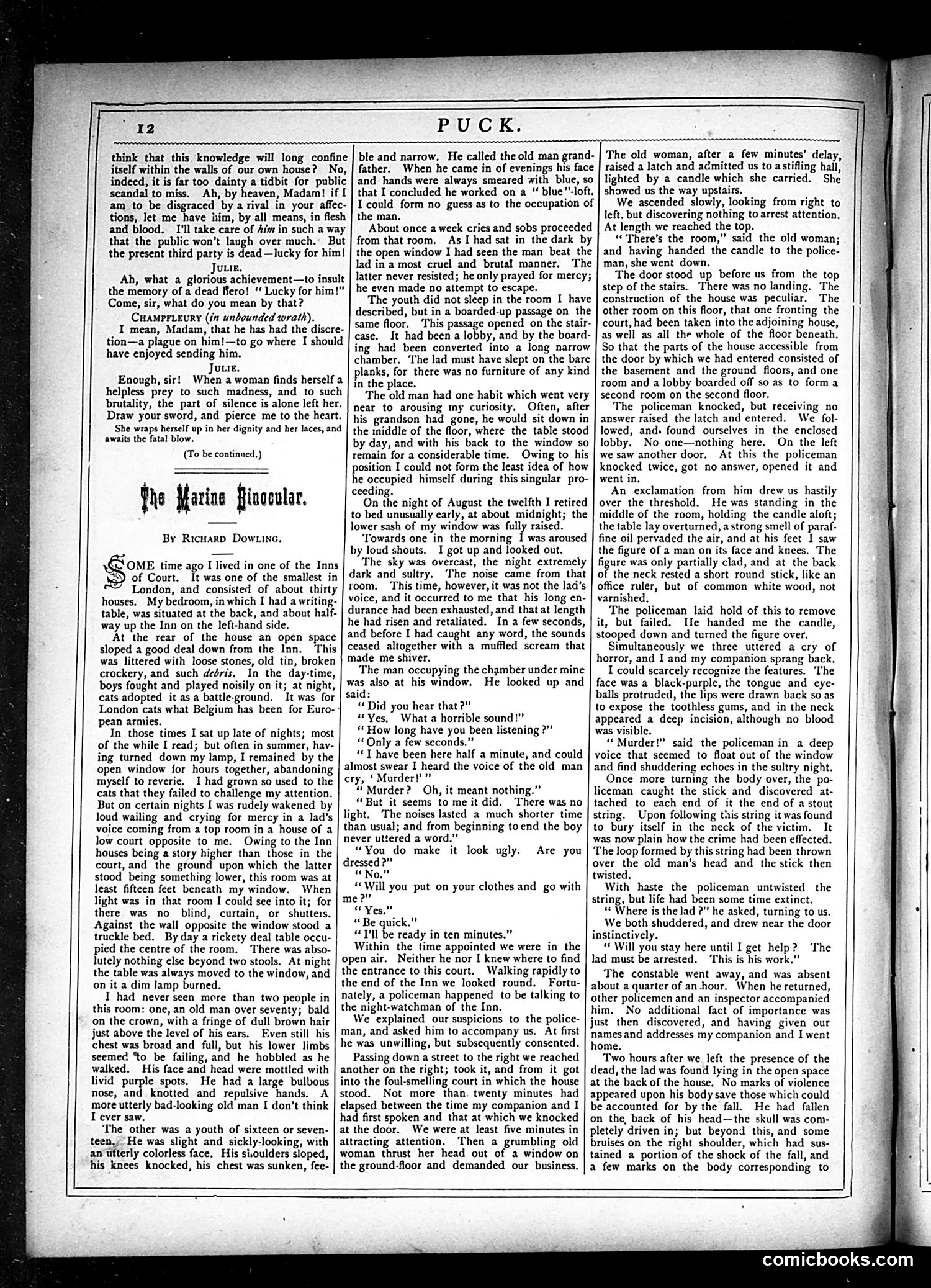
This page contains the beginning of a serialized short story rather than political satire. The narrative describes a narrator living in London's Inns of Court who investigates mysterious noises from a neighboring room—specifically a man's voice at night calling out disturbing phrases like "Murder!" and "Did you hear that?" The story involves the narrator contacting police to investigate the disturbances. A policeman accompanies him to discover the source. The tale appears to be a mystery/horror story playing on Victorian anxieties about urban life and the unknown residents of shared lodgings. This is straightforward fiction rather than political cartoon satire typical of Puck magazine.
📄 Transcribed text from this page (OCR, searchable)
Machine-transcribed from the original scan — historical spelling and the odd misread are preserved.
12 think that this knowledge will long confine itself within the walls of our own house? No, indeed, it is far too dainty a tidbit for public scandal to miss. Ah, by heaven, Madam! if 1 am to be disgraced by a rival in your affec- tions, let me have him, by all means, in flesh and blood. I'll take care of Aim in such a way that the public won’t laugh over much.’ But the present third party is dead—lucky for him! Juiie. Ah, what a glorious achievement—to insult the memory of a dead Hero! “ Lucky for him!” Come, sir, what do you mean by that? Cuasprtevry (in unbounded wrath). I mean, Madam, that he has had the discre- tion—a plague on him!—to go where I should have enjoyed sending him. Jute. Enough, sir! When a woman finds herself a helpless prey to such madness, and to such brutality, the part of silence is alone left her. Draw your sword, and pierce me to the heart. She wraps herself up in her dignity and her laces, and awaits the fatal blow. (To be continned.) Fhe ffarine fioocular, By Ricuarp Dow inc. OME time ago I lived in one of the Inns Ss) of Court. It was one of the smallest in London, and consisted of about thirty houses. My bedroom, inwhich I had awriting- table, was situated at the back, and about half- way up the Inn on the left-hand side. At the rear of the house an open space sloped a good deal down from the Inn. This was littered with loose stones, old tin, broken crockery, and such deéris, In the day-time, boys fought and played noisily on it; at night, cats adopted it asa battleground. It was for London cats what Belgium has been for Euro- pean armies. In those times I sat up late of nights; most of the while I read; but often in summer, hav- ing turned down my lamp, I remained by the open window for hours together, abandoning myself to reverie. I had grown so used to the cats that they failed to challenge my attention. But on certain nights I was rudely wakened by loud wailing and crying for mercy in a lad’s voice coming from a top room in a house of a Jow court opposite to me. Owing to the Inn houses being a story higher than those in the court, and the ground upon which the latter stood being something lower, this room was at least fifteen feet beneath my window. When light was in that room I could see into it; for there was no blind, curtain, or shutters. Against the wall opposite the window stood a truckle bed. By day a rickety deal table occu- pied the centre of the room. There was abso- lutely nothing else beyond two stools. At night the table was always moved to the window, and on it a dim lamp burned. I had never seen more than two people in this room: one, an old man over seventy; bald on the crown, with a fringe of dull brown hair just above the level of his ears. Even still his chest was broad and full, but his lower limbs seemed Yo be failing, and he hobbled as he walked. His face and head were mottled with livid purple spots. He had a large bulbous nose, and knotted and repulsive hands. A more utterly bad-looking old man I don’t think lever saw. ‘The other was a youth of sixteen or seven- teen, "He was slight and sickly-looking, with an utterly colorless face. His sioulders sloped, his knees knocked, his chest was sunken, fee- ble and narrow. He called the old man grand- father. When he came in of evenings his face and hands were always smeared with blue, so that I concluded he worked on a ‘ blue”’-loft. I could form no guess as to the occupation of the man. About once a week cries and sobs proceeded from that room. As I had sat in the dark by the open window I had seen the man beat the lad in a most cruel and brutal manner. The latter never resisted; he only prayed for mercy; he even made no attempt to escape. The youth did not sleep in the room I have described, but in a boarded-up passage on the same floor. ‘This passage opened on the stair- case. It had been a lobby, and by the board- ing had been converted into a long narrow chamber. ‘The lad must have slept on the bare planks, for there was no furniture of any kind in the place. The old man had one habit which went very near to arousing my curiosity. Often, after his grandson had gone, he would sit down in the iniddle of the floor, where the table stood by day, and with his back to the window so remain for a considerable time. Owing to his position I could not form the least idea of how he occupied himself during this singular pro- ceeding. On the night of August the twelfth I retired to bed unusually early, at about midnight; the lower sash of my window was fully raised. ‘Towards one in the morning I was aroused by loud shouts. I got up and looked out. The sky was overcast, the night extremely dark and sultry. The noise came from that room. This time, however, it was not the lad’s voice, and it occurred to me that his long en- durance had been exhausted, and that at length he had risen and retaliated. In a few seconds, and before I had caught any word, the sounds ceased altogether with a muffled scream that made me shiver. ‘The man occupying the chamber under mine was also at his window. He looked up and said: “Did you hear that?” “Yes, What a horrible sound!"”” “ How long have you been listening ?” “Only a few seconds.” “T have been here half a minute, and could almost swear I heard the voice of the old man cry, ‘Murder!’ ” “Murder? Oh, it meant nothing.” “But it seems to me it did. There was no light. The noises lasted a much shorter time than usual; and from beginning toend the boy never uttered a word.” “You do make it look ugly. dressed ?”” No.” “Will you put on your clothes and go with Are you «© Yes," “Be quick.” “I'll be ready in ten minutes.” Within the time appointed we were in the open air. Neither he nor I knew where to find the entrance to this court. Walking rapidly to the end of the Inn we looked round. Fortu- nately, a policeman happened to be talking to the night-watchman of the Inn. We explained our suspicions to the police- man, and asked him to accompany us. At first he was unwilling, but subsequently consented. Passing down a street to the right we reached another on the right; took it, and from it got into the foul-smelling court in which the house stood. Not more than. twenty minutes had elapsed between the time my companion and I had first spoken and that at which we knocked at the door. We were at least five minutes in attracting attention. Then a grumbling old woman thrust her head out of a window on the ground-floor and demanded our business. The old woman, after a few minutes’ delay, raised a latch and acmitted us to astifling hail, lighted by a candle which she carried. She showed us the way upstairs. We ascended slowly, looking from right to left. but discovering nothing to arrest attention. At length we reached the top. “There’s the room,” said the old woman; and having handed the candle to the police- man, she went down. The door stood up before us from the top step of the stairs. There was no landing. The construction of the house was peculiar. The other room on this floor, that one fronting the court, had been taken into the adjoining house, as well as all the whole of the floor beneath, So that the parts of the house accessible from the door by which we had entered consisted of the basement and the ground floors, and one room and a lobby boarded off so as to forma second room on the second floor. ‘The policeman knocked, but receiving no answer raised the latch and entered. We fol- lowed, ands found ourselves in the enclosed lobby. No one—nothing here. On the left we saw another door. At this the policeman knocked twice, got no answer, opened it and went in. ‘An exclamation from him drew us hastily over the threshold. He was standing in the middle of the room, holding the candle aloft; the table lay overturned, a strong smell of paraf- fine oil pervaded the air, and at his feet I saw the figure of a man on its face and knees. The figure was only partially clad, and at the back of the neck rested a short round stick, like an office ruler, but of common white wood, not varnished, The policeman laid hold of this to remove it, but failed. Ife handed me the candle, stooped down and turned the figure over. Simultaneously we three uttered a cry of horror, and I and my companion sprang back. I could scarcely recognize the features. ‘The face was a black-purple, the tongue and eye- balls protruded, the lips were drawn back so as to expose the toothless gums, and in the neck appeared a deep incision, although no blood was visible. “Murder!” said the policeman in a deep voice that seemed to float out of the window and find shuddering echoes in the sultry night. Once more turning the body over, the po- liceman caught the stick and discovered at- tached to each end of it the end of a stout string. Upon following tnis string it was found to bury itself in the neck of the victim. It was now plain how the crime had been effected. The loop formed by this string had been thrown over the old man’s head and the stick then twisted. With haste the policeman untwisted the string, but life had been some time extinct. « Where is the lad ?” he asked, turning to us. We both shuddered, and drew near the door instinctively. “ Will you stay here until I get help ? lad must be arrested. ‘This is his work.” The constable went away, and was absent about a quarter of an hour. When he returned, other policemen and an inspector accompanied him. No additional fact of importance was just then discovered, and having given our names and addresses my companion and I went home. Two hours after we left the presence of the dead, the lad was found lying in the open space at the back of the house. No marks of violence appeared upon his body save those which could be accounted for by the fall. He had fallen on the, back of his head—the skull was com- pletely driven in; but beyond this, and some bruises on the right shoulder, which had sus- tained a portion of the shock of the fall, and a few marks on the body corresponding to The comicbooks.com