
A complete issue · 16 pages · 1878
Puck — April 10, 1878
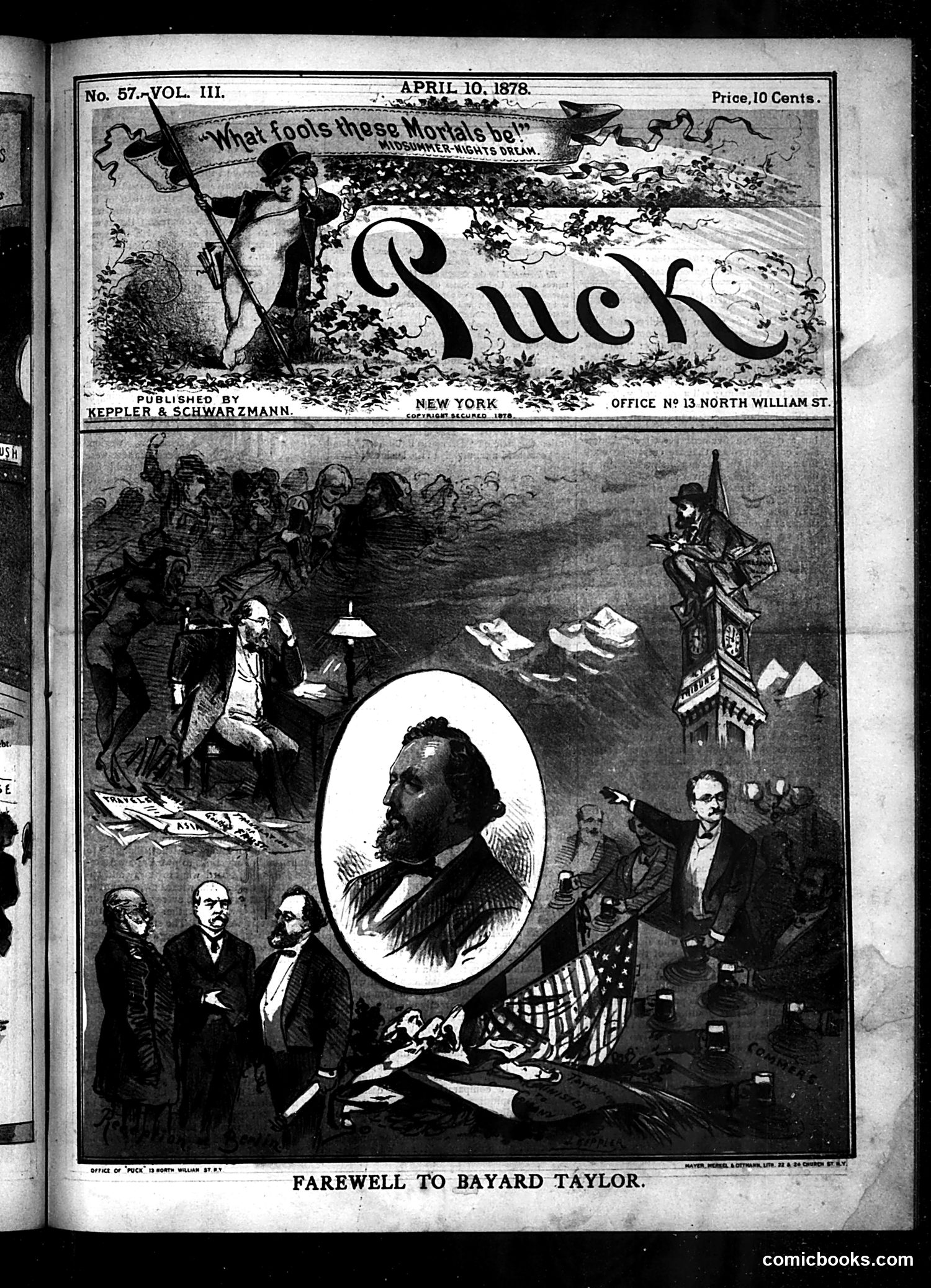
This is a tribute to Bayard Taylor, a prominent American writer, diplomat, and editor who appears to have died recently. The central portrait shows Taylor in an oval frame, surrounded by mourning scenes. The imagery depicts: - Political and literary figures in formal dress paying respects (left side) - A castle or significant building (right side), likely referencing his diplomatic service - Dramatic scenes above suggesting his life's work and travels - The classical reference at top ("What fools these Mortals be") from Shakespeare's *Midsummer Night's Dream* The overall composition treats Taylor's death as a significant cultural loss, presenting him as a major figure in American letters and public service worthy of formal commemoration.
This page contains three distinct articles rather than cartoons. The main content includes: 1. **"A Nice Little Bill"** — Commentary on a congressional bill protecting dramatic works and theatrical rights. The text criticizes how the measure benefits New York theater proprietors and play-brokers while inadequately protecting authors' international copyrights. 2. **"What Goeth On At Present"** — Satirical observations on contemporary social behavior, including commentary on church deacons and their hypocrisy. 3. **"Fitznoodle in America, No. LIV"** — A travel narrative featuring a character (Fitznoodle) observing American customs, particularly regarding American women and peculiar regional practices, written in a mocking, ethnographic style typical of 19th-century satirical journalism. The page is primarily text-based satire rather than visual cartooning.
This page contains political satire about Congressional debate regarding **army compensation and soldier welfare**. The cartoon depicts a figure labeled "Puck's Essential Oil of Congress," showing Congress debating whether disabled soldiers deserve continued payment. Multiple congressmen are quoted discussing whether reducing army pay was justified, with one arguing it constitutes "undue severity." The satirical point appears to be that Congress engaged in lengthy, philosophical debate about a straightforward moral issue—whether injured soldiers deserved support—treating it as an abstract principle rather than a human necessity. The page also includes a poetry section titled "Fantasy and Passion" and literary criticism, suggesting this addresses broader questions of governmental responsibility versus fiscal restraint during what appears to be a post-war period.
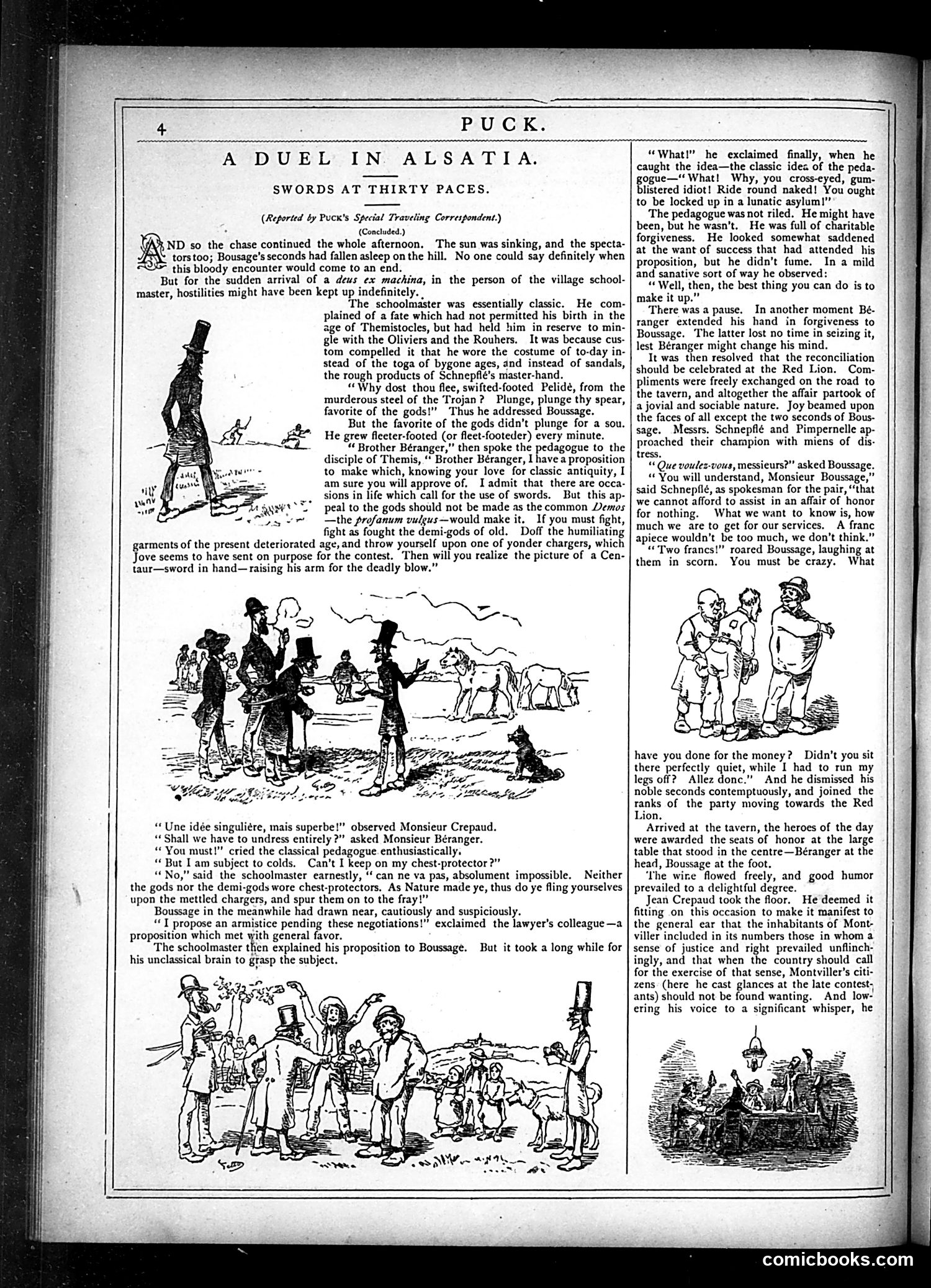
This satirical piece mocks a dispute between two French figures—likely intellectuals or public figures—over a trivial matter of honor. The elaborate negotiation scene depicts the absurd formality of arranging a duel, with multiple intermediaries debating ridiculous conditions (fighting at precisely thirty paces, arguments about sword specifications). The humor targets the pretentiousness of French dueling culture and the pedantic nature of academic or legal disputes being treated with mock-seriousness. The schoolmaster character and lawyer colleagues represent the bureaucratic absurdity surrounding what should be a simple matter. The satire critiques how pompous intellectuals inflate minor disagreements into elaborate formal confrontations, turning everyday quarrels into affairs of state. The illustrations emphasize the comedic disproportion between the trivial cause and the ceremonial gravity of the proposed duel.
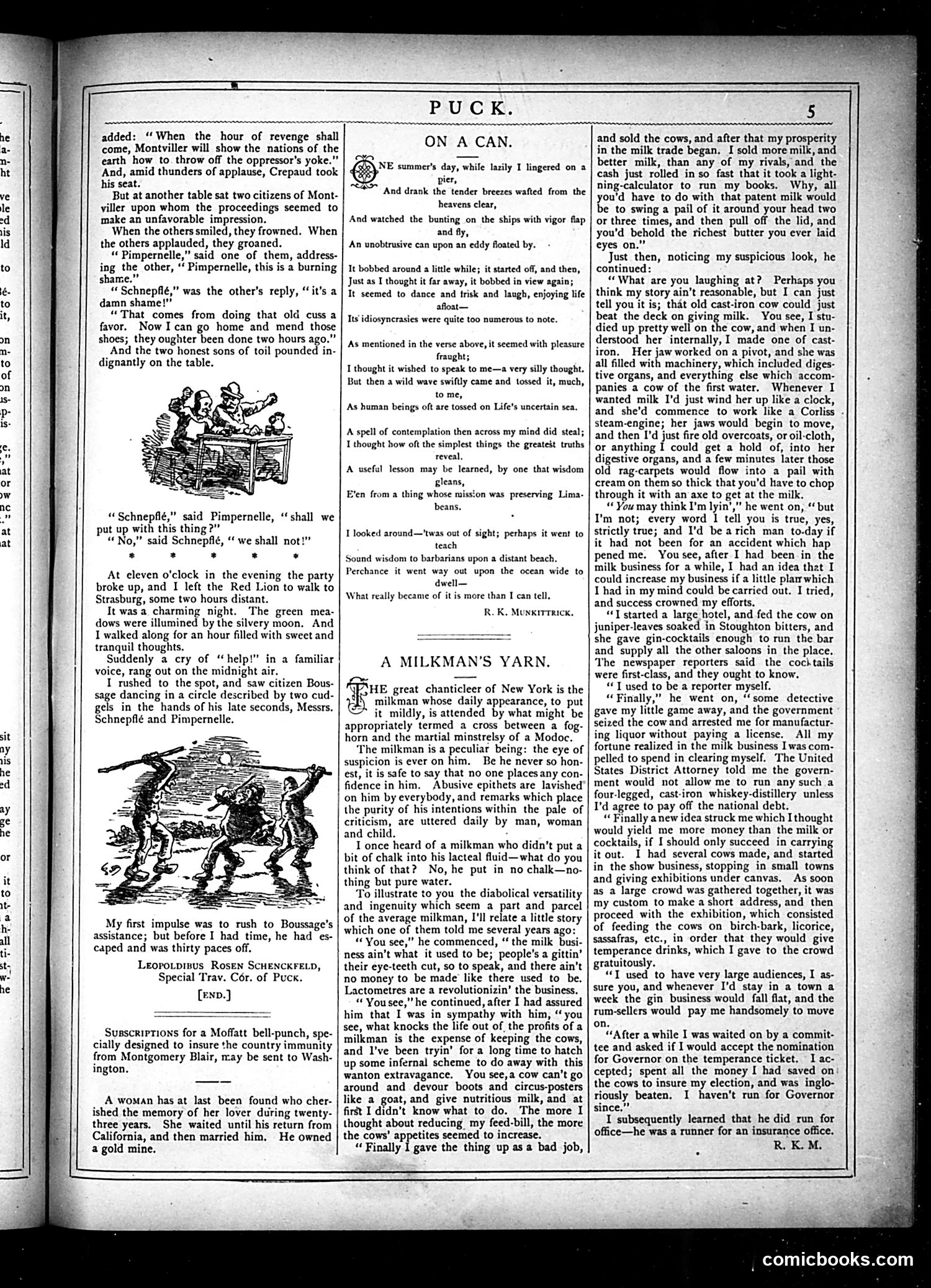
This page contains two distinct pieces: **"On a Can"** (top): A poem about someone observing a ship at sea, with philosophical reflections on life's uncertainties. The accompanying illustration shows figures on a beach watching a vessel. This appears to be general literary/philosophical satire rather than specific political commentary. **"A Milkman's Yarn"** (bottom): A first-person account by a milkman describing his entrepreneurial schemes to profit from the milk business—including plans to supply cocktails and gin to saloons, and attempts to monopolize the industry. The text satirizes get-rich-quick schemes and the milkman's increasingly absurd business ambitions. An illustration shows a figure in period dress, likely the milkman character. This mocks both individual greed and broader industrial consolidation trends of the era.
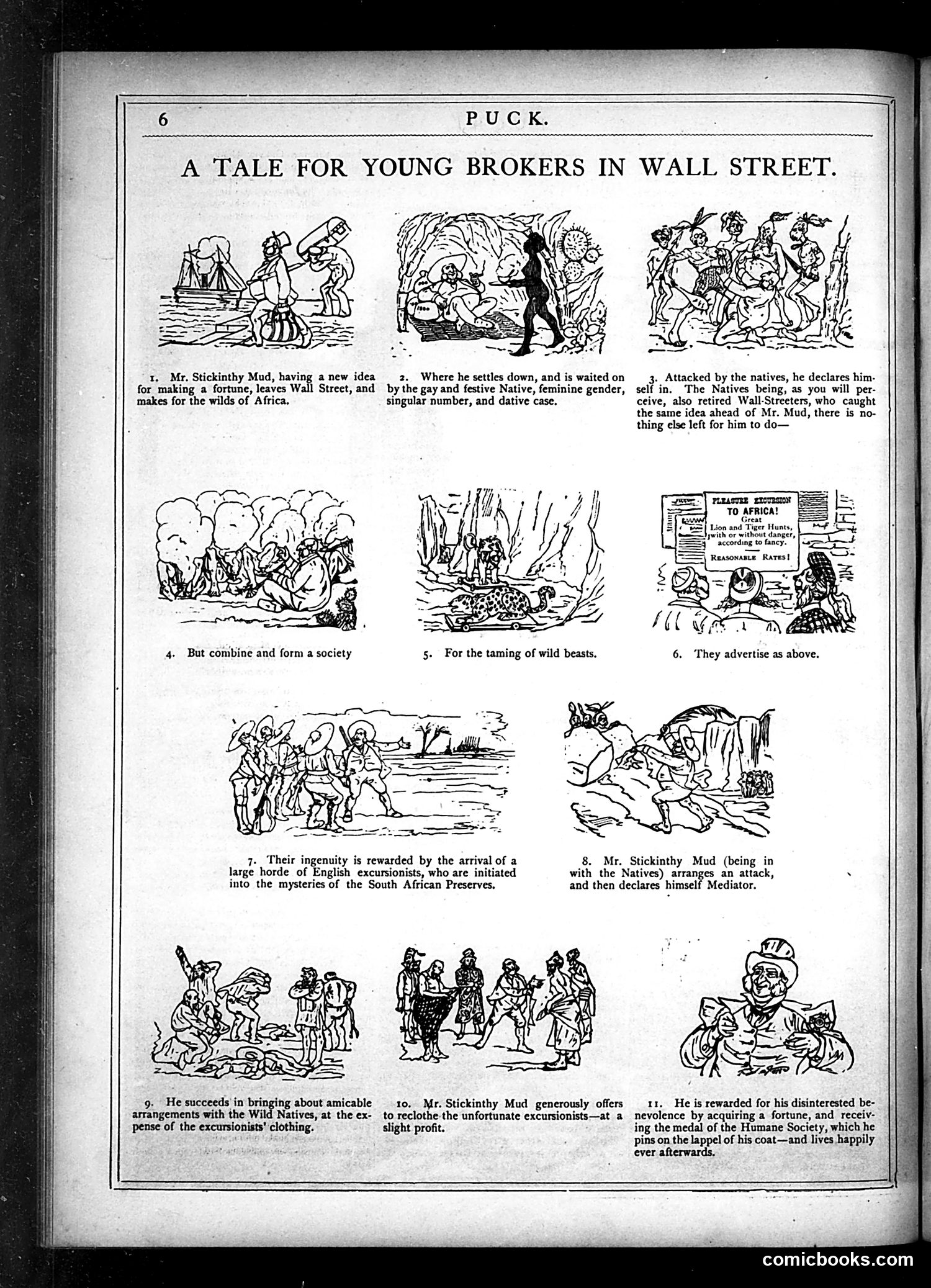
This satirical comic mocks wealthy Wall Street financiers by paralleling their schemes to a get-rich-quick swindle. Mr. Stickinthy Mud, a broker, leaves Wall Street seeking fortune in Africa. He creates an elaborate hoax involving "natives," wild beasts, and exotic adventures—advertising it to attract wealthy "excursionists" (tourists). The satire suggests that Wall Street brokers use similarly deceptive schemes to exploit investors. The cartoon compares financial manipulation to outright fraud: Mud orchestrates fake "discoveries" and manufactures interest to profit from gullible clients' money. He's ultimately rewarded with a medal, implying that successful deception in finance is celebrated rather than condemned. The joke targets both broker dishonesty and investor credulity.
This page is primarily theatrical criticism and drama notes, not political satire. The main article "Tom King's Strength" discusses an eccentric old fellow from the East River docks who tells tall tales about his past exploits. The "Diplomacy at Wallack's" section reviews a play production, praising the artistic and financial success of the theatrical staging. The "Dramatic Notes" section covers theater happenings: Maggie Mitchell performing at the Standard, circus performances, and various theatrical productions around town. There is also an "Answers for the Curious" section addressing reader questions about actors and performances. No political figures or social satire appear visible. This is entertainment journalism, not political commentary.
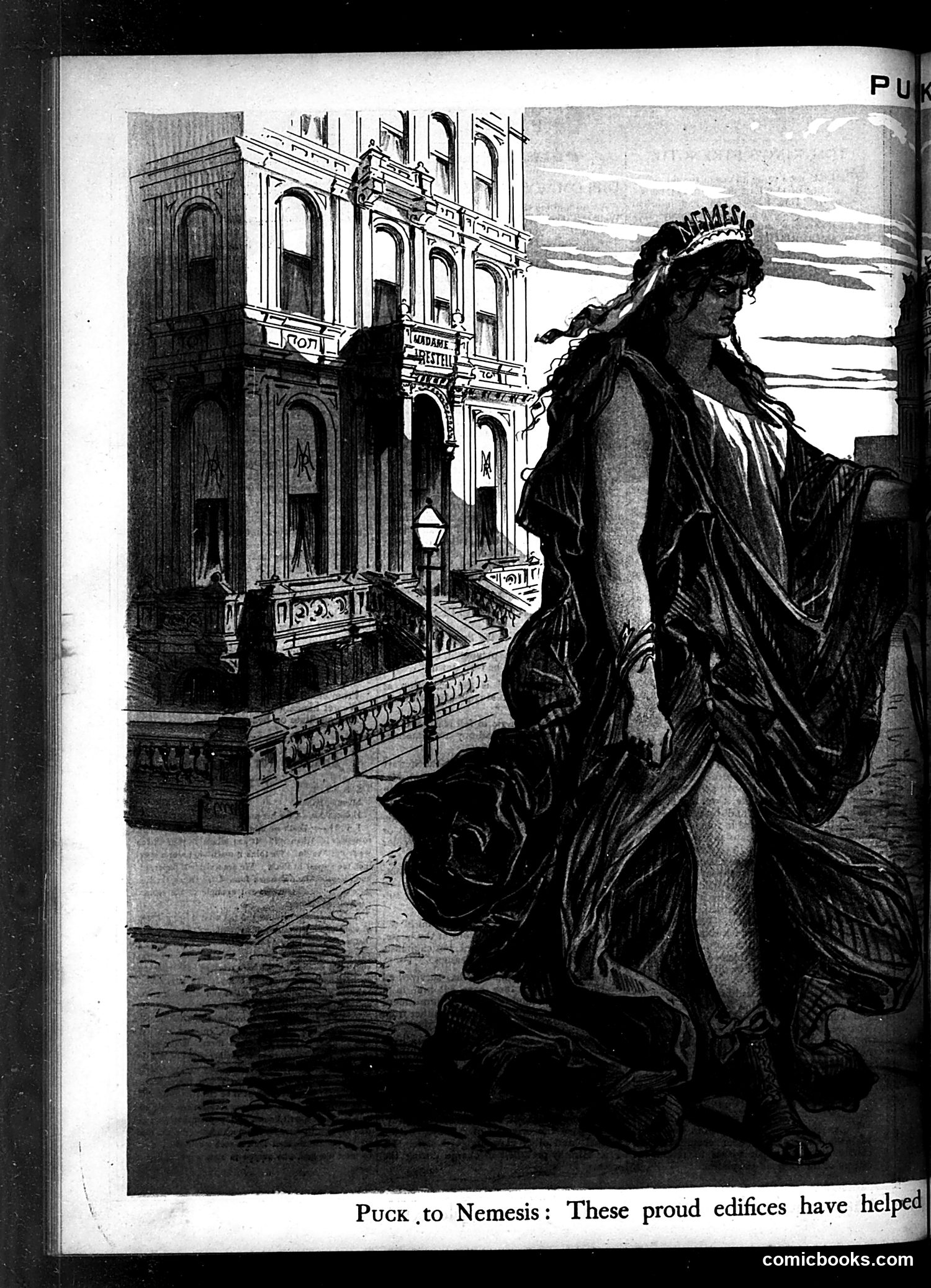
This is a political cartoon from Puck magazine showing a figure in classical/allegorical dress (labeled "Puck to Nemesis") addressing personified Nemesis, the Greek goddess of retribution. The figure gestures toward grand institutional buildings in the background—likely representing banks, government offices, or corporate headquarters based on their classical architecture and prominence. The caption reads: "These proud edifices have helped..."—suggesting the sentence continues beyond the visible text. The satire appears to critique wealthy institutions or powerful figures, implying that their grand buildings (symbols of their success and power) have contributed to some negative outcome. "Nemesis" invokes divine punishment or comeuppance, suggesting the cartoon warns that such pride and institutional excess will face eventual reckoning or downfall—a common Puck theme mocking corruption, greed, or unchecked power among the wealthy and influential.
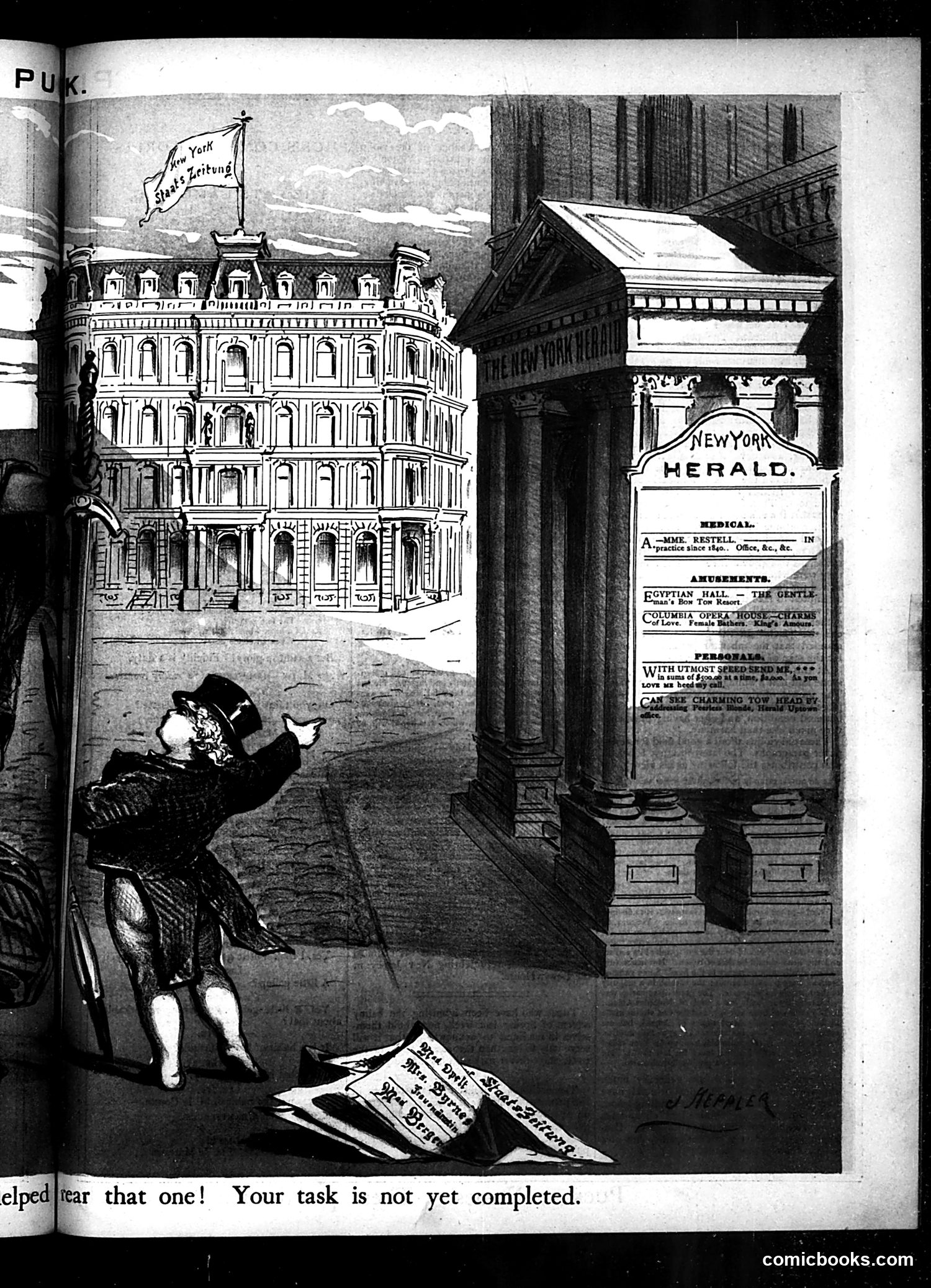
This satirical cartoon depicts a figure in period dress pointing accusingly at the New York Herald building. The figure appears to be personifying a competing newspaper or journalistic interest, suggesting rivalry between New York publications. The visible Herald advertisements mention "Egyptian Hall," "Columbia Opera House," and other entertainment venues, indicating the Herald's role in covering New York's cultural scene. The caption reads: "helped [that] one! Your task is not yet completed," suggesting the cartoon critiques the Herald's incomplete or ongoing efforts—possibly regarding coverage of scandals, political matters, or journalistic practices of the era. The exact historical context is unclear without additional dating, but this reflects late-19th/early-20th century newspaper competition and mutual criticism among major New York publications.
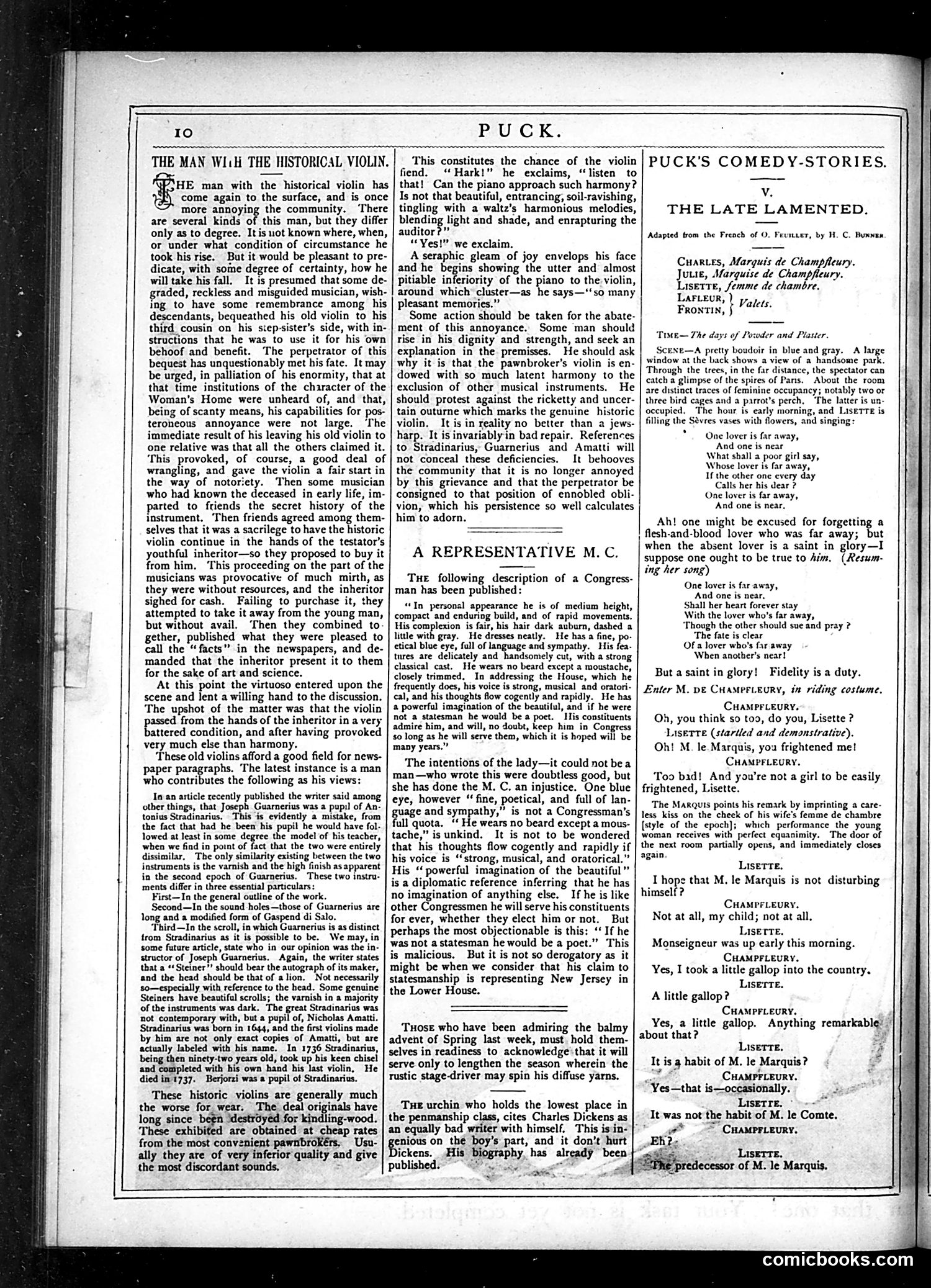
This page contains two distinct sections: **Left column:** An article titled "The Man with the Historical Violin" satirizes wealthy collectors who acquire violins supposedly owned by famous historical figures, then display them prominently while lacking actual musical skill or understanding. The satire mocks both the pretentiousness of the collectors and the dubious authenticity of such artifacts. **Right column:** "The Late Lamented" is a comedic dialogue adapted from French sources, featuring characters named Champleury, Lisette, and the Marquis de Champfleury. The humor appears to involve romantic misunderstandings and social posturing between aristocratic characters—typical parlor-comedy fare of the period. The page emphasizes Puck's satirical focus on American social pretension and class affectation rather than explicit political commentary.
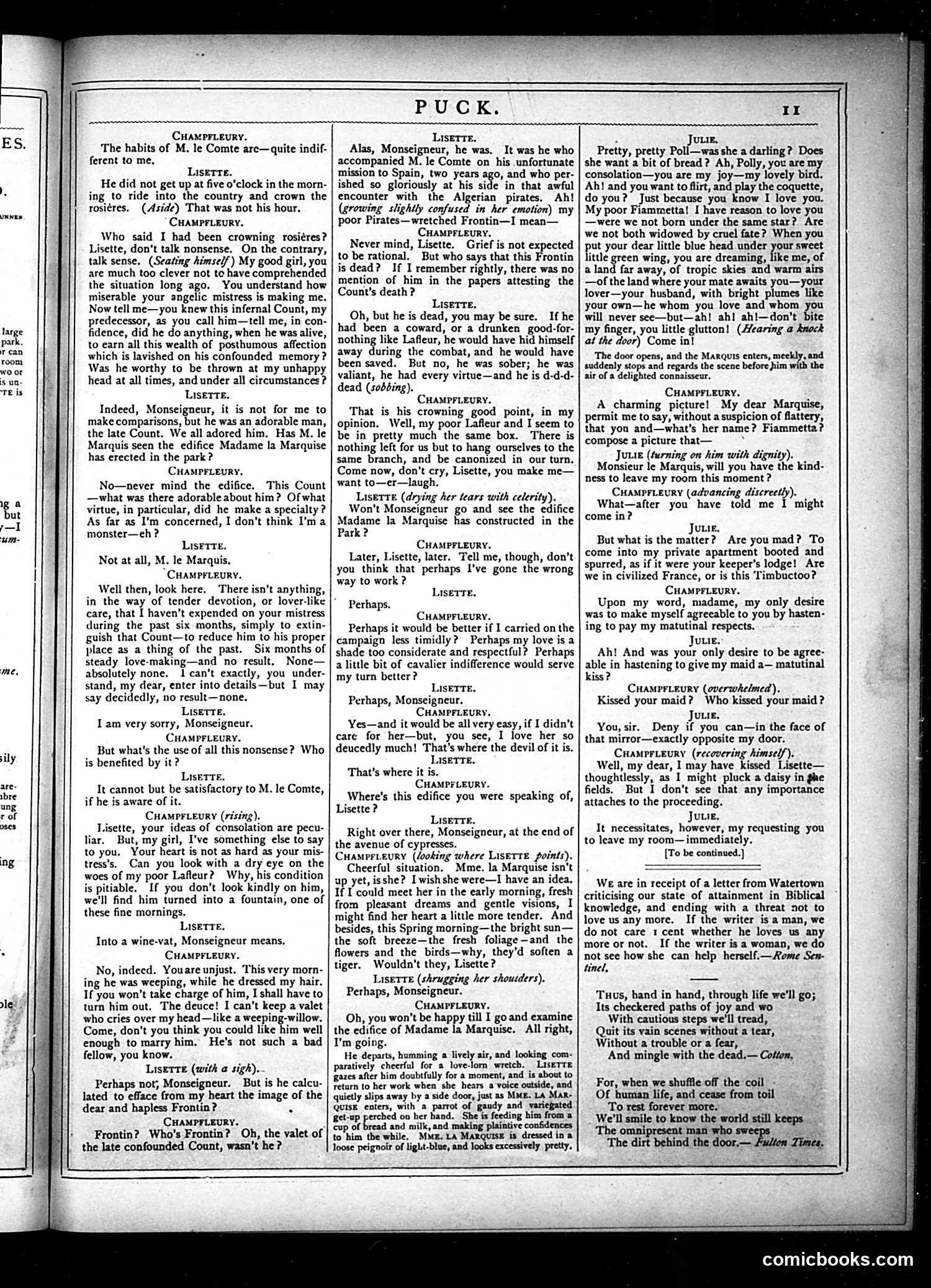
This page from *Puck* contains a dramatic dialogue scene rather than a political cartoon. The text shows an extended conversation between characters including Champfleury, Lisette, and a Marquis, discussing matters of romance, honor, and social propriety in what appears to be a French aristocratic setting. The dialogue references a "Frontini" (possibly a count), Algerian pirates, and various romantic entanglements. Without clearer visual identification of the illustrated figures or knowledge of the specific historical context this scene satirizes, I cannot definitively identify which real political or social figures are being lampooned. The page appears to be literary satire rather than direct political commentary, likely mocking French upper-class pretensions and romantic conventions of the era.
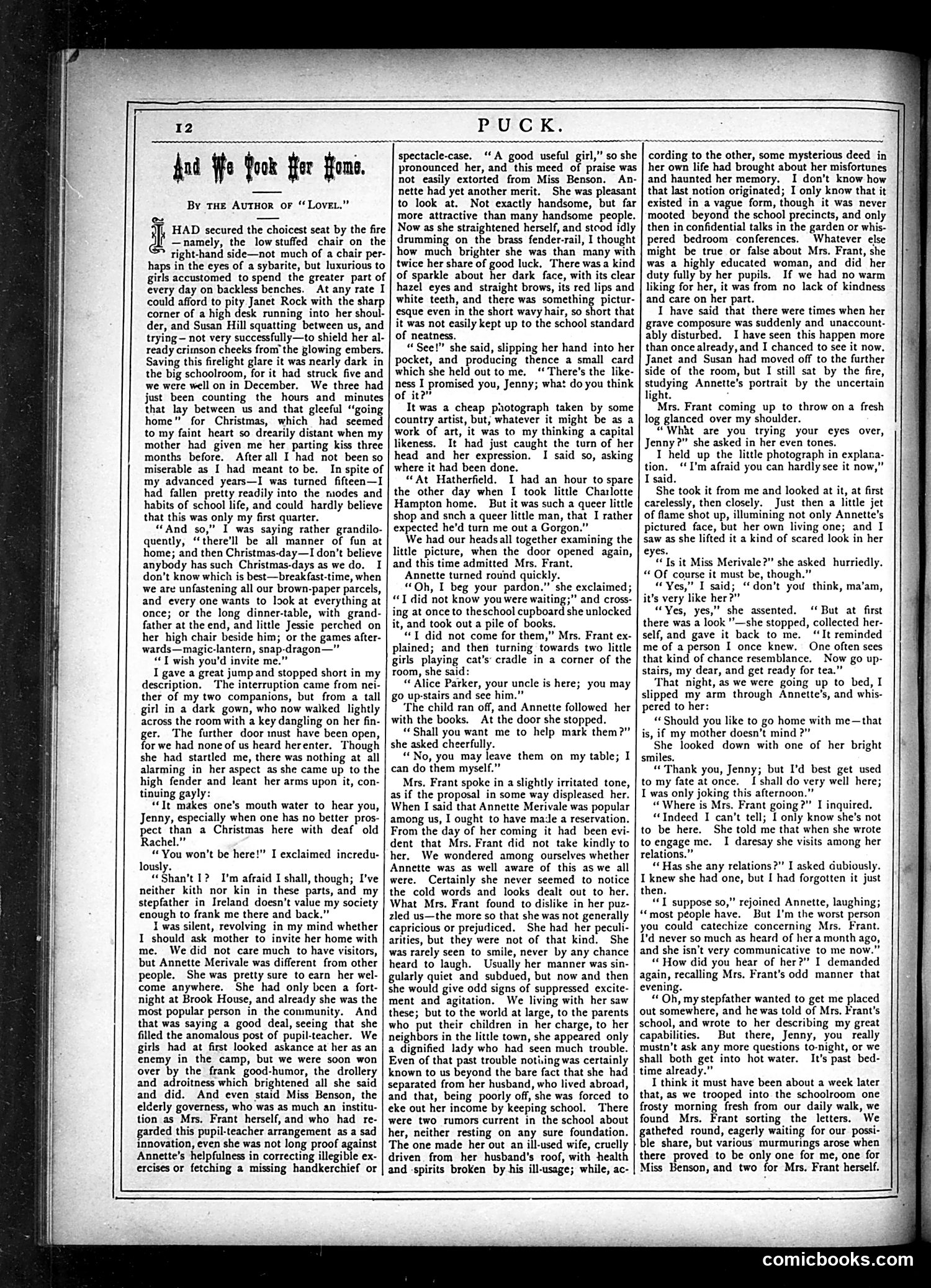
This page contains fiction rather than political satire. It's a short story titled "And We Took Her Home," attributed to the author of "Lovel," presenting a serialized narrative about a schoolteacher named Jenny and her interactions with students and community members. The text discusses themes of social class, education, and small-town life in what appears to be late 19th or early 20th-century America. References to schoolhouse dynamics, student behavior, and the social position of teachers suggest commentary on educational institutions and gender roles, but this is embedded in narrative fiction rather than explicit satire or cartooning. No identifiable political figures or satirical cartoons appear on this page—it's primarily a text-heavy story installment typical of Puck's literary content.
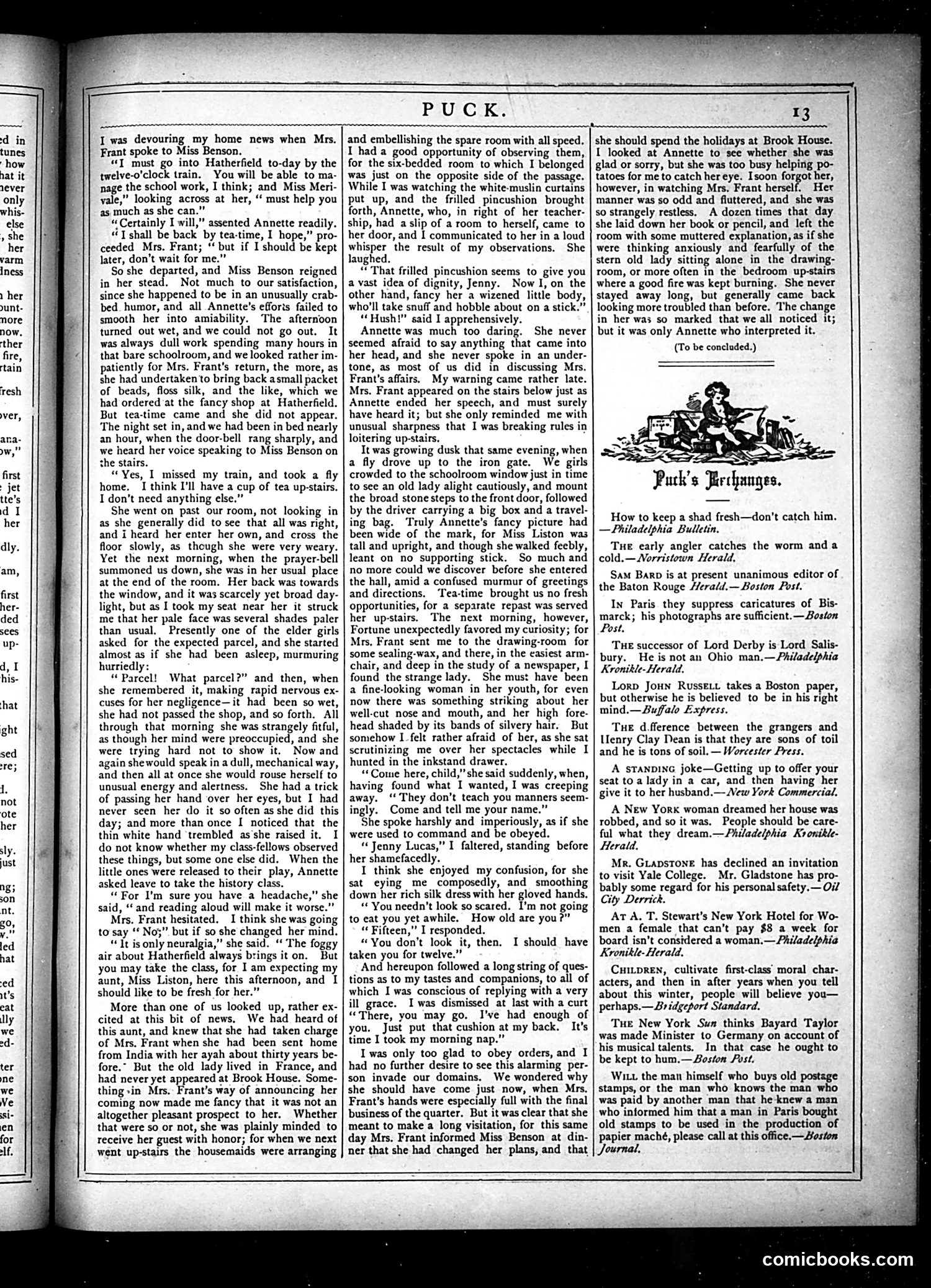
This page is primarily **text-based content**, not a political cartoon. It contains a serialized short story titled "Puck" (marked "To be concluded") about domestic drama involving characters like Mrs. Benson, Miss Annette, and Jenny. The narrative involves intrigue around a mysterious woman found in a house and discussions of social propriety. Below the main story is a section called **"Puck's Brithings"** — a collection of brief satirical items and jokes mocking contemporary figures and institutions. These include jabs at newspaper editors, Lord Derby, Lord Russell, and social commentary on women's wages and marriage customs. The page functions as **satirical humor and social criticism** through witty one-liners rather than visual caricature, typical of Puck's editorial voice.
This page is primarily **advertising and announcements** for Puck Publishing Company, not a political cartoon or satirical content. The right side features a "Special Announcement" advertising Puck's new "General Designing Office," promoting cartoonist **Joseph Keppler** and his services for creating illustrations and "lithographic portraits" for theatrical productions and other clients. The left side contains editorial snippets and commentary, including discussion of a piece titled "The Cow" by Flavius Josephus (likely satirical), and various brief critiques of contemporary issues. The page also includes a notice about back issues of Puck being available and an advertisement for **Fleischmann's Compressed Yeast**. Overall, this appears to be a page dedicated to promoting Puck's services and back issues rather than presenting satirical cartoons themselves.
This is primarily an **advertising and announcements page** from Puck's 1878 almanac issue, not a political cartoon page. The main content announces "Puck's Almanac for 1878" as "Just Out!" and "the most remarkable ever published" (priced 15 cents). The surrounding advertisements feature various 19th-century New York businesses: portrait studios, jewelry, clothing tailors, printing inks, theaters, and financial services. Notable is an ad for an "Imperial Austrian Vienna City-Government Bond" investment opportunity. The page includes a "Notice" about a puzzle contest with a $5 prize for solving "Seek and Ye Shall Find," suggesting Puck regularly featured reader-engagement puzzles. This reflects the magazine's mixed business model: combining satirical content with commercial advertising and reader activities.
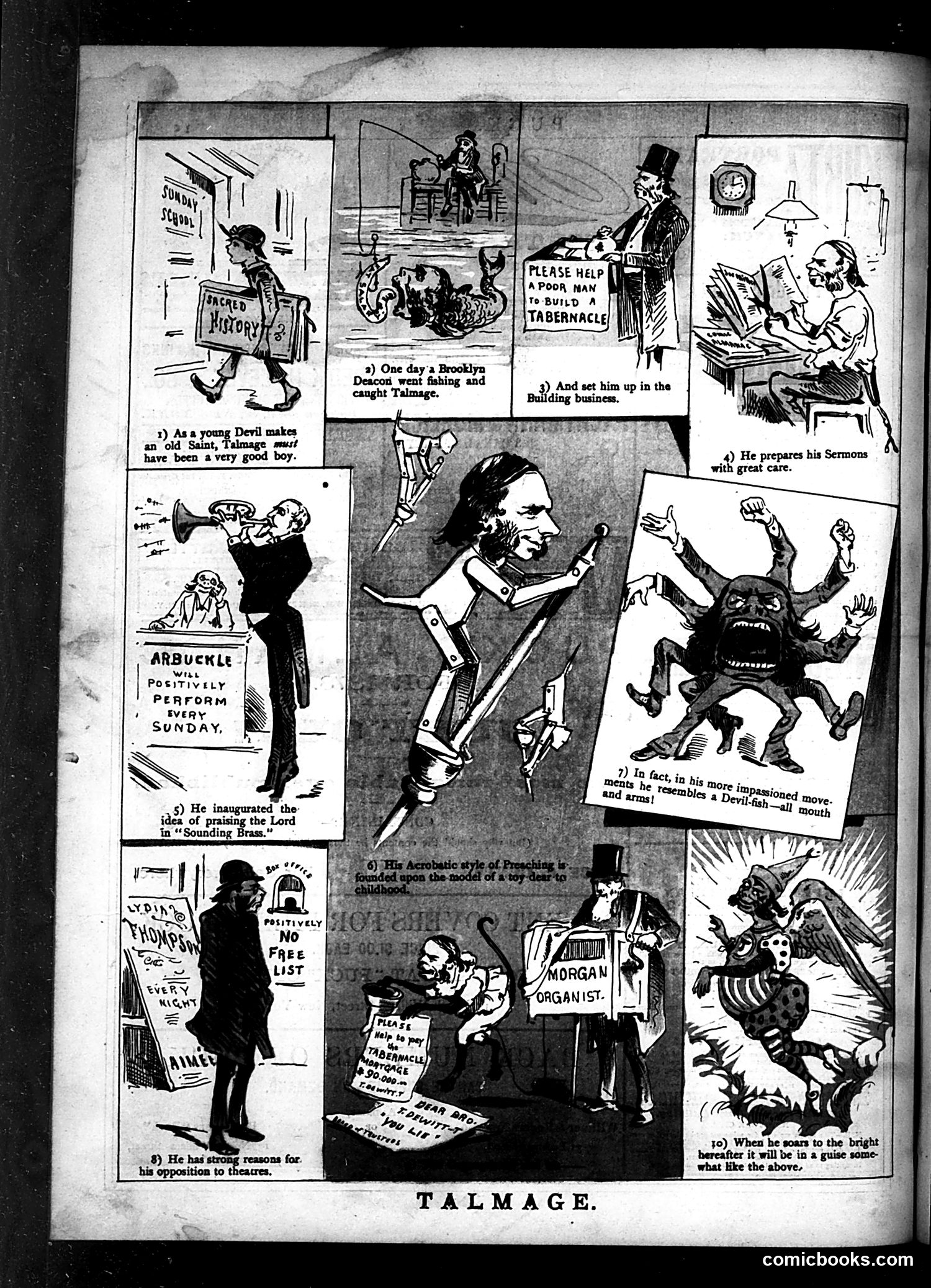
This is a ten-panel satirical biography of what appears to be a religious figure named Talmage. The cartoon traces his career trajectory from youthful mischief through religious prominence to eventual damnation. Key narrative points: Talmage begins as a troublemaker ("young Devil"), becomes a clergyman who invents "sounding brass" (praising the Lord theatrically), establishes a tabernacle through charitable appeals, and gains fame as a preacher and organist named "Morgan." The satire critiques his theatrical, sensational approach to religion—his movements are "impudent" and "devil-ish," his sermons prepared with suspicious care. The final panel suggests his ultimate fate: descent into hell, depicted as a demon emerging from flames. The cartoon mocks what it presents as religious charlatanry and theatrical manipulation disguised as piety.