
Puck, 1878-04-10 · page 11 of 16
Puck — April 10, 1878 — page 11: what you’re looking at
What you’re looking at
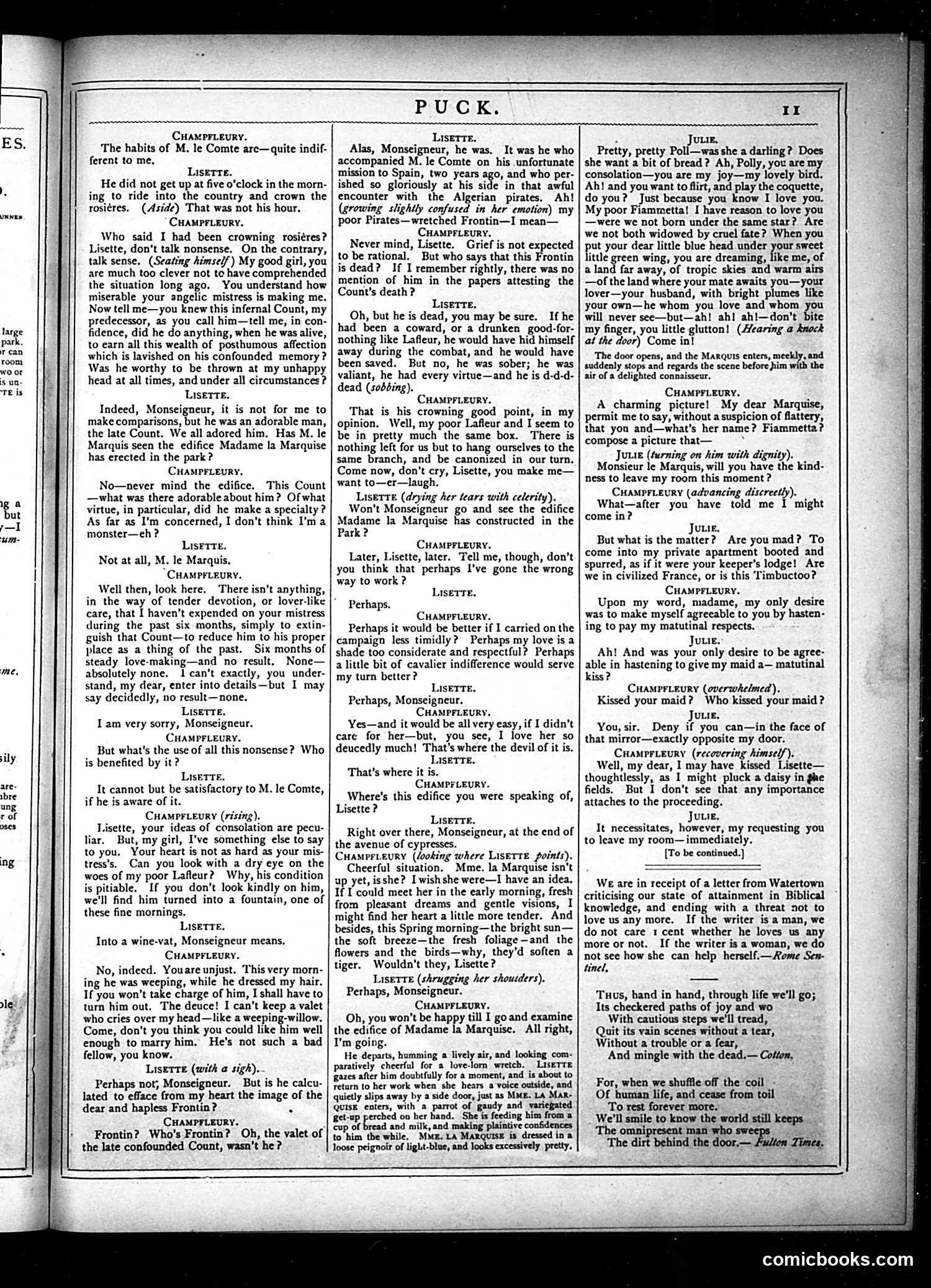
This page from *Puck* contains a dramatic dialogue scene rather than a political cartoon. The text shows an extended conversation between characters including Champfleury, Lisette, and a Marquis, discussing matters of romance, honor, and social propriety in what appears to be a French aristocratic setting. The dialogue references a "Frontini" (possibly a count), Algerian pirates, and various romantic entanglements. Without clearer visual identification of the illustrated figures or knowledge of the specific historical context this scene satirizes, I cannot definitively identify which real political or social figures are being lampooned. The page appears to be literary satire rather than direct political commentary, likely mocking French upper-class pretensions and romantic conventions of the era.
📄 Transcribed text from this page (OCR, searchable)
Machine-transcribed from the original scan — historical spelling and the odd misread are preserved.
PUCK. II CHAMPFLEURY. The habits of M. le Comte arc—quite indif- ferent to me. Lisette. He did not get up at five o'clock in the morn- ing to ride into the country and crown the rosiéres. (Aside) That was not his hour. CHAMPFLEURY. Who said I had been crowning rosi¢res? Lisette, don’t talk nonsense. On the contrary, talk sense. (Seating himself) My good girl, you are much too clever not te have comprehended the situation long ago. You understand how miserable your angelic mistress is making me. Now tell me—you knew this infernal Count, my predecessor, as you call him—tell me, in con- fidence, did he do anything, when he was alive, to earn all this wealth of posthumous affection which is lavished on his confounded memory? Was he worthy to be thrown at my unhappy head at all times, and under all circumstances ? Lisette. Indeed, Monseigneur, it is not for me to make comparisons, but he was an adorable man, the late Count. We all adored him. Has M. le Marquis seen the edifice Madame la Marquise has erected in the park? CHAMPFLEURY. No—never mind the edifice. This Count —what was there adorable about him? Of what virtue, in particular, did he make a specialty ? As far as I'm concerned, I don’t think I'ma monster—eh ? Lisette. Not at all, M. le Marquis, CHAMPFLEURY. Well then, look here. ‘There isn’t anything, in the way of tender devotion, or lover-like |* care, that I haven’t expended on your mistress during the past six months, simply to extin- guish that Count—to reduce him to his proper place as a thing of the past. Six months of steady love-making—and no result, None— absolutely none. 1 can’t exactly, you under- stand, my dear, enter into details—but I may say decidedly, no result—none. Lisetre. Iam very sorry, Monseigneur. CHAMPFLEURY. But what's the use of all this nonsense? Who is benefited by it? Lisette. It cannot but be satisfactory to M. le Comte, if he is aware of it. Cuamprceury (rising). Lisette, your ideas of consolation are pecu- liar. But, my girl, I’ve something else to say to you. Your heart is not as hard as your mis- tress’s, Can you look with a dry eye on the woes of my poor Lafleur? Why, his condition is pitiable. If you don’t look kindly on him, we'll find him turned into a fountain, one of these fine mornings. Lisette. Into a wine-vat, Monseigneur means. CHAMPFLEURY. No, indeed. Youare unjust. This very morn- ing he was weeping, while he dressed my hair. If you won't take charge of him, I shall have to turn him out. The deuce! I can’t keep a valet who cries over my head—like a weeping-willow. Come, don’t you think you could like him well enough to marry him. He's not such a bad fellow, you know. LisetTE (with a sigh). Perhaps not; Monseigneur. But is he calcu- lated to efface from my heart the image of the dear and hapless Frontin? 2 CHAMPFLEURY. Frontin? Who's Frontin? Oh, the valet of the late confounded Count, wasn’t he? Lisette. Alas, Monseigneur, he was. It was he who accompanied M. le Comte on his unfortunate mission to Spain, two years ago, and who per- ished so gloriously at his side in that awful encounter with the Algerian pirates. Ah! (growing slightly confused in her emotion) my poor Pirates—wretched Frontin—I mean— CHAMPFLEURY. Never mind, Lisette. Grief is not expected to be rational. But who says that this Frontin is dead? If I remember rightly, there was no mention of him in the papers attesting the Count’s death ? Lisette. Oh, but he is dead, you may be sure. If he had been a coward, or a drunken good-for- nothing like Lafleur, he would have hid himself away during the combat, and he would have been saved. But no, he was sober; he was valiant, he had every virtue—and he is d-d-d- dead (sobsing). CHAMPFLEURY. That is his crowning good point, in my opinion. Well, my poor Lafleur and I’ seem to be in pretty much the same box. There is nothing left for us but to hang ourselves to the same branch, and be canonized in our turn. Come now, don’t cry, Lisette, you make me— want to—er—laugh. Lisette (drying her tears with celerity). Won't Monseigneur go and see the edifice Madame la Marquise has constructed in the Park ? CHAMPFLEURY. Later, Lisette, later. Tell me, though, don’t you think that perhaps I’ve gone the wrong way to work ? LisETTE. Perhaps. CHAMPFLEURY. Perhaps it would be better if I carried on the campaign less timidly? Perhaps my love is a shade too considerate and respectful? Perhaps a little bit of cavalier indifference would serve my turn better? Lisette. Perhaps, Monseigneur. CHAMPFLEURY. Yes—and it would be all very easy, if I didn’t care for her—but, you see, I love her so deucedly much! That's where the devil of it is. Lisette. That's where it is. CHAMPFLEURY. Where's this edifice you were speaking of, Lisette ? Lisette. Right over there, Monseigneur, at the end of the avenue of cypresses. Cuamprceury (looking where Lisette points). Cheerful situation. Mme. la Marquise isn’t up yet, isshe? Iwish she were—I have an idea. If I could meet her in the early morning, fresh from pleasant dreams and gentle visions, I might find her heart a little more tender. And besides, this Spring morning—the bright sun— the soft breeze—the fresh foliage—and the flowers and the birds—why, they'd soften a tiger. Wouldn't they, Lisette? Lisette (shrugging her shoutders). Perhaps, Monseigneur. CHAMPFLEURY. Oh, you won't be happy till I go and examine the edifice of Madame la Marquise. All right, I'm going. He departs, humming a lively air, and looking com- paratively cheerful for a love-lorn wretch. LiseTTE gazes after him doubtfully for a moment, and is about to return to her work when she hears a voice outside, and quietly slips away by a side door, just as MME. LA MAR- QUISE enters, with a parrot of gaudy and variegated get-up perched on her hand. She is feeding him from a cup of Eread and milk, and making plaintive confidences to him the while. MMz.1A MARQUISE is dressed in a loose peignoir of light-blue, and looks excessively pretty. . Juiie. Pretty, pretty Poll—was she a darling? Does she want a bit of bread? Ah, Polly, you pak consolation—you are my joy—my lovely bird. Ah! and you want to flirt, and play the coquette, do you? Just because you know I love you. My poor Fiammetta! I have reason to love you —were we not born under the same star? Are we not both widowed by cruel fate? When you a your dear little blue head under your sweet ittle green wing, you are dreaming, like me, of a land far away, of tropic skies and warm airs —of the land where your mate awaits you—your lover—your husband, with bright plumes like your own—he whom you love and whom you will never see—but—ah! ah! ah!—don't bite my finger, you little glutton! (Hearing a knock at the door) Come in! ‘The door opens, and the Marquis enters, meekly, and suddenly stops and regards the scene before him with the air of a delighted connaisseur. CHAMPFLEURY. A charming picture! My dear Marquise, permit me to say, without a suspicion of flattery, that yon and—what’s her name? Fiammetta? compose a picture that— JuLie (turning on him with dignity). Monsieur le Marquis, will you have the kind- ness to leave my room this moment ? CHaMPFLEuRY (advancing discreetly). What—after you have told me I might come in? Junie. But what is the matter? Are you mad? To come into my private apartment booted and spurred, as if it were your keeper's lodge! Are we in civilized France, or is this Timbuctoo? CHAMPFLEURY. Upon my word, madame, my only desire was to make myself agreeable to you by hasten- ing to pay my matutinal respects. June. Ah! And was your only desire to be agree- able in hastening to give my maid a— matutinal kiss ? CHamprLeury (overwhelmed). Kissed your maid? Who kissed your maid ? Junie. You, sir. Deny if you can—in the face of that mirror—exactly opposite my door. CHamprLeury (recovering himself). Well, my dear, I may have kissed Lisette— thoughtlessly, as I might pluck a daisy in ghe fields. But I don’t see that any importance attaches to the proceeding. June. It necessitates, however, my requesting you to leave my room—immediately. [To be continued.) We are in receipt of a letter from Watertown criticising our state of attainment in Biblical knowledge, and ending with a threat not to love us any more. If the writer is a man, we do not care 1 cent whether he loves us any more or not. If the writer is a woman, we do not see how she can help herself.—Rome Sen- tinel, Tuus, hand in hand, through life we'll go; Its checkered paths of joy and wo With cautious steps we'll tread, Quit its vain scenes without a tear, Without a trouble or a fear, And mingle with the dead.— Coton, For, when we shuffle off the coil - Of human life, and cease from toil To rest forever more. ‘We'll smile to know the world still keeps ‘The omnipresent man who aN: ‘The dirt behind the oor, Palen Tees, comicbooks.com