
Puck, 1878-04-10 · page 10 of 16
Puck — April 10, 1878 — page 10: what you’re looking at
What you’re looking at
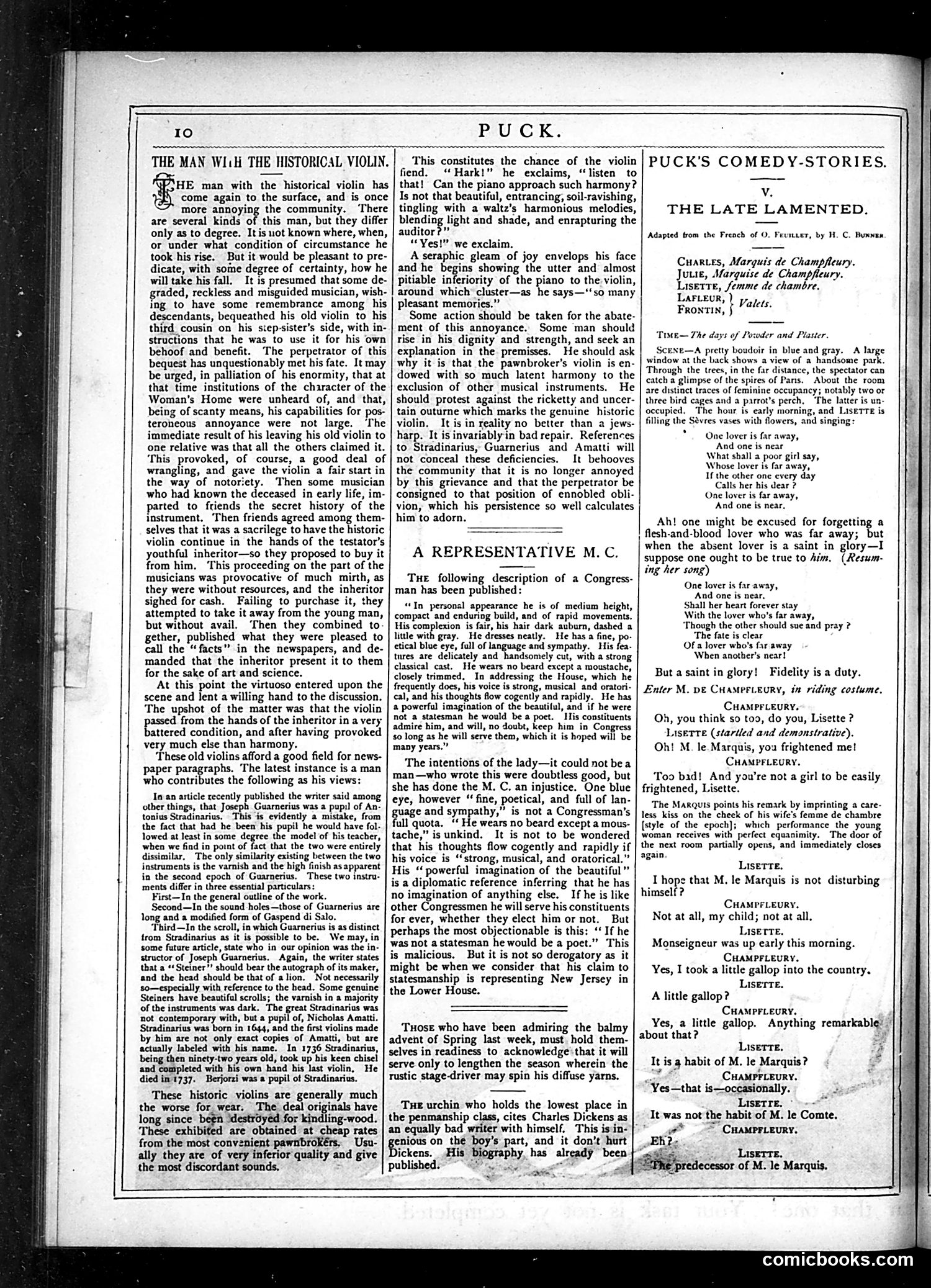
This page contains two distinct sections: **Left column:** An article titled "The Man with the Historical Violin" satirizes wealthy collectors who acquire violins supposedly owned by famous historical figures, then display them prominently while lacking actual musical skill or understanding. The satire mocks both the pretentiousness of the collectors and the dubious authenticity of such artifacts. **Right column:** "The Late Lamented" is a comedic dialogue adapted from French sources, featuring characters named Champleury, Lisette, and the Marquis de Champfleury. The humor appears to involve romantic misunderstandings and social posturing between aristocratic characters—typical parlor-comedy fare of the period. The page emphasizes Puck's satirical focus on American social pretension and class affectation rather than explicit political commentary.
📄 Transcribed text from this page (OCR, searchable)
Machine-transcribed from the original scan — historical spelling and the odd misread are preserved.
Io PUCK. THE MAN WliH THE HISTORICAL VIOLIN. ee man with the historical violin has come again to the surface, and is once more annoying the community. There are several kinds of this man, but they differ only as to degree. It is uot known where, when, or under what condition of circumstance he took his rise. But it would be pleasant to pre- dicate, with some degree of certainty, how he will take his fall. It is presumed that some de- raded, reckless and misguided musician, wish- ing to have some remembrance among his descendants, bequeathed his old violin to his third cousin on his step-sister’s side, with in- structions that he was to use it for his own behoof and benefit. The perpetrator of this bequest has unquestionably met his fate. It may be urged, in palliation of his enormity, that at that time institutions of the character of the Woman’s Home were unheard of, and that, being of scanty means, his capabilities for pos- teroheous annoyance were not large. ‘The immediate result of his leaving his old violin to one relative was that all the others claimed it. ‘This provoked, of course, a good deal of wrangling, and’ gave the violin a fair start in the way of notoriety. Then some musician who had known the deceased in early life, im- parted to friends the secret history of the instrument, Then friends agreed among them- selves that it was a sacrilege to have the historic violin continue in the hands of the testator’s youthful inheritor—so they proposed to buy it from him. is proceeding on the part of the musicians was provocative of much mirth, as they were without resources, and the inheritor sighed for cash. Failing to purchase it, they attempted to take it away from the young man, but without avail. ‘Then they combined to- gether, published what they were pleased to call the “facts” in the newspapers, and de- manded that the inheritor present it to them for the sake of art and science. At this point the virtuoso entered upon the scene and lent a willing hand to the discussion. The upshot of the matter was that the violin assed from the hands of the inheritor in a very battered condition, and after having provoked very much else than harmony. These old violins afford a good field for news- paper paragraphs. ‘The latest instance is a man who contributes the following as his views: In an article recently published the writer said among other things, that Joseph Guarnerius was a pupil of An- tonius Stradinarius, This is evidently a mistake, from the fact that had he been his pupil he would have fol- lowed at least in some degree the model of his teacher, when we find in point of fact that the two were entirely dissimilar, The only similarity existing between the two instruments is the varnish and the high finish as apparent in the second epoch of Guarnerius. ‘These two instru- ments differ in three essential particulars: First—In the general outline of the work. Second—In the sound holes—those of Guarnerius are long and a modified form of Gaspend di Salo. ‘Third—In the scroll, in which Guarnerius is as distinct trom Stradinarius as it is possible to be. We may, i some future article, state who in our opinion was the in- structor of Joseph Guarnerius. Again, the writer states that a ‘*Steiner’” should bear the autograph of its maker, and the head should be that of alion. Not necessarily so—especially with reference to the head. Some genuine Steiners have beautifal scrolls; the varnish in a majority of the instruments was dark. The great Stradinarius was not contemporary with, but a pupil of, Nicholas Amatti. Stradinarius was born in 1644, and the first violins made by him are not only exact copies of Amati, but are actually labeled with his name. In 1736 Stradinarius, being then ninety-two years old, took up his keen chisel and completed with his own hand his last violin, He died in 1737. Berjorzi was a pupil of Stradinarius. These historic violins are generally much the worse for_wear. The: deal originals have long since been ‘destroyed for iing-wood. These exhibited are obtained at cheap rates from the most make Hes PRRSrORET eet ally they are of very inferior quality and give the most discordant sounds, This constitutes the chance of the violin fiend. ‘ Hark!” he exclaims, “listen to that! Can the piano approach such harmony? Is not that beautiful, entrancing, soil-ravishing, tingling with a waltz’s harmonious melodies, blending light and shade, and enrapturing the auditor?” “Yes!” we exclaim. A seraphic gleam of joy envelops his face and he begins showing the utter and almost pitiable inferiority of the piano to the violin, around which’ cluster—as he says—‘‘so many pleasant memories.” Some action should be taken for the abate- ment of this annoyance. Some man should rise in his dignity and strength, and seek an explanation in the premisses. He should ask why it is that the pawnbroker’s violin is en- dowed with so much latent harmony to the exclusion of other musical instruments. He should protest against the ricketty and uncer- tain outurne which marks the genuine historic violin, It isin reality no better than a jews- harp. It is invariably in bad repair. References to Stradinarius, Guarnerius and Amatti will not conceal these deficiencies. It behooves the community that it is no longer annoyed by this grievance and that the perpetrator be consigned to that position of ennobled obli- vion, which his persistence so well calculates him to adorn. A REPRESENTATIVE M.C. Tue following description of a Congress- man has been published: ‘In personal appearance he is of medium height, compact and enduring build, and of rapid movements. His complexion is fair, his hair dark auburn, dashed a little with gray. He dresses neatly. He has a fine, po- etical blue eye, full of language and sympathy. His fea- tures are delicately and handsomely cut, with a strong classical cast. He wears no beard except a moustache, closely trimmed, In addressing the House, which he frequently does, his voice is strong, musical and oratori- cal, and his thoughts flow cogently and rapidly. He has ‘a powerful imagination of the beautiful, and if he were not a statesman he would be a poet. Ilis constituents admire him, and will, no doubt, keep him in Congress so long as he will serve them, which it is hoped will be many years.” The intentions of the lady—it could not bea man—who wrote this were doubtless good, but she has done the M. C. an injustice. One blue eye, however “fine, poetical, and full of lan- guage and sympathy,” is not a Congressman’s full quota. ‘‘ He wears no beard except a mous- tache,” is unkind. It is not to be wondered that his thoughts flow cogently and rapidly if his voice is ‘strong, musical, and oratorical.” His “powerful imagination of the beautiful” is a diplomatic reference inferring that he has no imagination of anything else. If he is like other Congressmen he will serve his constituents for ever, whether they clect him or not. But perhaps the most objectionable is this: “If he was not a statesman he would be a poet.” This is malicious. But it is not so derogatory as it might be when we consider that his claim to statesmanship is representing New Jersey in the Lower House. ‘Tose who have been admiring the balmy advent of Spring last week, must hold them- selves in readiness to acknowledge’ that it will serve only to lengthen the season wherein the rustic stage-driver may spin his diffuse yarns. Tue urchin who holds the lowest place in the penmanship class, cites Charles Dickens as an equally bad writer with himself. This is in- enious on thé boy’s part, and it don't hurt Bickens. His biography, has already been. published. : ae. 4 2 PUCK’S COMEDY-STORIES. Vv. THE LATE LAMENTED. Adapted trom the French of O. Feunuer, by H.C. Buxwex Cuartes, Marguis de Champfleury. Junie, Marquise de Champfleury. Lisette, femme de chambre, LaFLevr, ) Frownin, 5 Yalets Time— The days of 2 and Plaster. Scexe—A pretty boudoir in blue and gray. A large window at the back shows a view of a handsome park. Through the trees, in the far distance, the spectator can catch a glimpse of the spires of Pans. About the room are distinct traces of feminine occupancy; notably two or three bird cages and a parrot’s perch, “The latter is un- occupied. ‘The hour is early morning, and Lisette is filling the Sdvres vases with flowers, and singing: © One lover is far away, And one is near What shall a poor girl say, Whose lover is far away, If the other one every day Calls her his dear ? One lover is far away, And one is near. Ah! one might be excused for forgetting a flesh-and-blood lover who was far away; But when the absent lover is a saint in glory—I suppose one ought to be true to Aim, (Resum- ing her song) One lover is far away, And onc is near. Shall her heart forever stay With the lover who's far away, ‘Though the other should sue and pray ? The fate is clear Of a lover who's far away When another's near! But a saint in glory! Fidelity is a duty. Enter M. pt CHampreury, i” riding costume, CutamprLeury. Oh, you think so too, do you, Lisette ? Lisette (startled and demonstrative). Oh! M. le Marquis, you frightened me! CHAMPFLEURY, Too bad! And you're not a girl to be easily frightened, Lisette. The Marquis points his remark by imprinting a care- less kiss on the cheek of his wife’s femme de chambre {style of the epoch]; which performance the young woman receives with perfect equanimity. The door of the next room partially opens, and immediately closes again Lisette. T hope that M, le Marquis is not disturbing himself ? CHAMPFLEURY. Not at all, my child; not at all, Liserte. Monseigneur was up early this morning. CHAMPFLEURY. Yes, I took a little gallop into the country. Liserre. A little gallop? CuamprLeury. gallop. Anything remarkable: Yes, a little about that? Lisette. iF It is a habit of M. le Marquis? sd pe / CHaMPrLEuRY. ‘Yes—that is—occasionally. + Lisetre. mk It was not the habit of M. le Comte. * CHAMPFLEURY. ERK? - “ Lisette. 3 e predecessor of M. le Marquis. comicbooks.com