
Puck, 1878-04-10 · page 3 of 16
Puck — April 10, 1878 — page 3: what you’re looking at
What you’re looking at
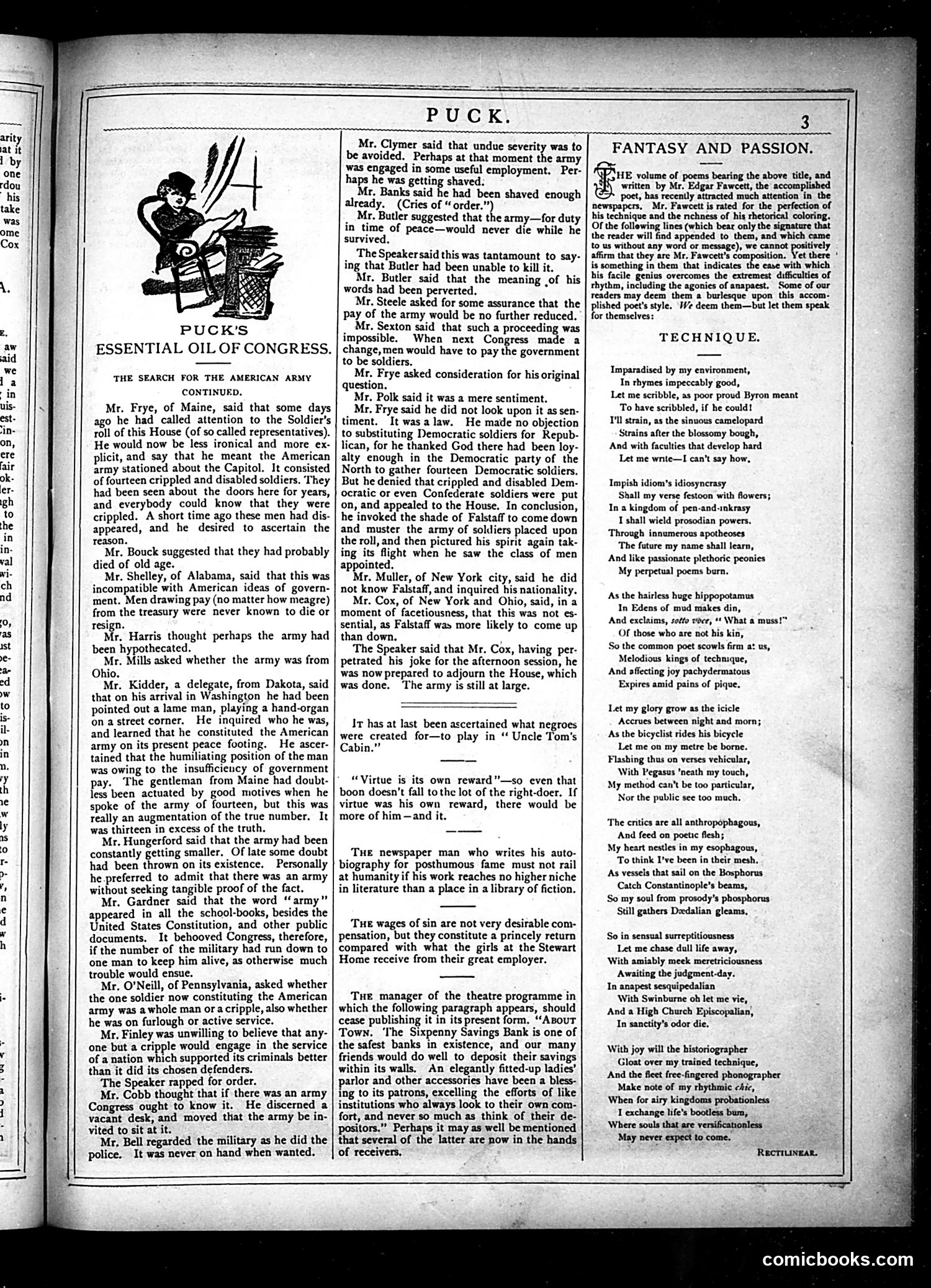
This page contains political satire about Congressional debate regarding **army compensation and soldier welfare**. The cartoon depicts a figure labeled "Puck's Essential Oil of Congress," showing Congress debating whether disabled soldiers deserve continued payment. Multiple congressmen are quoted discussing whether reducing army pay was justified, with one arguing it constitutes "undue severity." The satirical point appears to be that Congress engaged in lengthy, philosophical debate about a straightforward moral issue—whether injured soldiers deserved support—treating it as an abstract principle rather than a human necessity. The page also includes a poetry section titled "Fantasy and Passion" and literary criticism, suggesting this addresses broader questions of governmental responsibility versus fiscal restraint during what appears to be a post-war period.
📄 Transcribed text from this page (OCR, searchable)
Machine-transcribed from the original scan — historical spelling and the odd misread are preserved.
PUCK. ESSENTIAL OIL OF CONGRESS. THE SEARCH FOR THE AMERICAN ARMY CONTINUED. Mr. Frye, of Maine, said that some days o he had called attention to the Soldier’s roll of this House (of so called representatives). He would now be less ironical and more ex- plicit, and say that he meant the American army stationed about the Capitol. It consisted of fourteen crippled and disabled soldiers. They had been seen about the doors here for years, and everybody could know that they were crippled. A short time ago these men had dis- appeared, and he desired to ascertain the reason. Mr. Bouck suggested that they had probably died of old age. Mr. Shelley, of Alabama, said that this was incompatible with American ideas of govern- ment. Men drawing pay (no matter how meagre) from the treasury were never known to die or resign. Mr. Harris thought perhaps the army had been hypothecated. Mr. Mills asked whether the army was from Ohio. Mr. Kidder, a delegate, from Dakota, said that on his arrival in Washington he had been pointed out a lame man, playing a hand-organ ona street corner. He inquired who he was, and learned that he constituted the American army on its present peace footing. He ascer- tained that the humiliating position of the man was owing to the insufficiency of government pay. The gentleman from Maine had doubt- less been actuated by good motives when he spoke of the army of fourteen, but this was really an augmentation of the true number. It was thirteen in excess of the truth, Mr. Hungerford said that the army had been constantly getting smaller, Of late some doubt had been thrown on its existence. Personally he preferred to admit that there was an army without seeking tangible proof of the fact. Mr. Gardner said that the word “army” appeared in all the school-books, besides the United States Constitution, and other public documents. It behooved Congress, therefore, if the number of the military had run down to ‘one man to keep him alive, as otherwise much trouble would ensue. Mr. O'Neill, of Pennsylvania, asked whether the one soldier now constituting the American army was a whole man or acripple, also whether he was on furlough or active service. Mr. Finley was unwilling to believe that any- one but a cripple would engage in the service of a nation which supported its criminals better than it did its Say ae The Speaker ra for order. Mr. Cobb thought that if there was an army Congress ought to know it. He discerned a vacant desk, and moved that the army be in- vited to sit at it. fi Mr. Bell regarded the military as he did the police. It was never on hand when wanted. Mr. Clymer said that undue severity was to be avoided. Perhaps at that moment the army was engaged in some useful employment. Per- haps he was getting shaved. Mr. Banks said he had been shaved enough already. (Cries of “ order.”) __ Mr. Butler suggested that the army—for duty in time of peace—would never die while he survived, __ The Speaker said this was tantamount to say- ing that Butler had been unable to kill it. Mr. Butler said that the meaning of his words had been perverted. i Mr. Steele asked for some assurance that the pay of the army would be no further reduced. __ Mr. Sexton said that such a proceeding was impossible. When next Congress made a change, men would have to pay the government to be soldiers, Mr. Frye asked consideration for his original question. Mr. Polk said it was a mere sentiment. , Mr. Frye said he did not look upon it as sen- timent. It was alaw. He made no objection to substituting Democratic soldiers for Repub- lican, for he thanked God there had been loy- alty enough in the Democratic party of the North to gather fourteen Democratic soldiers. But he denied that crippled and disabled Dem: ocratic or even Confederate soldiers were put on, and appealed to the House. In conclusion, he invoked the shade of Falstaff to come down and muster the army of soldiers placed upon the roll, and then pictured his spirit again tak- ing its flight when he saw the class of men appointed. Mr. Muller, of New York city, said he did not know Falstaff, and inquired his nationality. Mr. Cox, of New York and Ohio, said, in a moment of facetiousness, that this was not ¢s- sential, as Falstaff was more likely to come up than down, ‘The Speaker said that Mr. Cox, having per- petrated his joke for the afternoon session, he was now prepared to adjourn the House, which was done. The army is still at large. It has at last been ascertained what negroes were created for—to play in ‘‘ Uncle Tom's Cabin.” “Virtue is its own reward”—so even that boon doesn’t fall tothe lot of the right-doer. If virtue was his own reward, there would be more of him—and it. Tue newspaper man who writes his auto- biography for posthumous fame must not rail at humanity if his work reaches no higher niche in literature than a place in a library of fiction. ‘Tue wages of sin are not very desirable com- pensation, but they constitute a princely return compared with what the girls at the Stewart Home receive from their great employer. Tue manager of the theatre programme in which the following paragraph appears, should cease publishing it in its present form. “ABouT Town. ‘The Sixpenny Savings Bank is one of the safest banks in existence, and our many friends would do well to deposit their savings within its walls. An elegantly fitted-up ladies’ arlor and other accessories have been a bless- ing to its patrons, excelling the efforts of like institutions who always look to their own com- fort, and never so much as think of their de- positors.” Perhaps it may as well be mentioned that several of the latter are now in the hands of receivers, FANTASY AND PASSION. HE volume of poems bearing the above title, and written by Mr. Edgar Fawcett, the accomplished poet, has recently attracted much attention in the newspapers, Mr. Fawcett js rated for the perfection of his technique and the nchness of his rhetorical coloring. Of the follewing lines (which bear only the signature that the reader will find appended to them, and which came to us without any word or message), we cannot positively affirm that they are Mr. Fawcett’s composition. Yet there ‘ is something in them that indicates the ease with which his facile genius overcomes the extremest difficulties of rhythm, including the agonics of anapaest. Some of our readers may deem them a burlesque upon this accom- plished poet's style. We deem them—but let them speak for themselves: TECHNIQUE. Imparadised by my environment, In rhymes impeccably good, Let me scribble, as poor proud Byron meant To have scribbled, if he could! T'll strain, as the sinuous camelopard Strains after the blossomy bough, And with faculties that develop hard Let me wnte—I can’t say how, Impish idiom’s idiosyncrasy Shall my verse festoon with flowers; In a kingdom of pen-and-inkrasy I shall wield prosodian powers. ‘Through innumerous apotheoses ‘The future my name shall learn, And like passionate plethoric peonies My perpetual poems burn, As the hairless huge hippopotamus In Edens of mud makes din, And exclaims, sotto voce, “ What a muss!” Of those who are not his kin, So the common poet scowls firm at us, Melodious kings of technique, And affecting joy pachydermatous Expires amid pains of pique. Let my glory grow as the icicle Accrues between night and morn; As the bicyclist rides his bicycle Let me on my metre be borne. Flashing thus on verses vehicular, With Pegasus ‘neath my touch, My method can't be too particular, Nor the public see too much. ‘The critics are all anthropophagous, And feed on poetic flesh} My heart nestles in my esophagous, To think I've been in their mesh. ‘As vessels that sail on the Bosphorus Catch Constantinople’s beams, So my soul from prosody’s phosphorus Still gathers Deedalian gleams, So in sensual surreptitiousness Let me chase dull life away, With amiably meek meretriciousness Awaiting the judgment-day. In anapest sesquipedalian With Swinburne ob let me vie, And a High Church Episcopalian, In sanctity's odor die, With joy will the historiographer Gloat over my trained technique, And the ficet free-fingered phonographer Make note of my rhythmic chic, When for airy kingdoms probationless I exchange life's bootless bum, ‘Where souls that are versificationless May never expect to come. RECTILINEAR. comicbooks.com