
Puck, 1878-04-10 · page 2 of 16
Puck — April 10, 1878 — page 2: what you’re looking at
What you’re looking at
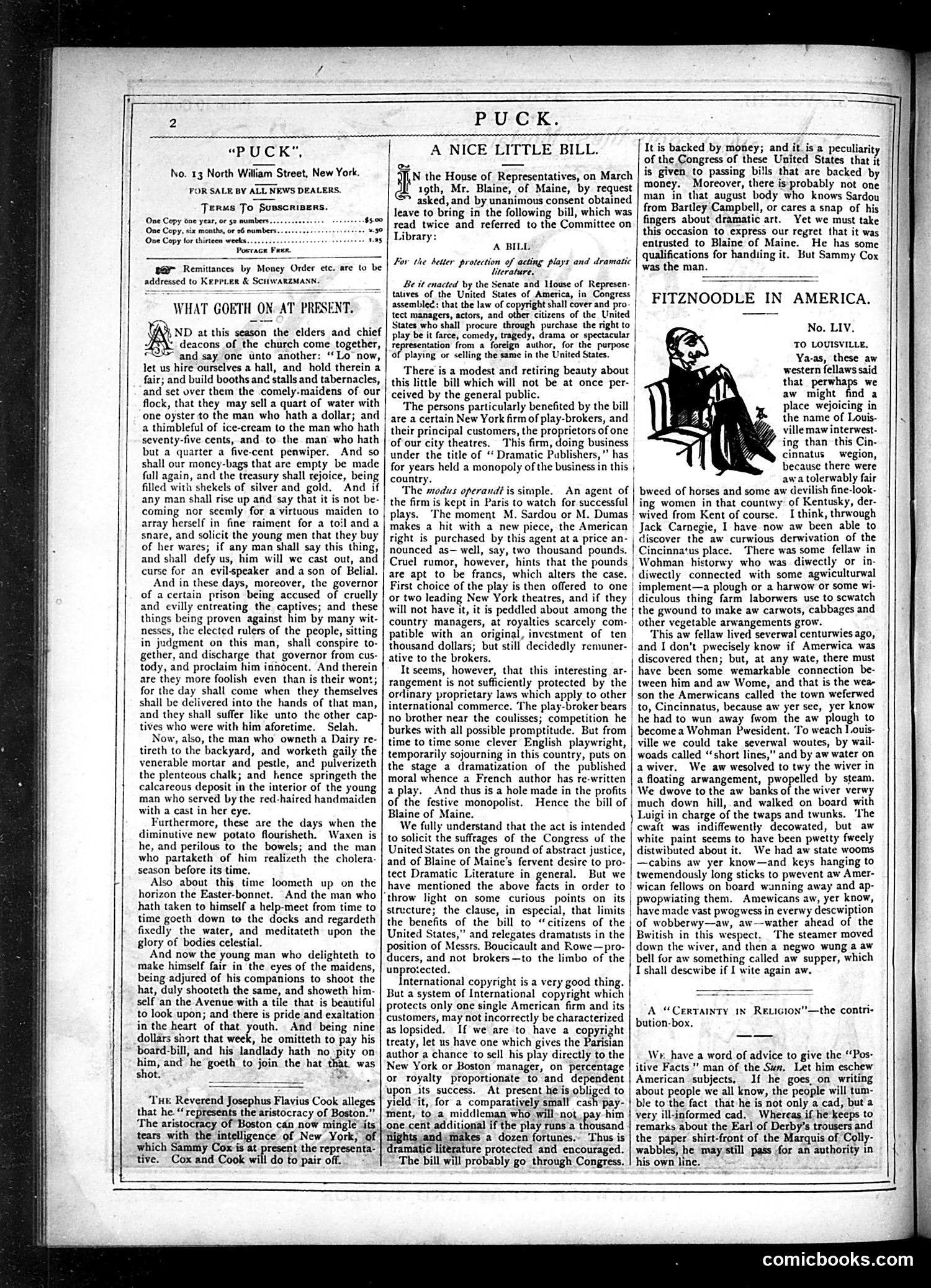
This page contains three distinct articles rather than cartoons. The main content includes: 1. **"A Nice Little Bill"** — Commentary on a congressional bill protecting dramatic works and theatrical rights. The text criticizes how the measure benefits New York theater proprietors and play-brokers while inadequately protecting authors' international copyrights. 2. **"What Goeth On At Present"** — Satirical observations on contemporary social behavior, including commentary on church deacons and their hypocrisy. 3. **"Fitznoodle in America, No. LIV"** — A travel narrative featuring a character (Fitznoodle) observing American customs, particularly regarding American women and peculiar regional practices, written in a mocking, ethnographic style typical of 19th-century satirical journalism. The page is primarily text-based satire rather than visual cartooning.
📄 Transcribed text from this page (OCR, searchable)
Machine-transcribed from the original scan — historical spelling and the odd misread are preserved.
PUCK. “PUCK”, No. 13 North William Street, New York. FOR SALE BY ALL NEWS DEALERS. Tenus To Sunscriners. One Copy one year, or 2 numbers... One Copy. six months, or 26 numbers ‘Ove Copy for thirteen weeks. Posen Ba Remittances by Money Order etc. are to be addressed to Krrrtet & SCHWARZMANN. WHAT GOETH ON: AT PRESENT. ND at this season the elders and chief \: deacons of the church come together, £ “and say one unto another: ‘‘Lo now, let us hire ourselves a hall, and hold therein a fair; and build booths and stalls and tabernacles, and set over them the comely-maidens of our flock, that they may sell a quart of water with one oyster to the man who hath a dollar; and a thimbleful of ice-cream to the man who hath seventy-five cents, and to the man who hath but a quarter a five-cent penwiper. And so shall our moncy-bags that are empty be made full again, and the treasury shall rejoice, being filled with shekels of silver and gold. And if any man shall rise up and say that it is not be- coming nor seemly for a virtuous maiden to | array herself in fine raiment for a toil anda snare, and solicit the young men that they buy of her wares; if any man shall say this thing, and shall defy us, him will we cast out, and curse for an evil-speaker and a son of Belial. And in these days, moreover, the governor of acertain prison being accused of cruelly and evilly entreating the captives; and these things being proven against him by many wit- nesses, the elected rulers of the people, sitting in judgment on this man, shall conspire to- gether, and discharge that governor from cus- tody, and proclaim him innocent. And therein are they more foolish even than is their wont; for the day shall come when they themselves shall be delivered into the hands of that man, and they shall suffer like unto the other cap- tives who were with him aforetime. Selah. Now, also, the man who owneth a Dairy re- tireth to the backyard, and worketh gaily the venerable mortar and pestle, and pulverizeth the plenteous chalk; and hence springeth the calcareous deposit in the interior of the young man who served by the red-haired handmaiden with a cast in her eye. Furthermore, these are the days when the diminutive new potato flourisheth. Waxen is he, and perilous to the bowels; and the man who partaketh of him realizeth the cholera- season before its tim Also about this time loometh up on the horizon the Easter-bonnet. And the man who hath taken to himself a help-meet from time to time goeth down to the docks and regardeth fixedly the water, and meditateth upon the glory of bodies celestial. And now the young man who delighteth to make himself fair in the eyes of the maidens, being adjured of his companions to shoot the hat, duly shooteth the same, and showeth him- self an the Avenue with a tile that is beautiful to look upon; and there is pride and exaltation in the heart of that youth. And being nine dollars short that week he omitteth to pay his board-bill, and his landlady hath no pity on Hn and he goeth to join the hat that was shot. ‘Tue Reverend Josephus Flavius Cook alleges that he “represents the aristocracy of Boston.” ‘The aristocracy of Boston can now mingle’ its | tears with the intelligence of New York, of which Sammy Cox is at pees the representa- tive. Cox and Cook will do to pair off. Is the House of Representatives, on March “throw light on some curious points on its A NICE LITTLE BILL. 1gth, Mr. Blaine, of Maine, by request asked, and by unanimous consent obtained leave to bring in the following bill, which was read twice and referred to the Committee on Library: A BILL For the better protection of acting plays and dramatic literature, Be it enacted by the Senate and Mouse of Represen- tatives of the United States of America, in Congress assembled: that the law of copyright shall cover and pro tect managers, actors, and other citizens of the United States who shall procure through purchase the right to | | play be it farce, comedy, tragedy, drama or spectacular Tepresentation from a foreign author, for the perpose | of playing or selling the same in the United States. | ‘There is a modest and retiring beauty about | this little bill which will not be at once per- ceived by the general public. | ‘The persons particularly benefited by the bill | are a certain New York firm of play-brokers, and | their principal customers, the proprietors of one of our city theatres. This firm, doing business under the title of ‘ Dramatic Publishers,” has for years held a monopoly of the business in this ; country. | The modus operandi is simple. An agent of the firm is kept in Paris to watch for successful plays. The moment M. Sardou or M. Dumas | makes a hit with a new piece, the American right is purchased by this agent at a price an- | nounced as— well, say, two thousand pounds. Cruel rumor, however, hints that the pounds | are apt to be francs, which alters the case. | First choice of the play is then offered to one | or two leading New York theatres, and if they | will not have it, it is peddled about among the country managers, at royaltics scarcely com- | patible with an original, investment of ten thousand dollars; but still decidedly remuner- ative to the brokers. It seems, however, that this interesting ar- rangement is not sufficiently protected by the ordinary proprietary laws which apply to other international commerce. The play-broker bears | no brother near the coulisses; competition he burkes with all possible promptitude. But from time to time some clever English playwright, temporarily sojourning in this country, puts on the stage a dramatization of the published moral whence a French author has re-written a play. And thus is a hole made in the profits of the festive monopolist. Hence the bill of Blaine of Maine. We fully understand that the act is intended to solicit the suffrages of the Congress of the United States on the ground of abstract justice, and of Blaine of Maine’s fervent desire to pro- tect Dramatic Literature in general. But we | have mentioned the above facts in order to | structure; the clause, in especial, that limits the benefits of the bill to “citizens of the United States,” and relegates dramatists in the position of Messrs. Boucicault and Rowe—pro- ducers, and not brokers—to the limbo of the unprotected. international copyright is a very good thing. But a system of International copyright which protects only one single American firm and its customers, may not incorrectly be characterized as lopsided. If we are to have a copyright treaty, let us have one which gives the Parisian author a chance to sell his play directly to the New York or Boston manager, on percentage or royalty proportionate to and dependent upon its success. At present he is obliged to yield-it, for a comparatively small cash pay- ment, to a middleman who .will-not. pay-him one cent additional if the play runs'a thousand Tights andsmmakes a dozen fortunes.. Thus is dramatic literature protected and encouraged. The bill will probably go through Congress, | Cincinnatus place. It is backed by money; and it isa peculiarit: of the Congress of these United States that it is given to passing bills that are backed by | money. Moreover, there is probably not one man in that august body who knows Sardou from Bartley Campbell, or cares a snap of his fingers about dramatic art. Yet we must take this occasion to express our regret that it was entrusted to Blaine of Maine. He has some qualifications for handling it. But Sammy Cox was the man. FITZNOODLE IN AMERICA. No. LIV, TO LOUISVILLE, Ya-as, these aw western fellaws said that perwhaps we aw might find a place wejoicing in the name of Louis- ville maw interwest- ing than this Cin- cinnatus wegion, because there were awa tolerwably fair bweed of horses and some aw devilish fine-look- ing women in that countwy of Kentusky, der- wived from Kent of course. I think, thrwough Jack Carnegie, I have now aw been able to discover the aw curwious derwivation of the ‘There was some fellaw in Wohman historwy who was diwectly or in- diwectly connected with some agwiculturwal implement—a plough or a harwow or some wi- diculous thing farm laborwers use to scwatch the gwound to make aw carwots, cabbages and other vegetable arwangements grow. This aw fellaw lived severwal centurwies ago, and I don’t pwecisely know if Amerwica was discovered then; but, at any wate, there must have been some wemarkable connection be- tween him and aw Wome, and that is the wea- son the Amerwicans called the town weferwed to, Cincinnatus, because aw yer see, yer know he had to wun away fwom the aw plough to become a Wohman Pwesident. ‘To weach I ouis- ville we could take severwal woutes, by wail- woads called ‘short lines,” and by aw water on awiver. We aw wesolved to twy the wiver in a floating arwangement, pwopelled by steam. We dwove to the aw banks of the wiver verwy much down hill, and walked on board with | Luigi in charge of the twaps and twunks. ‘The ewaft was indiffewently decowated, but aw white paint seems to have been pwetty fweely distwibuted about it. We had aw state wooms —cabins aw yer know—and keys hanging to twemendously long sticks to pwevent aw Amer- wican fellows on board wanning away and ap- pwopwiating them. Amewicans aw, yer know, have made vast pwogwess in everwy descwiption of wobberwy—aw, aw—wather ahead of the Bwitish in this wespect. ‘The steamer moved down the wiver, and then a negwo wung a aw bell for aw something called aw supper, which I shall descwibe if 1 wite again aw. A “Certainty IN Revicion’—the contri- bution-box. Wer, have a word of advice to give the ‘“Pos- itive Facts” man of the Sun. Let him eschew American subjects. If he goes, on writing about people we all know, the people will tum- ble to the fact that he is not only a cad, but a very ill-informed cad. Whereas if he'keeps to remarks about the Earl of Derby’s trousers and the paper shirt-front of the Marquis of Colly- wabbles, he ‘may still pass for an authority in his own line. f comicbooks.com