
Puck, 1878-04-10 · page 13 of 16
Puck — April 10, 1878 — page 13: what you’re looking at
What you’re looking at
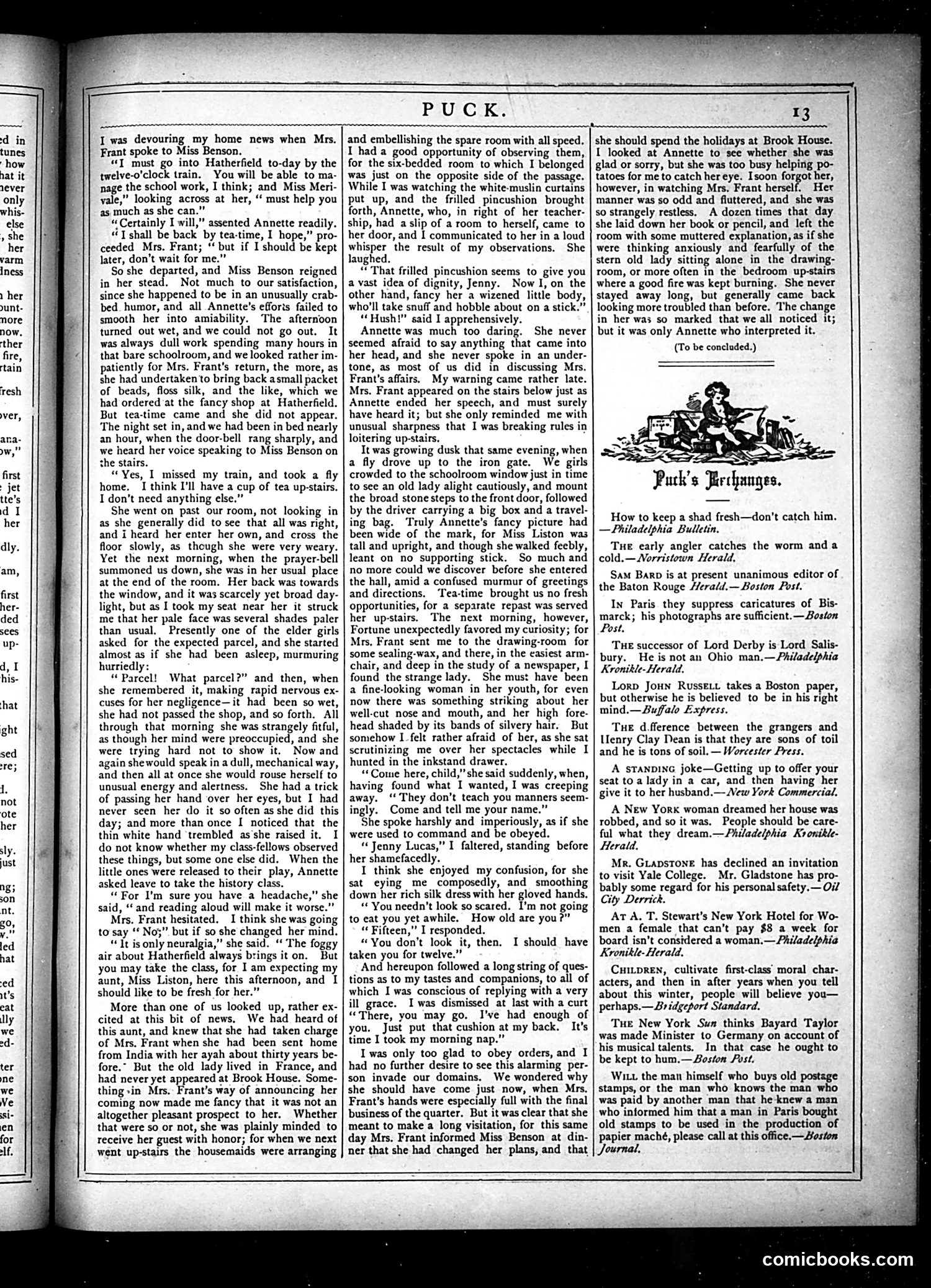
This page is primarily **text-based content**, not a political cartoon. It contains a serialized short story titled "Puck" (marked "To be concluded") about domestic drama involving characters like Mrs. Benson, Miss Annette, and Jenny. The narrative involves intrigue around a mysterious woman found in a house and discussions of social propriety. Below the main story is a section called **"Puck's Brithings"** — a collection of brief satirical items and jokes mocking contemporary figures and institutions. These include jabs at newspaper editors, Lord Derby, Lord Russell, and social commentary on women's wages and marriage customs. The page functions as **satirical humor and social criticism** through witty one-liners rather than visual caricature, typical of Puck's editorial voice.
📄 Transcribed text from this page (OCR, searchable)
Machine-transcribed from the original scan — historical spelling and the odd misread are preserved.
I was devouring my home news when Mrs. Frant spoke to Miss Benson. “I must go into Hatherfield to-day by the twelve-o'clock train. You will be able to ma- e the school work, I think; and Miss Meri- vale,” looking across at her, ‘ must help you as much as she can.” “Certainly I will,” assented Annette readily. “J shall be back by tea-time, I hope,” pro- ceeded Mrs. Frant; “ but if I should be kept later, don’t wait for me.”” So she departed, and Miss Benson reigned in her stead. Not much to our satisfaction, since she happened to be in an unusually crab- bed humor, and all Annette’s efforts failed to smooth her into amiability. The afternoon turned out wet, and we could not go out. It was always dull work spending many hours in that bare schoolroom, and we looked rather im- patiently for Mrs. Frant’s return, the more, as she had undertaken to bring back asmall packet of beads, floss silk, and the like, which we had ordered at the fancy shop at Hatherfield. But tea-time came and she did not appear. The night set in, and we had been in bed nearly an hour, when the door-bell rang sharply, and we heard her voice speaking to Miss Benson on the stairs. “Yes, I missed my train, and took a fly home. I think I'll have a cup of tea up-stairs. I don’t need anything else.” She went on past our room, not looking in as she generally did to see that all was right, and i heard her enter her own, and cross the floor slowly, as though she were very weary. Yet the next morning, when the prayer-bell summoned us down, she was in her usual place at the end of the room. Her back was towards the window, and it was scarcely yet broad day- light, but as I took my seat near her it struck me that her pale face was several shades paler than usual. Presently one of the elder girls asked for the expected parcel, and she started almost as if she had been asleep, murmuring hurriedly: “ Parcel! What parcel?” and then, when she remembered it, making rapid nervous ex- cuses for her negligence—it had been so wet, she had not passed the shop, and so forth. All through that morning she was strangely fitful, as though her mind were preoccupied, and she were trying hard not to show it. Now and again shewould speak in a dull, mechanical way, and then all at once she would rouse herself to unusual energy and alertness. She had a trick of passing her hand over her eyes, but I had never seen her do it so often as she did this day; and more than once I noticed that the thin white hand ‘trembled as’she raised it. I do not know whether my class-fellows observed these things, but some one else did. When the little ones were released to their play, Annette asked leave to take the history class. “For I’m sure you have a headache,” she said, ‘‘ and reading aloud will make it worse.” Mrs. Frant hesitated. 1 think she was going to say “ No;” but if so she changed her mind. “Te is only neuralgia,” she said. “ The foggy air about Hatherfield always brings iton. But you may take the class, for I am expecting my aunt, Miss Liston, here this afternoon, and I should like to be fresh for her.” More than one of us looked up, rather ex- cited at this bit of news, We had heard of this aunt, and knew that she had taken charge of Mrs. Frant when she had been sent home from India with her ayah about thirty years be- fore.” But the old lady lived in France, and had never yet appeared at Brook House. Some- thing+in Mrs. Frant’s way of announcing her coming now made me fancy that it was not an altogether pleasant prospect to her. Whether that were so or not, she was plainly minded to receive her guest with honor; for when we next went up-stairs the housemaids were arranging and embellishing the spare room with all speed. I had a good opportunity of observing them, for the six-bedded room to which I belonged was just on the opposite side of the passage. While I was watching the white-muslin curtains put up, and the frilled pincushion brought forth, Annette, who, in right of her teacher- ship, had a slip of a room to herself, came to her door, and I communicated to her in a loud whisper the result of my observations. She laughed. “That frilled pincushion seems to give you a vast idea of dignity, Jenny. Now I, on the other hand, fancy her a wizened little body, who'll take snuff and hobble about on a stick.” “Hush!” said I apprehensively. Annette was much too daring. She never seemed afraid to say anything that came into her head, and she never spoke in an under- tone, as most of us did in discussing Mrs. Frant’s affairs, My warning came rather late. Mrs. Frant appeared on the stairs below just as Annette ended her speech, and must surely have heard it; but she only reminded me with unusual sharpness that I was breaking rules in loitering up-stairs, It was growing dusk that same evening, when a fly drove up to the iron gate. We girls crowded to the schoolroom window just in time to see an old lady alight cautiously, and mount the broad stone steps to the front door, followed by the driver carrying a big box and a travel- ing bag. Truly Annette’s fancy picture had been wide of the mark, for Miss Liston was tall and upright, and though she walked feebly, leant on no supporting stick. So much and no more could we discover before she entered the hall, amid a confused murmur of greetings and directions. ‘Tea-time brought us no fresh opportunities, for a separate repast was served her up-sairs. The next morning, however, Fortune unexpectedly favored my curiosity; for Mrs, Frant sent me to the drawing-room for some sealing-wax, and there, in the easiest arm- chair, and deep in the study of a newspaper, I found the strange lady. She must have been a fine-looking woman in her youth, for even now there was something striking about her well-cut nose and mouth, and her high fore- head shaded by its bands of silvery hair. But somehow I felt rather afraid of her, as she sat scrutinizing me over her spectacles while I hunted in the inkstand drawer. “Come here, child,” she said suddenly, when, having found what I wanted, I was creeping away. “They don’t teach you manners seem- ingly. Come and tell me your name.” She spoke harshly and imperiously, as if she were used to command and be obeyed. “Jenny Lucas,” I faltered, standing before her shamefacedly. I think she enjoyed my confusion, for she sat eying me composedly, and smoothing down her rich silk dress with her gloved hands. ** You needn't look so scared. I’m not going to eat you yet awhile. How old are you ?” “ Fifteen,” I responded. “You don’t look it, then. taken you for twelve.” And hereupon followed a long string of ques- tions as to my tastes and companions, to all of which I was conscious of replying with a very ill grace. I was dismissed at last with a curt “There, you may go. I’ve had enough of you. Just put that cushion at my back. It’s time I took my morning nap.” I was only too glad to obey orders, and I had no further desire to see this alarming per- son invade our domains. We wondered why she should have come just now, when Mrs. Frant’s hands were especially full with the final business of the quarter. But it was clear that she meant to make a long visitation, for this same day Mrs. Frant informed Miss Benson at din- ner that she had changed her plans, and that I should have a. she should spend the holidays at Brook House. I looked at Annette to see whether she was glad or sorry, but she was too busy helping po- tatoes for me to catch hereye. Isoon irre her, however, in watching Mrs. Frant herself. Her manner was so odd and fluttered, and she was so strangely restless. A dozen times that day she laid down her book or pencil, and left the room with some muttered explanation, as if she were thinking anxiously and fearfully of the stern old lady sitting alone in the drawing- room, or more often in the bedroom up-stairs where a good fire was kept burning. She never stayed away long, but generally came back looking more troubled than before. The change in her was so marked that we all noticed it; but it was only Annette who interpreted it. (To be concluded.) How to keep a shad fresh—don’t catch him. —Philadelphia Bulletin, Tue early angler catches the worm and a cold.—Norristown Herald, Sam Baro is at present unanimous editor of the Baton Rouge Heral/d.— Boston Post. In Paris they suppress caricatures of Bis- marck; his photographs are sufficient.— Boston Post. Tue successor of Lord Derby is Lord Salis- bury. He is not an Ohio man.—Philadelphia Kronikle-Herald, Lorp Joun Russext takes a Boston paper, but otherwise he is believed to be in his right mind.—Buffalo Express. Tue d.fference between the grangers and Ifenry Clay Dean is that they are sons of toil and he is tons of soil. — Worcester Press. A sTanpiNG joke—Getting up to offer your seat to a lady in a car, and then having her give it to her husband.— New York Commercial. A New York woman dreamed her house was robbed, and so it was. People should be care- ful what they dream.—/iu/adelphia Kronikle- Herald, Mr. Gtapstor. has declined an invitation to visit Yale College. Mr. Gladstone has pro- bably some regard for his personal safety.— Oi City Derrick. Ar A, T. Stewart’s New York Hotel for Wo- men a female that can't pay $8 a week for board isn’t considered a woman.— Philadelphia Kronikle-Herald, Cuitpren, cultivate first-class moral char- acters, and then in after years when you tell about this winter, people will believe you— perhaps.—Bridgeport Standard. Tue New York Sun thinks Bayard Taylor was made Minister to Germany on account of his musical talents. In that case he ought to be kept to hum.—oston Post. Wit the man himself who buys old postage stamps, or the man who knows the man who was paid by another man that he-knew a man who informed him that a man in Paris bought old stamps to be used in the production of papier maché, please call at this office, —Boston Journal, comicbooks.com