
Puck, 1878-04-10 · page 12 of 16
Puck — April 10, 1878 — page 12: what you’re looking at
What you’re looking at
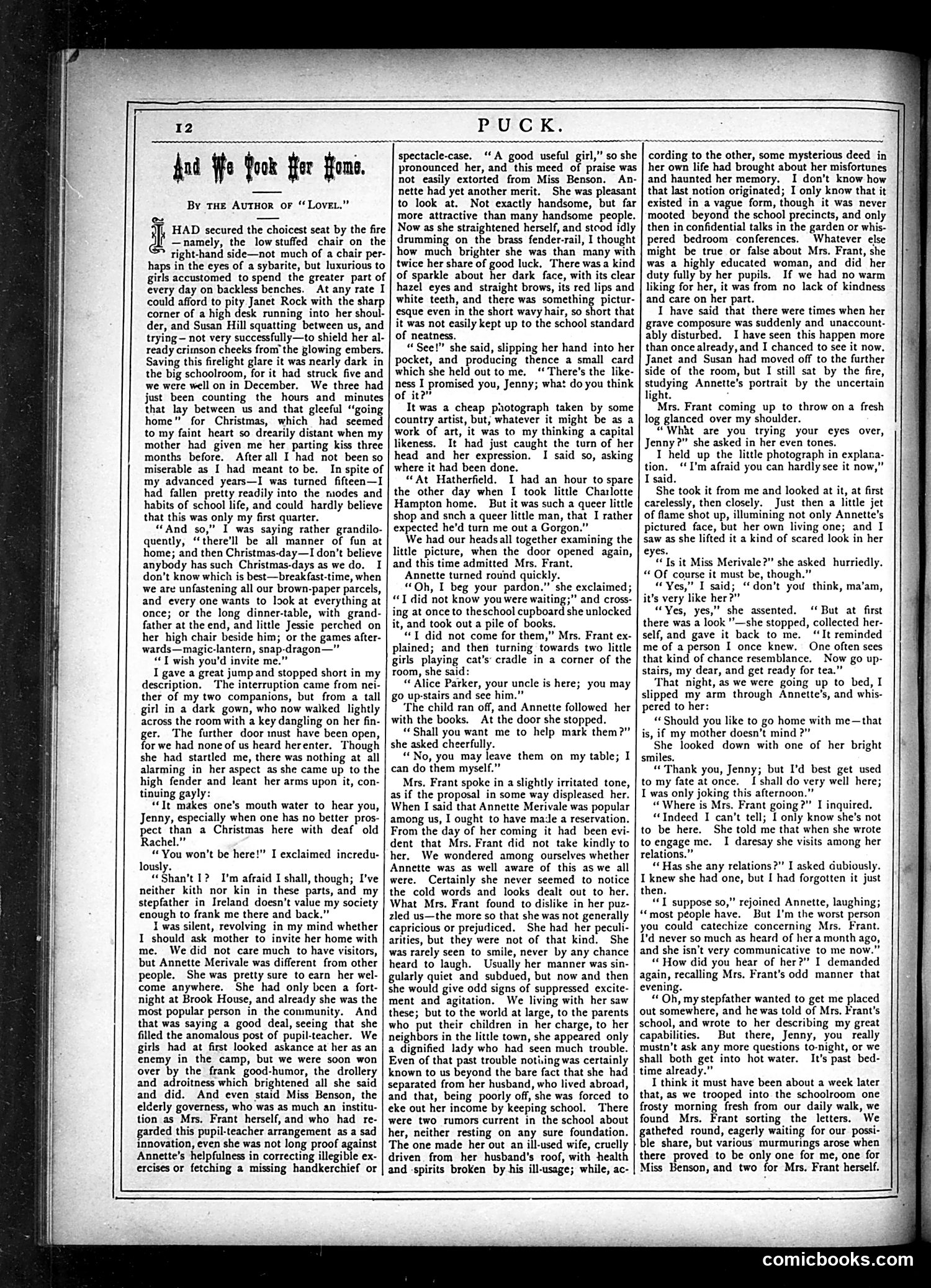
This page contains fiction rather than political satire. It's a short story titled "And We Took Her Home," attributed to the author of "Lovel," presenting a serialized narrative about a schoolteacher named Jenny and her interactions with students and community members. The text discusses themes of social class, education, and small-town life in what appears to be late 19th or early 20th-century America. References to schoolhouse dynamics, student behavior, and the social position of teachers suggest commentary on educational institutions and gender roles, but this is embedded in narrative fiction rather than explicit satire or cartooning. No identifiable political figures or satirical cartoons appear on this page—it's primarily a text-heavy story installment typical of Puck's literary content.
📄 Transcribed text from this page (OCR, searchable)
Machine-transcribed from the original scan — historical spelling and the odd misread are preserved.
And ffe Yook fer Home. | By THE AUTHOR oF “ LoveL.” f HAD secured the choicest seat by the fire —namely, the low stuffed chair on the right-hand side—not much of a chair per- haps in the eyes of a sybarite, but luxurious to girls accustomed to spend the greater part of every day on backless benches. At any rate I could afford to pity Janet Rock with the sharp corner of a high desk running into her shoul- der, and Susan Hill squatting between us, and trying — not very successfully—to shield her al- ready crimson checks from the glowing embers. Saving this firelight glare it was nearly dark in the big schoolroom, for it had struck five and we were well on in December. We three had just been counting the hours and minutes that lay between us and that gleeful “going home” for Christmas, which had seemed to my faint heart so drearily distant when my mother had given me her parting kiss three months before. After all I had not been so miserable as I had meant to be. In spite of my advanced years—I was turned fifteen—I had fallen pretty readily into the modes and habits of school life, and could hardly believe that this was only my first quarter. “And so,” I was saying rather grandilo- quently, “there'll be all manner of fun at home; and then Christmas-day—I don’t believe anybody has such Christmas-days as we do. I don’t know which is best—breakfast-time, when we are unfastening all our brown-paper parcels, and every one wants to look at everything at once; or the long dinner-table, with grand- father at the end, and little Jessie perched on her high chair beside him; or the games after- wards—magic-lantern, snap-dragon—" “‘T wish you'd invite me.” I gave a great jumpand stopped short in my description. The interruption came from nei- ther of my two companions, but from a tall girl in a dark gown, who now walked lightly across the room with a key dangling on her fin- ger. The further door tnust have been open, for we had none of us heard herenter. Though she had startled me, there was nothing at all alarming in her aspect as she came up to the high fender and leant her arms upon it, con- tinuing gayly: “(It makes one’s mouth water to hear you, Jenny, especially when one has no better pros- pect than a Christmas here with deaf old Rachel.” “You won't be here!” I exclaimed incredu- lously. “Shan't 1? I'm afraid I shall, though; I’ve neither kith nor kin in these parts, and my stepfather in Ireland doesn’t value my society enough to frank me there and back.” 1 was silent, revolving in my mind whether I should ask mother to invite her home with me. We did not care much to have visitors, but Annette Merivale was different from other people. She was pretty sure to earn her wel- come anywhere. She had only been a fort- night at Brook House, and already she was the most popular person in the community. And that was saying a good deal, seeing that she filled the anomalous post of pupil-teacher. We girls had at first looked askance at her as an enemy in the camp, but we were soon won over by the frank good-humor, the drollery and adroitness which brightened all she said and did. And even staid Miss Benson, the elderly governess, who was as much an institu- tion as Mrs. Frant herself, and who had re- garded this pupil-teacher arrangement as a sad innovation, even she was not long proof against Annette’s helpfulness in correcting illegible ex- ercises or fetching a missing handkerchief or spectacle-case. ‘A good useful girl,” so she pronounced her, and this meed of praise was not easily extorted from Miss Benson. An- nette had yet another merit. She was pleasant to look at. Not exactly handsome, but far more attractive than many handsome people. Now as she straightened herself, and stood idly drumming on the brass fender-rail, I thought how much brighter she was than many with twice her share of good luck, There was a kind of sparkle about her dark face, with its clear hazel eyes and straight brows, its red lips and white teeth, and there was something pictur- esque even in the short wavy hair, so short that it was not easily kept up to the school standard of neatness. “Sce!” she said, slipping her hand into her pocket, and producing thence a small card which she held out to me, ‘ There's the like- ness I promised you, Jenny; what do you think of it?” It was a cheap photograph taken by some country artist, but, whatever it might be as a work of art, it was to my thinking a capital likeness. It had just caught the turn of her head and her expression. I said so, asking where it had been done. “At Hatherfield. I had an hour to spare the other day when I took little Charlotte Hampton home. But it was such a queer little shop and snch a queer little man, that I rather expected he'd turn me out a Gorgon.” We had our heads all together examining the little picture, when the door opened again, and this time admitted Mrs. Frant. Annette turned round quickly. “Oh, I beg your pardon.” she exclaimed; “TI did not know you were waiting;” and cross- ing at once to theschool cupboard she unlocked it, and took out a pile of books. “T did not come for them,” Mrs. Frant ex- plained; and then turning towards two little girls playing cat’s cradle in a corner of the room, she said: “ Alice Parker, your uncle is here; you may go up-stairs and see him.” The child ran off, and Annette followed her with the books. At the door she stopped. “ Shall you want me to help mark them?” she asked cheerfully. “No, you may leave them on my table; I can do them myself.” Mrs. Frant spoke in a slightly irritated tone, as if the proposal in some way displeased her. When I said that Annette Merivale was popular among us, I ought to have made a reservation. From the day of her coming it had been evi- dent that Mrs. Frant did not take kindly to her, We wondered among ourselves whether Annette was as well aware of this as we all were. Certainly she never seemed to notice the cold words and looks dealt out to her. What Mrs. Frant found to dislike in her puz- zled us—the more so that she was not generally capricious or prejudiced. She had her peculi- arities, but they were not of that kind. She was rarely seen to smile, never by any chance heard to laugh. Usually her manner was sin- gularly quiet and subdued, but now and then she would give odd signs of suppressed excite- ment and agitation. We living with her saw these; but to the world at large, to the parents who put their children in her charge, to her neighbors in the little town, she appeared only a dignified lady who had seen much trouble. Even of that past trouble notiing was certainly known to us beyond the bare fact that she had separated from her husband, who lived abroad, and that, being poorly off, she was forced to eke out her income by keeping school. There were two rumors current in the school about her, neither resting on any sure foundation. The one made her out an ill-used wife, cruelly driven. from her husband's roof, with health and -spirits broken by his ill-usage; while, ac- cording to the other, some mysterious deed in her own life had brought about her misfortunes and haunted her memory. I don’t know how that last notion originated; I only know that it existed in a vague form, though it was never mooted beyond the school precincts, and only then in confidential talks in the garden or whis- pered bedroom conferences. Whatever else might be true or false about Mrs. Frant, she was a highly educated woman, and did’ her duty fully by her pupils. If we had no warm liking for her, it was from no lack of kindness and care on her part. I have said that there were times when her grave composure was suddenly and unaccount- ably disturbed. I have seen this happen more than once already, and I chanced to see it now. Janet and Susan had moved off to the further side of the room, but I still sat by the fire, studying Annette’s portrait by the uncertain light. eMrs. Frant coming up to throw ona fresh log glanced over my shoulder. “What are you trying your eyes over, Jenny ?” she asked in her even tones. I held up the little photograph in explana- tion. ‘I'm afraid you can hardly see it now,” I said. She took it from me and looked at it, at first carelessly, then closely. Just then a little jet of flame shot up, illumining not only Annette’s pictured face, but her own living one; and I saw as she lifted it a kind of scared look in her eyes. “Ts it Miss Merivale?” she asked hurriedly. “ OF course it must be, though.” “Yes,” I said; “don’t you think, ma’am, it's very like her?” “Yes, yes," she assented. ‘But at first there was a look ’—she stopped, collected her- self, and gave it back to me. “It reminded me of a person I once knew. One often sees that kind of chance resemblance. Now go up- stairs, my dear, and get ready for tea.”” That night, as we were going up to bed, I slipped my arm through Annette’s, and whis- pered to her: “Should you like to go home with me—that is, if my mother doesn’t mind ?” She looked down with one of her bright smiles, “ Thank you, Jenny; but I'd best get used to my fate at once. I shall do very well here; I was only joking this afternoon.” “Where is Mrs. Frant going?” I inquired. “Indeed I can’t tell; I only know she’s not to be here. She told me that when she wrote to engage me. I daresay she visits among her relations.” “Has she any relations?” I asked dubiously. I knew she had one, but I had forgotten it just then. “I suppose so,” rejoined Annette, laughing; “most people have. But 1’m the worst person you could catechize concerning Mrs. Frant. I'd never so much as heard of hera month ago, and she isn't very communicative to me now.” “ How did you hear of her?” I demanded again, recalling Mrs. Frant's odd manner that evening. “ Oh, my stepfather wanted to get me placed out somewhere, and he was told of Mrs. Frant’s school, and wrote to her describing my great capabilities. But there, Jenny, you really mustn’t ask any more questions to-night, or we shall both get into hot water. It’s past bed- time already.” I think it must have been about a week later that, as we trooped into the schoolroom one frosty morning fresh from our daily walk, we found Mrs. Frant sorting the letters. We gatheted round, eagerly waiting for our possi- ble share, but various murmurings arose when there proved to be only one for me, one for Miss Benson, and two for Mrs. Frant herself. comicbooks.com