
Puck, 1878-04-10 · page 4 of 16
Puck — April 10, 1878 — page 4: what you’re looking at
What you’re looking at
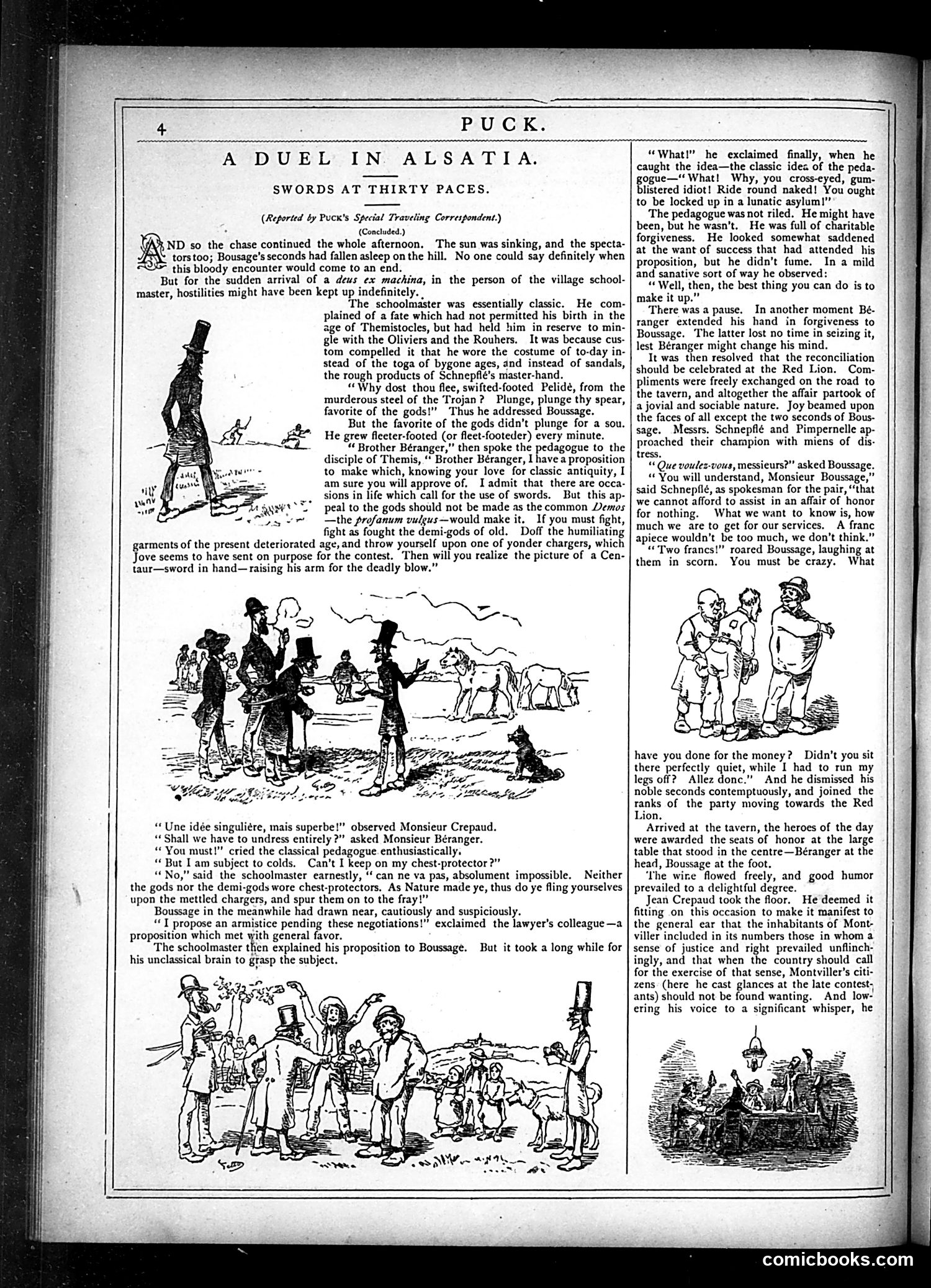
This satirical piece mocks a dispute between two French figures—likely intellectuals or public figures—over a trivial matter of honor. The elaborate negotiation scene depicts the absurd formality of arranging a duel, with multiple intermediaries debating ridiculous conditions (fighting at precisely thirty paces, arguments about sword specifications). The humor targets the pretentiousness of French dueling culture and the pedantic nature of academic or legal disputes being treated with mock-seriousness. The schoolmaster character and lawyer colleagues represent the bureaucratic absurdity surrounding what should be a simple matter. The satire critiques how pompous intellectuals inflate minor disagreements into elaborate formal confrontations, turning everyday quarrels into affairs of state. The illustrations emphasize the comedic disproportion between the trivial cause and the ceremonial gravity of the proposed duel.
📄 Transcribed text from this page (OCR, searchable)
Machine-transcribed from the original scan — historical spelling and the odd misread are preserved.
PUCK. A DUEL IN ALSATIA. SWORDS AT THIRTY PACES. (Reported by Pucn’s Special Traveling Correspondent.) : (Concluded.) ND so the chase continued the whole afternoon. The sun was sinking, and the specta- torstoo; Bousage’s seconds had fallen asleep on the hill. No one could say definitely when this bloody encounter would come to an end. But for the sudden arrival of a deus ex machina, in the person of the village school- master, hostilities might have been kept up indefinitely. | The schoolmaster was essentially classic. He com- plained of a fate which had not permitted his birth in the age of Themistocles, but had held him in reserve to min- gle with the Oliviers and the Rouhers. It was because cus- tom compelled it that he wore the costume of to-day in- stead of the toga of bygone ages, and instead of sandals, the rough products of Schnepflé’s master-hand. “Why dost thou flee, swifted-footed Pelidé, from the murderous steel of the Trojan? Plunge, plunge thy spear, favorite of the gods!” Thus he addressed Boussage. But the favorite of the gods didn’t plunge for a sou. He grew fleeter-footed (or fleet-footeder) every minute. “ Brother Béranger,” then spoke the pedagogue to the disciple of Themis, “ Brother Béranger, I have a proposition to make which, knowing your love for classic antiquity, I am sure you will approve of, I admit that there are occa- sions in life which call for the use of swords. But this ap- peal to the gods should not be made as the common Demos —the profanum vulgus—would make it. If you must fight, fight as fought the demi-gods of old. Doff the humiliating garments of the present deteriorated age, and throw yourself upon one of yonder chargers, which Jove seems to have sent on purpose for the contest. Then will you realize the picture of a Cen- taur—sword in hand—raising his arm for the deadly blow.” WHY ° “ Une idée singuli¢re, mais superbe!” observed Monsieur Crepaud. “Shall we have to undress entirely ?” asked Monsieur Béranger. “You must!” cried the classical pedagogue enthusiastically. “« But I am subject to colds. Can't I keep on my chest-protector ?” “No,” said the schoolmaster earnestly, “can ne va pas, absolument impossible. Neither the gods nor the demi-gods wore chest-protectors. As Nature made ye, thus do ye fling yourselves upon the mettled chargers, and spur them on to the fray!” Boussage in the meanwhile had drawn near, cautiously and suspiciously. “‘T propose an armistice pending these negotiations!” exclaimed the lawyer's colleague—a proposition which met with general favor. The schoolmaster then explained his proposition to Boussage. t But it took a long while for his unclassical brain to grasp the subject. “What!” he exclaimed finally, when he caught the idea—the classic idea of the peda- gogue— What! Why, you cross-eyed, gum- listered idiot! Ride round naked! You ought to be locked up in a lunatic asylum!” The pedagogue was not riled. He might have been, but he wasn’t. He was full of charitable forgiveness. He looked somewhat saddened at the want of success that had attended his proposition, but he didn’t fume. In a mild and sanative sort of way he observed: “Well, then, the best thing you can do is to make it up.” ‘There was a pause. In another moment Bé- ranger extended his hand in forgiveness to Boussage. The latter lost no time in seizing it, lest Béranger might change his mind. It was then resolved that the reconciliation should be celebrated at the Red Lion. Com- pliments were freely exchanged on the road to the tavern, and altogether the affair partook of a jovial and sociable nature. Joy beamed upon the faces of all except the two seconds of Bous- sage. Messrs. Schnepflé and Pimpernelle ap- proached their champion with miens of dis- tress. « Que voules-vous, messieurs?” asked Boussage. “You will understand, Monsieur Boussage,” said Schnepflé, as spokesman for the pair, “that we cannot afford to assist in an affair of honor for nothing. What we want to know is, how much we are to get for our services. A franc apiece wouldn’t be too much, we don’t think.” “Two francs!” roared Boussage, laughing at them in scorn. You must be crazy. What have you done for the money? Didn't you sit there perfectly quiet, while I had to run my legs off? Allez donc.” And he dismissed his noble seconds contemptuously, and joined the Sd of the party moving towards the Red ion, Arrived at the tavern, the heroes of the day were awarded the seats of honor at the large table that stood in the centre—Béranger at the head, Boussage at the foot. ‘The wine flowed freely, and good humor prevailed to a delightful degree. Jean Crepaud took the floor. He deemed it fitting on this occasion to make it manifest to the general ear that the inhabitants of Mont- viller included in its numbers those in whom a sense of justice and right prevailed unflinch- ingly, and that when the country should call for the exercise of that sense, Montviller’s citi- zens (here he cast glances at the late contest; ants) should not be found wanting. And low- ering his voice to a significant whisper, he comicbooks.com