
Puck, 1878-04-10 · page 5 of 16
Puck — April 10, 1878 — page 5: what you’re looking at
What you’re looking at
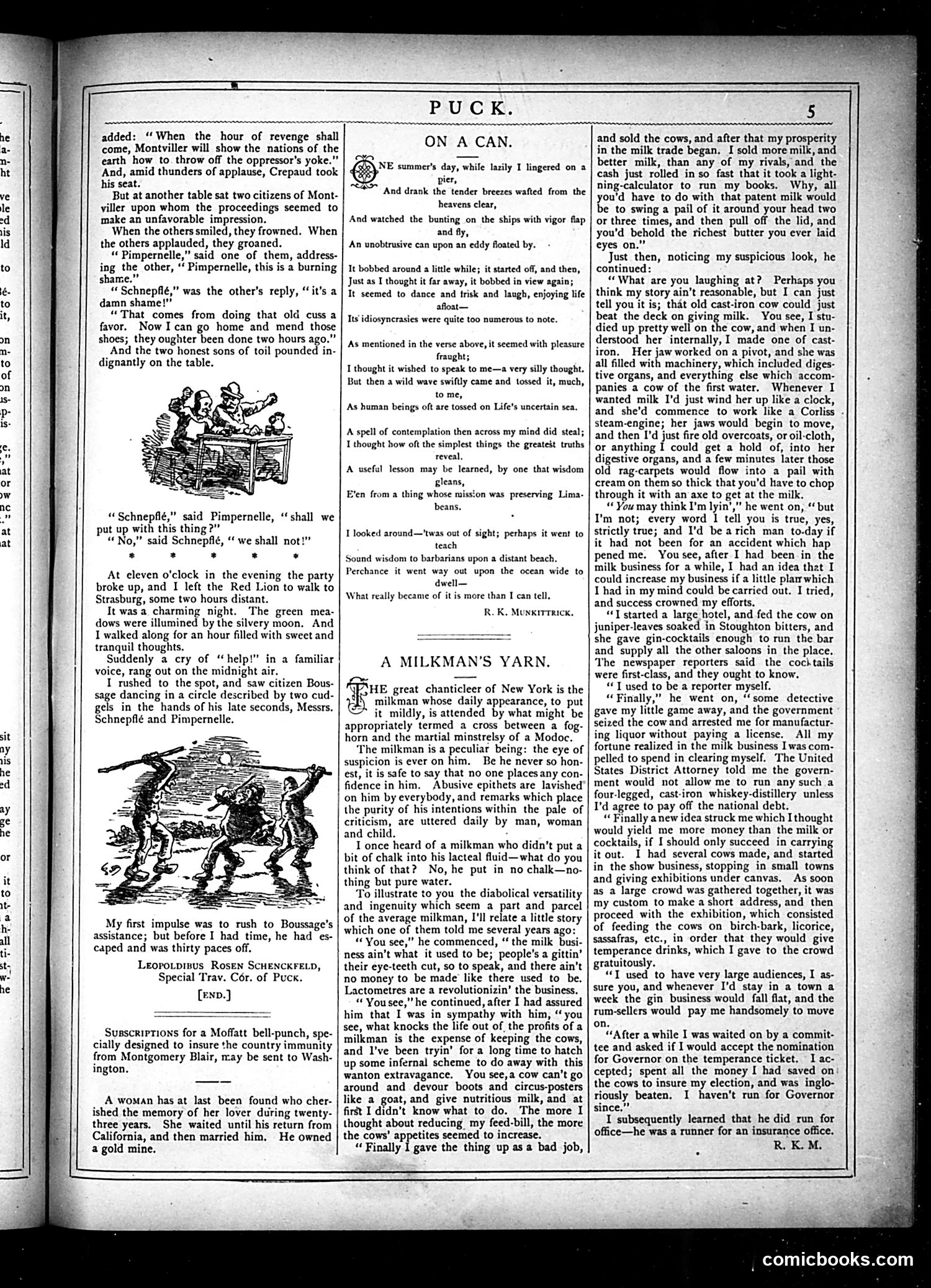
This page contains two distinct pieces: **"On a Can"** (top): A poem about someone observing a ship at sea, with philosophical reflections on life's uncertainties. The accompanying illustration shows figures on a beach watching a vessel. This appears to be general literary/philosophical satire rather than specific political commentary. **"A Milkman's Yarn"** (bottom): A first-person account by a milkman describing his entrepreneurial schemes to profit from the milk business—including plans to supply cocktails and gin to saloons, and attempts to monopolize the industry. The text satirizes get-rich-quick schemes and the milkman's increasingly absurd business ambitions. An illustration shows a figure in period dress, likely the milkman character. This mocks both individual greed and broader industrial consolidation trends of the era.
📄 Transcribed text from this page (OCR, searchable)
Machine-transcribed from the original scan — historical spelling and the odd misread are preserved.
added: ‘When the hour of revenge shall come, Montviller will show the nations of the earth how to. throw off the oppressor's yoke.”” ‘And, amid thunders of applause, Crepaud took his seat. But at another table sat two citizens of Mont- viller upon whom the proceedings seemed to make an unfavorable impression. When the others smiled, they frowned. When the others applauded, they groaned. “ Pimpernelle,” said one of them, address- ing the other, “ Pimpernelle, this is a burning shame.” “ Schnepflé,” was the other’s reply, “it’s a damn shame!” “That comes from doing that old cuss a favor. NowI can go home and mend those shoes; they oughter been done two hours ago.” And the two honest sons of toil pounded in- dignantly on the table. “Schnepflé,” said Pimpernelle, ‘shall we put up with this thing?” “No,” said Schnepfié, “ we shall not!"" * * * * * At eleven o'clock in the evening the party broke up, and I left the Red Lion to walk to Strasburg, some two hours distant. It was charming night. The green mea- dows were illumined by the silvery moon, And I walked along for an hour filled with sweet and tranquil thoughts. Suddenly a cry of “help!” in a familiar voice, rang out on the midnight air. I rushed to the spot, and saw citizen Bous- sage dancing in a circle described by two cud- gels in the hands of his late seconds, Messrs. Schnepflé and Pimpernelle. My first impulse was to rush to Boussage’s assistance; but before I had time, he had es- caped and was thirty paces off. Leopo.pisus RosEN SCHENCKFELD, Special Trav. Cér. of Puck. [enp.] Susscriptions for a Moffatt bell-punch, spe- cially designed to insure the country immunity from Montgomery Blair, may be sent to Wash- ington. A woman has at last been found who cher- ished the memory of her lover during twenty- three years. She waited until his return from California, and then married him. He owned ON A CAN. NE summer's day, while lazily I lingered on a pier, And drank the tender breezes wafted from the heavens clear, And watched the bunting on the ships with vigor flap and fy, ‘An unobtrusive can upon an eddy floated by. once) It bobbed around a little while; it started off, and then, Just as I thought it far away, it bobbed in view again; It seemed to dance and frisk and laugh, enjoying life afloat— Its idiosyncrasies were quite too numerous to note. As mentioned in the verse above, it seemed with pleasure fraught; I thought it wished to speak to me—a very silly thought. But then a wild wave swiftly came and tossed it, much, to me, ‘As human beings oft are tossed on Life's uncertain sea, A spell of contemplation then across my mind did steal; I thought how oft the simplest things the greateit truths reveal. A useful lesson may be learned, by one that wisdom gleans, Even from a thing whose mission was preserving Lima- beans, I looked around—"twas out of sight; perhaps it went to teach Sound wisdom to barbarians upon a distant beach, Perchance it went way out upon the ocean wide to dwell— What really became of it is more than I can tell, R. K, Monxrrtrick, A MILKMAN’S YARN. f HE great chanticleer of New York is the a milkman whose daily appearance, to put ~* it mildly, is attended by what might be appropriately termed a cross between a fog- horn and the martial minstrelsy of a Modoc. ‘The milkman is a peculiar being: the eye of suspicion is ever on him. Be he never so hon- est, it is safe to say that no one places any con- fidence in him. Abusive epithets are lavished’ on him by everybody, and remarks which place the purity of his intentions within the pale of criticism, are uttered daily by man, woman and child. I once heard of a milkman who didn’t put a bit of chalk into his lacteal fluid—what do you think of that? No, he put in no chalk—no- thing but pure water. To illustrate to you the diabolical versatility and ingenuity which seem a part and parcel of the average milkman, I'll relate a little story which one of them told me several years ago: “You see,” he commenced, “ the milk busi- ness ain’t what it used to be; people's a gittin’ their eye-teeth cut, so to speak, and there ain't no money to be made’ like there used to be. Lactometres are a revolutionizin’ the business. “ You see,” he continued, after I had assured him that I was in sympathy with him, “you see, what knocks the life out of the profits of a milkman is the expense of keeping the cows, and I’ve been tryin’ for a long time to hatch up some infernal scheme to do away with this wanton extravagance. You see,a cow can’t go around and devour boots and circus-posters like a goat, and give nutritious milk, and at first I didn’t know what to do. The more I thought about reducing my feed-bill, the more the cows’ appetites seemed to increase. and sold the cows, and after that my prosperity in the milk trade began, I sold more milk, and better milk, than any of my rivals, and the cash just rolled in so fast that it took a light- ning-calculator to run my books. Why, all ee have to do with that patent milk would e to swing a pail of it around your head two or three times, and then pull off the lid, and you'd behold the richest butter you ever laid eyes on.” Just then, noticing my suspicious look, he continued: “What are you laughing at? Perhaps you think my story ain’t reasonable, but I can just tell you it is; that old cast-iron cow could just beat the deck on giving milk. You see, I stu- died up pretty well on the cow, and when I un- derstood her internally, I made one of cast- iron. Her jaw worked on a pivot, and she was all filled with machinery, which included diges- tive organs, and everything else which accom- panies a cow of the first water. Whenever I wanted milk I'd just wind her up like a clock, and she'd commence to work like a Corliss - steam-engine; her jaws would begin to move, and then I'd just fire old overcoats, or oil-cloth, or anything I could get a hold of, into her digestive organs, and a few minutes later those old rag-carpets would flow into a pail with cream on themso thick that you'd have to chop through it with an axe to get at the milk. “ You may think I'm lyin’,” he went on, “but I'm not; every word I tell you is true, yes, strictly true; and I'd be arich man to-day if it had not been for an accident which hap pened me. You see, after I had been in the milk business for a while, I had an idea that I could increase my business if a little plarwhich I had in my mind could be carried out. I tried, and success crowned my efforts. “T started a large hotel, and fed the cow on juniper-leaves soaked in Stoughton bitters, and she gave gin-cocktails enough to run the bar and supply all the other saloons in the place. ‘The newspaper reporters said the cocktails were first-class, and they ought to know, “T used to be a reporter myself. “Finally,” he went on, ‘‘some detective gave my little game away, and the government seized the cow and arrested me for manufactur- ing liquor without paying a license. All my fortune realized in the milk business I was com- pelled to spend in clearing myself. The United States District Attorney told me the govern- ment would not allow me to run any such a four-legged, cast-iron whiskey-distillery unless I'd agree to pay off the national debt. “ Finally anew idea struck me which I thought would yield me more money than the milk or cocktails, if I should only succeed in carrying it out. I had several cows made, and started in the show business, stopping in small towns and giving exhibitions under canvas. As soon as a large crowd was gathered together, it was my custom to make a short address, and then proceed with the exhibition, which consisted of feeding the cows on birch-bark, licorice, sassafras, etc., in order that they would give temperance drinks, which I gave to the crowd gratuitously. “T used to have very large audiences, I as- sure you, and whenever I'd stay in a town a week the gin business would fall flat, and the rum-sellers would pay me handsomely to move on. “After a while I was waited on by a commit- tee and asked if I would accept the nomination for Governor on the temperance ticket. I ac- cepted; spent all the money I had saved on the cows to insure my election, and was inglo- riously beaten. I haven't run for Governor since.” I subsequently learned that he did run for office—he was a runner for an insurance office. a gold mine. “Finally 1 gave the thing up as a bad job, x R. K.M. , comicbooks.com