
A complete issue · 16 pages · 1878
Puck — March 27, 1878
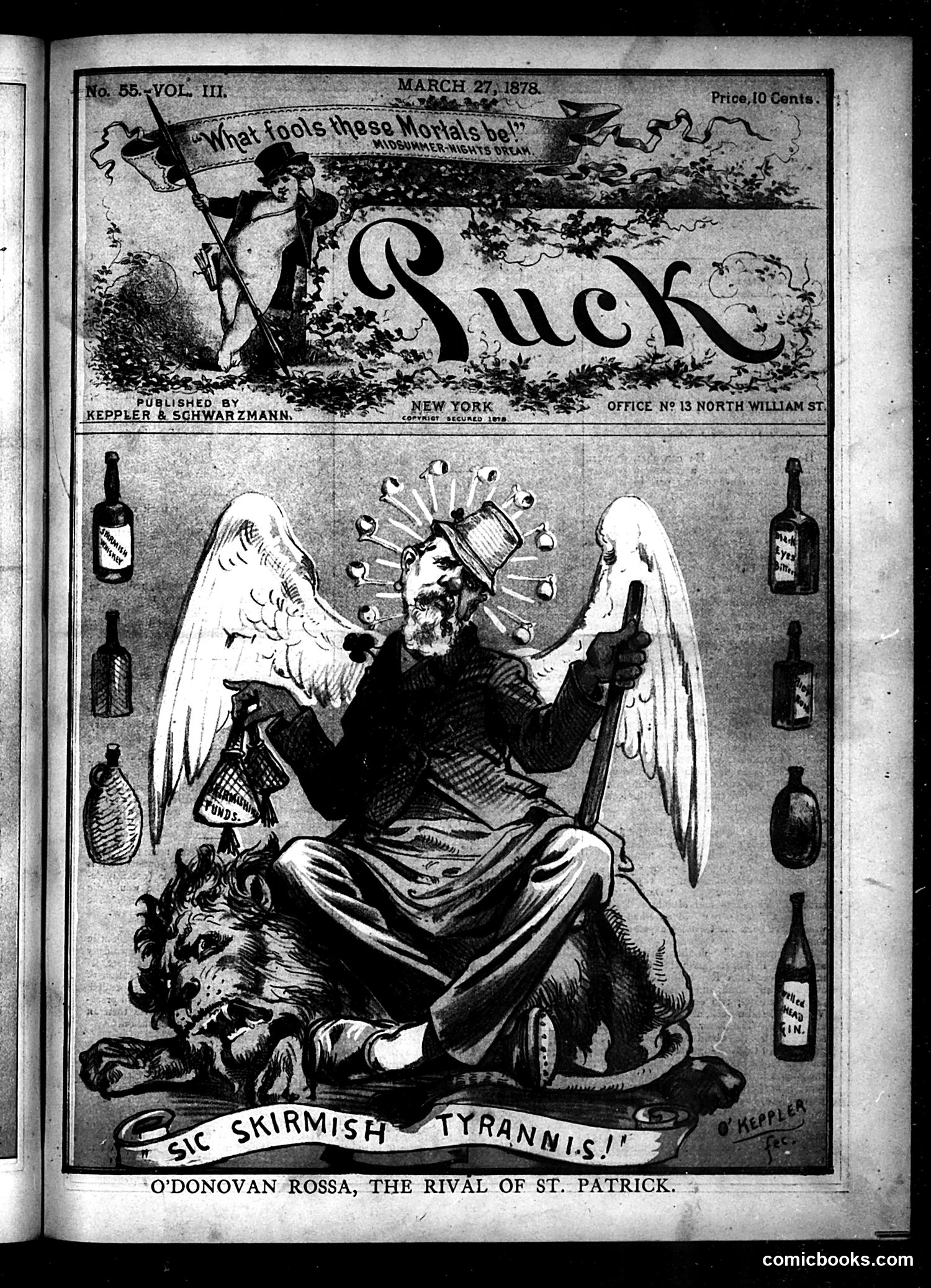
This 1878 *Puck* cartoon satirizes **Jeremiah O'Donovan Rossa**, an Irish nationalist and Fenian activist. The winged figure—likely representing Ireland or a demonic force—is depicted as a drunken, chaotic character surrounded by whiskey bottles, with spikes protruding from its head (suggesting dangerous instability). The caption's phrase "Sic Skirmish Tyrannis!" appears to mock O'Donovan Rossa's violent methods and rhetoric. The "rival of St. Patrick" comparison is ironic—suggesting he threatens Ireland's traditional Catholic identity through revolutionary extremism rather than spiritual guidance. The cartoon reflects American anxieties about Irish-American radicalism and dynamite campaigns associated with Fenian activity in the 1870s, portraying nationalist activism as drunken, anarchic, and dangerous.
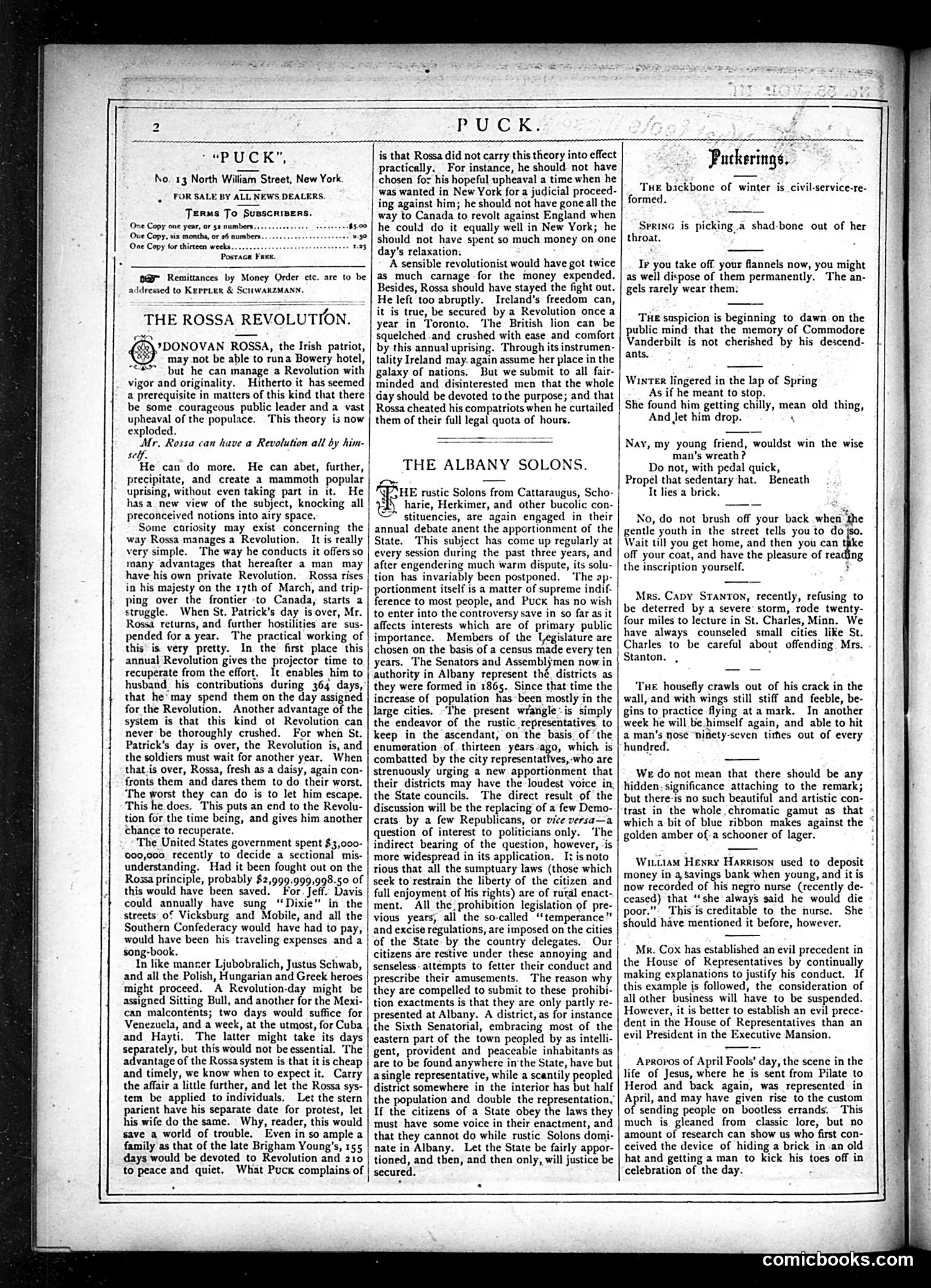
This page contains three distinct sections: advertisement for Puck magazine itself, an article titled "THE ROSSA REVOLUTION" discussing Irish patriot Donovan Rossa and revolutionary theory, and "THE ALBANY SOLONS" addressing New York State legislative representation disputes. The Rossa piece appears satirical—critiquing both Rossa's impractical revolutionary ambitions and the notion that managing a revolution resembles managing private business. The author suggests Rossa's theories, while dramatic, lack practical application. "The Albany Solons" satirizes New York politicians' ongoing gerrymandering and apportionment disputes, mocking their inability to resolve representational fairness despite repeated legislative sessions on the issue. The right column contains miscellaneous brief satirical observations about society and politics.
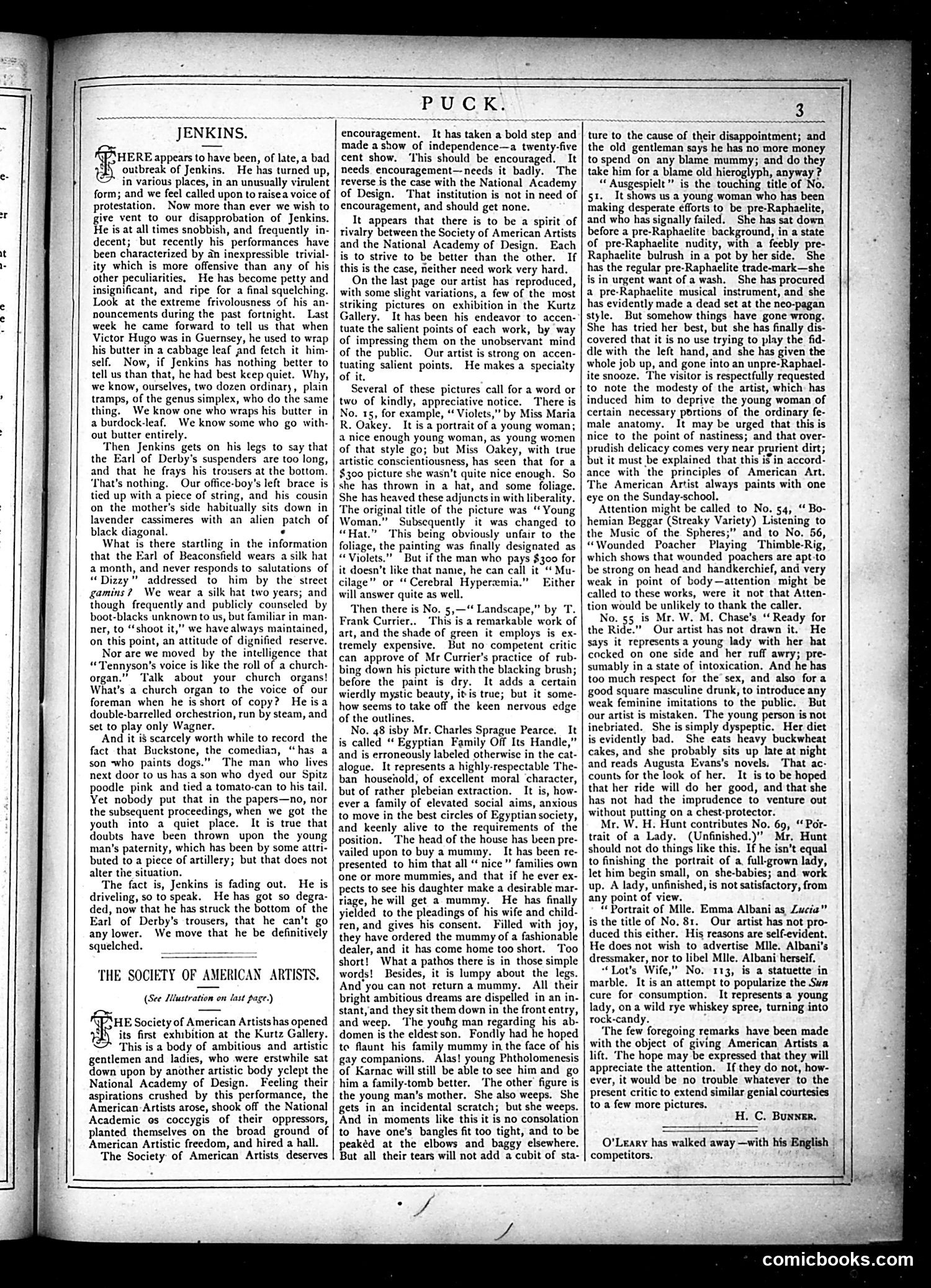
This page contains two distinct sections: **Jenkins** (top) and **The Society of American Artists** (bottom). The **Jenkins** section satirizes an artist who has become snobbish and difficult following minor success. The text criticizes his affected behavior, pretentiousness, and rivalry with the National Academy of Design. The satire targets artistic ego and the contradiction between an artist's need for encouragement and his subsequent arrogance. The **Society of American Artists** section (with illustration on facing page) mocks the organization's ambitious members and their pretensions. It particularly ridicules a controversy involving an "Egyptian mummy" portrait—apparently someone painted a mummy and created absurd backstory claims about its provenance and the subject's prominent Egyptian family connections. The satire highlights artistic fraud and the gullibility of collectors. Both pieces critique American artistic ambition, dishonesty, and social climbing.
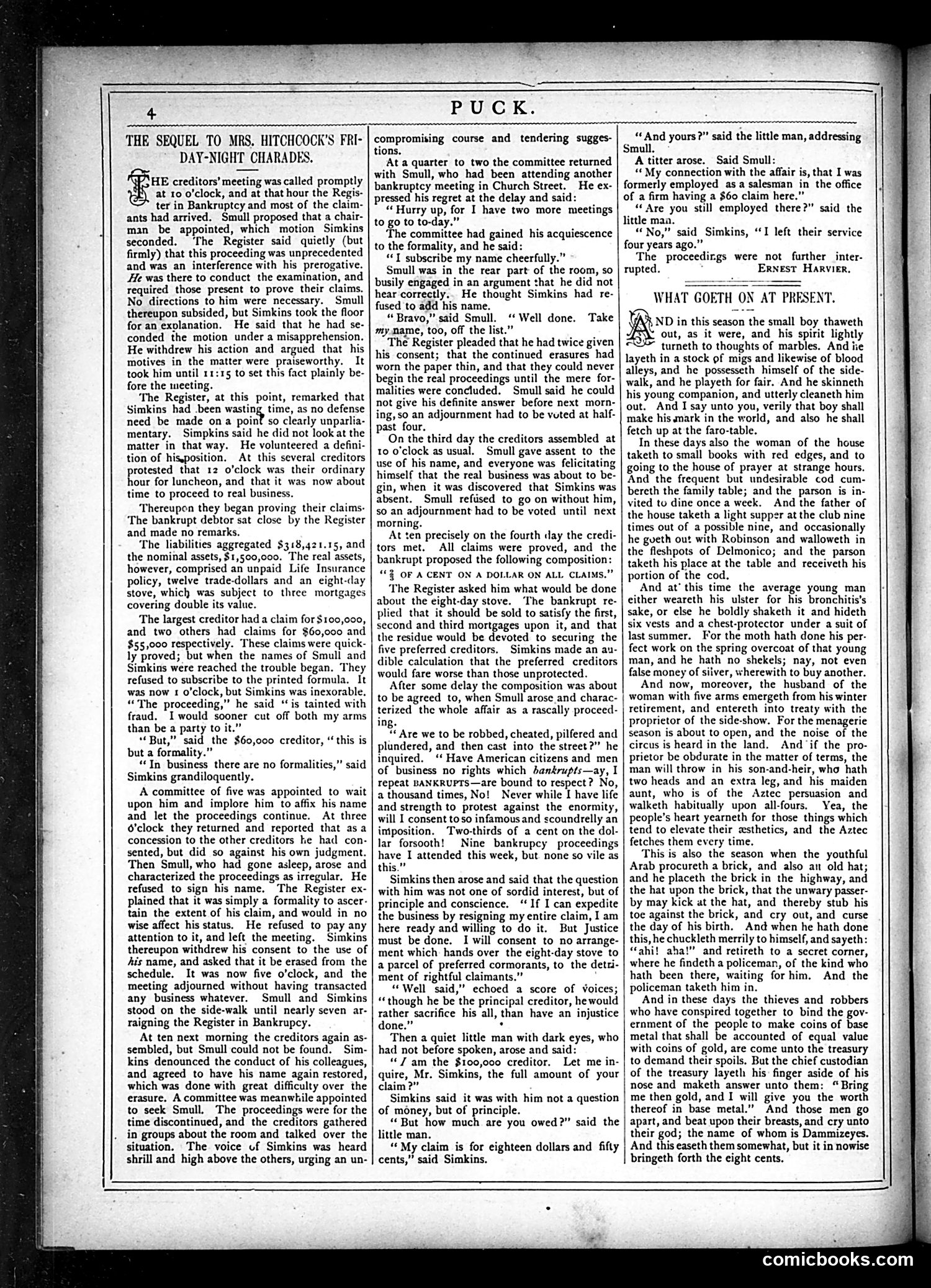
This page contains the satirical narrative "The Sequel to Mrs. Hitchcock's Friendly Guardians" and a separate piece titled "What Goeth On At Present." The main story appears to be a detailed account of a creditors' meeting regarding bankruptcy proceedings, featuring characters named Simkins and Small. The satire mocks the formalities and absurdities of bankruptcy law—creditors disputing claims, debates over composition settlements, and Simkins's dramatic refusal to resign his claim on principle despite financial impossibility. The secondary piece "What Goeth On At Present" satirizes upper-class social pretensions, describing a young boy's observations of marble-playing, social hierarchies among children, and adults' hypocritical moral lecturing. Both pieces use detailed, character-driven humor to critique American legal procedures and social class behaviors of the period.
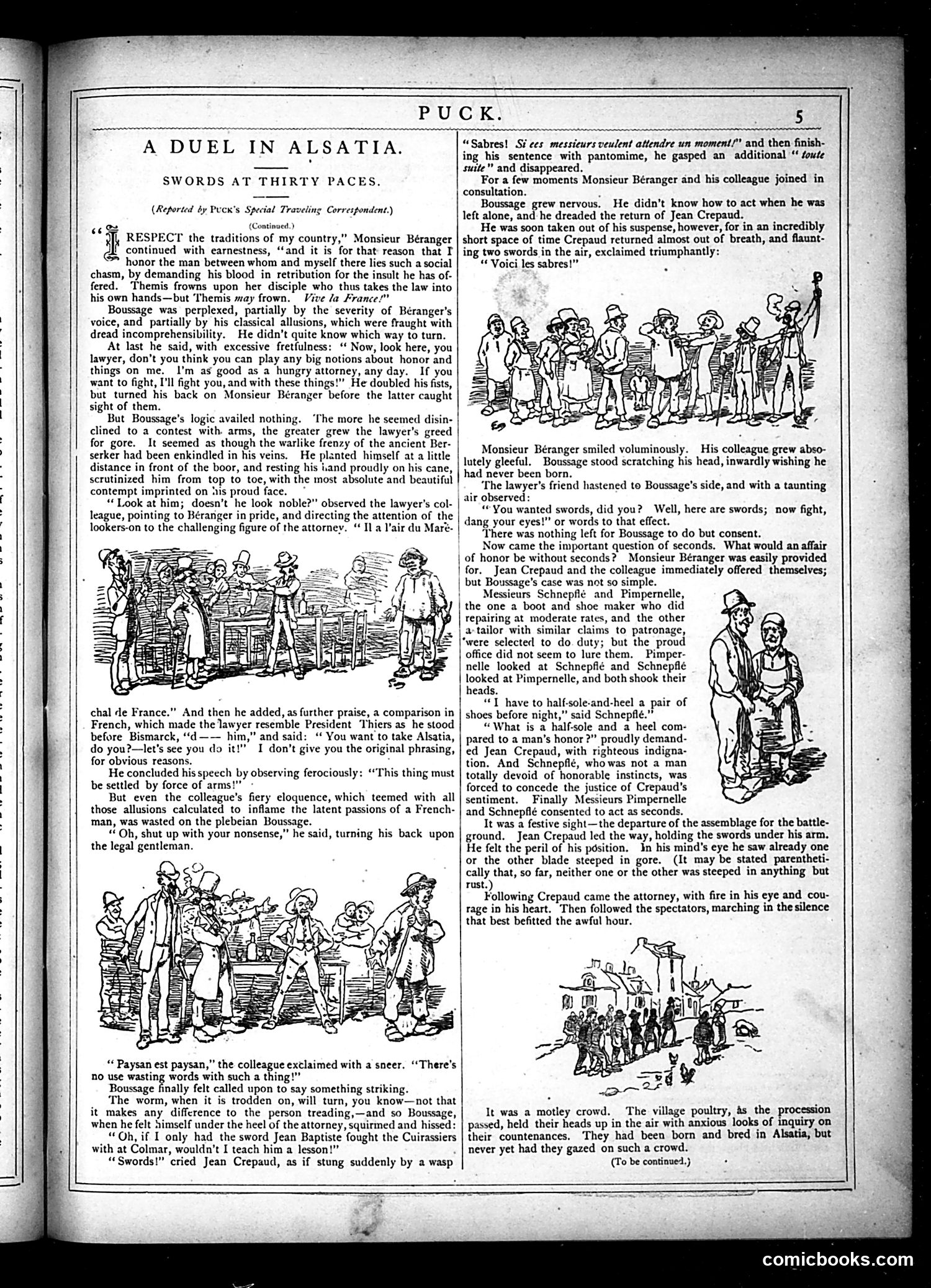
This Puck article satirizes a legal dispute between French lawyer Monsieur Béranger and his colleague over a professional matter. The humor centers on their escalating conflict—from verbal argument to threatened physical combat—which the author compares to a formal duel. The illustrations show the lawyers and involved parties in increasingly absurd confrontations. The satire targets French legal pretension and honor culture, mocking how disputes over shoe repairs and professional fees are treated with the dramatic gravity of affairs of state. The piece ridicules both Béranger's pompous behavior and his colleague's wounded pride, presenting their quarrel as emblematic of overwrought Continental legal drama. The title's reference to "Alsatia" (a lawless area) underscores the irony of lawyers behaving chaotically.
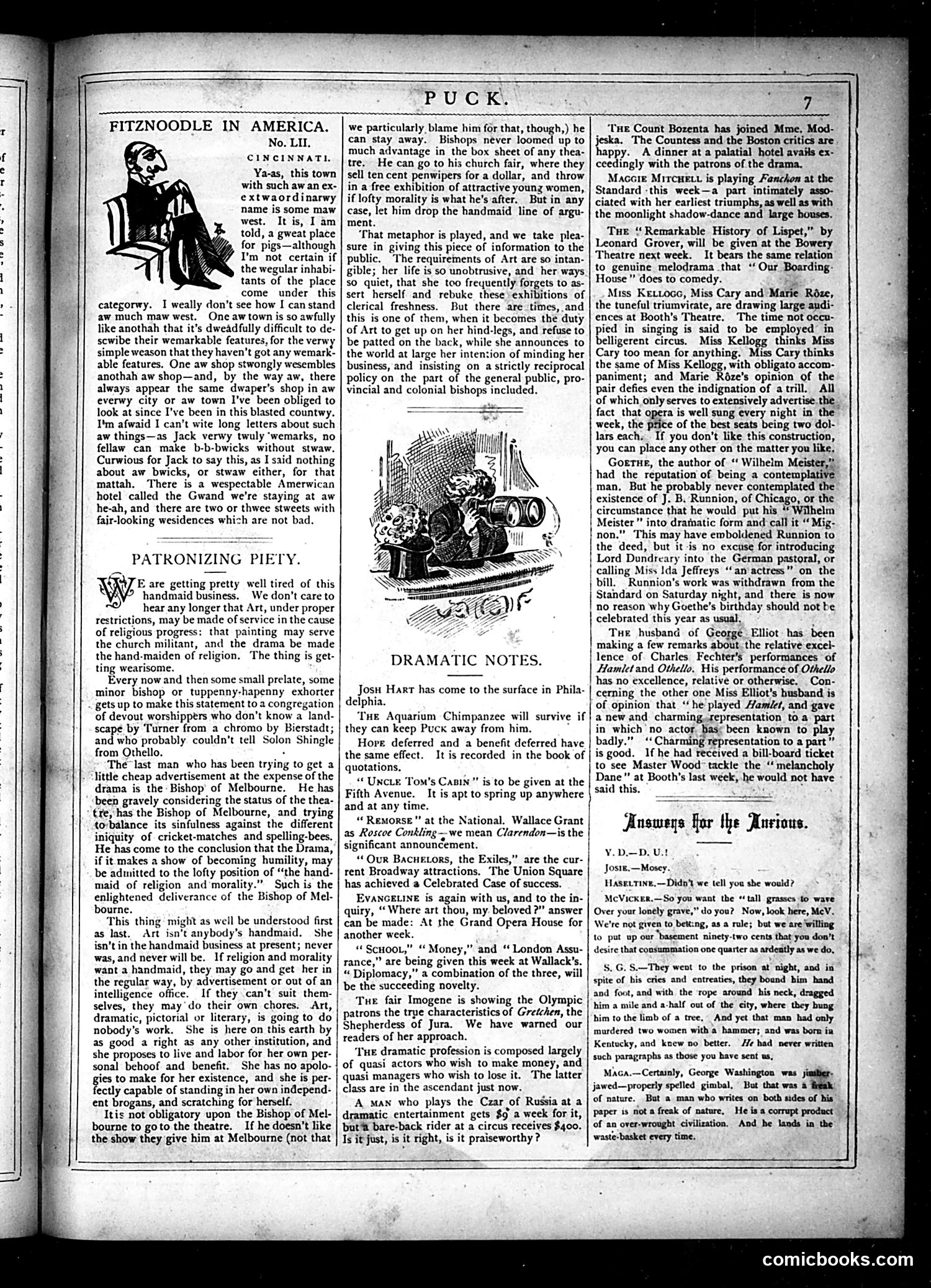
This page contains three sections: "Fitznoodle in America" (a serialized story with illustration), "Patronizing Piety" (an editorial column), and "Dramatic Notes" (theater criticism). The main cartoon shows a figure in an old-fashioned carriage or vehicle, appearing to caricature someone named Fitznoodle—likely a satirical foreign visitor observing American life and manners. The text criticizes various American towns and their peculiar characteristics, using the outsider perspective to mock provincial American society. "Dramatic Notes" reviews contemporary theater performances and actors, while "Patronizing Piety" critiques religious hypocrisy and institutional church behavior. The overall tone is satirical commentary on American culture, typical of Puck's editorial approach during this period.
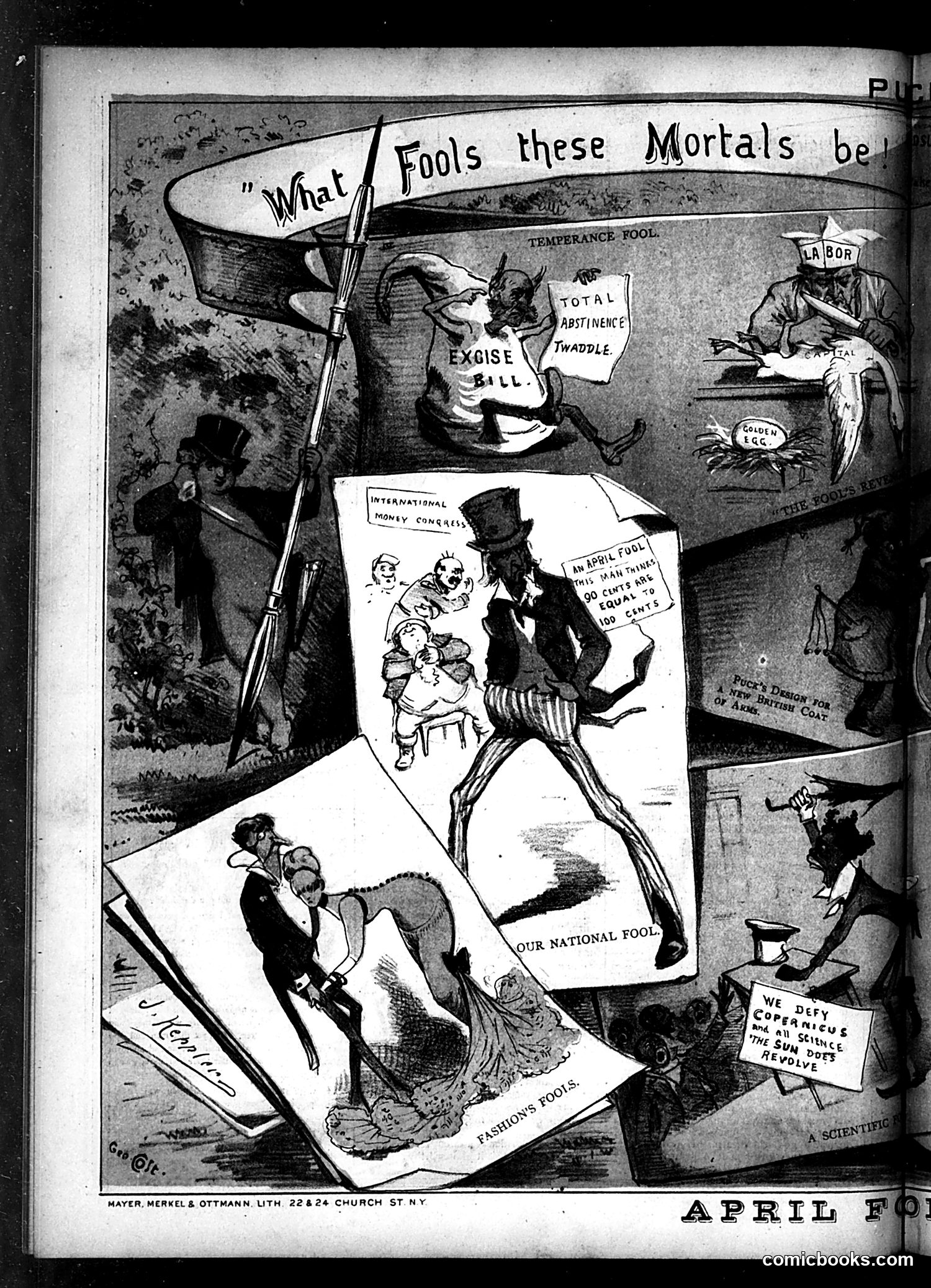
This Puck cartoon satirizes various social foolishness through multiple illustrated vignettes. The central figure appears to be "Our National Fool"—a tall, thin character in formal dress examining different types of foolishness displayed on papers around him. The visible panels mock: - **"Temperance Fool"** and **"Labor"** (upper right) - **"Fashion's Fools"** (lower left) - **"Excise Bill"** and references to **"Total Abstinence"** and **"Twaddle"** - **"International Money Congress"** (center panel with figures and children) The cartoon critiques what the satirists considered absurd social movements and legislative proposals of the era. Without a visible date, the specific targets remain somewhat unclear, but the overall message condemns contemporary reform movements and social trends as foolish pretensions by mortals.
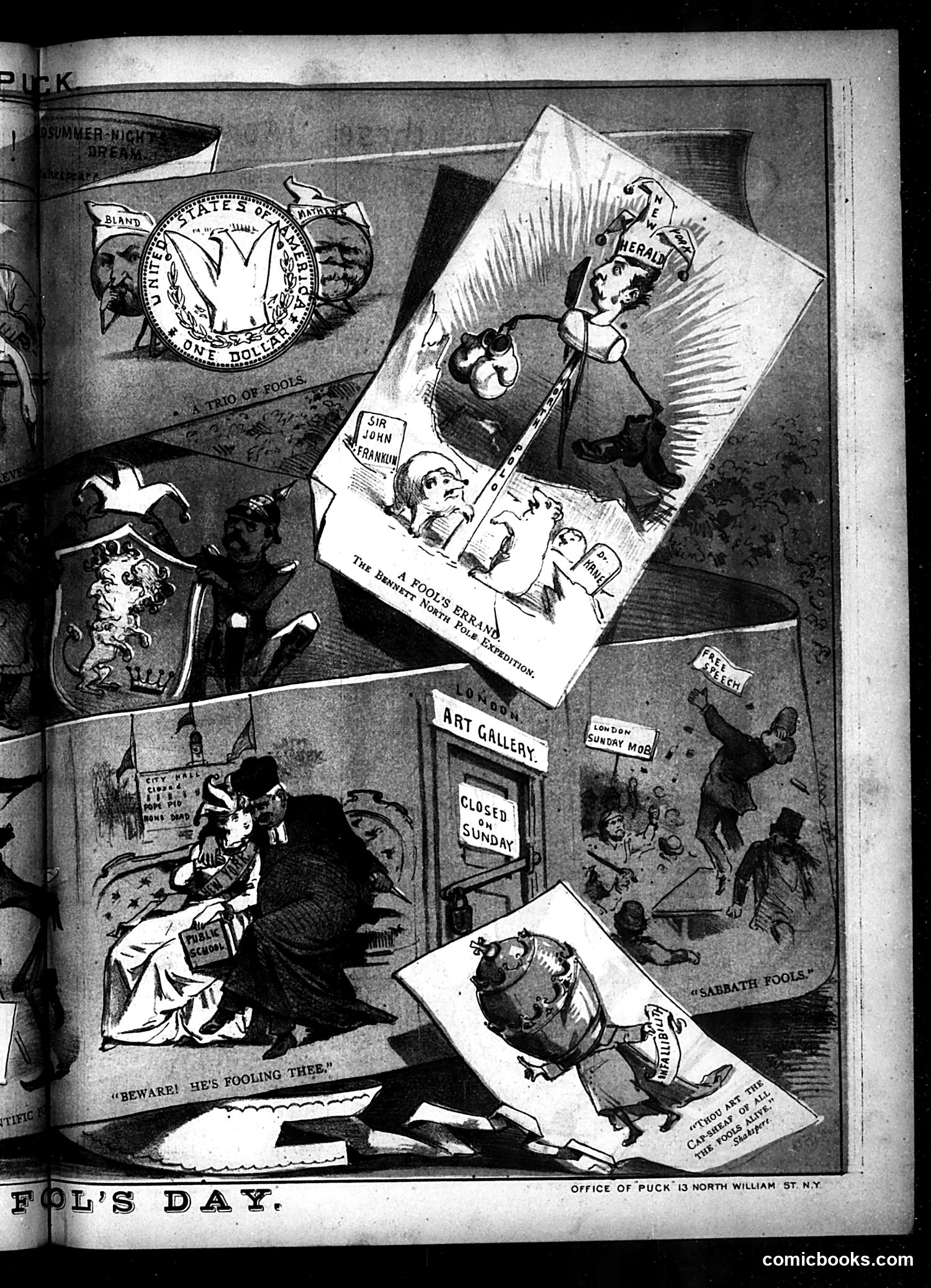
This is a Puck magazine "Fool's Day" (April Fools') satirical page mocking various targets of the era. The top shows a U.S. dollar coin labeled "A Trio of Fools," suggesting three political figures are being ridiculed as foolish, though their specific identities are unclear from the image alone. Below are several vignettes depicting foolishness: one shows someone at an art gallery "closed on Sunday," another depicts "Beware! He's fooling thee!" with figures being deceived, and others reference "Sabbath Fools" and similar April Fools'-themed jokes about gullibility and deception. The satire targets institutional hypocrisy (Sunday closures), political bungling, and general human foolishness—typical Puck fare using holiday themes to critique contemporary issues and public figures.
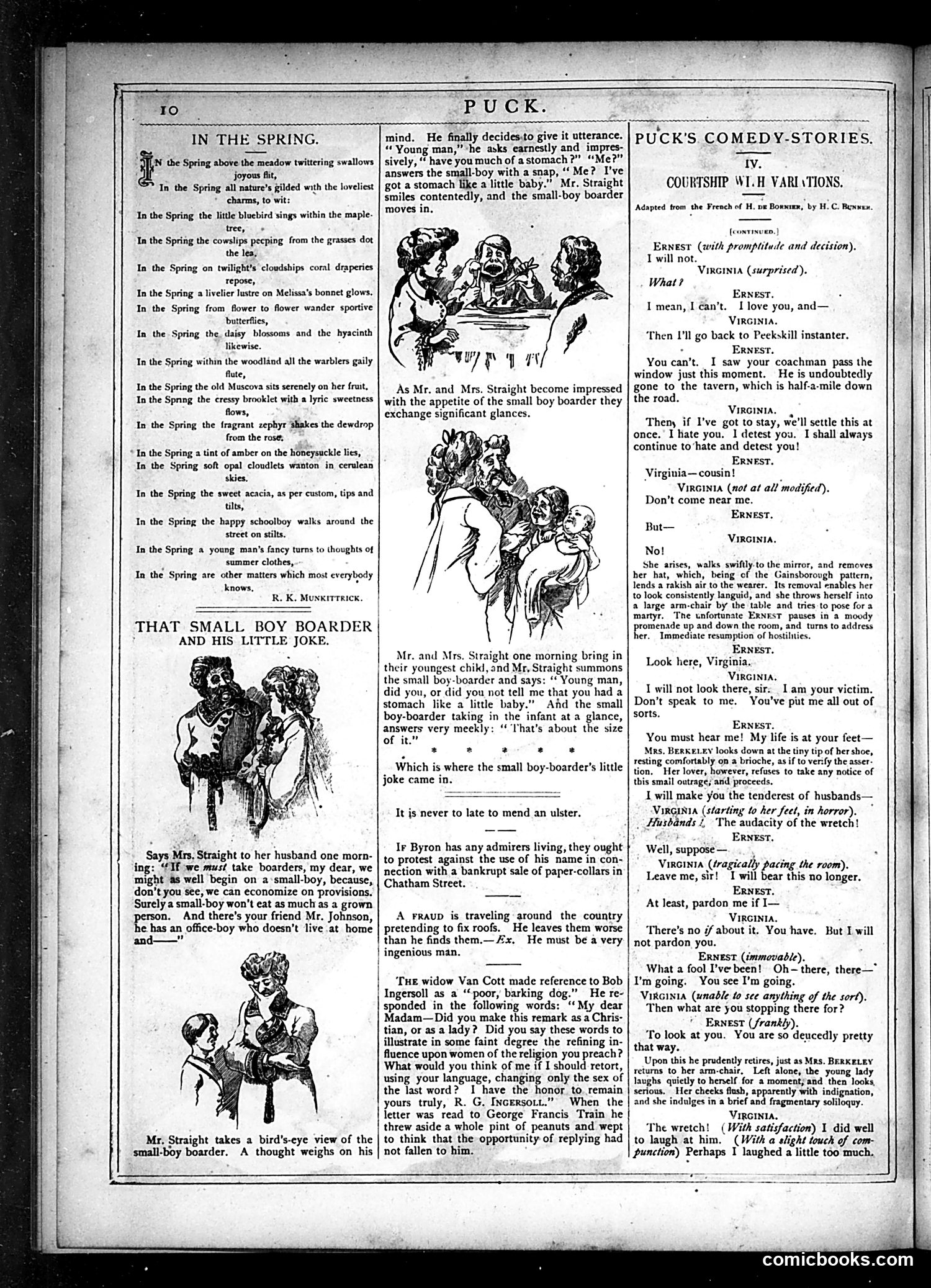
This page contains two distinct pieces: **Left side**: "In the Spring" is a humorous poem celebrating spring's arrival, with illustrations of children playing outdoors. It's sentimental verse about seasonal renewal with no political content. **Right side**: "That Small Boy Boarder and His Little Joke" depicts a boarding house scenario. A young boy boarder makes a joke comparing himself to a baby when asked about his appetite—claiming he has "a stomach like a little baby." The humor relies on the double meaning: he eats very little (like an infant) but the boarders initially misunderstand. Below this is "Courtship with Variations," a dialogue between Ernest and Virginia about a romantic dispute, showcasing typical Victorian courtship melodrama with stage directions noting Virginia's theatrical gestures. These are character sketches and domestic humor pieces typical of Puck's entertainment content, not political satire.
This page contains a theatrical dialogue between two characters: **Ernest** and **Virginia**. The play appears to be a romantic comedy involving misunderstandings and courtship rituals. The satire targets **Victorian-era gender relations and courtship conventions**. Virginia playfully manipulates Ernest through social rules—demanding forfeits, extracting money, and controlling his behavior while he attempts romantic gestures. The humor derives from Virginia's calculated use of "lady fair" etiquette to extract concessions from Ernest, who remains earnestly confused about the actual rules of courtship and romance. The italicized stage directions ("with sarcastic merriment," "emphatically") indicate this was published as a theatrical piece, likely mocking the artificial formality and power games embedded in period romance conventions.
This page contains the serialized story **"The Two Neighbors of Quimper"** by Katherine S. Macquoid, presented as text fiction rather than a visual cartoon. The content is a nineteenth-century romantic narrative about characters named Jehan, Olivier, and Françoise living in Quimper (a French town). The plot involves Jehan's financial troubles, his friend Olivier's business success, and romantic complications—specifically Olivier's reluctance to help Jehan and tensions over Françoise's affections and the family's prospects. This appears to be a **serialized novel** rather than political satire or visual comedy. Puck magazine regularly published illustrated stories alongside its satirical cartoons. Without seeing accompanying illustrations, the satirical intent—if any—remains unclear from the text alone.
This page consists primarily of a short story continuation and a "Puck's Persiflage" section—brief satirical commentary pieces on current events and social issues. The visible items mock: 1. **Arkansas Hot Springs** - criticism of its promotion as a health destination 2. **Vaccination debates** - ridiculing anti-vaccination sentiment 3. **A wealthy man's expensive dress costs** - approximately $150-200 annually, presented as absurdly extravagant 4. **An African character** - described as costing only one hundred lives; this appears to reference racist attitudes toward colonialism or slavery (historically offensive content typical of the era) 5. **A Mississippi river man** - some humorous observation about river life These brief satirical pieces target contemporary social attitudes, economic excess, and popular debates of Puck's era.
This is primarily an **advertising and announcements page** from Puck magazine, not a satirical cartoon page. The main content announces Puck's newly opened "General Designing Office" employing cartoonist **Joseph Keppler** (likely the magazine's founder or prominent artist) to provide illustrations for theatrical productions and other clients. The page includes various product advertisements typical of the era—compressed yeast, bitter water, tailoring services, bookbinding—interspersed with brief news items in the left column covering miscellaneous topics (Philadelphia finances, an Illinois murder, Egyptian diplomacy). There are no significant political cartoons or satirical illustrations visible on this page. It functions as a business/administrative update rather than editorial content.
This is primarily an **advertisement page** from Puck's 1878 almanac issue, not a political cartoon page. The visible content consists mostly of commercial ads for various businesses: dental services, portrait studios, printing companies, bonds, banking services, and tobacco products. The only illustration of note is a **decorative label for Hungarian Wines** featuring a horseman, which advertises an importer based in New York and Broadway. The page's main editorial content appears to be promoting **Puck's Almanac for 1878**, described as "the most remarkable ever published" and priced at 15 cents. This was typical for Puck—mixing satirical journalism with commercial advertising to fund the publication.
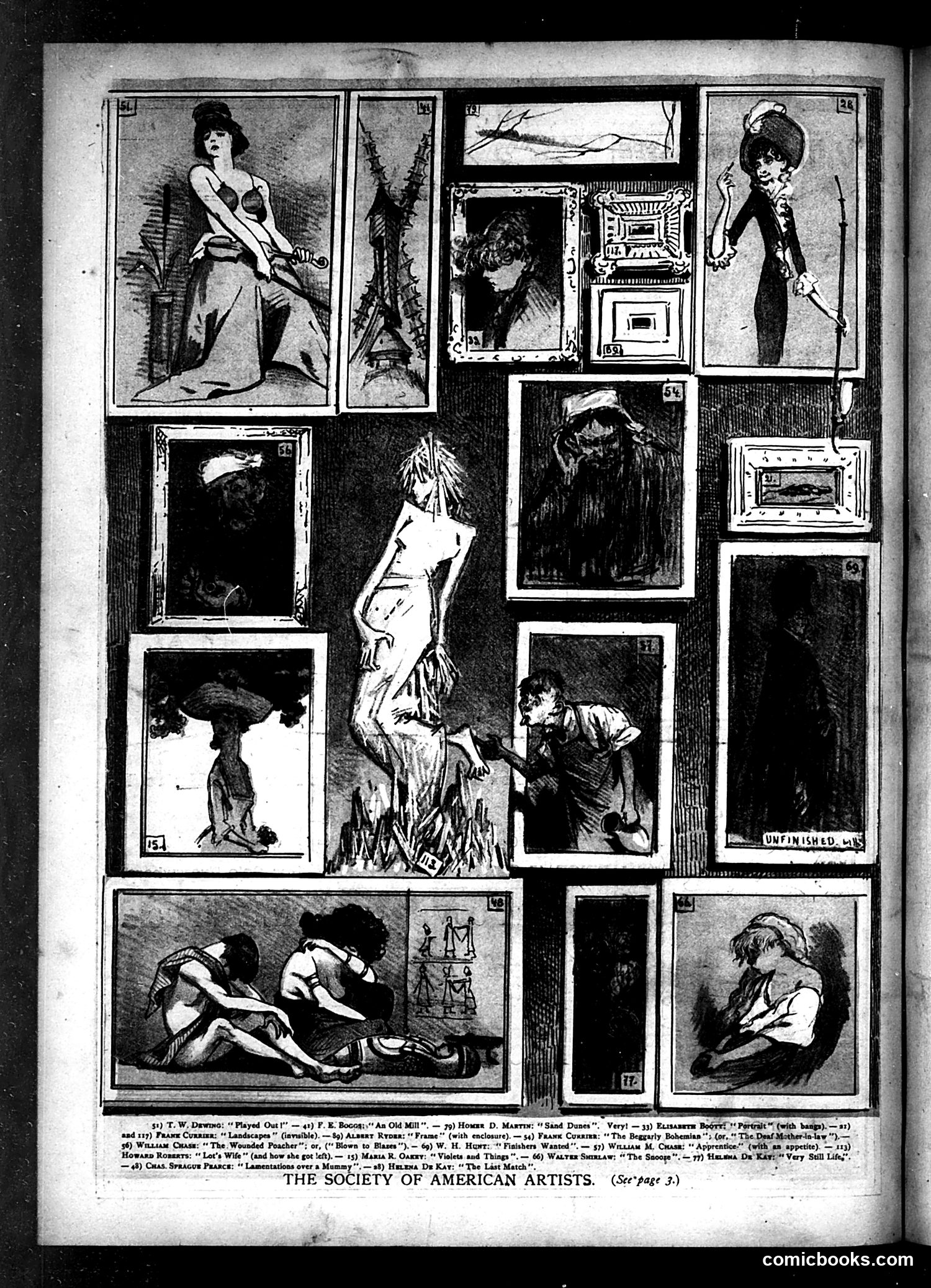
This page showcases works from the Society of American Artists' exhibition. Rather than political satire, it's a critical art review presented as a gallery layout. The page displays reproduced artwork with numbered captions identifying each piece and its artist. The works include portraits, figure studies, and narrative scenes rendered in various styles—some realistic, others more expressionistic or sketch-like. The quality and approach vary considerably across submissions, which appears to be the implicit point: this was a competitive exhibition where artistic merit ranged widely. The layout itself parodies a museum catalog or salon review, allowing Puck to comment on contemporary American art through curation and juxtaposition rather than explicit caricature. This reflects Puck's role documenting cultural events and artistic trends.