
Puck, 1878-03-27 · page 2 of 16
Puck — March 27, 1878 — page 2: what you’re looking at
What you’re looking at
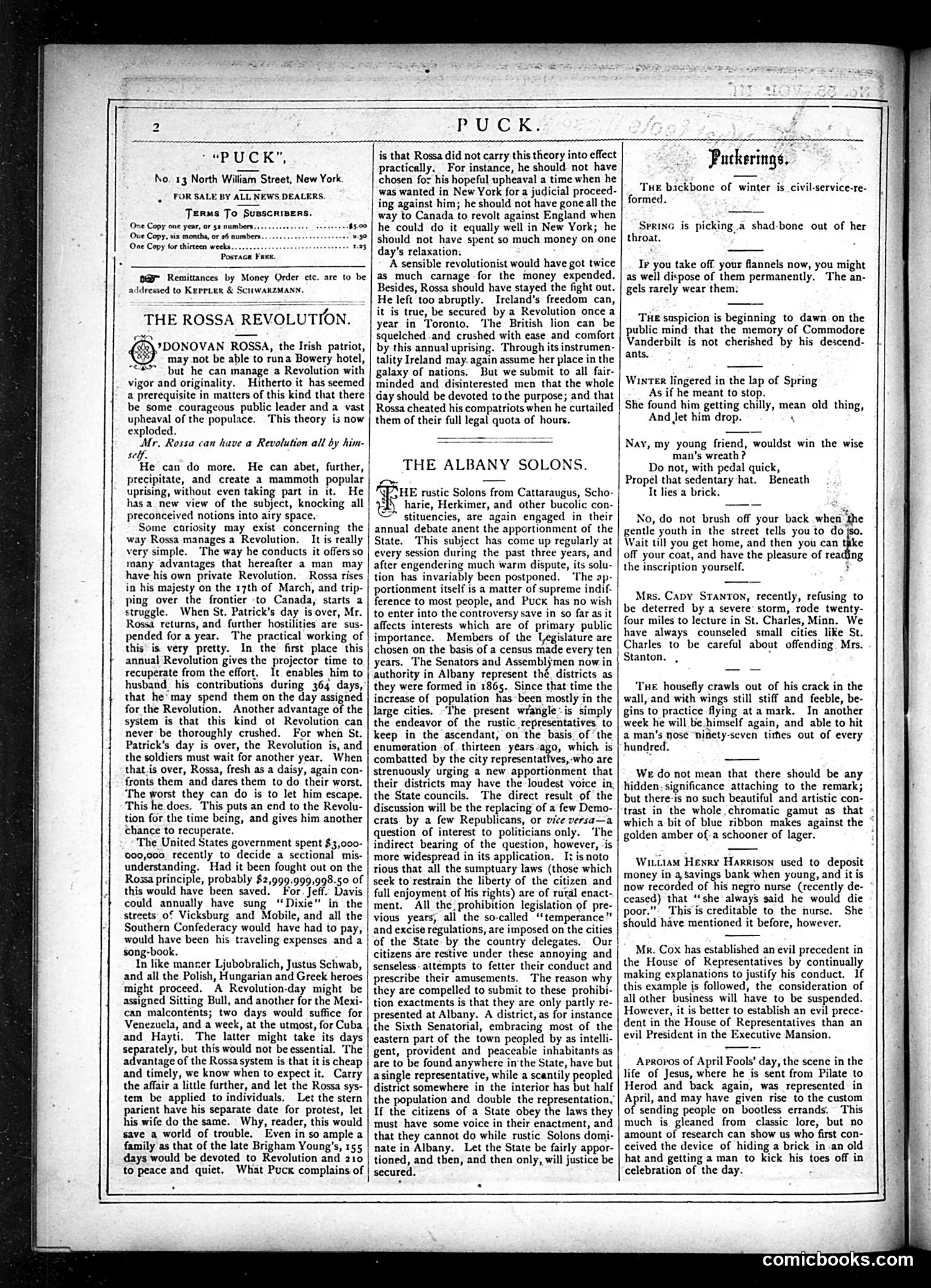
This page contains three distinct sections: advertisement for Puck magazine itself, an article titled "THE ROSSA REVOLUTION" discussing Irish patriot Donovan Rossa and revolutionary theory, and "THE ALBANY SOLONS" addressing New York State legislative representation disputes. The Rossa piece appears satirical—critiquing both Rossa's impractical revolutionary ambitions and the notion that managing a revolution resembles managing private business. The author suggests Rossa's theories, while dramatic, lack practical application. "The Albany Solons" satirizes New York politicians' ongoing gerrymandering and apportionment disputes, mocking their inability to resolve representational fairness despite repeated legislative sessions on the issue. The right column contains miscellaneous brief satirical observations about society and politics.
📄 Transcribed text from this page (OCR, searchable)
Machine-transcribed from the original scan — historical spelling and the odd misread are preserved.
PUCK. - “PUCK”, No. 13 North William Street, New York. FOR SALE BY ALL NEWS DEALERS. Terms To Susscrivers. One Copy one year, or $2 numbers... ? Oue Copy, six months, or 26 numbers. ... One Copy tor thirteen weeks... Postace Free. 8@ Remittances by Money Order etc. are to be addressed to Kerrier & THE ROSSA REVOLUTION. XDONOVAN ROSSA, the Irish patriot, may not be able to runa Bowery hotel, but he can manage a Revolution with vigor and originality. Hitherto it has seemed a prerequisite in matters of this kind that there be some courageous public leader and a vast upheaval of the populace. This theory is now exploded. Mr. Rossa can have a Revolution all by him- self. He can do more, precipitate, and create a mammoth popular uprising, without even taking part in it. He has a new view of the subject, knocking all preconceived notions into airy space. Some cariosity may exist concerning the way Rossa manages a Revolution. It is really very simple. The way he conducts it offersso many advantages that hereafter a man may have his own private Revolution. Rossa rises in his majesty on the 17th of March, and trip- ping over the frontier to Canada, starts a struggle. When St. Patrick's day is over, Mr. Rossa returns, and further hostilities are sus- pended for a year. The practical working of this is very pretty. In the first place this annual Revolution gives the projector time to recuperate from the effort. It enables him to husband his contributions during 364 days, that he‘ may spend them on the day assigned for the Revolution. Another advantage of the system is that this kind of Revolution can never be thoroughly crushed. For when St. Patrick’s day is over, the Revolution is, and the soldiers must wait for another year. When that.is over, Rossa, fresh as a daisy, again con- fronts them and dares them to do their worst. ‘The worst they can do is to let him escape. This he does. This puts an end to the Revolu- tion for the time being, and gives him another chance to recuperate. ‘The United States government spent $3,000- 00,000 recently to decide a sectional mis- understanding. Had it been fought out on the Rossa principle, probably $2,999.999,998.50 of this would have been saved. For. Jeff. Davis could annually have sung “Dixie” in the streets of Vicksburg and Mobile, and all the Southern Confederacy would have had to pay, would have been his traveling expenses and a song-book. In like manrer Ljubobralich, Justus Schwab, and all the Polish, Hungarian and Greek heroes might proceed. A Revolution-day might be assigned Sitting Bull, and another for the Mexi- can malconténts; two days would suffice for Venezuela, and a week, at the utmost, for Cuba and Hayti. The latter might take its days separately, but this would not be essential. The advantage of the Rossa system is that it is cheap and timely, we know when to expect it. Carry the affair a little further, and let the Rossa sys- tem be applied to individuals. Let the stern parient have his separate date for protest, let his wife do the same. Why, reader, this would save a world of trouble. Even in so ample a family as that of the late Brigham Young's, 155 days would be devoted to Revolution and 210 to peace and quiet. What Puck complains of oe He can abet, further, | is that Rossa did not carry this theory into effect practically. For instance, he should not have chosen foz his hopeful upheaval a time when he was wanted in New York for a judicial proceed- ing against him; he should not have gone all the way to Canada to revolt against England when he could do it equally well in New York; he should not have spent so much money on one day's relaxation: A sensible revolutionist would have got twice as much carnage for the money expended. Besides, Rossa should have stayed the fight out. He left too abruptly. Ireland’s freedom can, it is true, be secured by a Revolution once a year in Toronto. ‘The British lion can be squelched and crushed with ease and comfort by this annual uprising. Through its instrumen- tality Ireland may. again assume her place in the galaxy of nations. But we submit to all fair- minded and disinterested men that the whole day should be devoted to the purpose; and that Rossa cheated his compatriots when he curtailed | them of their full legal quota of hours. THE ALBANY SOLONS. ee rustic Solons from Cattaraugus, Scho- S\ harie, Herkimer, and other bucolic con- >* stituencies, are again engaged in their annual debate anent the apportionment of the State. This subject has come up regularly at every session during the past three years, and after engendering much warm dispute, its solu- tion has invariably been postponed. ‘The ap- portionment itself is a matter of supreme indif- ference to most people, and Puck has no wish to enter into the controversy save in so far as it affects interests which are of primary public importance. Members of the Legislature are chosen on the basis of a census made every ten years. The Senators and Assemblymen now in authority in Albany represent thé. districts as they were formed in 1865. Since that time the increase of population has been mostly in the large cities. ‘The present wrangle-is simply the endeavor of the rustic representatives to keep in the ascendant, on the basis. of ‘the enumeration of thirteen years-ago, which is combatted by the city representatives,-who are strenuously urging a new apportionment that their districts may have the loudest voice in. the State councils. The direct result of the discussion will be the replacing of a few Demo- crats. by a few Republicans, or vice versa—a question of interest to politicians only. ‘The indirect bearing of the question, however, ‘is more widespread in its application. I: is noto rious that all the sumptuary laws (those which seek to restrain the liberty of the citizen and full enjoyment of Iris rights) are of rural enact- ment. All the prohibition legislation of pre- vious years, all the so-called “temperance” and excise regulations, are imposed on the cities of the State by the country delegates. Our citizens are restive under these annoying and senseless- attempts to fetter their conduct and prescribe their amusements. The reason why they are compelled to submit to these prohibi- tion exactments is that they are only partly re- presented at Albany. A district, as for instance the Sixth Senatorial, embracing most of the eastern part of the town peopled by as intelli- gent, provident and peaceabie inhabitants as are to be found anywhere in‘the State, have but asingle representative, while a scantily peopled district somewhere in the interior has but half the population and double the representation, If the citizens of a State obey the laws they must have some voice in their enactment, and that they cannot do while rustic Solons domi- nate in Albany. Let the State be fairly appor- tioned, and then, and then only, will justice be secured. Puckerings. ‘Tue backbone of winter is. civil-service-re- formed. Sprinc is picking .a shad-bone out of her throat, Tr you take off. your flannels now, you might as well dispose of them permanently. The an- gels rarely wear them: ‘Tue suspicion is beginning to dawn on the public mind that the memory of Commodore Vanderbilt is not cherished by his descend- ants. Winter lingered in the lap of Spring As if he meant to stop. She found him getting chilly, mean old thing, And Jet him drop. \ Nay, my young friend, wouldst win the wise man's wreath? Do not, with pedal quick, Propel that sedentary hat. Beneath Tt lies a brick. No, do not brush off your back when the gentle youth in the street tells you to dojso. Wait till you get home, and then you can fe off your coat, and have the pleasure of reading the inscription yourself. e Mrs. Capy Stanton, recently, refusing to be deterred by a severe’ storm, rode twenty- four miles to lecture in St. Charles, Minn. We have always counseled small cities like St. Charles to be careful about offending. Mrs. Stanton. , . ‘Tue housefly crawls out of his crack in the wall, and with wings still stiff and feeble, be- gins to practice flying ata mark. In another week he will be himself again, and able to hit a man’s nose “ninety-seven times out of every hundred. We do not mean that there should be any hidden. significance attaching to the remark; but there-is no such beautiful and artistic con- trast in the whole chromatic gamut as that which a bit of blue ribbon makes against the golden amber of-a schooner of lager. : Wittiam Hesry Harrison used to deposit money in a savings bank when young, and it is now recorded of his negro nurse (recently de- ceased) that ‘she always said he would die poor.” This is creditable to the nurse. She should have mentioned it before, however. Mr. Cox has established an evil precedent in the House’ of Representatives by continually making explanations to justify his conduct. If this example is followed, the consideration of all other business will have to be suspended. However, it is better to establish an evil prece- dent in the House of Representatives than an evil President in the Executive Mansion. Apropos of April Fools’ day, the scene in the life of Jesus, where he is sent from Pilate to Herod and back again, was represented in April, and may have given rise to the custom of sending people on bootless errands. This much is gleaned from classic lore, but no amount of research can show us who first con- ceived the device of hiding a brick in an old hat and getting a man to kick his toes off in celebration of the day. F comicbooks.com