
Puck, 1878-03-27 · page 6 of 16
Puck — March 27, 1878 — page 6: what you’re looking at
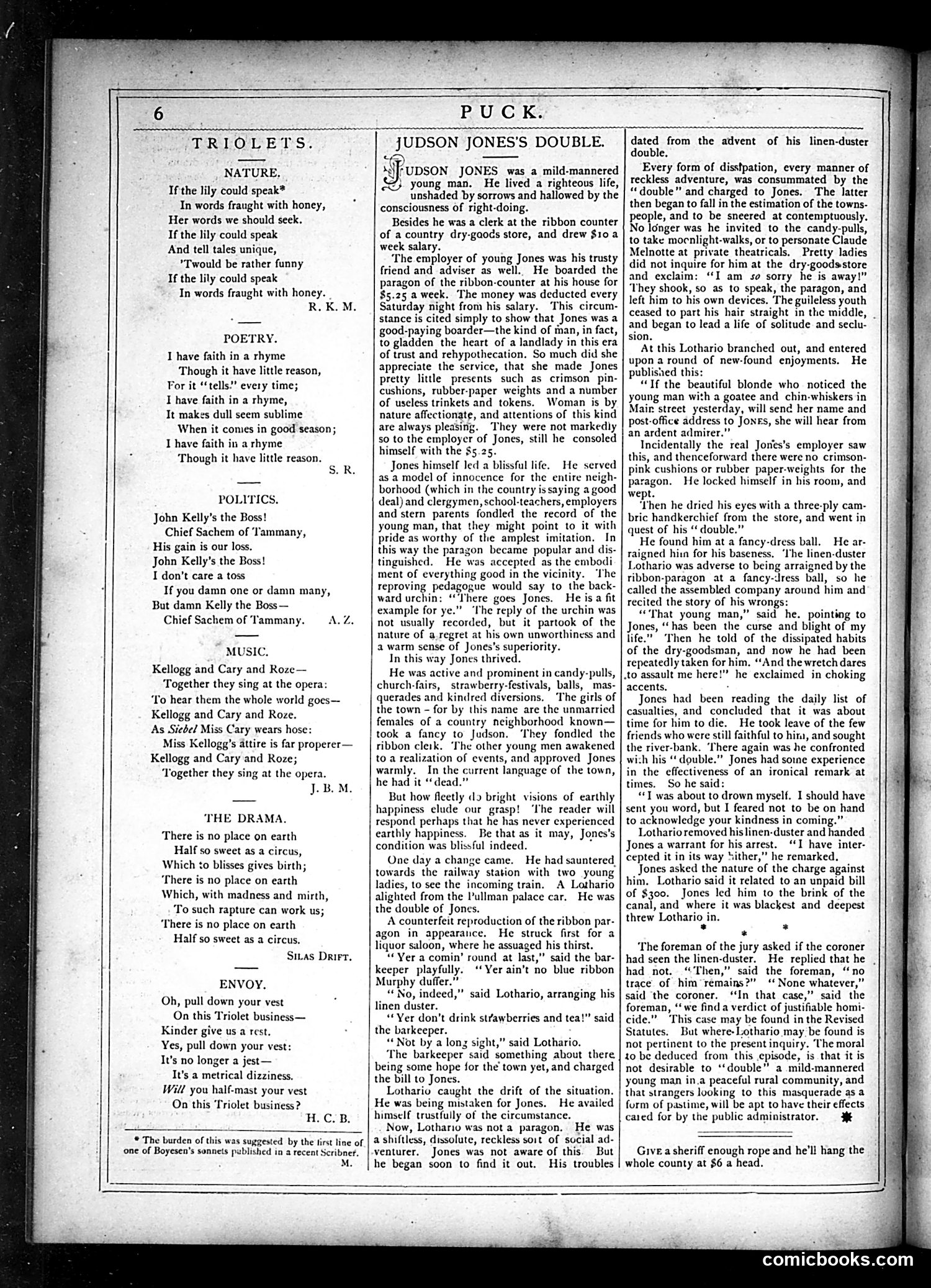
A restored page from Puck, 1878-03-27. Page through the whole issue in the reader above.
📄 Transcribed text from this page (OCR, searchable)
Machine-transcribed from the original scan — historical spelling and the odd misread are preserved.
PUCK. TRIOLETS. NATURE, If the lily could speak* In words fraught with honey, Her words we should seek. If the lily could speak And tell tales unique, ’Twould be rather funny If the lily could speak In words fraught with honey. R.K.M. POETRY. I have faith in a rhyme Though it have little reason, For it “tells.” every time; I have faith in a rhyme, It makes dull seem sublime When it comes in good season; I have faith in a rhyme Though it have little reason. POLITICS. John Kelly’s the Boss! Chief Sachem of ‘Tammany, His gain is our loss. John Kelly’s the Boss! I don’t care a toss If you damn one or damn many, But damn Kelly the Boss— Chief Sachem of ‘l'ammany. MUSIC. Kellogg and Cary and Roze— Together they sing at the opera: ‘To hear them the whole world gocs— Kellogg and Cary and Roze. As Siebel Miss Cary wears hose: Miss Kellogg’s attire is far properer— Kellogg and Cary and Roze; ‘Together they sing at the opera. J. BOM. THE DRAMA. There is no place on earth Half so sweet as a circus, Which to blisses gives birth; ‘There is no place on earth Which, with madness and mirth, ‘To such rapture can work us; ‘There is no place on earth Half so sweet as a circus. Sttas Drier. ENVOY. Oh, pull down your vest On this Triolet business— Kinder give us a rest, Yes, pull down your vest: It’s no longer a jest— It's a metrical dizziness. Will you half-mast your vest On this Triolet business? H.C. B, © The burden of this was suggested by the list line of one of Boyesen's sonnets published in a recent Scribnef. JUDSON JONES'S DOUBLE. aS SN[-UDSON JONES was a mild-mannered & young man. He lived a righteous life, unshaded by sorrows and hallowed by the consciousness of right-doing. Besides he was a clerk at the ribbon counter of acountry dry-gaods store, and drew $10 a week salar ‘The employer of young Jones was his trusty friend and adviser as well.. He boarded the paragon of the ribbon-counter at his house for $5.25 a week. The money was deducted every Saturday night from his salary. ‘This circum- stance is cited simply to show that Jones was a good-paying boarder—the kind of than, in fact, to gladden the heart of a landlady in this era of trust and rehypothecation. So much did she appreciate the service, that she made Jones pretty little presents such as crimson pin- cushions, rubber-paper weights and a number of useless trinkets and tokens. Woman is by nature affectionate, and attentions of this kind are always pleasing. They were not markedly so to the employer of Jones, still he consoled himself with the $5.25. Jones himself led a blissful life. He served as a model of innocence for the entire neigh- borhood (which in the country issaying a good deal) and clergymen, school-teachers, employers and stern parents fondled the record of the young man, that they might point to it with pride as worthy of the amplest imitation. In this way the paragon became popular and dis- tinguished. He was accepted as the embodi ment of everything good in the vicinity. ‘he reproving pedagogue would say to the back- ward urchin: “There goes Jones. He isa fit example for ye.” ‘The reply of the urchin was not usually Tecoided, but it partook of the nature of a.regret at his own unworthiness and a warm sense of Jones's superiority. In this way Jones thrived. He was active and prominent in candy-pulls, church-fairs, strawberry-festivals, balls, mas- querades and kindred diversions. ‘The girls of the town - for by this name are the unmarried females of a country neighborhood known— took a fancy to Judson. They fondled the ribbon clesk. ‘The other young men awakened to a realization of events, and approved Jones warmly. In the current language of the town, he had it “dead.” But how fleetly dl bright visions of earthly happiness elude our grasp! ‘The reader will respond perhaps that he has never experienced earthly happiness. Be that as it may, Jones's condition was blissful indeed. One day a change came. He had sauntered. towards the railway station with two young ladies, to see the incoming train. A Lothario alighted from the Pullman palace car. He was the double of Jones. A counterfeit reproduction of the ribbon par- agon in appearance. He struck first for a liquor saloon, where he assuaged his thirst. “Yer a comin’ round at last,” said the bar- keeper playfully. ‘Yer ain’t no blue ribbon Murphy duffer.” “No, indeed,” linen duster. “Yer don’t drink stfawberries and tea!” said the barkeeper. Nat by a long sight,” said Lothario. ‘The barkeeper said something about there being some hope for the’ town yet, and charged the bill to Jones. Lothario caught the drift of the situation. He was being mistaken for Jones. He availed himself trustfully of the circumstance. Now, Lothario was not a paragon. He was a shiftless, dissolute, reckless soit of social ad- venturer, Jones was not aware of this. But he began soon to find it out. His troubles said Lothario, arranging his dated from the advent of his linen-duster double, Every form of disstpation, every manner of reckless adventure, was consummated by the “double” and charged to Jones. The latter then began to fall in the estimation of the towns- people, and to be sneered at contemptuously, No longer was he invited to the candy-pulls, to take mocnlight-walks, or to personate Claude Melnotte at private theatricals. Pretty ladies did not inquire for him at the dry-goodsstore and exclaim: “I am so sorry he is away!” They shook, so as to speak, the paragon, and left him to his own devices. The guileless youth ceased to part his hair straight in the middle, _ and began to lead a life of solitude and seclu- sion. At this Lothario branched out, upon a round of new-found enjoyments. published this: “If the beautiful blonde who noticed the young man with a goatee and chin-whiskers in Main strect yesterday, will send her name and post-office address to Jones, she will hear from an ardent admirer.” Incidentally the real Jor‘es’s employer saw this, and thenceforward there were no crimson- pink cushions or rubber paper-weights for the paragon. He locked himself in his room, and wept. ‘Then he dried his eyes with a three-ply cam- bric handkerchief from the store, and went in quest of his double.” He found him at a fancy-dress ball. He ar- raigned hiin for his baseness. ‘I'he linen-duster Lothario was adverse to being arraigned by the ribbon-paragon at a fancy-dress ball, so he called the assembled company around him and recited the story of his wrongs: “That young man,” said he. pointing to Jones, “has been the curse and blight of my life.” Then he told of the dissipated habits of the dry-goodsman, and now he had been repeatedly taken for him. “And the wretch dares and entered He .to assault me here!” he exclaimed in choking accents. Jones had been reading the daily list of casualties, and concluded that it was about time for him to die. He took leave of the few friends who were still faithful to him, and sought the river-bank. ‘There again was he confronted wich his “double.” Jones had somne experience in the effectiveness of an ironical remark at times. So he said: “T was about to drown myself. I should have sent you word, but I feared not to be on hand to acknowledge your kindness in coming.” Lotharioremoved hislinen-duster and handed Jones a warrant for his arrest. ‘1 have inter- cepted it in its way hither,” he remarked, Jones asked the nature of the charge against him. Lothario said it related to an unpaid bill of $300. Jones led him to the brink of the canal, and where it was blackest and deepest threw Lothario in. * * ‘The foreman of the jury asked if the coroner had seen the linen-duster. He replied that he , had not. “Then,” said the foreman, “no trace of him remains?” ‘‘ None whatever,” said the coroner. ‘In that case,” said the foreman, ‘we finda verdict of justifiable homi- cide.” ‘This case may be found in the Revised Statutes. But where-Lothario may. be found is not pertinent to the present inquiry. The moral to be deduced from this episode, is that it is not desirable to ‘‘double” a mild-mannered young man in.a peaceful rural community, and that strangers looking to this masquerade as a form of pastime, will be apt to have their effects cared for by the public administrator. Give a sheriff enough rope and he'll hang the whole county at $6 a head. comicbooks.com