
Puck, 1878-03-27 · page 3 of 16
Puck — March 27, 1878 — page 3: what you’re looking at
What you’re looking at
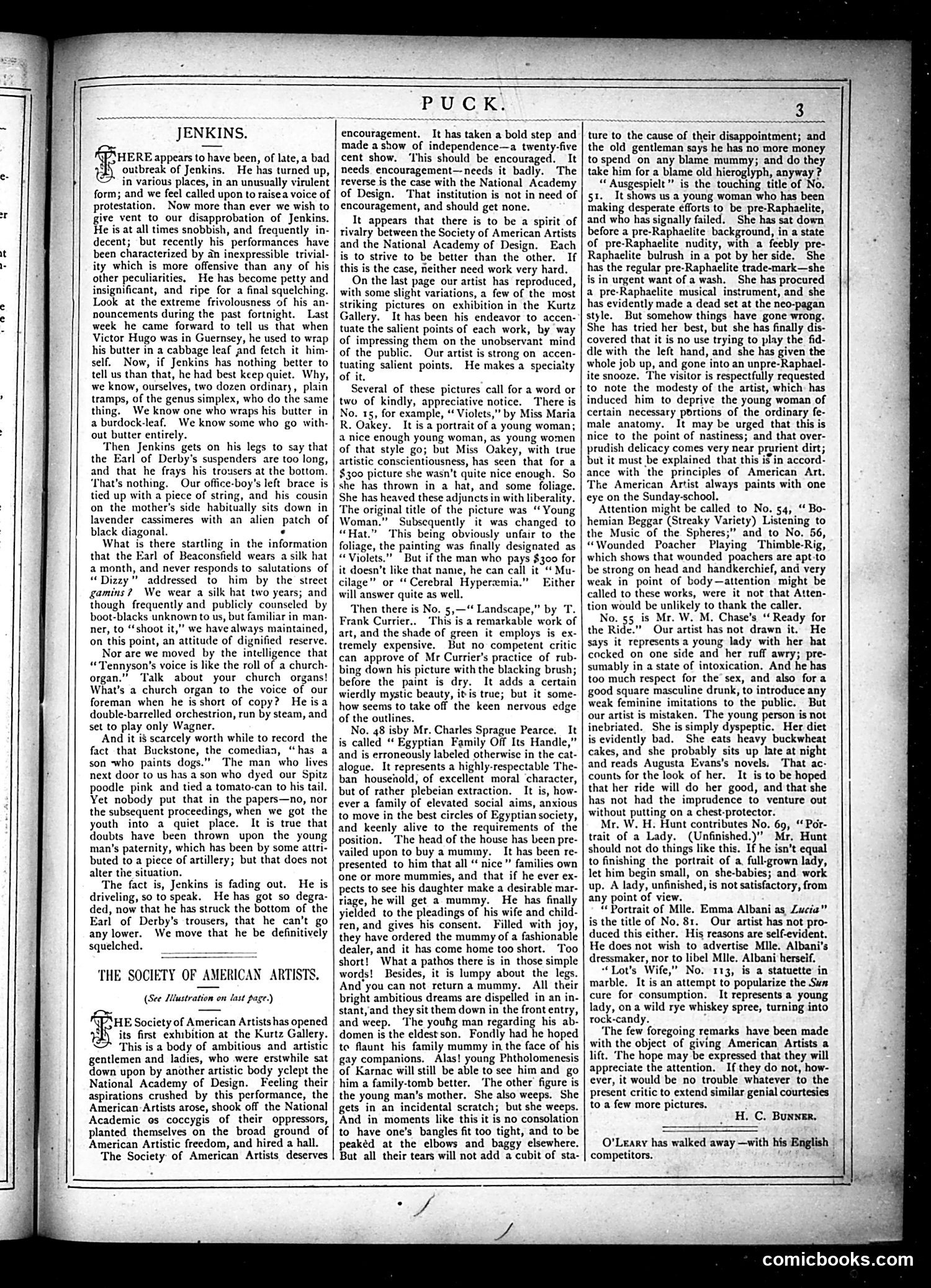
This page contains two distinct sections: **Jenkins** (top) and **The Society of American Artists** (bottom). The **Jenkins** section satirizes an artist who has become snobbish and difficult following minor success. The text criticizes his affected behavior, pretentiousness, and rivalry with the National Academy of Design. The satire targets artistic ego and the contradiction between an artist's need for encouragement and his subsequent arrogance. The **Society of American Artists** section (with illustration on facing page) mocks the organization's ambitious members and their pretensions. It particularly ridicules a controversy involving an "Egyptian mummy" portrait—apparently someone painted a mummy and created absurd backstory claims about its provenance and the subject's prominent Egyptian family connections. The satire highlights artistic fraud and the gullibility of collectors. Both pieces critique American artistic ambition, dishonesty, and social climbing.
📄 Transcribed text from this page (OCR, searchable)
Machine-transcribed from the original scan — historical spelling and the odd misread are preserved.
HERE appears to have been, of late, a bad ree outbreak of Jenkins. He has turned up, in various places, in an unusually virulent form; and we feel called upon to raisea voice of protestation. Now more than ever we wish to give vent to our disapprobation of Jenkins. He is at all times snobbish, and frequently in- decent; but recently his performances have been characterized by an inexpressible trivial- ity which is more offensive than any of his other peculiarities, He has become petty and insignificant, and ripe for a final squelching. Look at the extreme frivolousness of his an- nouncements during the past fortnight. Last week he came forward to tell us that when Victor Hugo was in Guernsey, he used to wrap his butter in a cabbage leaf and fetch it him- self. Now, if Jenkins has nothing better to tell us than that, he had best keep quiet. Why, we know, ourselves, two dozen ordinary, plain tramps, of the genus simplex, who do the same thing. We know one who wraps his butter in a burdock-leaf. We know some who go with- out butter entirely. Then Jenkins gets on his legs to say that the Earl of Derby's suspenders are too long, and that he frays his trousers at the bottom. ‘That's nothing. Our office-boy’s left brace is tied up with a piece of string, and his cousin on the mother’s side habitually sits down in lavender cassimeres with an alien patch of black diagonal. ‘ What is there startling in the information that the Earl of Beaconsfield wears a silk hat a month, and never responds to salutations of “ Dizzy" addressed to him by the street gamins? We wear a silk hat two years; and though frequently and publicly counseled by boot-blacks unknown to us, but familiar in man- ner, to “shoot it,” we have always maintained, on this point, an attitude of dignified reserve. Nor are we moved by the intelligence that “Tennyson's voice is like the roll of a church- organ.” ‘Talk about your church organs! What's a church organ to the voice of our foreman when he is short of copy? He isa double-barreled orchestrion, run by steam, and set to play only Wagner. And it i$ scarcely worth while to record the fact that Buckstone, the comedian, “has a son -who paints dogs.” The man who lives next door to us has a son who dyed our Spitz poodle pink and tied a tomato-can to his tail. Yet nobody put that in the papers—no, nor the subsequent proceedings, when we got the youth into a quiet place. It is true that doubts have been thrown upon the young man’s paternity, which has been by some attri- buted to a piece of artillery; but that does not alter the situation. The fact is, Jenkins is fading out. He is driveling, so to speak. He has got so degra- ded, now that he has struck the bottom of the Earl of Derby's trousers, that he can’t go any lower. We move that he be definitively squelched. THE SOCIETY OF AMERICAN ARTISTS. (See Ilustration on last page.) PSHE Society of American Artists has opened eat its first exhibition at the Kurtz Gallery. 7 This is a body of ambitious and artistic gentlemen and ladies, who were erstwhile sat down upon by another artistic body yclept the National Academy of Design. Feeling their aspirations crushed by this performance, the American Artists arose, shook off the National Academic es coccygis of their oppressors, planted themselves on the broad ground of American Artistic freedom, and hired a hall. The Society of American Artists deserves PUCK. encouragement. It has taken a bold step and made a show of independence—a twenty-five cent show. ‘I'his should be encouraged. It needs. encouragement—needs it badly. The reverse is the case with the National Academy of Design. That institution is not in need of encouragement, and should get none. It appears that there is to be a spirit of rivalry between the Society of American Artists and the National Academy of Design. Each is to strive to be better than the other. If this is the case, neither need work very hard. On the last page our artist has reproduced, with some slight variations, a few of the most striking pictures on exhibition in the Kurtz Gallery. It has been his endeavor to accen- tuate the salient points of each work, by way of impressing them on the unobservant mind of the public. Our artist is strong on accen- tuating salient points, He makes a speciaity of it. Several of these pictures call for a word or two of kindly, appreciative notice. There is No. 15, for example, “Violets,” by Miss Maria R. Oakey. It is a portrait of a young woman; a nice enough young woman, as young women of that style go; but Miss Oakey, with true artistic conscientiousness, has seen that for a $300 picture she wasn't quite nice enough. So she has thrown in a hat, and some foliage. She has heaved these adjuncts in with liberality. The original title of the picture was “ Young Woman.” Subsequently it was changed to “Hat.” This being obviously unfair to the foliage, the painting was finally designated as “Violets.” But if the man who pays $300 for it doesn’t like that name, he can call it “ Mu- cilage” or “Cerebral Hyperemia.” Either will answer quite as well. ‘Then there is No. 5,—‘ Landscape,” by T. Frank Currier.. ‘This is a remarkable work of art, and the shade of green it employs is ex- tremely expensive. But no competent critic can approve of Mr Currier’s practice of rub- bing down his picture with the blacking brush; before the paint is dry. It adds a certain wierdly mystic beauty, itis true; but it some- how seems to take off the keen nervous edge of the outlines. No. 48 isby Mr. Charles Sprague Pearce. It is called “ Egyptian Family Off Its Handle,” and is erroneously labeled otherwise in the cat- alogue. It represents a highly-respectable The- ban household, of excellent moral ‘character, but of rather plebeian extraction. It is, how- ever a family of elevated social aims, anxious to move in the best circles of Egyptian society, and keenly alive to the requirements of the position. The head of the house has been pre- vailed upon to buy a mummy. It has been re- presented to him that all “ nice” families own one or more mummies, and that if he ever ex- pects to see his daughter make a desirable mar- riage, he will get a mummy. He has finally yielded to the pleadings of his wife and child- ren, and gives his consent. Filled with joy, they have ordered the mummy of a fashionable dealer, and it has come home too short. Too short! What a pathos there is in those simple words! Besides, it is lumpy about the legs. And you can not return a mummy. All their bright ambitious dreams are dispelled in an in- stant, and they sit them down in the frontentry, | and weep. ‘The youhg man regarding his ab- domen is the eldest son. Fondly had he hoped | to flaunt his family mummy in the face of his | gay companions. Alas! young Phtholomenesis | of Karnac will still be able to see him and go him a family-tomb better. ‘The other’ figure is the young man’s mother. She also weeps. She gets in an incidental scratch; but she weeps. And in moments like this it is no consolation to have one’s bangles fit too tight, and to be peakéd at the elbows and baggy elsewhere. But all their tears will not add a cubit of sta- ture to the cause of their disappointment; and the old gentleman says he has no more money to spend on any blame mummy; and do they take him for a blame old hieroglyph, anyway ? “ Ausgespielt” is the touching title of No. 51. It shows us a young woman who has been making desperate efforts to be pre-Raphaelite, and who has signally failed. She has sat down before a pre-Raphaelite background, in a state of pre-Raphaelite nudity, with a feebly pre- Raphaelite bulrush in a pot by her side. She has the regular pre-Raphaelite trade-mark—she is in urgent want of a wash. She has procured a pre-Raphaelite musical instrument, and she has evidently made a dead set at the neo-pagan style. But somehow things have gone wrong. She has tried her best, but she has finally dis- covered that it is no use trying to play the fid- dle with the left hand, and she has given the whole job up, and gone into an unpre-Raphael- ite snooze. The visitor is respectfully requested to note the modesty of the artist, which has induced him to deprive the young woman of certain necessary p®rtions of the ordinary fe- male anatomy. It may be urged that this is nice to the point of nastiness; and that over- prudish delicacy comes very near prurient dirt; but it must be explained that this iS in accord- ance with ‘the principles of American Art. The American Artist always paints with one eye on the Sunday-school. Attention might be called to No. 54, “ Bo- hemian Beggar (Streaky Variety) Listening to the Music of the Spheres;” and to No. 56, “Wounded Poacher Playing Thimble-Rig, which shows that wounded poachers are apt-to be strong on head and handkerchief, and very weak in point of body—attention might be called to these works, were it not that Atten- tion would be unlikely to thank the caller. No. 55 is Mr. W. M. Chase’s “Ready for the Ride.” Our artist has not drawn it. He says it represents a young lady with her hat cocked on one side and her ruff awry; pre- sumably in a state of intoxication. And he has too much respect for the’ sex, and also fora good square masculine drunk, to introduce any weak feminine imitations to the public. But our artist is mistaken. The young person is not inebriated. She is simply dyspeptic. Her diet is evidently bad. She eats heavy buckwheat cakes, and she probably sits up late at night and reads Augusta Evans’s novels. That ac- counts for the look of her. It is to be hoped that her ride will do her good, and that she has not had the imprudence to venture out without putting on a chest-protector. Mr, W. H. Hunt contributes No. 69, “ Por- trait of a Lady. (Unfinished.)” Mr, Hunt should not do things like this. If he isn't equal to finishing the portrait of a, full-grown lady, let him begin small, on she-babies; and. work up. A lady, unfinished, is not satisfactory, from any point of view. “ Portrait of Mlle. Emma Albani as Lucia" is the title of No, 81. Our artist has not pro- duced this either. His reasons are self-evident. He does not wish to advertise Mlle. Albani’s dressmaker, nor to libel Mile. Albani herself. “Lot's Wife,” No. 113, is a statuette in marble, It is an attempt to popularize the Sun cure for consumption. It represents a young lady, ona wild rye whiskey spree, turning into rock-candy. ‘The few foregoing remarks have been made with the object of giving American Artists a lift. The hope may be expressed that they will appreciate the attention. If they do not, how- ever, it would be no trouble whatever to the present critic to extend similar genial courtesies to a few more pictures. H, C. Bunner, O'Leary has walked away —with his English | | competitors. 4 “wh he Sab comicbooks.com