
Puck, 1878-03-27 · page 4 of 16
Puck — March 27, 1878 — page 4: what you’re looking at
What you’re looking at
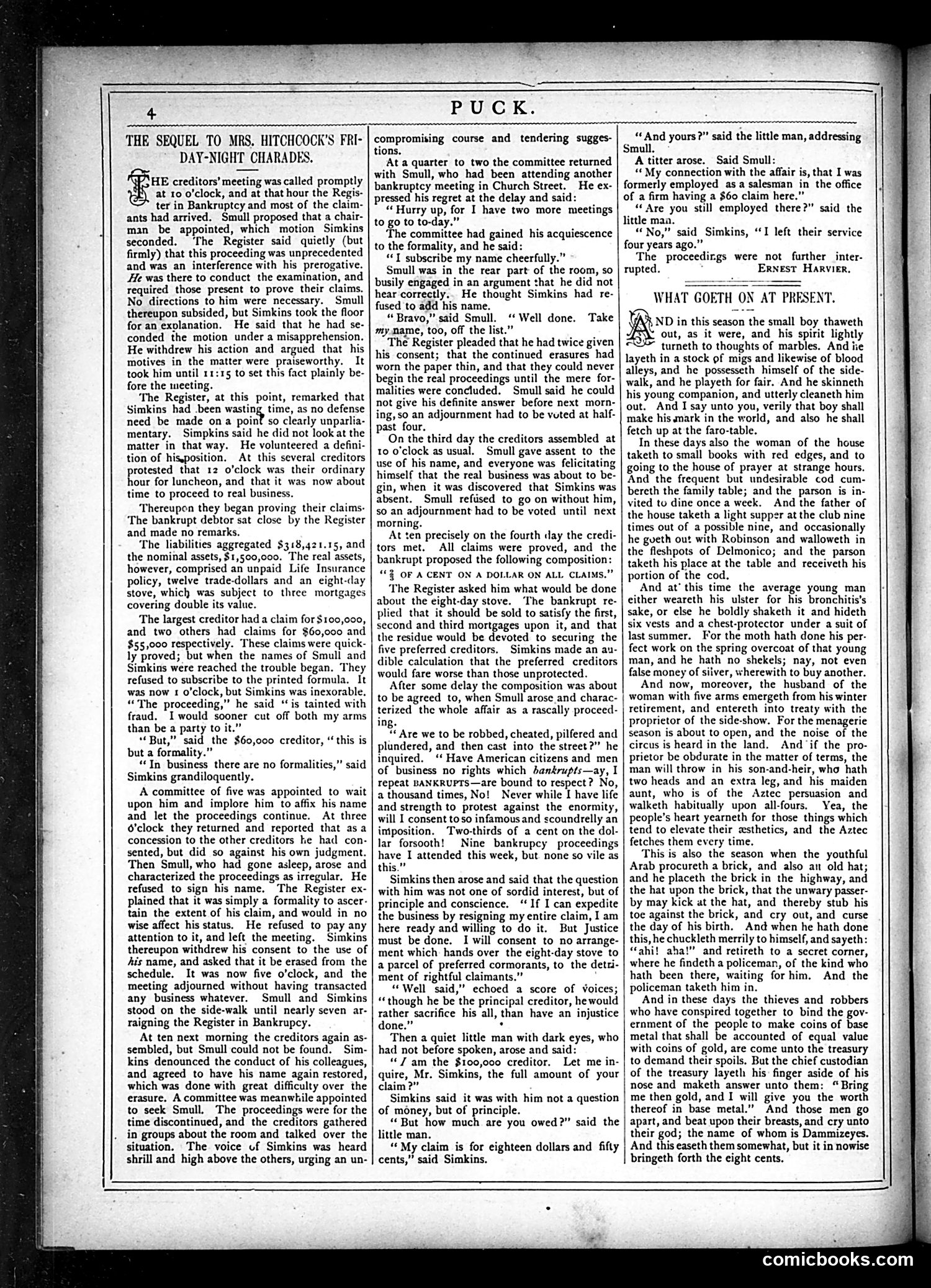
This page contains the satirical narrative "The Sequel to Mrs. Hitchcock's Friendly Guardians" and a separate piece titled "What Goeth On At Present." The main story appears to be a detailed account of a creditors' meeting regarding bankruptcy proceedings, featuring characters named Simkins and Small. The satire mocks the formalities and absurdities of bankruptcy law—creditors disputing claims, debates over composition settlements, and Simkins's dramatic refusal to resign his claim on principle despite financial impossibility. The secondary piece "What Goeth On At Present" satirizes upper-class social pretensions, describing a young boy's observations of marble-playing, social hierarchies among children, and adults' hypocritical moral lecturing. Both pieces use detailed, character-driven humor to critique American legal procedures and social class behaviors of the period.
📄 Transcribed text from this page (OCR, searchable)
Machine-transcribed from the original scan — historical spelling and the odd misread are preserved.
PUCK. THE SEQUEL TO MRS. HITCHCOCK'S FRI- DAY-NIGHT CHARADES. HE creditors’ meeting was called promptly at 10 o'clock, and at that hour the Regis- ter in Bankruptcy and most of the claim- ants had arrived. Smull proposed that a chair- man be appointed, which motion Simkins seconded. ‘The Register said quietly (but firmly) that this proceeding was unprecedented and was an interference with his prerogative. He was there to conduct the examination, and required those present to prove their claims. No directions to him were necessary. Smull thereupon subsided, but Simkins took the floor for an exvlanation. He said that he had se- conded the motion under a misapprehension. He withdrew his action and argued that his motives in the matter were praiseworthy. It took him until 11:15 to set this fact plainly be- fore the meeting. ‘The Register, at this point, remarked that Simkins had -been wasting time, as no defense need be made ona point so clearly unparlia- mentary. Simpkins said he did not look at the matter in that way. He volunteered a defini- tion of hisposition. At this several creditors rotested that 12 o'clock was their ordinary our for luncheon, and that it was now about time to proceed to real business. ‘Thereupon they began proving their claims. ‘The bankrupt debtor sat close by the Register and made no remarks. The liabilities aggregated $318,421.15, and the nominal assets, $1,500,000. The real assets, however, comprised an unpaid Life Insurance policy, twelve trade-dollars and an eight-day stove, which was subject to three mortgages covering double its value. The largest creditor had a claim for $100,000, and two others had claims for $60,000 and $55,000 respectively. These claims were quick- ly proved; but when the names of Smull and Simkins were reached the trouble began. They refused to subscribe to the printed formula. It was now 1 o'clock, but Simkins was inexorable. “The proceeding,” he said ‘is tainted with fraud. I would sooner cut off both my arms than be a party to it.” “But,” said the $60,000 creditor, “this is but a formality.” “(In business there are no formalities,” said Simkins grandiloquently. Acommittee of five was appointed to wait upon him and implore him to affix his name and let the proceedings continue. At three o'clock they returned and reported that asa concession to the other creditors he had con- sented, but did so against his own judgment. Then Smull, who had gone asleep, arose and characterized the proceedings as irregular. He refused to sign his name. The Register ex- plained that it was simply a formality to ascer- tain the extent of his claim, and would in no wise affect his status. He refused to pay any attention to it, and left the meeting. Simkins thereupon withdrew his consent to the use of Ais name, and asked that it be erased from the schedule. It was now five o’clock, and the meeting adjourned without having transacted any business whatever. Smull and Simkins stood on the side-walk until nearly seven ar- raigning the Register in Bankrupcy. At ten next morning the creditors again as- sembled, but Smull could not be found. Sim- kins denounced the conduct of his colleagues, and agreed to have his name again restored, which was done with great difficulty over the erasure. A committee was meanwhile appointed to seek Smull. The proceedings were for the time discontinued, and the creditors gathered in groups about the room and talked over the situation. The voice uf Simkins was heard shrill and high above the others, urging an un- compromising course and tendering sugges- tions. Ata quarter to two the committee returned with Smull, who had been attending another bankruptcy meeting in Church Street. He ex- pressed his regret at the delay and said: “Hurry up, for I have two more meetings to go to to-day.” The committee had gained his acquiescence to the formality, and he said: “I subscribe my name cheerfully.” Smull was in the rear part of the room, so busily engaged in an argument that he did not hear correctly.. He thought Simkins had re- fused to add his name. “Bravo,” said Smull. ‘‘ Well done. my ame, too, off the list.” The Register pleaded that he had twice given his consent; that the continued erasures had worn the paper thin, and that they could never begin the real proceedings until the mere for- malities were concluded. Smull said he could not give his definite answer before next morn- ing, so an adjournment had to be voted at half- past four. On the third day the creditors assembled at 10 o'clock as usual. Smull gave assent to the use of his name, and everyone was felicitating himself that the real business was about to be- gin, when it was discovered that Simkins was absent. Smull reftised to go on without him, so an adjournment had to be voted until next morning. At ten precisely on the fourth day the credi- tors met. All claims were proved, and the bankrupt proposed the following composition: “(3 OF A CENT ON A DOLLAR ON ALL CLAIMS.” ‘The Register asked him what would be done about the eight-day stove. The bankrupt _re- plied that it should be sold to satisfy the first, second and third mortgages upon it, and that the residue would be devoted to securing the five preferred creditors. Simkins made an au- dible calculation that the preferred creditors would fare worse than those unprotected. After some delay the composition was about to be agreed to, when Smull arose and charac- terized the whole affair as a rascally proceed- ing. i Are we to be robbed, cheated, pilfered and plundered, and then cast into the street?” he inquired. ‘‘ Have American citizens and men of business no rights which bankrupts—ay, I repeat BANKRUPTS—are bound to respect? No, a thousand times, No! Never while I have life and strength to protest against the enormity, will 1 consent toso infamous and scoundrelly an imposition. Two-thirds of a cent on the dol- lar forsooth! Nine bankrupcy proceedings have I attended this week, but none so vile as this.” Simkins then arose and said that the question with him was not one of sordid interest, but of principle and conscience. ‘If I can expedite the business by resigning my entire claim, I am here ready and willing to do it. But Justice must be done. I will consent to no arrange- ment which hands over the eight-day stove to a parcel of preferred cormorants, to the detri- ment of rightful claimants.” “Well said,” echoed a score of Voices; “though he be the principal creditor, hewould rather sacrifice his all, than have an injustice done.” ; Then a quiet little man with dark eyes, who had not before spoken, arose and said: “7 am the $100,000 creditor. Let me in- quire, Mr. Simkins, the full amount of your claim?” Simkins said it was with him not a question of money, but of principle. “But how much are you owed?” said the little man. “My claim is for eighteen dollars and fifty cents,” said Simkins. Take “ And yours?” said the little man, addressing Smull. A titter arose. Said Smull: “My connection with the affair is, that I was formerly employed asa salesman in the office of a firm having a $60 claim here.” “Are you still employed there?” said the little maa. “No,” said Simkins, “I left their service four years ago.” The proceedings were not further inter- rupted. . Ernest Harvier, WHAT GOETH ON AT PRESENT. ND in this season the small boy thaweth AN: out, as it were, and his spirit lightly “<*> turneth to thoughts of marbles. And jie layeth in a stock of migs and likewise of bloos alleys, and he possesseth himself of the side- walk, and he playeth for fair. And he skinneth his young companion, and utterly cleaneth him out. And I say unto you, verily that boy shall make his mark in the world, and also he shall fetch up at the faro-table. In these days also the woman of the house taketh to small books with red edges, and to going to the house of prayer at strange hours. And the frequent but undesirable cod cum- bereth the family table; and the parson is in- vited to dine once a week. And the father of the house taketh a light supper at the club nine times out of a possible nine, and occasionally he gueth out with Robinson and walloweth in the fleshpots of Delmonico; and the parson taketh his place at the table and receiveth his portion of the cod, And at’ this time the average young man either weareth his ulster for his bronchitis’s sake, or else he boldly shaketh it and hideth six vests and a chest-protector under a suit of last summer. For the moth hath done his per- fect work on the spring overcoat of that young man, and he hath no shekels; nay, not even false money of siiver, wherewith to buy another. And now, moreover, the husband of the woman with five arms emergeth from his winter retirement, and entereth into treaty with the proprietor of the side-show. For the menagerie season is about to open, and the noise of the circus is heard in the land. And ‘if the pro- prietor be obdurate in the matter of terms, the man will throw in his son-and-heir, who hath two heads and an extra leg, and his maiden aunt, who is of the Aztec persuasion and walketh habitually upon all-fours. Yea, the people’s heart yearneth for those things which tend to elevate their zsthetics, and the Aztec fetches them every time. This is also the season when the youthful Arab procureth a brick, and also an old hat; and he placeth the brick in the highway, and the hat upon the brick, that the unwary passer- by may kick at the hat, and thereby stub his toe against the brick, and cry out, and curse the day of his birth. And when he hath done this, he chuckleth merrily to himself, and sayeth: “ahi! aha!” and retireth to a secret corner, where he findeth a policeman, of the kind who hath been there, waiting forhim. And the policeman taketh him in. And in these days the thieves and robbers who have conspired together to bind the gov- ernment of the people to make coins of base metal that shall be accounted of equal value with coins of gold, are come unto the treasury to demand their spoils. But the chief custodian of the treasury layeth his: finger aside of his nose and maketh answer unto them: “Bring me then gold, and I will give you the worth thereof in base metal.” And those men go apart, and beat upon their breasts, and cry unto their god; the name of whom is Dammizeyes. And this easeth them somewhat, but it in nowise bringeth forth the eight cents. comicbooks.com