
Puck, 1878-03-27 · page 5 of 16
Puck — March 27, 1878 — page 5: what you’re looking at
What you’re looking at
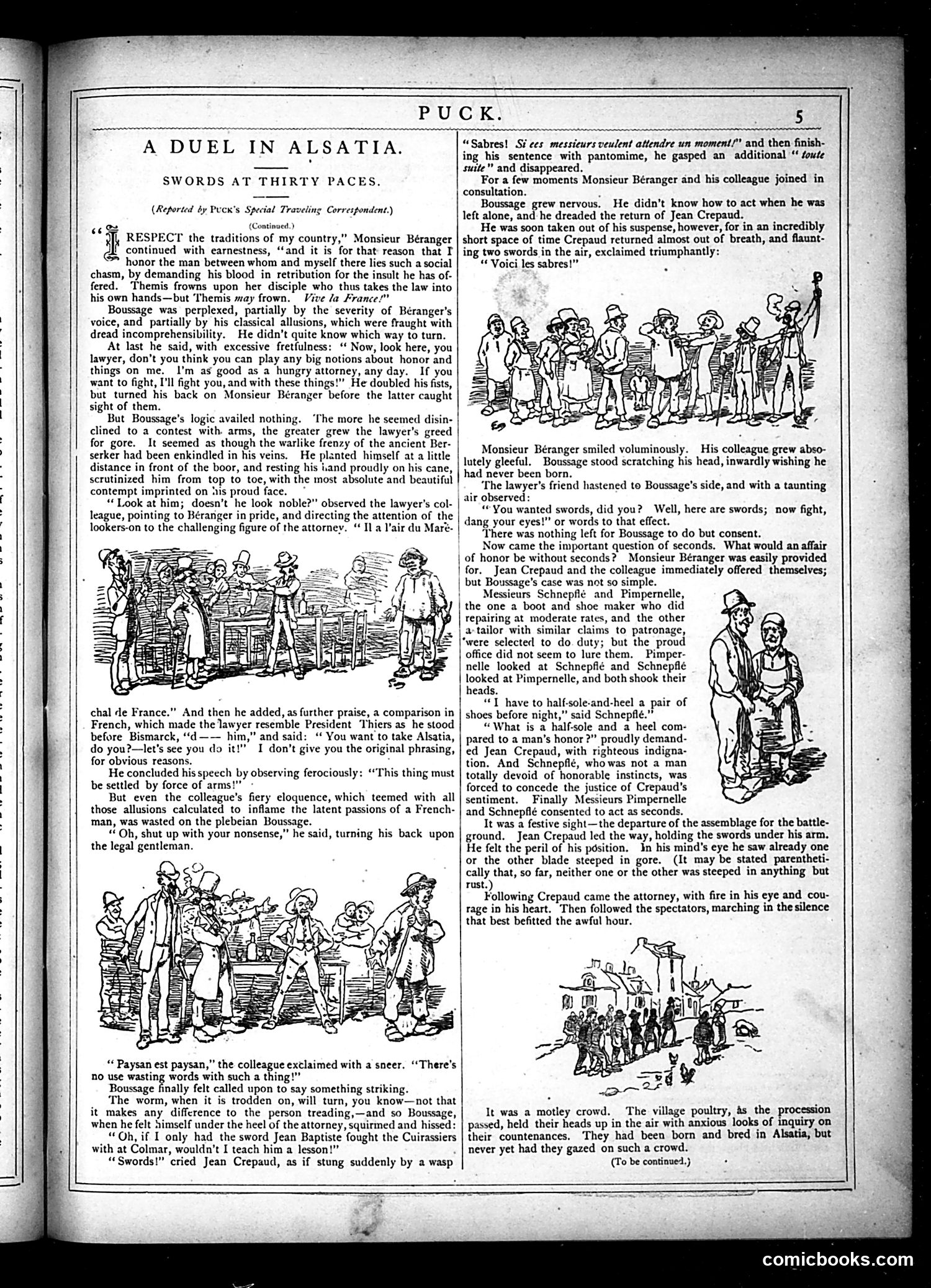
This Puck article satirizes a legal dispute between French lawyer Monsieur Béranger and his colleague over a professional matter. The humor centers on their escalating conflict—from verbal argument to threatened physical combat—which the author compares to a formal duel. The illustrations show the lawyers and involved parties in increasingly absurd confrontations. The satire targets French legal pretension and honor culture, mocking how disputes over shoe repairs and professional fees are treated with the dramatic gravity of affairs of state. The piece ridicules both Béranger's pompous behavior and his colleague's wounded pride, presenting their quarrel as emblematic of overwrought Continental legal drama. The title's reference to "Alsatia" (a lawless area) underscores the irony of lawyers behaving chaotically.
📄 Transcribed text from this page (OCR, searchable)
Machine-transcribed from the original scan — historical spelling and the odd misread are preserved.
A DUEL IN ALSATIA. SWORDS AT THIRTY PACES, (Reported by Puck's Special Traveling Correspondent.) as (Continued.) f RESPECT the traditions of my country,” Monsieur Béranger continued with earnestness, ‘and it is for that reason that I “ honor the man between whom and myself there lies such a social chasm, by demanding his blood in retribution for the insult he has of- fered. Themis frowns upon her disciple who thus takes the law into his own hands—but Themis may frown. Vive fa France!" Boussage was perplexed, partially by the severity of Béranger’s voice, and partially by his classical allusions, which were fraught with dread incomprehensibility. He didn’t quite know which way to turn. At last he said, with excessive fretfulness: ‘ Now, look here, you lawyer, don’t you think you can play any big notions about honor and things on me. I’m as good as a hungry attorney, any day. If you want to fight, I'll fight you, and with these things!” He doubled his fists, but turned his back on Monsieur Béranger before the latter caught sight of them. But Boussage’s logic availed nothing. ‘The more he seemed disin- | clined to a contest with. arms, the greater grew the lawyer’s greed for gore. It seemed as though the warlike frenzy of the ancient Ber- serker had been enkindled in his veins. He planted himself ata little distance in front of the boor, and resting his iand proudly on his cane, scrutinized him from top to toe, with the most absolute and beautiful contempt imprinted on iis proud face.” “Look at him; doesn’t he look noble?” observed the lawyer's col- league, pointing to Béranger in pride, and directing the attention of the | lookers-on to the challenging figure of the attorney. ‘ Ila l’air du Mare- | | | chal de France.” And then he added, as further praise, a comparison in French, which made the lawyer resemble President ‘Thiers as he stood before Bismarck, ““d—— him,” and said: ‘* You want to take Alsatia, do you?—let’s see you do it!” I don’t give you the original phrasing, for obvious reasons. He concluded his speech by observing ferociously: “This thing must be settled by force of arms!” ~ But even the colleague's fiery eloquence, which teemed with all those allusions calculated to inflame the latent passions of a French- man, was wasted on the plebeian Boussage. “Oh, shut up with your nonsense,” he said, turning his back upon the legal gentleman. “ Paysan est paysan,” the colleague exclaimed with a sneer. ‘‘There's no use wasting words with such a thing!” Boussage finally felt called upon to say something striking. The worm, when it is trodden on, will turn, you know—not that it makes any difference to the person treading,—and so Boussage, when he felt himself under the heel of the attorney, squirmed and hissed: “Oh, if I only had the sword Jean Baptiste fought the Cuirassiers with at Colmar, wouldn’t I teach him a lesson!” “Sabres! Si ces messieurs veulent attendre un moment?” and then finish- ing his sentence with pantomime, he gasped an additional “ soute suite” and disappeared. For a few moments Monsieur Béranger and his colleague joined in consultation. : Boussage grew nervous. He didn’t know how to act when he was left alone, and he dreaded the return of Jean Crepaud. - He was soon taken out of his suspense, however, for in an incredibly short space of time Crepaud returned almost out of breath, and flaunt- ing two swords in the air, exclaimed triumphantly: “ Voici les sabres!” Monsieur Béranger smiled voluminously. His colleague grew abso- lutely gleeful. Boussage stood scratching his head, inwardly wishing he had never been born. ‘The lawyer's friend hastened to Boussage’s side, and with a taunting air observed: “You wanted swords, did you? Well, here are swords; now fight, dang your eyes!” or words to that effect. ‘There was nothing left for Boussage to do but consent. Now came the important question of seconds. What would an affair of honor be without seconds? Monsieur Béranger was easily provided for. Jean Crepaud and the colleague immediately offered themselves; but Boussage’s case was not so simple. Messieurs Schnepflé and Pimpernelle, the one a boot and shoe maker who did repairing at moderate rates, and the other a-tailor with similar claims to patronage, “were selected to do. duty; but the proud office did not seem to lure them. _Pimper- nelle looked at Schnepfié and Schnepflé looked at Pimpernelle, and both shook their MI heads. “T have to half-sole-and-heel a pair of shoes before night,” said Schnepfié.” “ What is a half-sole and a heel com- pared to a man’s honor ?” proudly demand- ed Jean Crepaud, with righteous indigna- tion. And Schnepflé, who was not a man totally devoid of honorable instincts, was forced to concede the justice of Crepaud’s sentiment. Finally Messieurs Pimpernelle and Schnepfié consented to act as seconds. It was a festive sight—the departure of the assemblage for the battle- ground. Jean Crepaud led the way, holding the swords under his arm. He felt the peril of his pdsition. Jn his mind's eye he saw already one or the other blade steeped in gore. (It may be stated parentheti- cally that, so far, neither one or the other was steeped in anything but rust. Pollowing Crepaud came the attorney, with fire in his eye and cou- rage in his heart. Then followed the spectators, marching in the silence that best befitted the awful hour. It was a motley crowd. The village poultry, 4s the procession passed, held their heads up in the air with anxious looks of inquiry on their countenances. They had been born and bred in Alsatia, but never yet had they gazed on such a crowd. “Swords!” cried Jean Crepaud, as if stung suddenly by a wasp (To be continued.) : comicbooks.com