
Puck, 1878-03-27 · page 13 of 16
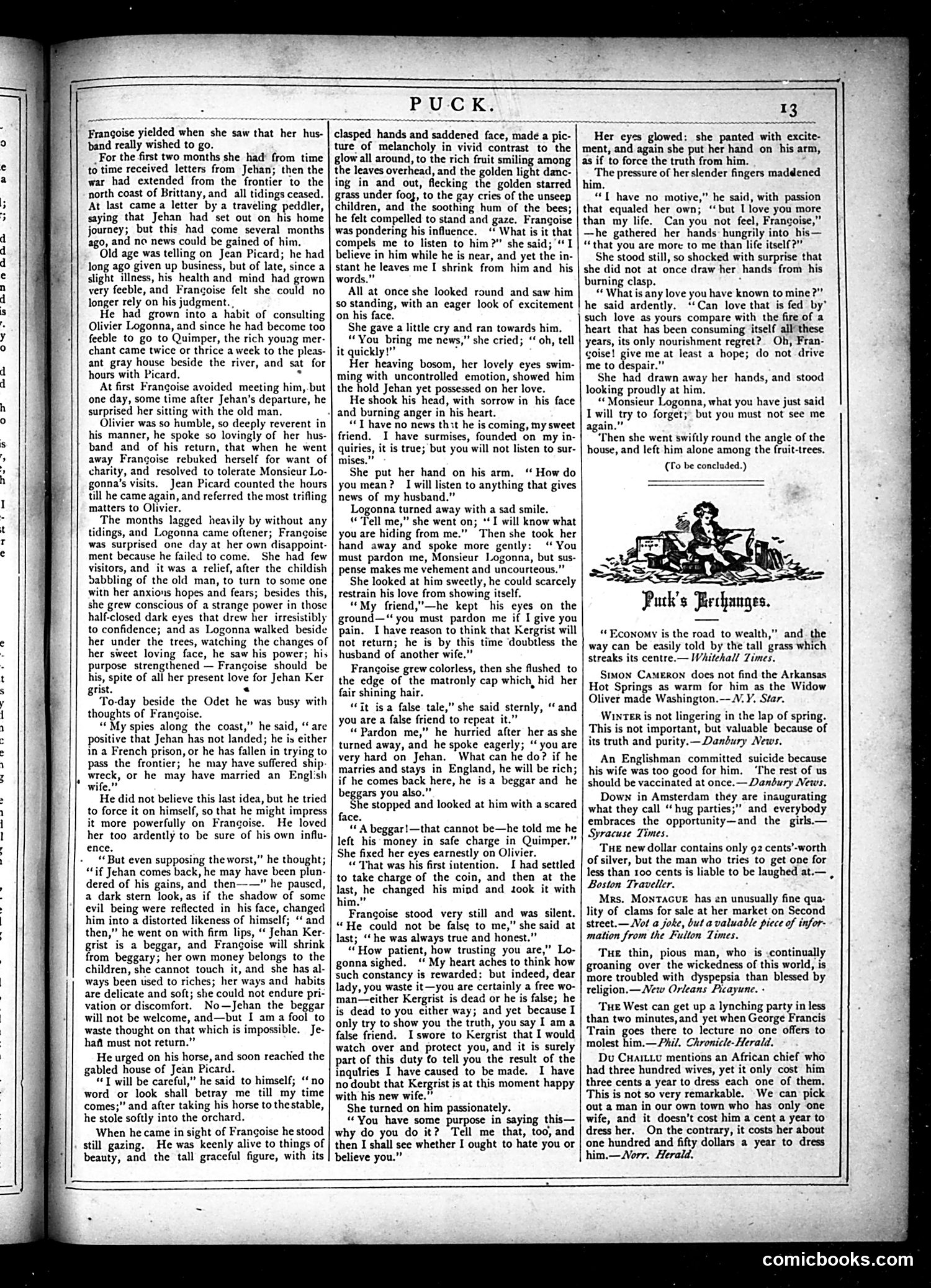
Puck — March 27, 1878 — page 13: what you’re looking at
What you’re looking at
This page consists primarily of a short story continuation and a "Puck's Persiflage" section—brief satirical commentary pieces on current events and social issues. The visible items mock: 1. **Arkansas Hot Springs** - criticism of its promotion as a health destination 2. **Vaccination debates** - ridiculing anti-vaccination sentiment 3. **A wealthy man's expensive dress costs** - approximately $150-200 annually, presented as absurdly extravagant 4. **An African character** - described as costing only one hundred lives; this appears to reference racist attitudes toward colonialism or slavery (historically offensive content typical of the era) 5. **A Mississippi river man** - some humorous observation about river life These brief satirical pieces target contemporary social attitudes, economic excess, and popular debates of Puck's era.
📄 Transcribed text from this page (OCR, searchable)
Machine-transcribed from the original scan — historical spelling and the odd misread are preserved.
Frangoise yielded when she saw that her hus- band really wished to go. _For the first two months she had’ from time to time received letters from Jehan; then the war had extended from the frontier to the north coast of Brittany, and all tidings ceased. At last came a letter by a traveling peddler, saying that Jehan had set out on his home journey; but this had come several months ago, and no news could be gained of him. Old age was telling on Jean Picard; he had long ago given up business, but of late, since a slight illness, his health and mind had grown very feeble, and Frangoise felt she could no longer rely on his judgment. He had grown into a habit of consulting Olivier Logonna, and since he had become too feeble to go to Quimper, the rich youag mer- chant came twice or thrice a week to the pleas- ant gray house beside the river, and sat for hours with Picard. = At first Francoise avoided meeting him,-but one day, some time after Jehan’s departure, he surprised her sitting with the old man. Olivier was so humble, so deeply reverent in his manner, he spoke so lovingly of her hus- band and of his return, that when he went away Frangoise rebuked herself for want of charity, and resolved to tolerate Monsicur Lo- gonna’s visits. Jean Picard counted the hours till he came again, and referred the most trifling matters to Olivier. The months lagged heavily by without any tidings, and Logonna came oftener; Frangoise was surprised one day at her own disappoint- ment because he failed to come. She had few visitors, and it was a relief, after the childish dabbling of the old man, to turn to some one witn her anxious hopes and fears; besides this, she grew conscious of a strange power in those half-closed dark eyes that drew her irresistibly to confidence; and as Logonna walked beside her under the trees, watching the changes of her siveet loving face, he saw his power; his purpose strengthened — Frangoise should be his, spite of all her present love for Jehan Ker grist. . ‘To-day beside the Odet he was busy with thoughts of Frangoise. “My spies along the coast,” he said, “are positive that Jehan has not landed; he is either in a French prison, or he has fallen in trying to pass the frontier; he may have suffered ship wreck, or he may have married an Engl'sh wife.” He did not believe this last idea, but he tried to force it on himself, so that he might impress it more powerfully on Frangoise. He loved her too ardently to be sure of his own influ- ence. “ But even supposing the worst,” he thought; “if Jehan comes back, he may have been plun- dered of his gains, and then——” he paused, a dark stern look, as if the shadow of some evil being were reflected in his face, changed him into a distorted likeness of himself; ‘‘ and then,” he went on with firm lips, “ Jehan Ker- grist’ is a beggar, and Francoise will shrink from beggary; her own money belongs to the children, she cannot touch it, and she has al- ways been used to riches; her ways and habits are delicate and soft; she could not endure pri- vation or discomfort. No—Jchan the beggar will not be welcome, and—but I am a fool to waste thought on that which is impossible. Je- hafi must not return.” He urged on his horse, and soon reached the gabled house of Jean Picard. “T will be careful,” he said to himself; “no word or look shall betray me till my time comes;” and after taking his horse to thestable, he stole softly into the orchard. When he came in sight of Frangoise he stood still gazing. He was keenly alive to things of beauty, and the tall graceful figure, with its PUCK. clasped hands and saddened face, made a pic- ture of melancholy in vivid contrast to the glow all around, to the rich fruit smiling among the leaves overhead, and the golden light danc- ing in and out, flecking the golden starred grass under foog, to the gay cries of the unseep children, and the soothing hum of the bees; he felt compelled to stand and gaze. Frangoise was pondering his influence.“ What is it that compels me to listen to him?” she said; “I believe in him while he is near, and yet the in- stant he leaves me I shrink from him and his words.” All at once she looked round and saw him so standing, with an eager look of excitement on his face. She gave a little cry and ran towards him. “You bring me news,” she cried; “ oh, tell it quickly!” e Her heaving bosom, her lovely eyes swim- ming with uncontrolled emotion, showed him the hold Jehan yet possessed on her love. He shook his head, with sorrow in his face and burning anger in his heart. “T have no news thit he is coming, my sweet friend. I have surmises, founded on my in- quiries, it is true; but you will not listen to sur- mises.” She put her hand on his arm. ‘ How do you mean? I will listen to anything that gives news of my husband.” Logonna turned away with a sad smile. « Tell me,” she went on; *‘I will know what you are hiding from me.” Then she took her hand away and spoke more gently: ‘“ You must pardon me, Monsieur Logonna, but sus- pense makes me vehement and uncourteous.”” She looked at him sweetly, he could scarcely restrain his love from showing itself. “My friend,"—he kept his eyes on the ground—* you must pardon me if I give you pain. I have reason to think that Kergrist will not return; he is by this time doubtless the husband of another wife.” Frangoise grew colorless, then she flushed to the edge of the matronly cap which, hid her fair shining hair. “it isa false tale,” she said sternly, “and you are a false friend to repeat it.” “Pardon me,” he hurried after her as she turned away, and he spoke eagerly; “you are very hard on Jehan. What can he do? if he marries and stays in England, he will be rich; if he comes back here, he isa beggar and he beggars you also.” She stopped and looked at him with a scared face. “4 beggar!—that cannot be—he told me he left his money in safe charge in Quimper.” She fixed her eyes earnestly on Olivier. “ That was his first intention. I had settled to take charge of the coin, and then at the last, he changed his mind and took it with him.” Frangoise stood very still and was silent. “He could not be fals¢ to me,” she said at last; ‘ he was always true and honest.” “How patient, how trusting you are,” Lo- gonna sighed.“ My heart aches to think how such constancy is rewarded: but indeed, dear lady, you waste it—you are certainly a free wo- man—either Kergrist is dead or he is false; he is dead to you either way; and yet because I only try to show you the truth, you say I ama false friend. I swore to Kergrist that I would watch over and protect you, and it is surely part of this duty fo tell you the result of the inquiries I have caused to be made. I have no doubt that Kergrist js at this moment happy with his new wife.” She turned on him passionately. “You have some purpose in saying this— why do you do it? Tell me that, too, and then I shall see whether I ought to hate you or believe you.” 'he said ardently. He Her eyes glowed: she panted with excite- ment, and again she put her hand on his arm, as if to force the truth from him. 3 The pressure of her slender fingers maddened him. “T have no motive,” he said, with passion that equaled her own; ‘but I love you more than my life. Can you not feel, Francoise,” —he gathered her hands: hungrily into his— “that you are more to me than life itself?” She stood still, so shocked with surprise that hands from his she did not at once draw her burning clasp. “What is any love you have known to mine?” “Can love that is fed by’ such love as yours compare with the fire of a heart that has been consuming itself all’ these years, its only nourishment regret? Oh, Fran- Goise! give me at least a hope; do not drive me to despair.” She had drawn away her hands, and stood looking proudly at him. “Monsieur Logonna, what you have just said I will try to forget;: but you must not see me again.” ‘Then she went swiftly round the angle of the house, and left him alone among the fruit-trees. (To be concluded.) “Economy is the road to wealth,” and. the way can be easily told by the tall grass which streaks its centre.— Whitehall Times, Siton Cameron does not find the Arkansas Hot Springs as warm for him as the Widow Oliver made Washington.—. Y. Star, WinTER is not lingering in the lap of spring. This is not important, but valuable because of its truth and purity.—Dandury News. An Englishman committed suicide because his wife was too good for him. ‘The rest of us should be vaccinated at once.— Danbury News. Down in Amsterdam they are inaugurating what they call “hug parties; and everybody embraces the opportunity—and the girls.— Syracuse Times. Tue new dollar contains only 92 cents’-worth of silver, but the man who tries to get one for less than 100 cents is liable to be laughed at.— , Boston Traveller. Mrs. Montacve has en unusually fine qua- lity of clams for sale at her market on Second street.— Not a joke, but avaluable piece of infor- mation from the Fulton Times. Tue thin, pious man, who is .continually groaning over the wickedness of this world, is more troubled with dyspepsia than blessed by religion.—New Orleans Prcayune, » ‘Tue West can get up a lynching party in less than two minutes, and yet when George Francis Train goes there to lecture no one offers to molest him.—/kil. Chronicle- Herald. Du Cuarttu mentions an African chief who had three hundred wives, yet it only cost him three cents a year to dress each one of them. This is not so very remarkable. We can pick out a man in our own town who has only one wife, and it doesn’t cost him a cent a year to dress her. On the contrary, it costs her about one hundred and fifty dollars a year to dress him.—Norr. Herald. comicbooks.com