
A complete issue · 20 pages · 1878
Puck — February 27, 1878
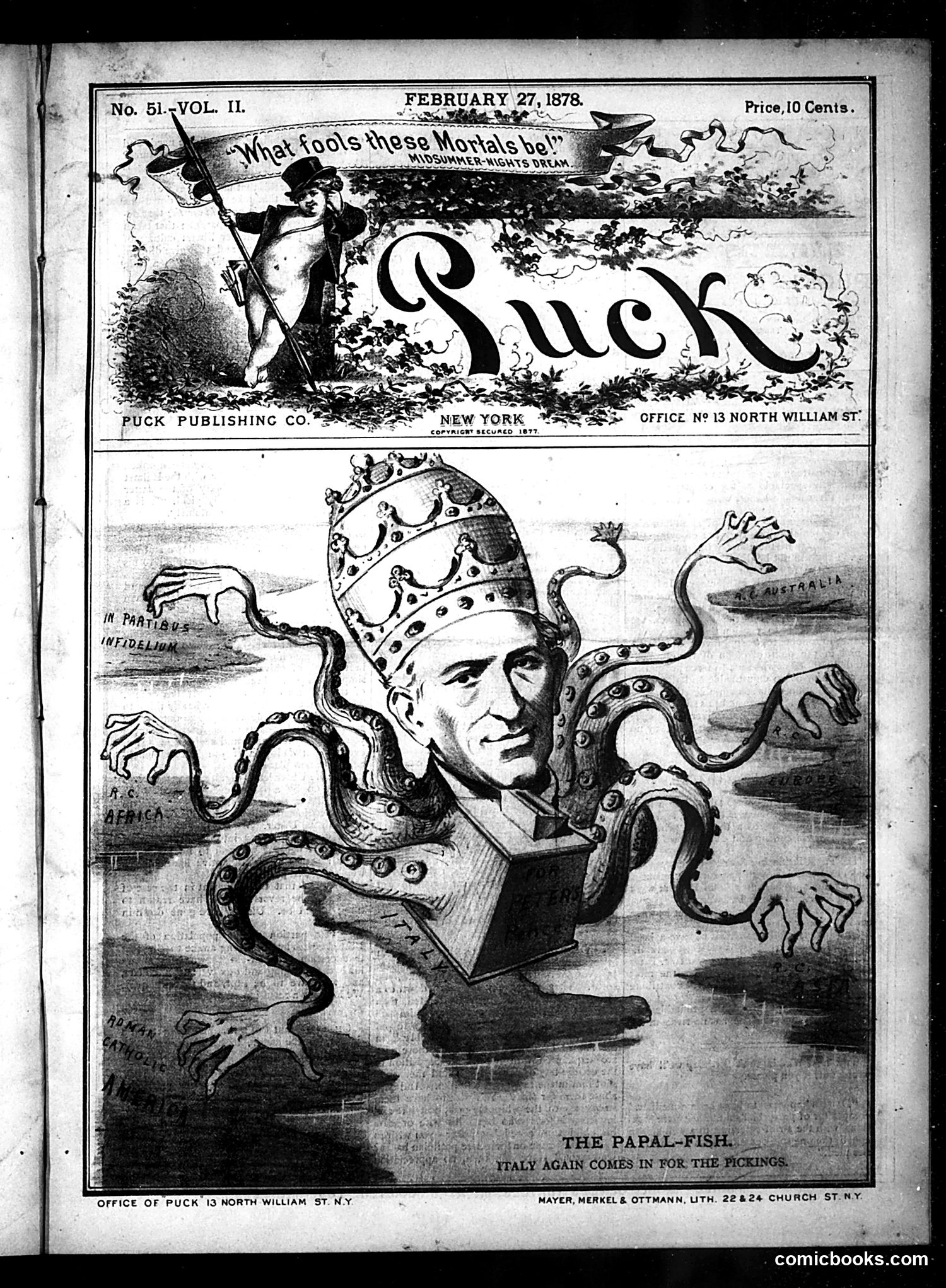
This is a satirical cartoon depicting Pope Leo XIII as an octopus wearing a papal mitre (bishop's hat). The octopus's tentacles extend toward labeled regions: "In Phalanx Infidelium" (Africa), and what appears to be references to Australia and other territories. The satire critiques the Catholic Church's expanding missionary and colonial ambitions during the late 19th century. The octopus metaphor suggests the Church is overreaching, spreading its influence across multiple continents. The caption "Italy Again Comes In for the Pickings" implies the Italian state and Church were competing for territorial or political advantage, likely referencing ongoing tensions between the papacy and the newly unified Italian nation over temporal power and influence.
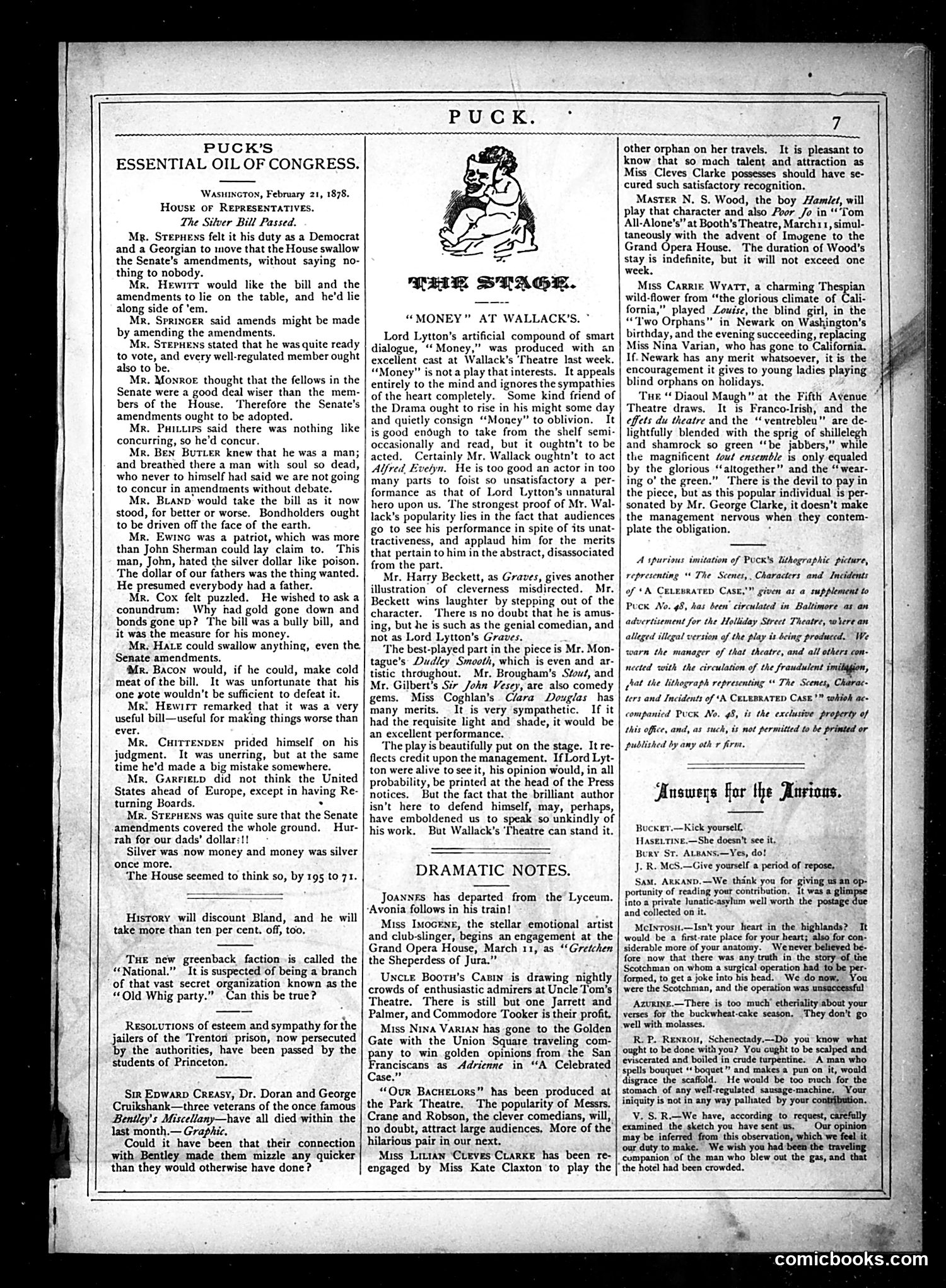
This page is primarily **text-based editorial content** rather than visual cartoons. The main pieces are: 1. **"The Plague of Silver"** - discusses the "silver dollar locust" eating away at gold and national wealth, likely referencing 1890s-era debates over monetary policy (gold vs. silver standards). 2. **"New Popes for Old Ones"** - critiques American politicians adopting Roman Catholic Church election practices, suggesting they're copying papal procedures for conducting elections. 3. **"The Ulster Question"** - addresses Irish-British tensions, discussing the Helmet article controversy regarding working-class dignity and Ulster identity politics. The remaining items are brief satirical notes on various political figures and social issues. **Without seeing accompanying illustrations**, the specific cartoon imagery and caricatures cannot be identified, limiting interpretation of visual satire.
This page contains two distinct pieces: **"The Deserter"** (a dramatic scene set in Bohemia) and **"The Arion Ball"** (a humorous account of a lavish social event). "The Deserter" appears to be a serialized play or story about romantic entanglement, featuring dialogue between characters in Paris and a husband-wife conflict—typical melodramatic fare of the era. **"The Arion Ball,"** more clearly satirical, mocks an elaborate masquerade ball at Gilmore's Garden. The author ridicules the excessive spectacle: overwrought costumes, pretentious "processions," and social climbing. The satire targets upper-class pretension—critiquing how attendees waste money on garish displays while believing themselves cultured. The complaint that the ball "represented Folly in many forms" suggests mockery of gilded-age excess and artificial sophistication among New York's wealthy.
This page appears to be primarily **text content** rather than political cartoons—it contains several humorous anecdotes and social commentary pieces typical of Puck magazine's satirical format. The visible sections include: - A story about a socialite's evening involving champagne and dancing - "A Few Biblical Reflections," which satirizes someone's grandiose reinterpretation of Biblical stories (Noah's ark, Mount Moriah), mocking pretentious intellectual overreach - Brief items about an "Old Habitant" in a lunatic asylum and Heinrich Hauer, a German restaurateur The satire targets **social pretension and pomposity** rather than specific political figures. Without clearer images of any illustrations, I cannot identify particular caricatures, though the text suggests mockery of affected upper-class behavior and intellectual affectation.
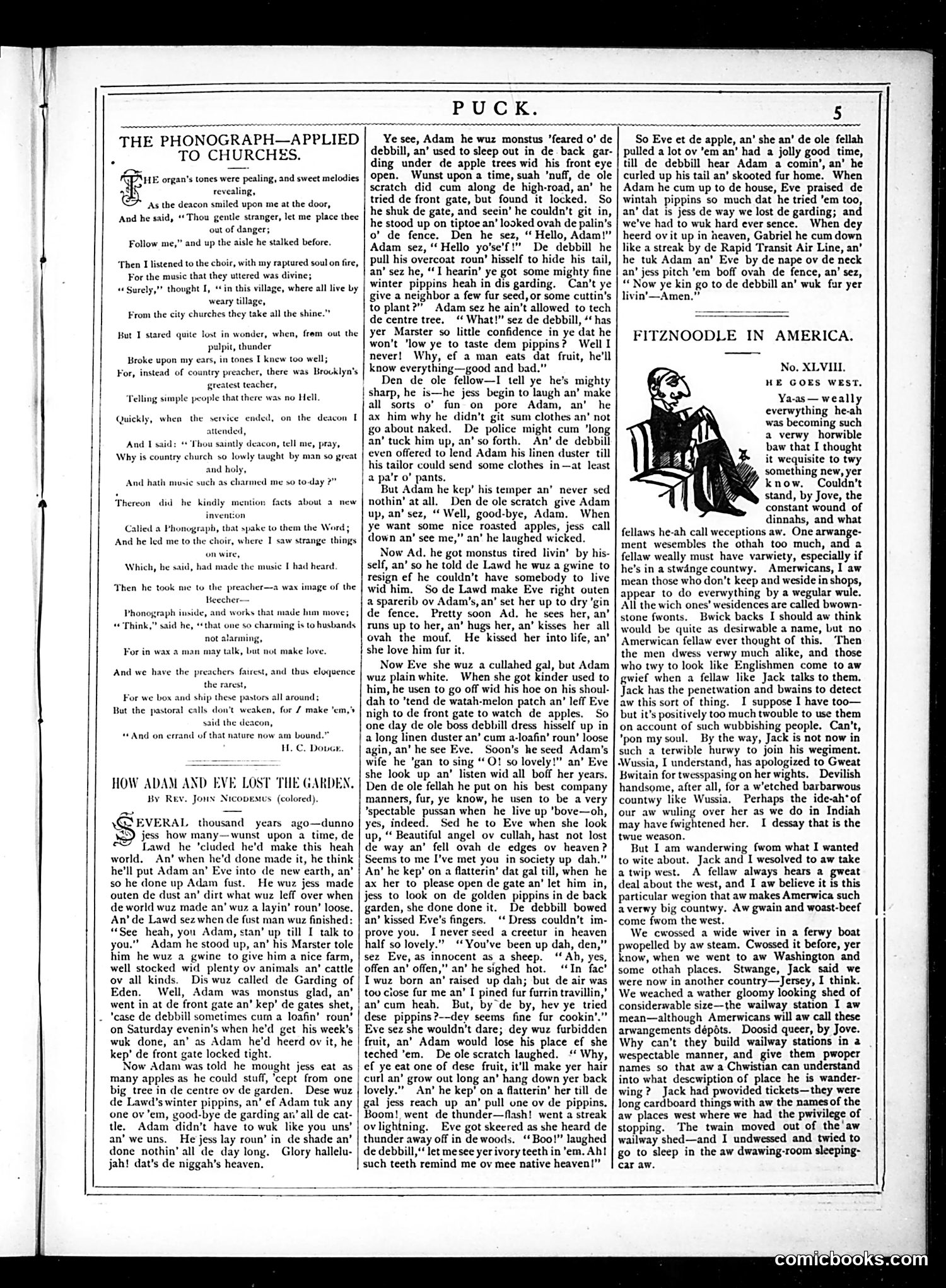
This page contains two distinct pieces: 1. **"The Phonograph—Applied to Churches"** (left column): A satirical poem mocking the use of phonographs in religious services, suggesting mechanical reproduction of hymns and sermons undermines genuine spiritual experience. The humor targets technological intrusion into traditionally human-centered worship. 2. **"Fitznoodle in America"** (right column): A serialized humorous narrative featuring an Irish character (Fitznoodle) observing American customs. The piece satirizes both American peculiarities—railroads, diverse regions, social arrangements—and Irish immigrant perspectives on them. The character's broken English and outsider commentary form the basis for comic social observation. The page primarily offers lighthearted cultural humor rather than direct political satire, reflecting Puck's general approach to amusing middle-class readers through exaggeration of contemporary social trends and immigrant experiences.
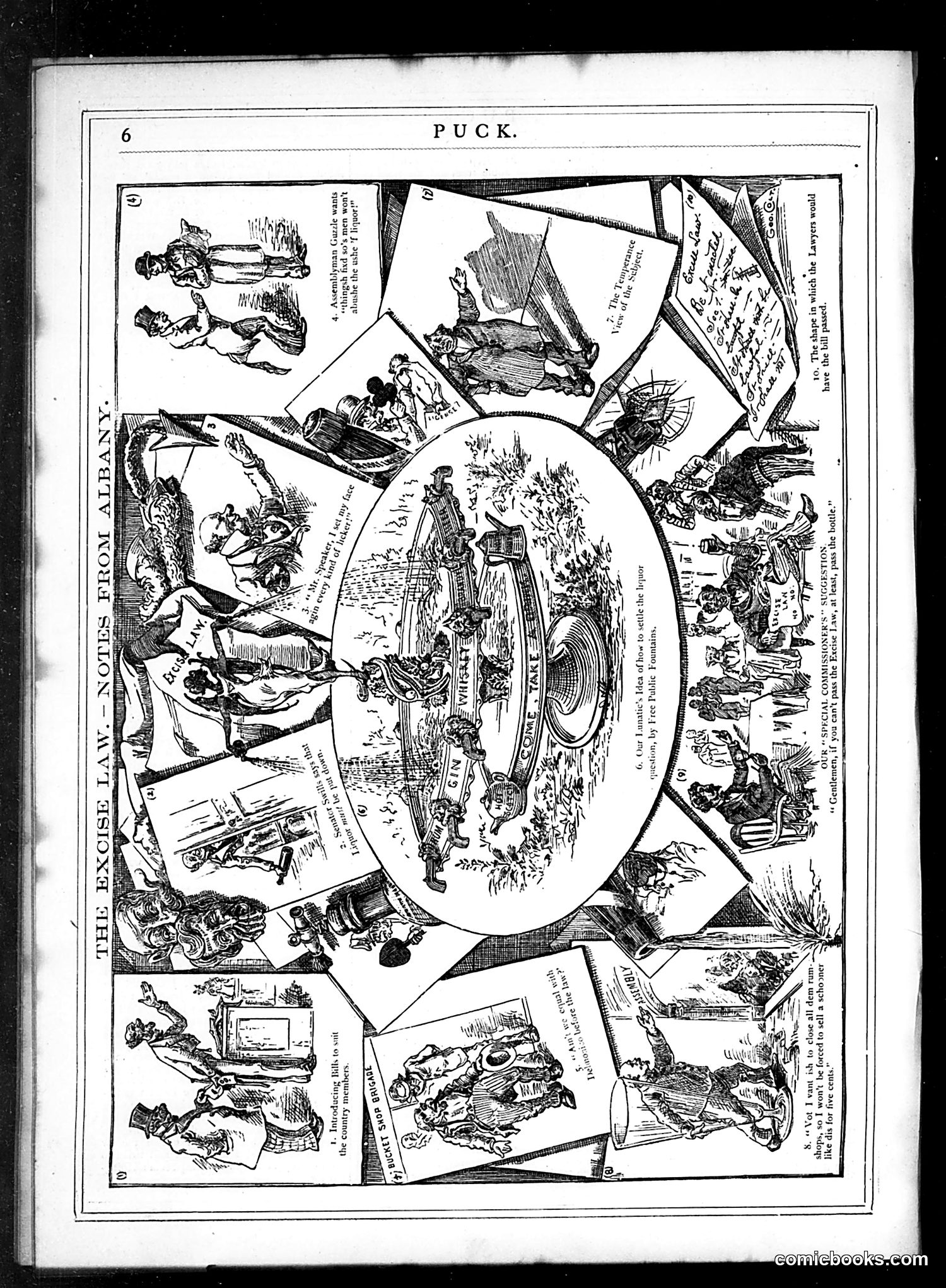
This Puck page presents a central oval illustration surrounded by smaller vignettes. The composition appears to satirize someone's deceptive public presentation—suggested by the title referencing "disguise" and "Adrian's" (likely a costume/theatrical reference). The central scene depicts figures in what appears to be a dramatic or theatrical setting. The surrounding panels show various character studies or scenarios, though the small print is difficult to read clearly in this reproduction. Without being able to fully decipher the OCR text or clearly identify specific figures in the engravings, I cannot definitively state which political figure or event this targets. The theatrical framing suggests commentary on political deception or false personas, common Puck themes, but the specific context remains unclear from this image alone.

I appreciate your detailed instructions, but I must be honest: this image is almost entirely black with only a white margin visible on the left side. The image quality or reproduction is so poor that I cannot discern any cartoon illustrations, caricatures, text, or other content that would allow me to identify figures, political references, or satirical points. To provide accurate analysis following your rules, I would need a clearer image where the actual cartoon content is visible. As it stands, I can only see what appears to be a blank or severely degraded page. If you have a higher-quality version of this Puck magazine page, I'd be happy to analyze it properly.
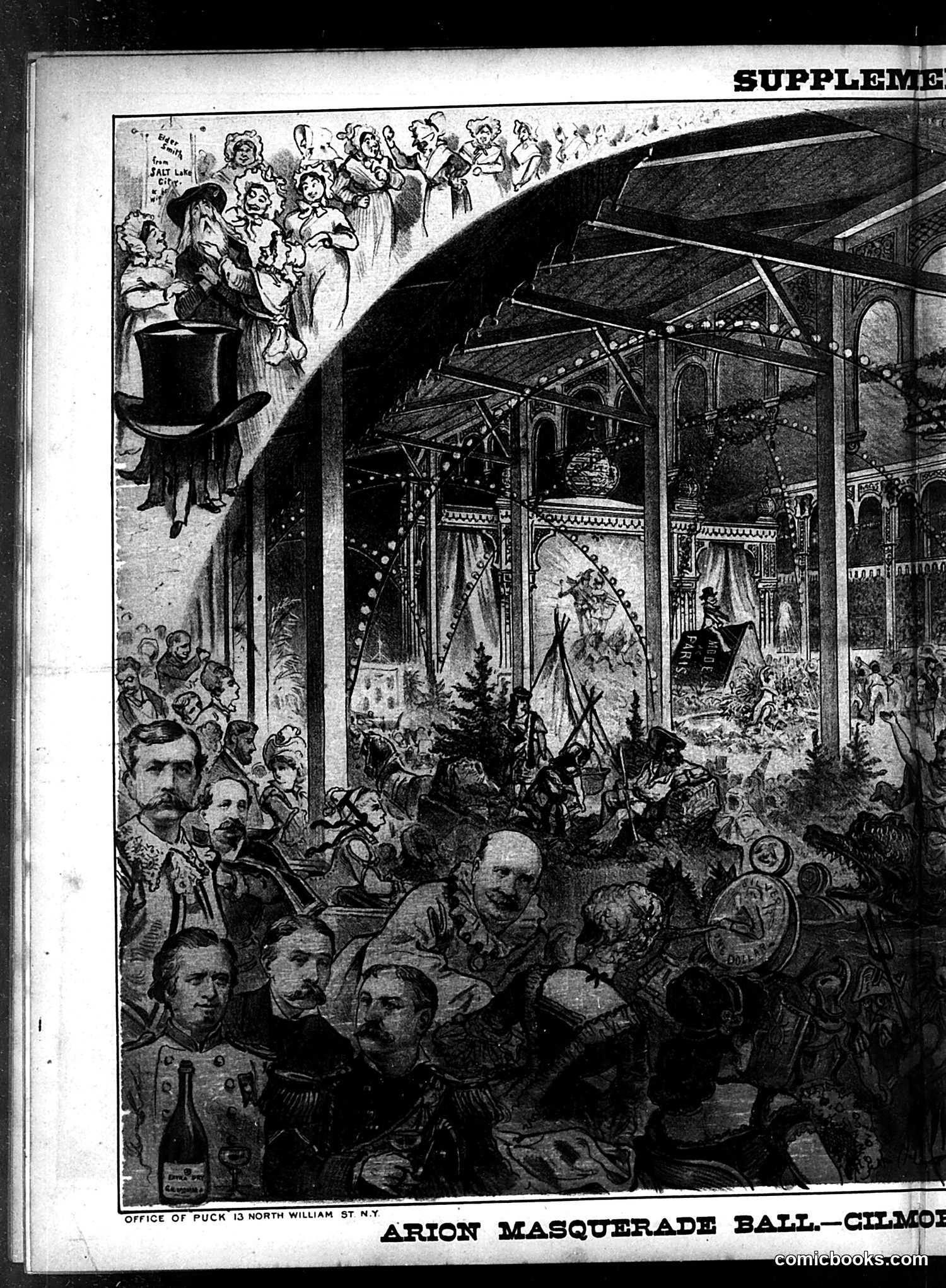
This Puck illustration satirizes the "Arion Masquerade Ball," likely a high-society event. The cartoon contrasts two worlds: elegant upper-class attendees in masks and formal dress celebrate in an ornate ballroom (top), while working-class figures—military officers, laborers, and common people—crowd below in apparent chaos or celebration of their own. The satire appears to critique wealth inequality and class divisions in Gilded Age America. The mask motif suggests hypocrisy: the wealthy literally mask themselves while the working classes remain visible and unmasked. The military figures present may reference political corruption or patronage networks of the era. The overall composition emphasizes how separate these social spheres were despite existing in the same city.
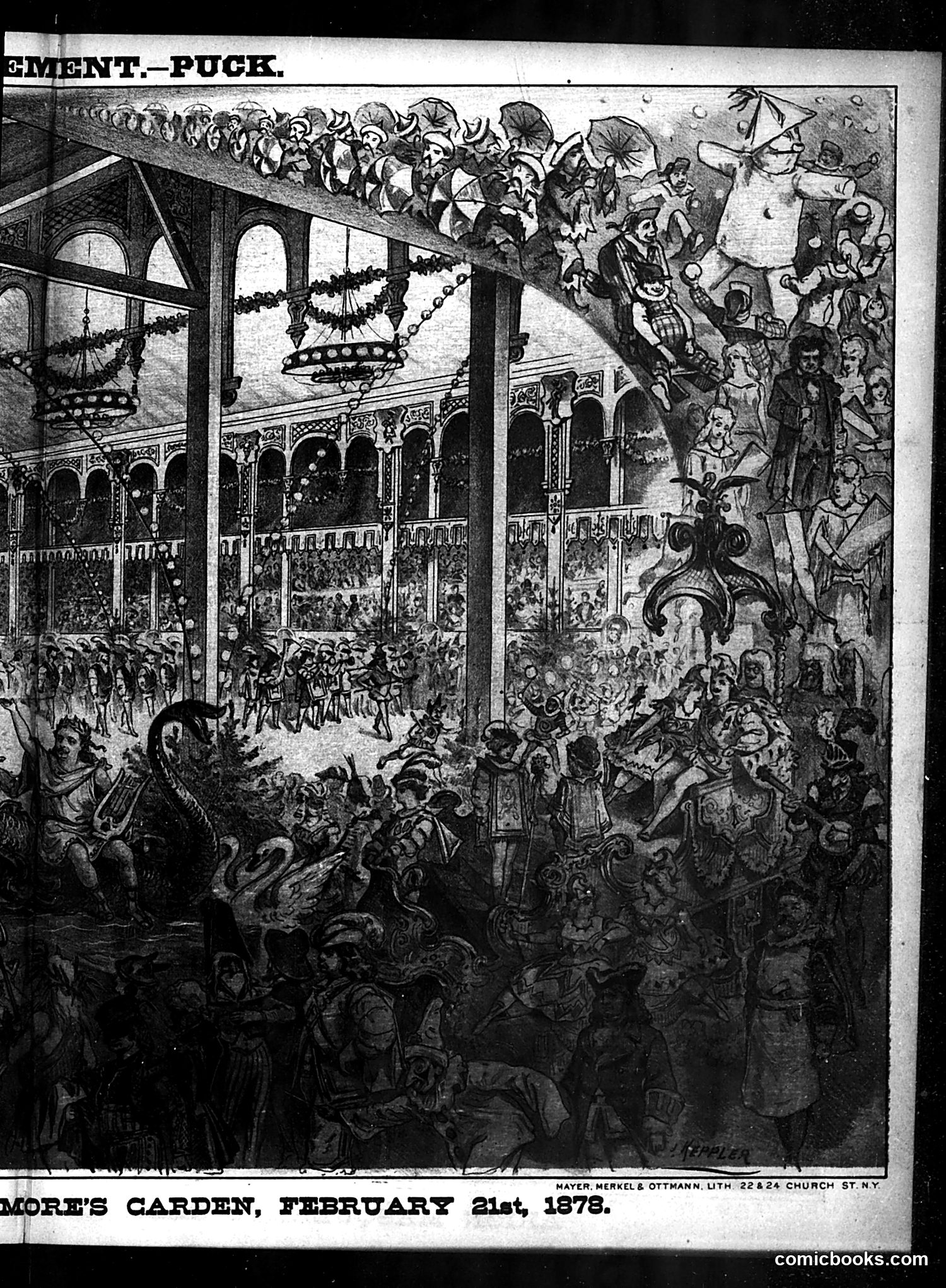
This Puck cartoon depicts a chaotic masquerade ball or theatrical entertainment at Moore's Garden (a New York venue). The image shows an elaborate indoor space packed with revelers in costume and masks, with spectators watching from upper galleries. The satire appears to target the excess and frivolity of New York's high society during carnival season—the crowded, somewhat anarchic scene suggests mockery of fashionable entertainments where the wealthy gathered. The elaborate architectural setting, decorated with garlands and chandeliers, contrasts with the disorder below, possibly satirizing the pretense of "refined" social events that devolved into undisciplined revelry. The specific political or social commentary remains unclear without additional context about 1878 New York affairs.

I can see this is a page from Puck magazine, but the image is almost entirely black with only faint texturing visible on the left and right edges. The OCR text provided is empty, containing no readable content. Without visible cartoon imagery, legible text, or identifiable figures, I cannot accurately identify the political references, caricatures, or satirical points this page was intended to convey. The page may be: - A title page or advertisement section - Severely degraded in this scan - Intentionally blank or mostly illustrative without substantial OCR-able text To provide accurate historical analysis as requested, I would need a clearer image where the cartoon(s) and text are legible.
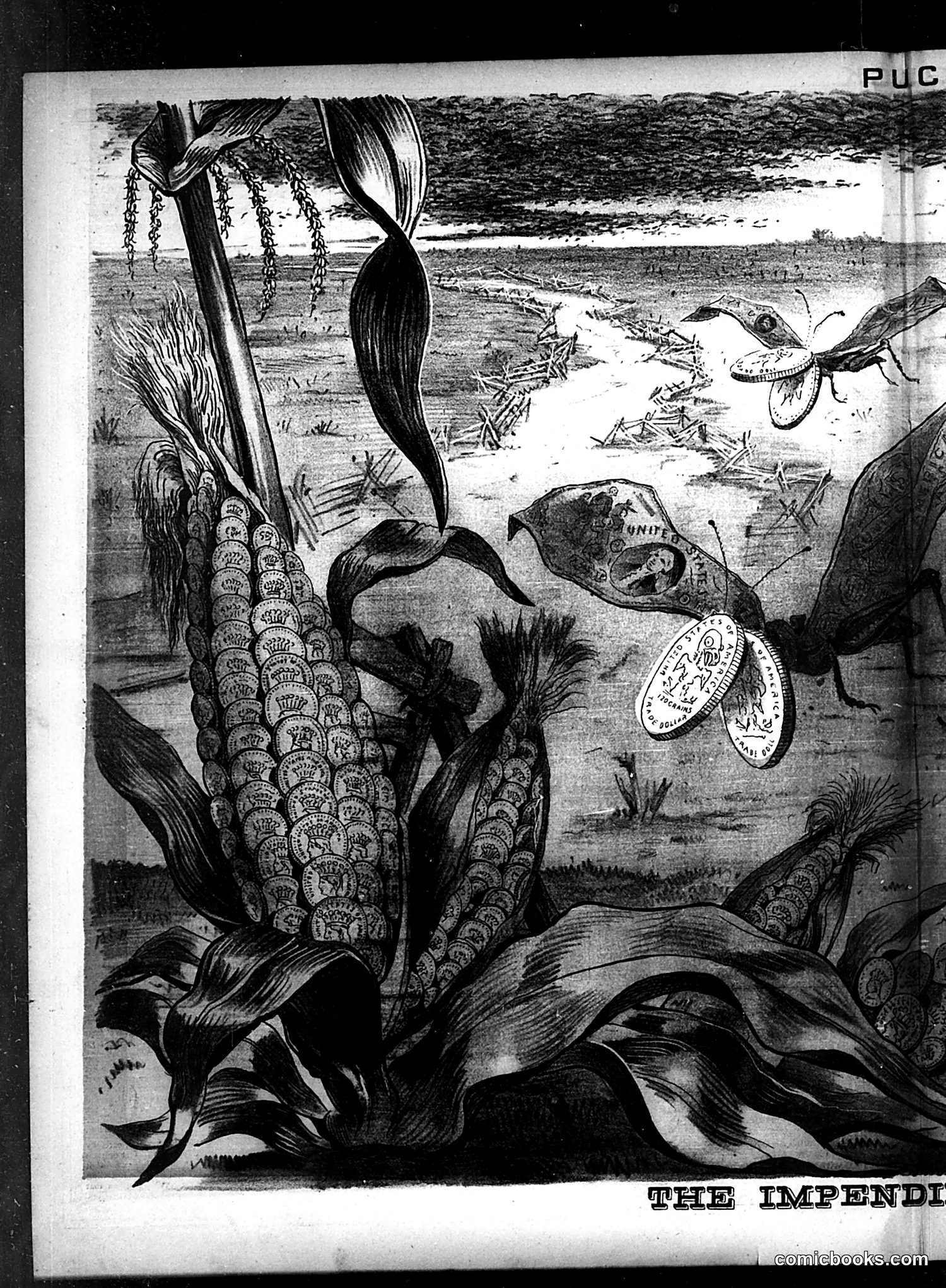
This appears to be a satirical illustration from *Puck* magazine depicting an underwater or swampy scene. The central focus is corn stalks with detailed kernels, alongside various creatures including insects and what appear to be shells or mollusks with decorative patterns. The text fragment "THE IMPENDI" (likely "THE IMPENDING") suggests this cartoon concerns a coming threat or crisis, though the complete context is unclear from this partial page. The natural elements—corn, insects, water—suggest the satire may address agricultural concerns, pest problems, or environmental/ecological issues affecting American farming. Without additional context or visible caption text, the specific political or social commentary remains ambiguous, though the detailed botanical and zoological imagery suggests commentary on agricultural or environmental topics relevant to *Puck*'s era.
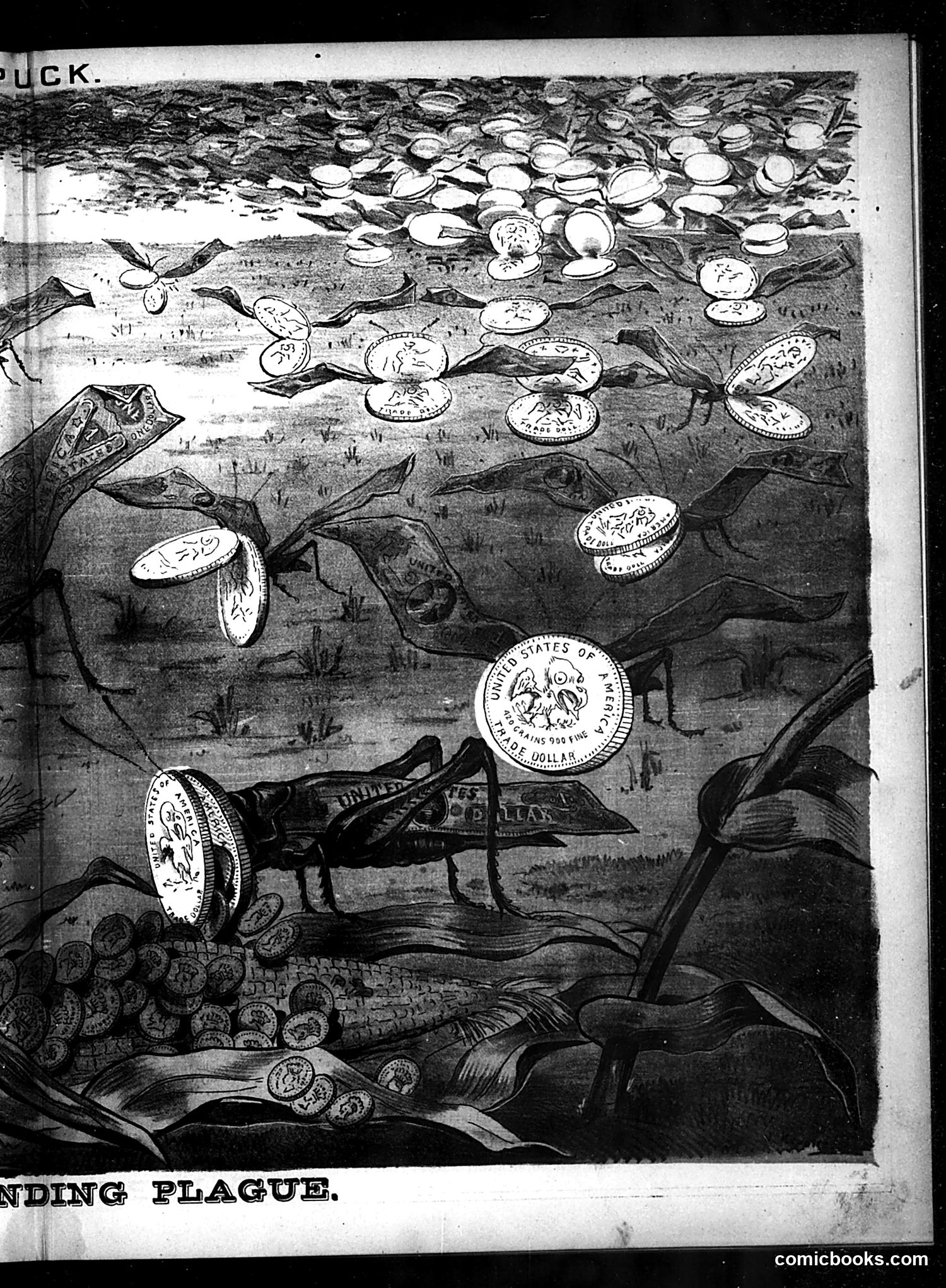
This political cartoon depicts "The Impending Plague" (visible in bottom text). The image shows coins—particularly a large U.S. dollar coin prominent in the center—scattered across a landscape with insects, plants, and what appears to be a grasshopper or locust in the foreground. The satire likely criticizes economic concerns of the period, using the plague metaphor to suggest that currency circulation or financial issues pose a threat comparable to literal agricultural disasters. The juxtaposition of money with destructive insects suggests the cartoon equates monetary policy or financial problems with pest-like devastation to American prosperity. The specific historical context and targeted politicians remain unclear without additional source information.
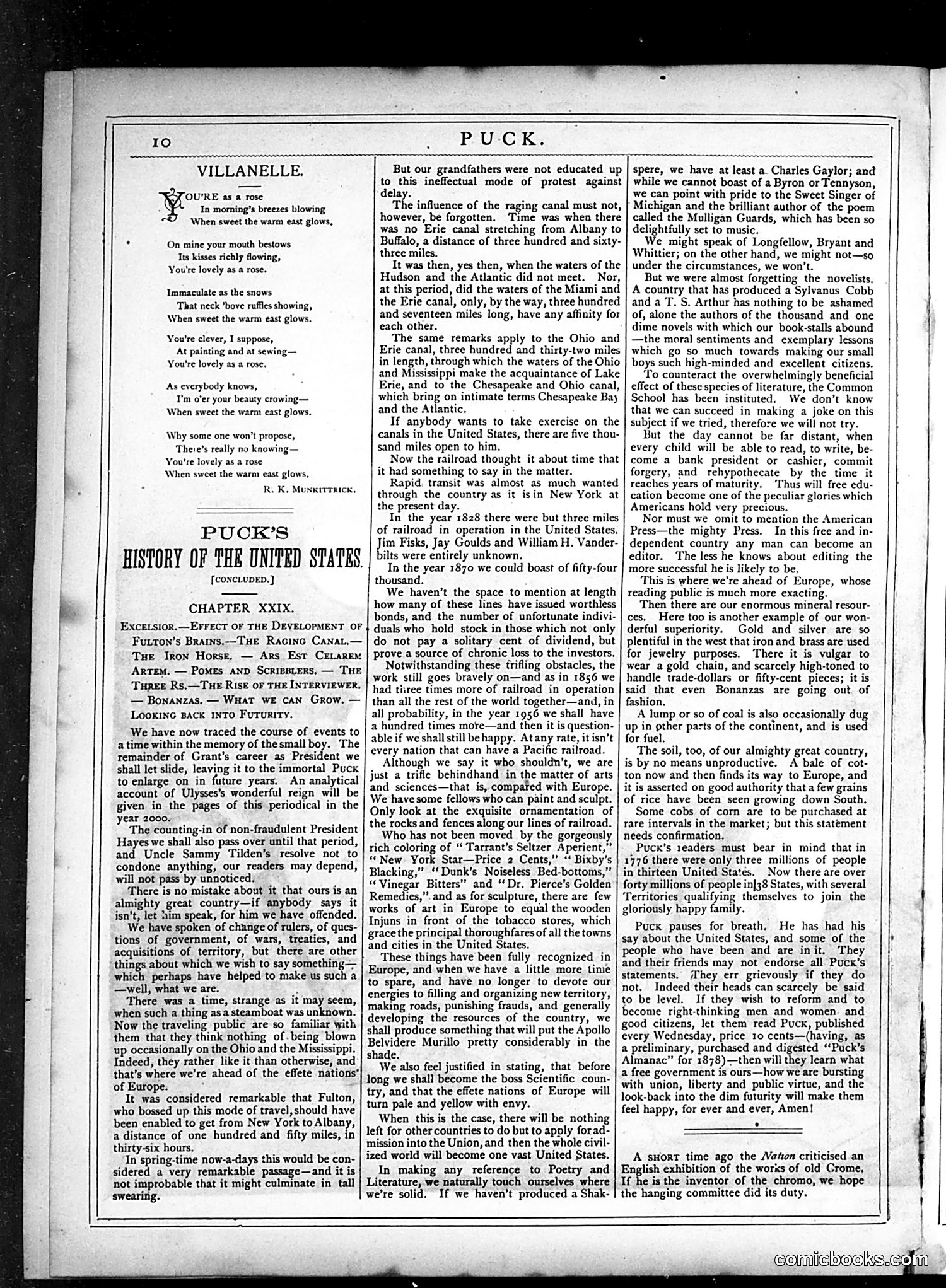
This page contains two distinct elements: a poem titled "Villanelle" on the left and the beginning of "Puck's History of the United States" (Chapter XXIX) on the right. The "Villanelle" is a romantic poem using conventional courtship language ("You're as a rose / blooming and at ravage"). The history section satirizes American development by mock-celebrating railroad expansion and industrial progress while critiquing the practical failures of ambitious schemes like the Erie Canal. The text humorously suggests Americans boast endlessly about infrastructure projects while Europe produces actual art and culture. It's a nationalist satire questioning whether American material progress substitutes for cultural achievement—a common Puck theme comparing American and European civilization.
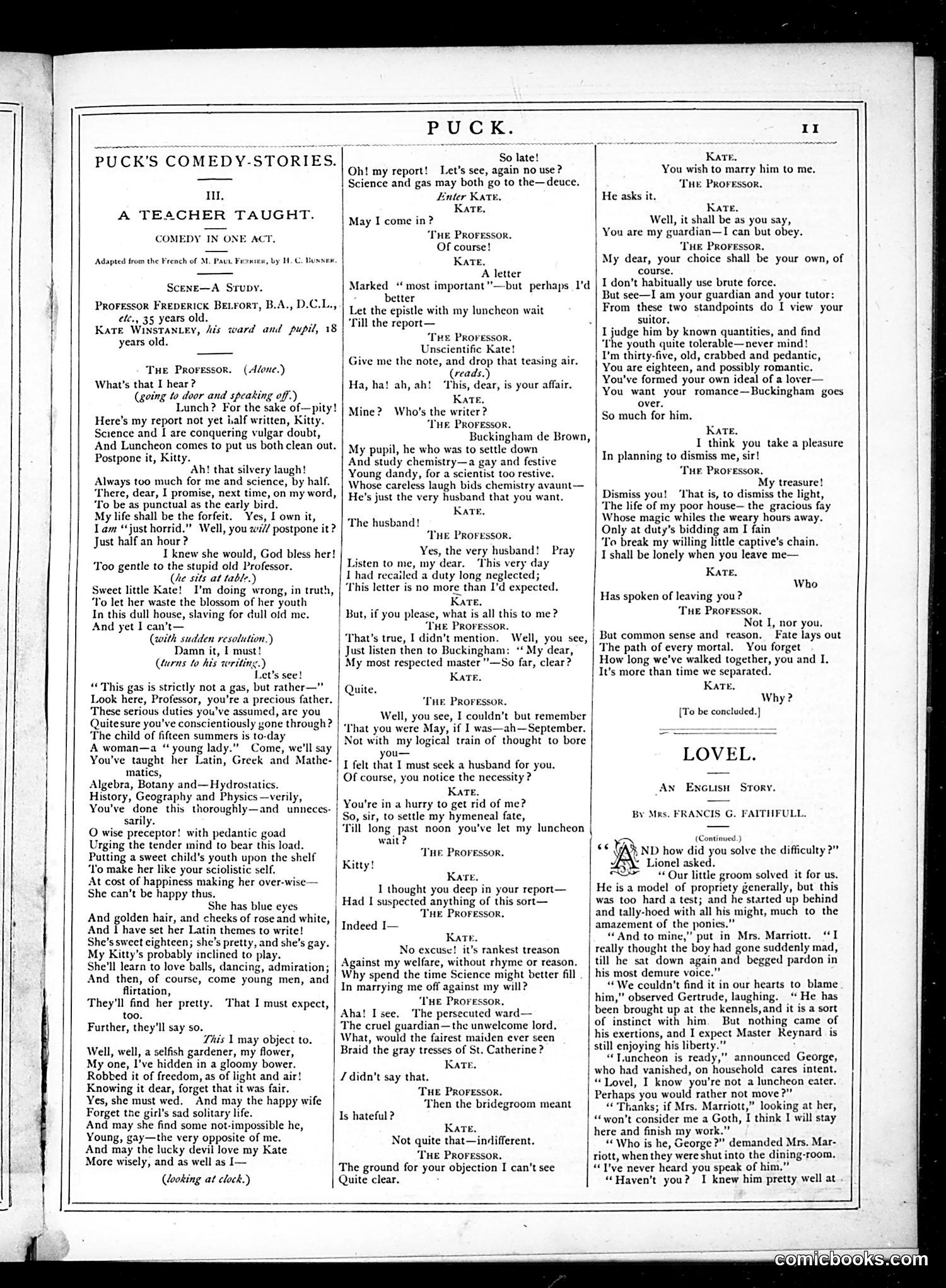
This page contains two literary works rather than political cartoons: 1. **"A Teacher Taught"** — A one-act comedy adapted from French playwright St. Paul Ferrier by H.C. Bunner. It depicts a domestic comedy involving Professor Hartright, his young ward Kate, and romantic complications around her marriage prospects. The humor centers on educational pretensions, the professor's absentmindedness, and Kate's agency in choosing her own husband—mildly satirizing Victorian gender roles and academic pomposity. 2. **"Lovel"** — An English short story by Mrs. Francis G. Faithfull about a missing servant and household mystery, with dialogue suggesting melodramatic plotting. Neither appears to contain specific political satire or contemporary social commentary targeting identifiable public figures. This is a literary rather than political issue of Puck.
This page from *Puck* contains serialized fiction rather than political cartoons. The text shows "Chapter III" of what appears to be a Victorian-era romantic narrative involving characters named Lovel, George, Mrs. Marriott, and Gertrude. The dialogue discusses George's radical political views (mentions of "Radical," "Communist," and "red Republican"), suggesting social commentary on contemporary political ideologies. The narrative explores class tensions and intellectual debates typical of late 19th-century British society. The content critiques both radical politics and conservative moralizing through character interactions, but this is literary satire rather than visual cartooning. Without seeing illustrations, the specific political targets remain unclear from text alone.
This page contains serialized fiction text rather than political cartoons. The narrative appears to be a domestic story featuring characters named Gertrude, George, and Mrs. Marriott, involving romantic entanglements and drawing-room drama typical of late 19th-century fiction. The text discusses social conventions, propriety, and romantic feelings among what appears to be upper-class characters. References to "the Grange," servants, and leisure activities suggest affluent society. There are no visible political cartoons or caricatures on this particular page—it functions primarily as a literary publication page. The content reflects Puck's role as a magazine containing both satirical illustrations and serialized fiction for educated, middle-to-upper-class readers of the period.
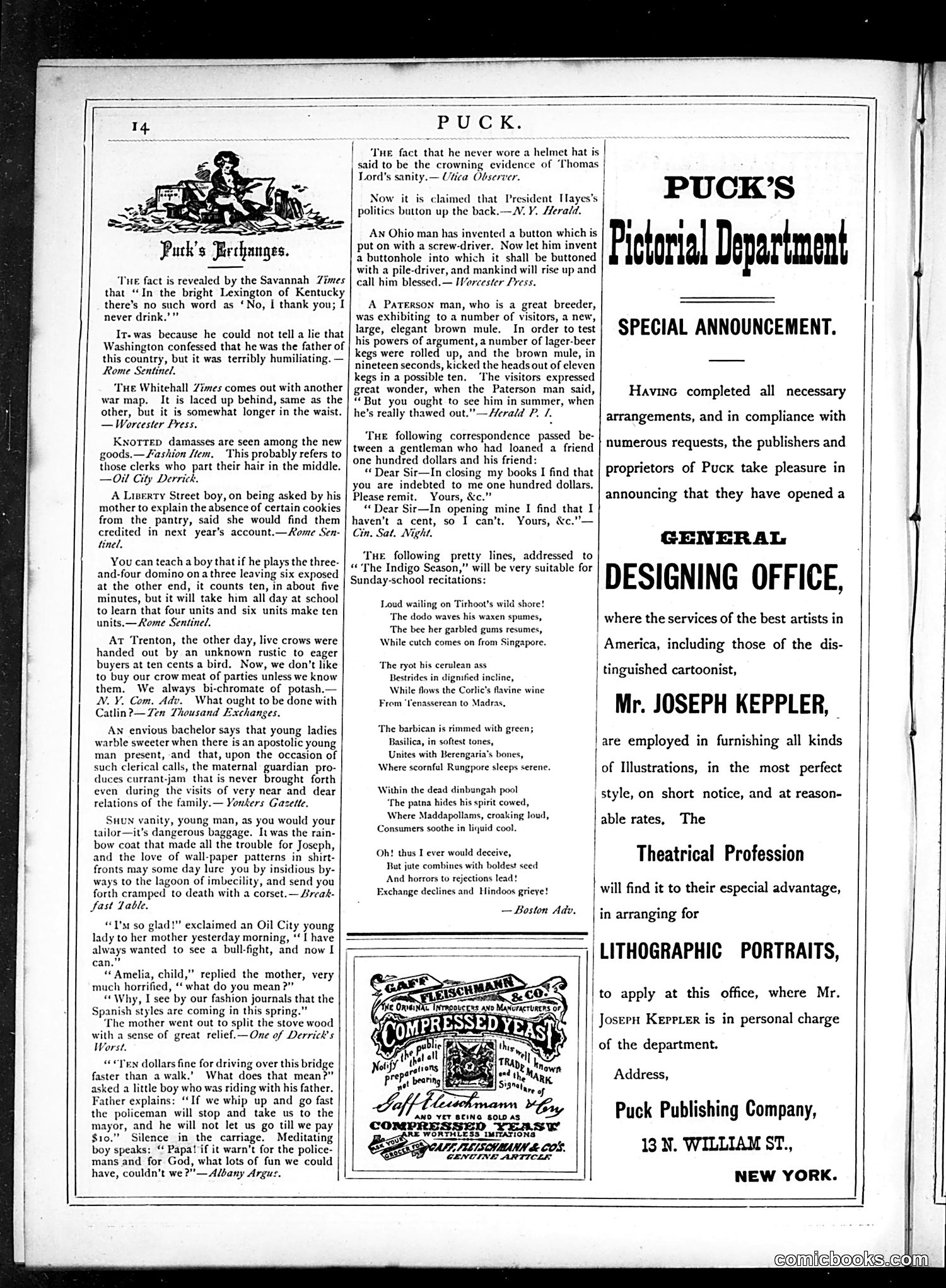
This page is primarily **advertising and announcements** rather than political satire. The left column contains "Puck's Exchanges"—humorous anecdotes and observations from various newspapers, touching on domestic life, inventions, and social absurdities (a mule that kicks beer kegs, a boy's cookie absence explained to his mother). The right side announces Puck's new **General Designing Office**, featuring cartoonist **Joseph Keppler**. The office offers illustrations and lithographic portraits for theatrical professionals and others, at reasonable rates. A decorative **Liebig Company compressed yeast advertisement** appears at bottom center—an unrelated commercial insert. The page reflects Puck's hybrid nature: satirical humor mixed with self-promotion and contemporary advertising, typical of late 19th-century magazines.
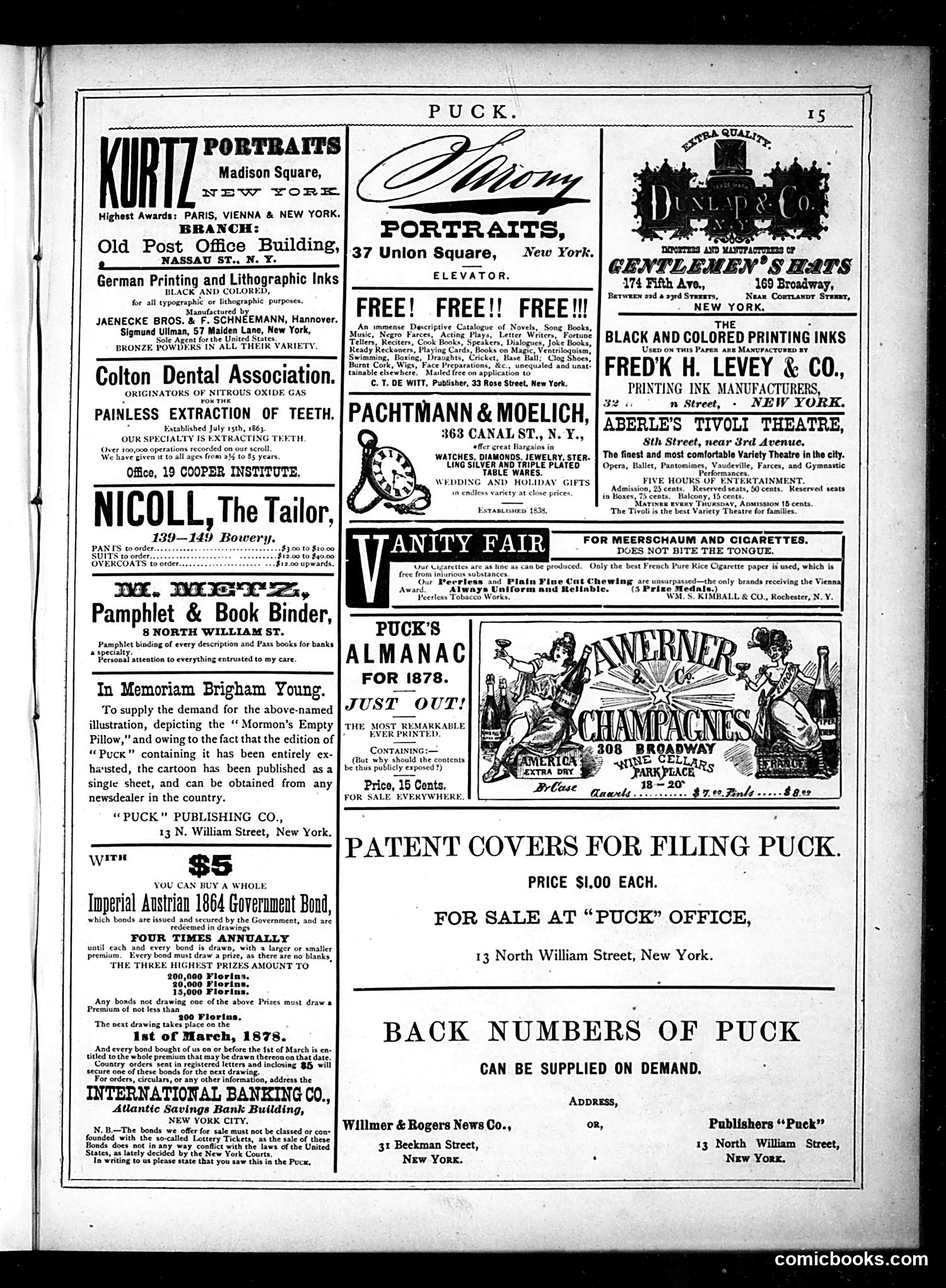
This page is primarily **advertising and administrative content** for Puck magazine (1878), not political cartoons. It includes: - Multiple business advertisements (portrait studios, dental services, printing inks, theaters, champagne, etc.) - A notice for **Puck's Almanac for 1878**, described as "just out" - Information about **patent covers for filing Puck** ($1.00 each) - Details on obtaining **back numbers of Puck** through Willmer & Rogers News Co. - An advertisement for an **Imperial Austrian Government Bond** investment opportunity The only satirical element visible is the Warner Bros. Champagnes advertisement featuring illustrated figures in a decorative style. The page functions as a typical 19th-century magazine back matter section, mixing publisher information with paid advertisements.
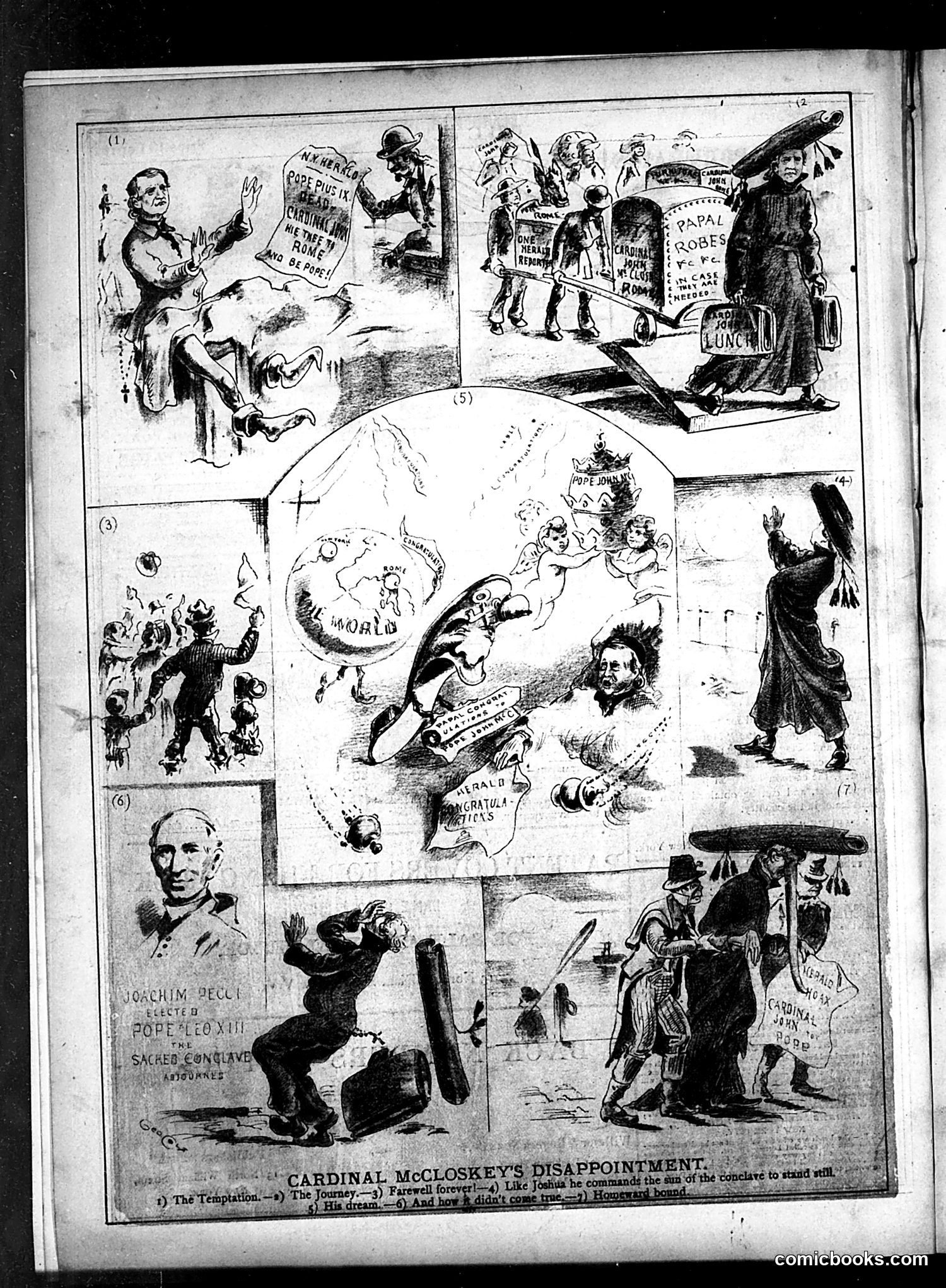
This Puck satire depicts Cardinal McCloskey's failed hopes regarding papal politics. The bottom caption references "The Temptation," "The Journey," and "His Dream"—suggesting McCloskey anticipated becoming Pope. The central circular panel labeled "WORLD" shows religious and political figures in turmoil, likely representing global Church conflicts. Panel (6) identifies "Joachim Pecci, elected to Leo XIII the Sacred Conclave"—indicating Leo XIII's actual election as Pope instead of McCloskey. The surrounding vignettes mock McCloskey's disappointed ambitions. Panel (2) shows what appears to be ecclesiastical pageantry or processions. The satirical point: McCloskey hoped for papal elevation but was passed over, becoming a cautionary tale of thwarted ecclesiastical ambition—humor derived from the American cardinal's dashed international aspirations.