
Puck, 1878-02-27 · page 16 of 20
Puck — February 27, 1878 — page 16: what you’re looking at
What you’re looking at
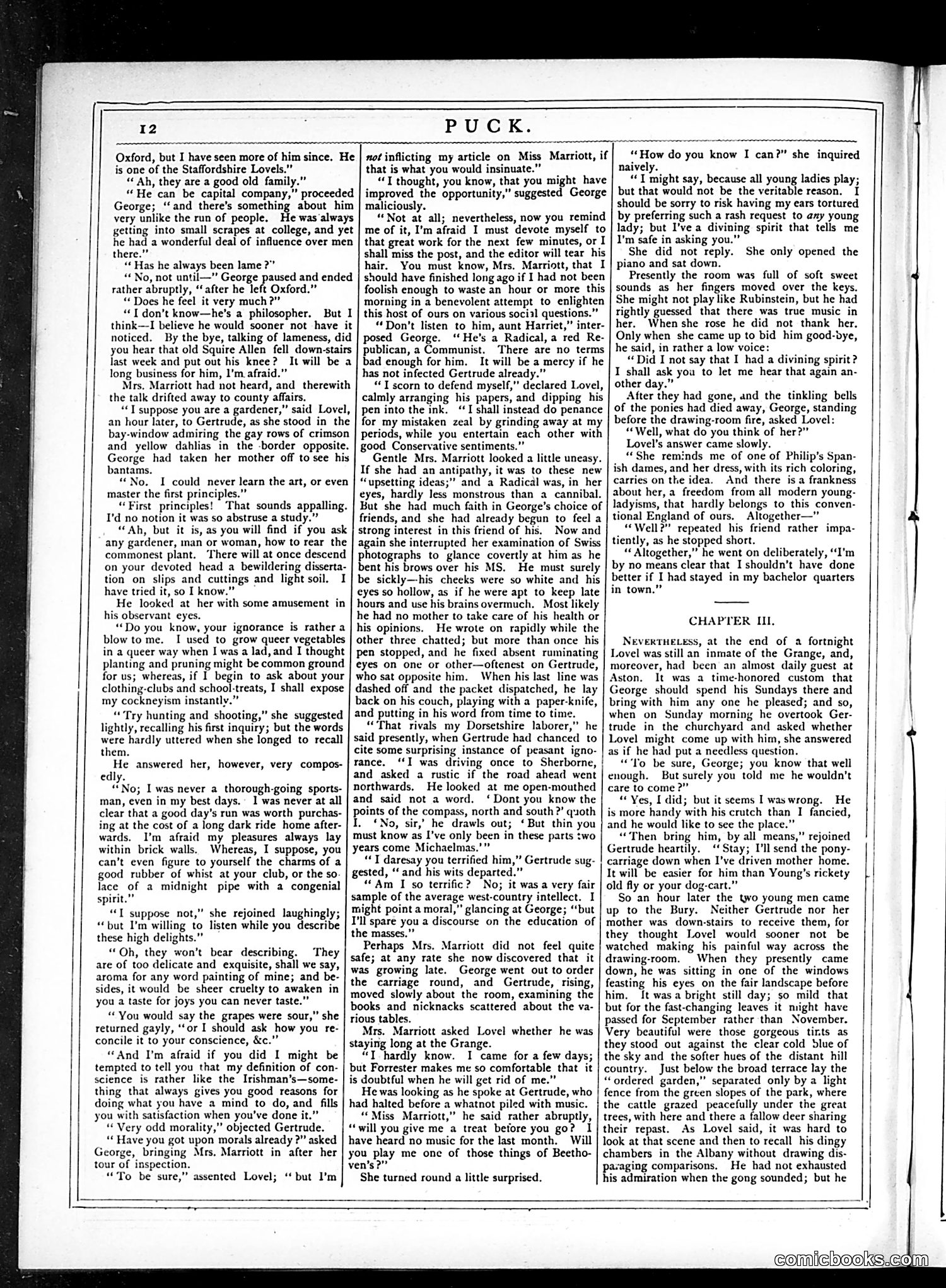
This page from *Puck* contains serialized fiction rather than political cartoons. The text shows "Chapter III" of what appears to be a Victorian-era romantic narrative involving characters named Lovel, George, Mrs. Marriott, and Gertrude. The dialogue discusses George's radical political views (mentions of "Radical," "Communist," and "red Republican"), suggesting social commentary on contemporary political ideologies. The narrative explores class tensions and intellectual debates typical of late 19th-century British society. The content critiques both radical politics and conservative moralizing through character interactions, but this is literary satire rather than visual cartooning. Without seeing illustrations, the specific political targets remain unclear from text alone.
📄 Transcribed text from this page (OCR, searchable)
Machine-transcribed from the original scan — historical spelling and the odd misread are preserved.
12 PUCK. Oxford, but I have seen more of him since. He is one of the Staffordshire Lovels.” “ Ah, they are a good old famil “He can be capital company,” proceeded George; ‘and there’s something about him very unlike the run of people. He was‘always getting into small scrapes at college, and yet he had a wonderful deal of influence over men there.” “ Has he always been lame ?” “No, not until—” George paused and ended rather abruptly, ‘after he left Oxford.” “Does he feel it very much?” “I don’t know—he’s a philosopher. But I think—I believe he would sooner not have it noticed. By the bye, talking of lameness, did you hear that old Squire Allen fell _down-stairs last week and put out his knee? It will be a long business for him, 1’m afraid.” Mrs. Marriott had not heard, and therewith the talk drifted away to county affairs. “T suppose you are a gardener,” said Lovel, an hour later, to Gertrude, as she stood in the bay-window admiring the gay rows of crimson and yellow dablias in the -border opposite. George had taken her mother off to see his bantams. “No. I could never learn the art, or even master the first principles.” ‘First principles! That sounds appalling. I'd no notion it was so abstruse a study.” “Ah, but it is, as you will find if you ask any gardener, man or woman, how to rear the commonest plant. ‘There will at once descend on your devoted head a bewildering disserta- tion on slips and cuttings and light soil. I have tried it, so I know.” He looked at her with some amusement in his observant eyes. “Do you know, your ignorance is rather a blow to me. I used to grow queer vegetables in a queer way when I was a lad, and I thought planting and pruning might be common ground for us; whereas, if I begin to ask about your clothing-clubs and school-treats, I shall expose my cockneyism instantly.” “Try hunting and shooting,” she suggested lightly, recalling his first inquiry; but the words were hardly uttered when she longed to recall them. He answered her, however, very compos- edly. “No; I was never a thorough-going sports- man, even in my best days. 1 was never at all clear that a good day’s run was worth purchas- ing at the cost of a long dark ride home after- wards. I’m afraid my pleasures always lay within brick walls. Whereas, I suppose, you can’t even figure to yourself the charms of a good rubber of whist at your club, or the so- of a midnight pipe with a congenial “I suppose not,” she rejoined laughingly; “but I’m willing to listen while you describe these high delights.” “Oh, they won't bear describing. They are of too delicate and exquisite, shall we say, aroma for any word painting of mine; and be- sides, it would be sheer cruelty to awaken in you a taste for joys you can never taste.” “You would say the grapes were sour,” she returned gayly, “‘or I should ask how you re- concile it to your conscience, &c."” “And I'm afraid if you did I might be tempted to tell you that my definition of con- science is rather like the Irishman’s—some- thing that always gives you good reasons for doing what you have a mind to do, and fills you with satisfaction when you've done it.” “Very odd morality,” objected Gertrude. ‘« Have you got upon morals already ?” asked George, bringing Mrs. Marriott in after her tour of inspection. “To be sure,” assented Lovel; “but I’m not inflicting my article on Miss Marriott, if that is what you would insinuate.” “T thought, you know, that you might have improved the opportunity,” suggested George maliciously. ; “Not at all; nevertheless, now you remind me of it, I’m afraid I must devote myself to that great work for the next few minutes, orl shall miss the post, and the editor will tear his hair. You must know, Mrs. Marriott, that I should have finished long ago if I had not been foolish enough to waste an hour or more this morning in a benevolent attempt to enlighten this host of ours on various social questions.” “Don't listen to him, aunt Harriet,” inter- posed George. ‘‘He’s a Radical, a red Re- publican, a Communist. There are no terms bad enough for him. It will be a mercy if he has not infected Gertrude already.” “TI scorn to defend myself,” declared Lovel, calmly arranging his papers, and dipping his pen into the ink. “I shall instead do penance for my mistaken zeal by grinding away at my periods, while you entertain each other with good Conservative sentiments.” Gentle Mrs. Marriott looked a little uneasy. If she had an antipathy, it was to these new “upsetting ideas;” and a Radical was, in her eyes, hardly less monstrous than a cannibal. But she had much faith in George’s choice of friends, and she had already begun to feel a strong interest in this friend of his. Now and again she interrupted her examination of Swiss photographs to glance covertly at him as he bent his brows over his MS. He must surely be sickly—-his cheeks were so white and his eyes so hollow, as if he were apt to keep late hours and use his brains overmuch. Most likely he had no mother to take care of his health or his opinions. He wrote on rapidly while the other three chatted; but more than once his pen stopped, and he fixed absent ruminating eyes on one or other—oftenest on Gertrude, who sat opposite him. When his last line was dashed off and the packet dispatched, he lay back on his couch, playing with a paper-knife, and putting in his word from time to time. “That rivals my Dorsetshire laborer,” he said presently, when Gertrude had chanced to it ising instance of peasant igno- “T was driving once to Sherborne, and asked a rustic if the road ahead went northwards. He looked at me open-mouthed and said not a word. ‘Dont you know the points of the compass, north and south?’ quoth I. No, sir,’ he drawls out; ‘But thin you must know as I’ve only been in these parts two years come Michaelmas.’” “T daresay you terrified him,” Gertrude sug- gested, ‘and his wits departed.” “Am I so terrific? No; it was a very fair sample of the average west-country intellect. I might point a moral,” glancing at George; “but I'll spare you a discourse on the education of the masses.”” Perhaps Mrs. Marriott did not feel quite safe; at any rate she now discovered that it was growing late. George went out to order the carriage round, and Gertrude, rising, moved slowly about the room, examining the books and nicknacks scattered about the va- rious tables. Mrs. Marriott asked Lovel whether he was staying long at the Grange. “I hardly know. I came for a few days; but Forrester makes me so comfortable that it is doubtful when he will get rid of me.” He was looking as he spoke at Gertrude, who had halted before a whatnot piled with music. “Miss Marriott,” he said rather abruptly, “will you give me a treat before you go? 1 have heard no music for the last month. Will you play me one of those things of Beetho- ven’s ?” She turned round a little surprised. “How do you know I can?” she inquired naively. “T might say, because all young ladies play; but that would not be the veritable reason. I should be sorry to risk having my ears tortured by preferring such a rash request to any young lady; but I've a divining spirit that tells me I'm safe in asking you." She did not reply. She only opened the piano and sat down. Presently the room was full of soft sweet sounds as her fingers moved over the keys. She might not play like Rubinstein, but he had rightly guessed that there was true music in her. When she rose he did not thank her. Only when she came up to bid him good-bye, he said, in rather a low voice: “Did I not say that I had a divining spirit? I shall ask you to let me hear that again an- other day.” ‘After they had gone, and the tinkling bells of the ponies had died away, George, standing before the drawing-room fire, asked Lovel: “Well, what do you think of her?” Lovel’s answer came slowly. “She reminds me of one of Philip’s Span- ish dames, and her dress, with its rich coloring, carries on the idea. And there is a frankness about her, a freedom from all modern young- ladyisms, that hardly belongs to this conven- tional England of ours. Altogether—" “Well?” repeated his friend rather impa- tiently, as he stopped short. “ Altogether,” he went on deliberately, “I'm by no means clear that I shouldn’t have done better if I had stayed in my bachelor quarters in town.” CHAPTER III, NEVERTHELESS, at the end of a fortnight Lovel was still an inmate of the Grange, and, moreover, had been an almost daily guest at Aston. It was a time-honored custom that George should spend his Sundays there and bring with him any one he pleased; and so, when on Sunday morning he overtook Ger- trude in the churchyard and asked whether Lovel might come up with him, she answered as if he had put a needless question. “To be sure, George; you know that well enough. But surely you told me he wouldn't care to come 2” “ Yes, I did; but it seems I was wrong. He is more handy with his crutch than I fancied, and he would like to see the place.”” “Then bring him, by all means,” rejoined Gertrude heartily. ‘‘ Stay; I'll send the pony- carriage down when I’ve driven mother home. It will be easier for him than Young’s rickety old fly or your dog-cart.” So an hour later the two young men came up to the Bury. Neither Gertrude nor her mother was down-stairs to receive them, for they thought Lovel would sooner not be watched making his painful way across the drawing-room. When they presently came down, he was sitting in one of the windows feasting his eyes on the fair landscape before him. {t was a bright still day; so mild that but for the fast-changing leaves it might have passed for September rather than November. Very beautiful were those gorgeous tints as they stood out against the clear cold dlue of the sky and the softer hues of the distant hill country. Just below the broad terrace lay the “ordered garden,” separated only by a light fence from the green slopes of the park, where the cattle grazed peacefully under the great trees, with here and there a fallow deer sharing their repast. As Lovel said, it was hard to look at that scene and then to recall his dingy chambers in the Albany without drawing dis- pasaging comparisons. He had not exhausted his admiration when the gong sounded; but he