
Puck, 1878-02-27 · page 11 of 20
Puck — February 27, 1878 — page 11: what you’re looking at
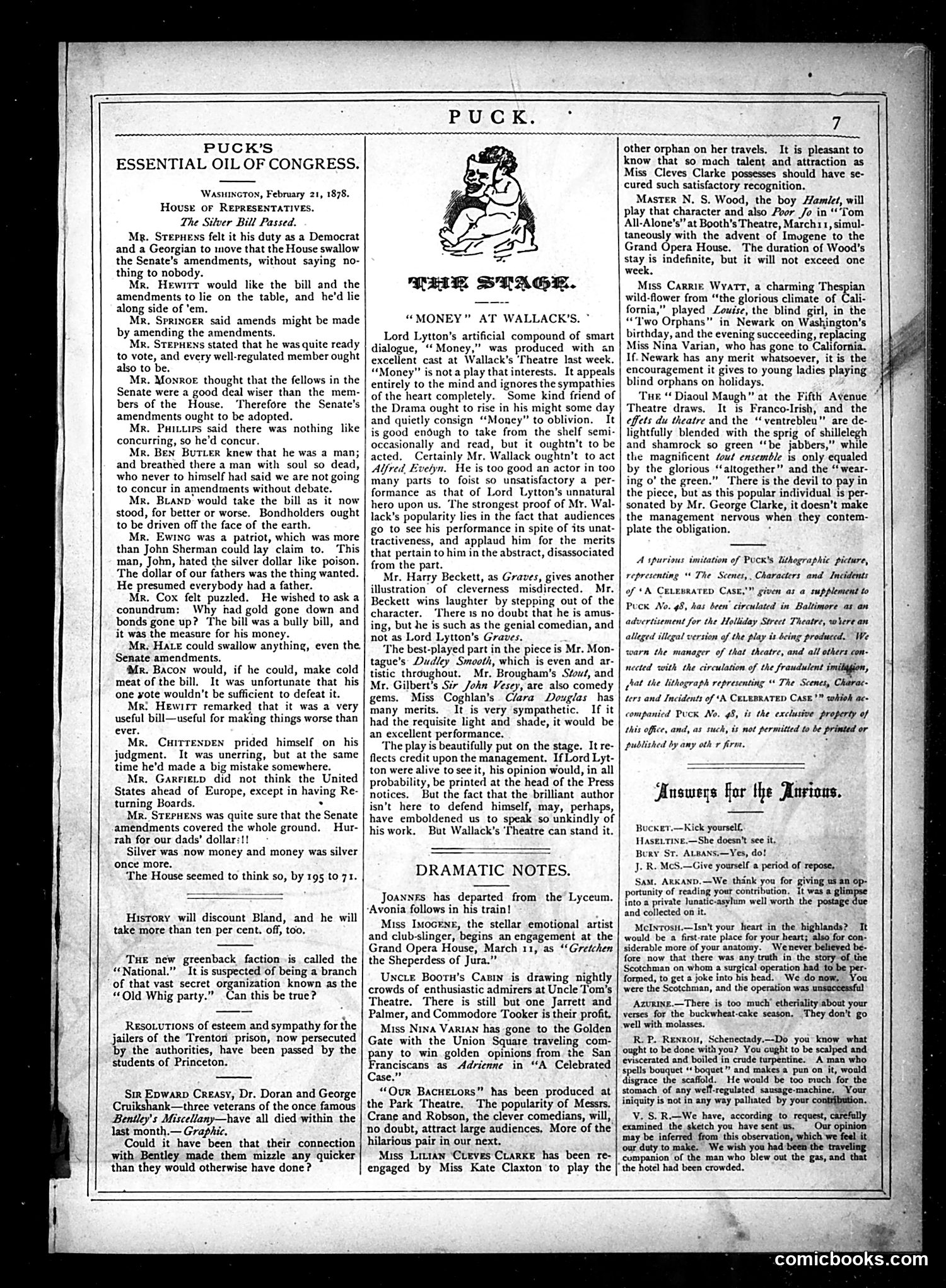
A restored page from Puck, 1878-02-27. Page through the whole issue in the reader above.
📄 Transcribed text from this page (OCR, searchable)
Machine-transcribed from the original scan — historical spelling and the odd misread are preserved.
PUCK’S ESSENTIAL OIL OF CONGRESS. Wasiincton, February 21, 1878. House oF REPRESENTATIVES. The Silver Bill Passed. Mr. Stepuens felt it his duty as a Democrat and a Georgian to move that the House swallow the Senate’s amendments, without saying no- thing to nobody. Mr. Hewitt would like the bill and the amendments to lie on the table, and he'd lie along side of ‘em. Mk. SprinceR said amends might be made by amending the amendments. Mr. Stepuens stated that he was quite ready to vote, and every well-regulated member ought also to be. Mr. Monroe thought that the fellows in the Senate were a good deal wiser than the mem- bers of the House. ‘Therefore the Senate's amendments ought to be adopted. Mr. Puituirs said there was nothing like concurring, so he’d concur. Mr. Ben Butter knew that he was a man; and breathed there a man with soul so dead, who never to himself had said we are not going to concur in amendments without debate. Mr. Branp would take the bill as it now stood, for better or worse. Bondholders ought to be driven off the face of the earth. Mr. Ewinc was a patriot, which was more than John Sherman could lay claim to, This man, John, hated the silver dollar like poison. The dollar of our fathers was the thing wanted. He presumed everybody had a father. Mr. Cox felt puzzled. He wished to ask a conundrum: Why had gold gone down and bonds gone up? The bill was a bully bill, and it was the measure for his money. Mr. Hate could swallow anything, even the Senate amendments. Mr. Bacon would, if he could, make cold meat of the bill. It was unfortunate that his one yote wouldn't be sufficient to defeat it. Mr: Hewirr remarked that it was a very useful bill—useful for making things worse than ever. Mr. Cuirrenpen prided himself on his judgment. It was unerring, but at the same time he’d made a big mistake somewhere. Mr. Garrietp did not think the United States ahead of Europe, except in baying Re- turning Boards. Mr. STEPHENS was quite sure that the Senate amendments covered the whole ground. Hur- rah for our dads’ dollar:!! Silver was now money and money was silver once more, ‘The House seemed to think so, by 195 to 71. History will discount Bland, and he will take more than ten per cent. off, too. THE new greenback faction is called the “National.” It is suspected of being a branch of that vast secret organization known as the “Old Whig party.” Can this be true? Reso.vutions of esteem and sympathy for the jailers of the Trenton prison, now persecuted by the authorities, have been passed by the students of Princeton. Sir Epwarp Creasy, Dr. Doran and George Crmikshank—three veterans of the once famous Bentley's Miscellany—have all died within the last month.— Graphic, Could it have been that their connection with Bentley made them mizzle any quicker than they would otherwise have done ? LAR STAGR. “MONEY” AT WALLACK'S. * Lord Lytton’s artificial compound of smart dialogue, “Money,” was produced with an excellent cast at Wallack’s Theatre last week. “Money” is nota play that interests. It appeals entirely to the mind and ignores the sympathies. of the heart completely. Some kind friend of the Drama ought to rise in his might some day and quietly consign “Money” to oblivion. It is good endugh to take from the shelf semi- occasionally and read, but it oughtn’t to be acted, Certainly Mr. Wallack oughtn’t to act Alfred, Evelyn. He is too good an actor in too many parts to foist so unsatisfactory a per- formance as that of Lord Lytton’s unnatural hero upon us. ‘The strongest proof of Mr. Wal- lack’s popularity lies in the fact that audiences go to sce his performance in spite of its unat- tractiveness, and applaud him for the merits that pertain to him in the abstract, disassociated from the part. ‘Mr. Harry Beckett, as Graves, gives another illustration’ of cleverness misdirected. Mr. Beckett wins laughter by stepping out of the character. ‘There 1s no doubt that he is amus- ing, but he is such as the genial comedian, and not as Lord Lytton’s Graves. ‘The best-played part in the piece is Mr. Mon- tague’s Dudley Smooth, which is even and ar- tistic throughout. Mr. Brougham’s Sfout, and Mr. Gilbert’s Sir John Vesey, are also comedy gems. Miss Coghlan’s Clara Douglas has many merits. It is very sympathetic. If it had the requisite light and shade, it would be an excellent performance. The play is beautifully put on the stage. It re- flects credit upon the management. IfLord Lyt- ton were alive to see it, his opinion would, in all probability, be printed at the head of the Press notices. But the fact that the brilliant author isn’t here to defend himself, may, perhaps, have emboldened us to speak so unkindly of his work. But Wallack’s ‘Theatre can stand it. DRAMATIC NOTES. Joanngs has departed from the Lyceum. -Avonia follows in his train! Miss ImoGENe, the stellar emotional artist and club-slinger, begins an engagement at the Grand Opera House, March 11, as “Gretchen the Sheperdess of Jura.” Uncie Bootn’s Canin is drawing nightly crowds of enthusiastic admirers at Uncle Tom’s Theatre. There is still but one Jarrett and Palmer, and Commodore Tooker is their profit, Miss Nina Varian has gone to the Golden Gate with the Union Square traveling com- pany to win golden opinions from. the San Franciscans as Adrienne in “A Celebrated Case.” “Our BacHetors” has been produced at the Park Theatre. The popularity of Messrs. Crane and Robson, the clever comedians, will, no doubt, attract large audiences, More of the hilarious pair in our next. Miss Littan ‘Creves Cuarke has been re- engaged by Miss Kate Claxton to play the other orphan on her travels. It is pleasant to know that so mach talent and attraction as Miss Cleves Clarke should have se- cured such satisfactory recognition. Master N. S. Wood, the boy Hamlet, will play that character and also Poor Jo in “Tom All-Alone’s” at Booth’s Theatre, March11, simul- taneously with the advent of Imogene to the Grand Opera House. The duration of Wood’s stay is indefinite, but it will not exceed one week, Miss Carrie Wyatt, a charming Th mila: Hower from “the glorious climate of ali: for ” played Louise, the blind girl, in the “ Two Orphans” in Newark on Washington’s birthday, and the evening succeeding, replacing Miss Nina Varian, who has gone to California. If. Newark has any merit whatsoever, it is the encouragement it gives to young ladies playing blind orphans on holidays. Tue “ Diaoul Maugh” at the Fifth Avenue “ Theatre draws. It is Franco-Irish, and the effets du theatre and the “‘ ventrebleu" are de- lightfully blended with the sprig of shillelegh and shamrock so green ‘‘be jabbers,” while the magnificent fout ensemble is only equaled by the glorious ‘‘altogether” and the ‘ wear- ing o’ the green.” ‘There is the devil to pay in the piece, but as this popular individual is per- sonated by Mr. George Clarke, it doesn’t make the management nervous when they contem- plate the obligation. ‘ A spurious imitation of Puck's lithegraphic picture, representing “ The Scenes, Characters and Incidents of ‘A CELEBRATED CasE,'” given as a supplement to Puck No. 48, has been’ circulated in Baltimore as an advertisement for the Holliday Street Theatre, were an alleged illegal version of the play is being produced. We warn the manager of that theatre, and all others con- nected with the circulation of the fraudulent imiligion, pat the lithograph representing The Scenes, Charac- ters and Incidents of ‘S CELEBRATED CASE!” wwhioh ace companied Puck No. 48, is the exclusive property of this office, and, as such, is not permitted to be printed or published by any oth r firm. i Answers for the Anrinns. Bucker.—Kick yourself, Hasen.tive.—She doesn't see it, Bury St. ALBANS: dot J. R. McS.—Give yourself a period of repose, Saat. ARKAND.—We think you for giving us an a5.op- portuniy of reading yout contribution, it was a glimpse into a private Junatic-asylum well worth the postage and collected on it. McInrosit.—Isn’t your heart in the highlands? It would be a first-rate place for your heart; also for con- siderable more of your anatomy. Wenever believed be- fore now that there was any truth in the story of the Scotchman on whom a surgical operation had to be formed, to get a joke into his head. We do now,» You were the Scotchman, and the operation was unsuccessful ‘Azunine.—There is too much’ etheriality about your verses for the buckwheat-cake season, ‘They don't go well with molasses. R. P. ReNRowt, Schenectady.-Do you know what cought to be done with you? You ought to be scalped and eviscerated and boiled in crude turpentine. A man who spas bouquet * boquet” and makes a pun on it, would disgrace the scaffold. He would be too much for the stomach of any well-regulsted sausage-machine, “Your iniquity is not in any way pallated by your ae YS. R-We Ihave, accorlings to) requ oueran examined the sketch you have sent us, may be inferred from this observation, whicd'we otal it our duty to make. We wish you had been the traveling companion of the man who blew out the gas, and that the hotel had been crowded. COMmIcbOOkS: com