
Puck, 1878-02-27 · page 14 of 20
Puck — February 27, 1878 — page 14: what you’re looking at
What you’re looking at
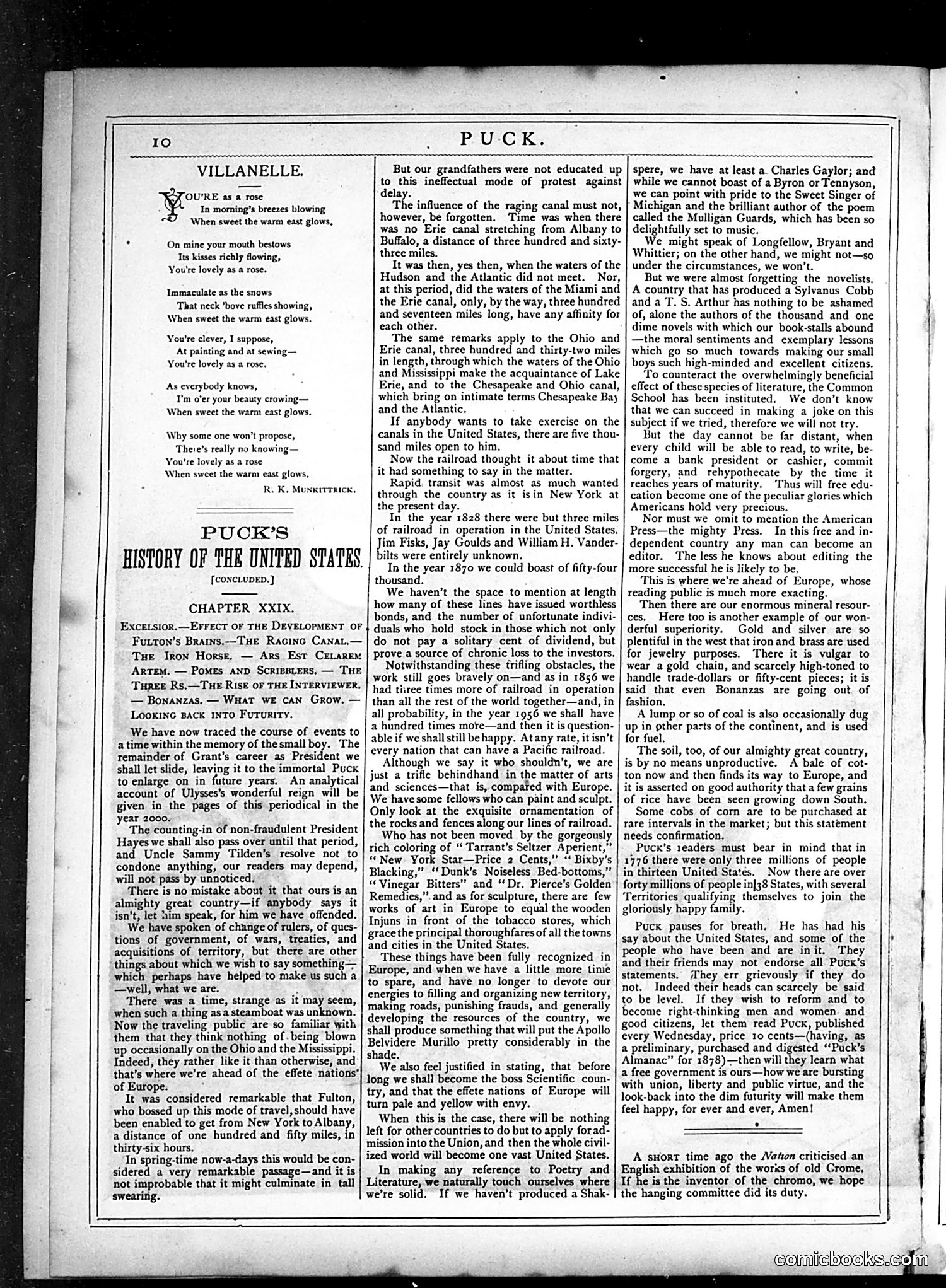
This page contains two distinct elements: a poem titled "Villanelle" on the left and the beginning of "Puck's History of the United States" (Chapter XXIX) on the right. The "Villanelle" is a romantic poem using conventional courtship language ("You're as a rose / blooming and at ravage"). The history section satirizes American development by mock-celebrating railroad expansion and industrial progress while critiquing the practical failures of ambitious schemes like the Erie Canal. The text humorously suggests Americans boast endlessly about infrastructure projects while Europe produces actual art and culture. It's a nationalist satire questioning whether American material progress substitutes for cultural achievement—a common Puck theme comparing American and European civilization.
📄 Transcribed text from this page (OCR, searchable)
Machine-transcribed from the original scan — historical spelling and the odd misread are preserved.
PUCK. VILLANELLE. ‘OU'RE 8s a rose : In morning’s breezes blowing ‘When sweet the warm east glows, 0 On mine your mouth bestows Its kisses richly flowing, You're lovely as a rose. Immaculate as the snows ‘That neck ‘bove ruffles showing, When sweet the warm east glows. You're clever, I suppose, At painting and at sewing— You're lovely as a rose. As everybody knows, I'm o'er your beauty crowing— When sweet the warm east glows. Why some one won't propose, Theie’s really no knowing— You're lovely as a rose When sweet the warm east glows. R. K. Munxrrreick. PUCK'S HISTORY OF THE UNITED STATES [coxciupED.] CHAPTER XXIX. EXxceLsion.—EFFect OF THE DEVELOPMENT OF Furton’s Brains.—THE Racine CaNnat.— Tue Iron Horse. — Ars Est CELAREX ARTEM. — PoMEs AND SCRIBBLERS. — THE ‘Turee Rs.—Tue Rise oF THE INTERVIEWER. — Bonanzas, — WHat WE can Grow. — LooxinG BACK INTO Futurity. We have now traced the course of events to atime within the memory of thesmall boy. The remainder of Grant’s career as President we shall let slide, leaving it to the immortal Puck to enlarge on in future years. An analytical account of Ulysses’s wonderful reign will be given in the pages of this periodical in the year 2000. The counting-in of non-fraudulent President Hayes we shall also pass over until that period, and Uncle Sammy Tilden’s resolve not to condone anything, our readers may depend, will not pass by unnoticed. ‘There is no mistake about it that ours is an almighty great country—if anybody says it isn’t, let him speak, for him we have offended. We have spoken of chunge of rulers, of ques- tions of government, of wars, treaties, and acquisitions of territory, but there are other things about which we wish to say something— which perhaps have helped to make us such a —well, what we are. ; There was a time, strange as it may seem, when such a thing as a steamboat was unknown. Now the traveling public are so familiar with them that they think nothing of. being blown up occasionally on the Ohio and the Mississippi. Indeed, they rather like it than otherwise, and that’s where we're ahead of the effete nations’ of Europe. P It was considered remarkable that Fulton, who bossed up this mode of travel, should have been enabled to get from New York to Albany, a distance of one hundred and fifty miles, in thirty-six hours. In spring-time now-a-days this would be con- sidered a very remarkable passage—and it is not improbable that it might culminate in tall swearing. But our grandfathers were not educated up to this ineffectual mode of protest against delay. The influence of the raging canal must not, however, be forgotten. Time was when there was no Erie canal stretching from Albany to Buffalo, a distance of three hundred and sixty- three miles. It was then, yes then, when the waters of the Hudson and the Atlantic did not meet. Nor, at this period, did the waters of the Miami and the Erie canal, only, by the way, three hundred and seventeen miles long, have any affinity for each other. The same remarks apply to the Ohio and Erie canal, three hundred and thirty-two miles in length, through which the waters of the Ohio and Mississippi make the acquaintance of Lake Erie, and to the Chesapeake and Ohio canal, which bring on intimate terms Chesapeake Bay and the Atlantic. If anybody wants to take exercise on the canals in the United States, there are five thou- sand miles open to him. Now the railroad thought it about time that it had something to say in the matter. Rapid. transit was almost as much wanted through the country as it isin New York at the present day. In the year 1828 there were but three miles of railroad in operation in the United States. Jim Fisks, Jay Goulds and William H. Vander- bilts were entirely unknown. In the year 1870 we could boast of fifty-four thousand. We haven’t the space to mention at length how many of these lines have issued worthless bonds, and the number of unfortunate indivi- duals who hold stock in those which not only do not pay a solitary cent of dividend, but prove a source of chronic loss to the investors. Notwithstanding these frifling obstacles, the work still goes bravely on—and as in 1856 we had tiree times more of railroad in operation than all the rest of the world together—and, in all probability, in the year 1956 we shall have a hundred times mote—and then it is question- able if we shall still be happy. Atany rate, it isn’t every nation that can have a Pacific railroad. Although we say it who shouldn't, we are just a trifle behindhand in the matter of arts and sciences—that is, compared with Europe. We have some fellows who can paint and sculpt. Only look at the exquisite ornamentation of the rocks and fences along our lines of railroad. Who has not been moved by the gorgeously rich coloring of “ Tarrant’s Seltzer Aperient,” “New. York Star—Price 2 Cents,” ‘ Bixby’s Blacking,” ‘Dunk’s Noiseless Bed-bottoms,” “Vinegar Bitters” and “Dr. Pierce's Golden Remedies,”. and as for sculpture, there are few works of art in Europe to equal the wooden Injuns in front of the tobacco stores, which grace the principal thoroughfares of all the towns and cities in the United States. These things have been fully recognized in Europe, and when we have a little more time to spare, and have no longer to devote our energies to filling and organizing new territory, making roads, punishing frauds, and generally developing the resources of the country, we shall produce something that will put the Apollo Belvidere Murillo pretty considerably in the shade, We also feel justified in stating, that before long we shall become the boss Scientific coun- try, and that the effete nations of Europe will turn pale and yellow with envy. When this is the case, there will be nothing left for other countries to do but to apply forad- mission into the Union, and then the whole civil- ized world will become one vast United States. In making any reference to Poetry and Literature, we naturally touch ourselves where we're solid. If we haven’t produced a Shak- spere, we have at least a Charles Gaylor; and while we cannot boast of a Byron or Tennyson, we can point with pride to the Sweet Singer of Michigan and the brilliant author of the poem called the Mulligan Guards, which has been so delightfully set to music. We might speak of Longfellow, Bryant and Whittier; on the other hand, we might not—so under the circumstances, we won't. But we were almost forgetting the novelists, A country that has produced a Sylvanus Cobb and a T. S. Arthur has nothing to be ashamed of, alone the authors of the thousand and one dime novels with which our book-stalls abound —the moral sentiments and exemplary lessons which go so much towards making our small boys such high-minded and excellent citizens. ‘To counteract the overwhelmingly beneficial effect of these species of literature, the Common. School has been instituted. We don’t know that we can succeed in making a joke on this subject if we tried, therefore we will not try. But the day cannot be far distant, when every child will be able to read, to write, be- come a bank president or cashier, commit forgery, and rehypothecate by the time it reaches years of maturity. ‘Thus will free edu- cation become one of the peculiar glories which Americans hold very precious. Nor must we omit to mention the American Press—the mighty Press. In this free and in- dependent country any man can become an editor. ‘The less he knows about editing the more successful he is likely to be. This is where we're ahead of Europe, whose reading public is much more exacting. Then there are our enormous mineral resour- ces. Here too is another example of our won- derful superiority. Gold and silver are so plentiful in the west that iron and brass are used for jewelry purposes. ‘There it is vulgar to wear a gold chain, and scarcely high-toned to handle trade-dollars or fifty-cent pieces; it is said that even Bonanzas are going out of fashion. A lump or so of coal is also occasionally dug up in other parts of the continent, and is used for fuel. The soil, too, of our almighty great country, is by no means unproductive. A bale of cot- ton now and then finds its way to Europe, and it is asserted on good authority that a few grains of rice have been seen growing down South. Some cobs of corn are to be purchased at rare intervals in the market; but this statement needs confirmation. Pucx’s 1eaders must bear in mind that in 1476 there were only three millions of people in thirteen United States. Now there are over forty millions of people in]38 States, with several Territories qualifying themselves to join the gloriously happy family. Puck pauses for breath. He has had his say about the United States, and some of the people who have been and are init, ‘They and their friends may not endorse all Puck’s statements. (They err grievously if they do not. Indeed their heads can scarcely be said to be level. If they wish to reform and to become right-thinking men and women. and good citizens, let them read Puck, published every Wednesday, price 10 cents—(having, as a preliminary, purchased and digested “Puck's Almanac” for 1878)—then will they learn what a free government is ours—how we are bursting with union, liberty and public virtue, and the look-back into the dim futurity will make them feel happy, for ever and ever, Amen! . A sHort time ago the Vaton criticised an English exhibition of the works of old Crome, If he is the inventor of the chromo, we hope the hanging committee did its duty. comichooks.