
Puck, 1878-02-27 · page 15 of 20
Puck — February 27, 1878 — page 15: what you’re looking at
What you’re looking at
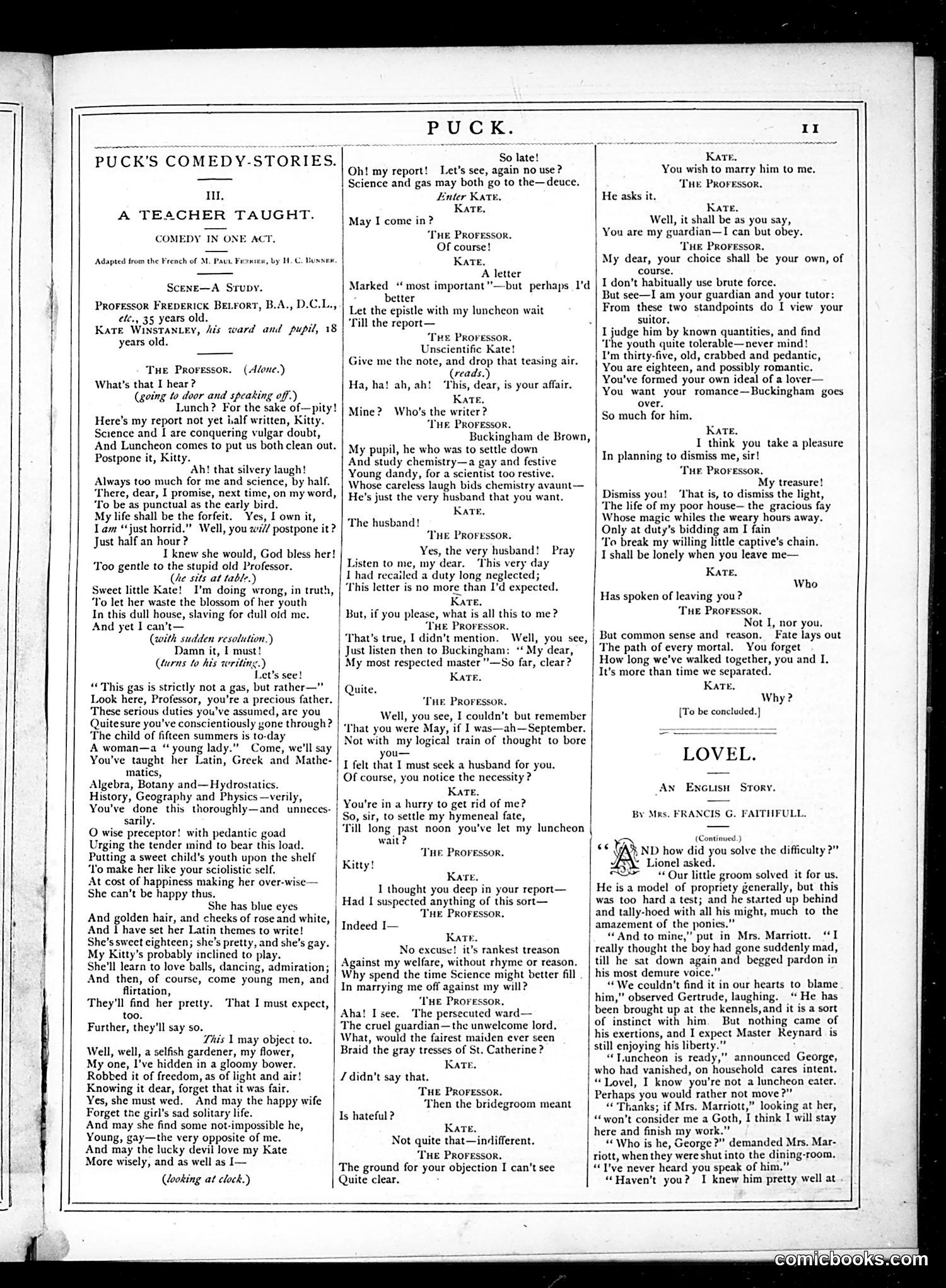
This page contains two literary works rather than political cartoons: 1. **"A Teacher Taught"** — A one-act comedy adapted from French playwright St. Paul Ferrier by H.C. Bunner. It depicts a domestic comedy involving Professor Hartright, his young ward Kate, and romantic complications around her marriage prospects. The humor centers on educational pretensions, the professor's absentmindedness, and Kate's agency in choosing her own husband—mildly satirizing Victorian gender roles and academic pomposity. 2. **"Lovel"** — An English short story by Mrs. Francis G. Faithfull about a missing servant and household mystery, with dialogue suggesting melodramatic plotting. Neither appears to contain specific political satire or contemporary social commentary targeting identifiable public figures. This is a literary rather than political issue of Puck.
📄 Transcribed text from this page (OCR, searchable)
Machine-transcribed from the original scan — historical spelling and the odd misread are preserved.
PUCK’S COMED Y-STORIES. I, A TEACHER TAUGHT. COMEDY IN ONE ACT. Adapted from the French of M, Paut. Frauen, by H.C. Hunsax Scene—A Srupy. ProFessor FREDERICK Betrort, B.A., D.C.L., etc., 35 years old. ; Kate WINSTANLEY, Ais ward and pupil, 18 years old. Tue Proressor. (Aéone.) What's that I hear? (going to door and speaking off.) Lunch? For the sake of—pity! Here’s my report not yet half written, Kitty. Science and I are conquering vulgar doubt, ‘And Luncheon comes to put us both clean out. Postpone it, Kitty. Ah! that silvery laugh! Always too much for me and science, by half. ‘There, dear, I promise, next time, on my word, ‘To be as punctual as the early bird. My life shall be the forfeit. Yes, I own it, Iam “just horrid.” Well, you wii/ postpone it ? Just half an hour ? I knew she would, God bless her! | Too gentle to the stupid old Professor. (he sits at table.) Sweet little Kate! I'm doing wrong, in truth, ‘Yo let her waste the blossom of her youth In this dull house, slaving for dull old me. And yet I can’t— (with sudden resolution.) Damn it, I must! (turns to his writing.) Let's see! “This gas is strictly not a gas, but rather—” Look here, Professor, you're a precious father. These serious duties you’ve assumed, are you Quitesure you've conscientiously gone through ? The child of fifteen summers is to-day A woman—a “young lady.” Come, we'll say You've taught her Latin, Greek and Mathe- matics, Algebra, Botany and—Hyzdrostatics. History, Geography and Physics —verily, You've done this thoroughly—and_ unneces- sarily. O wise preceptor! with pedantic goad Urging the tender mind to bear this load. Putting a sweet child’s youth upon the shelf ‘lo make her like your sciolistic self. At cost of happiness making her over-wise— She can’t be happy thus. She has blue eyes And golden hair, and cheeks of rose and white, And Phave set her Latin themes to write! She's sweet cighteen; she's pretty, and she’s gay. My Kitty’s probably inclined to play. She'll learn to love balls, dancing, admiration; And then, of course, come young men, and flirtation, They'll find her pretty. That I must expect, t 00. Further, they'll say so. This 1 may object to. Well, well, a selfish gardener, my flower, My one, I've hidden in a gloomy bower. Robbed it of freedom, as of light and air! Knowing it dear, forget that it was fair. Yes, she must wed. And may the happy wife Forget the girl’s sad solitary life. And may she find some not-impossible he, Young, gay—the very opposite of me. And may the lucky devil love my Kate More wisely, and as well as I— (looking at clock.) | May I come in? | Had I suspected anything of this sort— PUCK. So late! Oh! my report! Let's see, again no use? Science and gas may both go to the—deuce. Enter Kate. Kate. ‘THE PRoFEssor. Of course! Kate. A letter Marked “ most important"—but perhaps I'd better Let the epistle with my luncheon wait ‘Till the report — ‘THe PRroressor. | Unscientific Kate! Give me the note, and drop that teasing air. (reads.) Ha, ha! ah, ah! This, dear, is your affair. Who's t ‘THE PROFESSOR. Buckingham de Brown, My pupil, he who was to settle down And study chemistry—a gay and festive Young dandy, for a scientist too restive. Whose careless laugh bids chemistry avaunt— He's just the very husband that you want. Kate. Mine? The husband! ‘THE PRroressor. Yes, the very husband! Listen to me, my dear. ‘This very day Thad recailed a duty long neglected; ‘This letter is no more than I'd expected. Kate. But, if you please, what is all this to me? ‘THE PRoFEssor. ‘That’s true, I didn’t mention. Pray Well, you see, | Just listen then to Buckingham: ‘‘ My dear, My most respected master ""—So far, clear? Kate. Quite. ‘THe PROFESSOR. Well, you see, I couldn’t but remember ‘That you were May, if I was—ah—September. | Not with my logical train of thought to bore you— I felt that I must seek a husband for you. | Of course, you notice the necessity ? Kate. You're in a hurry to get rid of me? So, sir, to settle my hymeneal fate, ‘Till long past noon you've let my luncheon | wait? ‘THE PROFESSOR. | Kitty! Kare. I thought you deep in your report—_— | ‘THE PRoFEssor. Indeed I— Kate. No excuse! it’s rankest treason Against my welfare, without rhyme or reason. Why spend the time Science might better fill In marrying me off against my will? ‘THe PRroressor. Aha! Isee. The persecuted ward— The cruel guardian—the unwelcome lord. What, would the fairest maiden ever seen Braid the gray tresses of St. Catherine ? Kate. / didn’t say that. THE PRorEssor. ‘Then the bridegroom meant Is hateful ? Kate. Not quite that— ‘THE PRoFEssor. ‘The ground for your objection I can’t see Quite clear. II Karte. You wish to marry him to me. ‘THE PRoFEssor. He asks it, Kate. Well, it shall be as you say, You are my guardian—I can but obey. ‘THe PRroressor. My dear, your choice shall be your own, of course. I don’t habitually use brute force. But see—I am your guardian and your tutor: From these two standpoints do I view your suitor. I judge him by known quantities, and find ‘The youth quite tolerable—never mind! I'm thirty-five, old, crabbed and pedantic, You are eighteen, and possibly romantic. You've formed your own ideal of a lover— You want your romance—Buckingham goes over. So much for him. Kate. I think you take a pleasure In planning to dismiss me, sir! ‘THE PRroressor. My treasure! Dismiss you! ‘That is, to dismiss the light, ‘The life of my poor house— the gracious fay Whose magic whiles the weary hours away. Only at duty’s bidding am I fain ‘To break my willing little captive’s chain. I shall be lonely when you leave me— Kare. Who Has spoken of leaving you? ‘Tue Proressor. Not I, nor you. But common sense and reason. Fate lays out ‘The path of every mortal. You forget How long we've walked together, you and I. It’s more than time we separated. Kate, Why? [To be concluded.] An EnGuisn Story. By Mrs. FRANCIS G. FAITHFULL. oe (Continved.) © VAX. ND how did you solve the difficulty ?” DY \ Lionel asked. o> “Our little groom solved it for u He is a model of propriety generally, but th was too hard a test; and he started up behind and tally-hoed with all his might, much to the amazement of the ponies.’ “And to mine,” put in Mrs. Marriott. “1 really thought the boy had gone suddenly mad, till he sat down again and begged pardon in his most demure voice.” “We couldn't find it in our hearts to blame him,” observed Gertrude, laughing.“ He has been brought up at the kennels, and it is a sort of instinct with him. But nothing came of his exertions, and I expect Master Reynard is still enjoying his liberty.” “Tuncheon is ready,” announced George, who had vanished, on household cares intent. “Lovel, I know you're not a luncheon eater. Perhaps you would rather not move ?” “Thanks; if Mrs. Marriott,” looking at her, «won't consider me a Goth, I think I will stay here and finish my work.” “Who is he, George ?” demanded Mrs. Mar- riott, when they were shut into the dining-room. “T've never heard you speak of him.” “Haven't you? I knew him pretty well at