
Puck, 1878-02-27 · page 5 of 20
Puck — February 27, 1878 — page 5: what you’re looking at
What you’re looking at
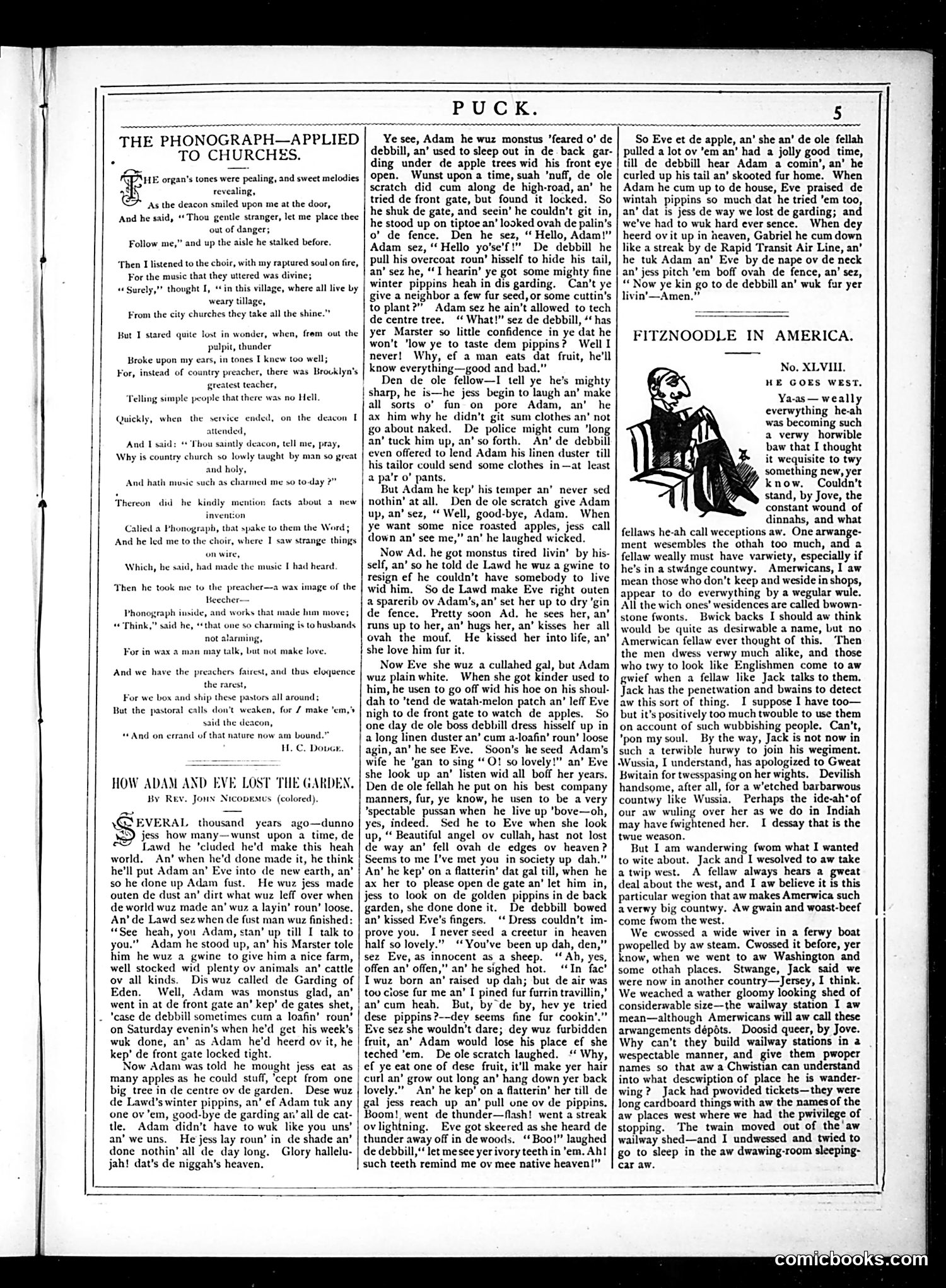
This page contains two distinct pieces: 1. **"The Phonograph—Applied to Churches"** (left column): A satirical poem mocking the use of phonographs in religious services, suggesting mechanical reproduction of hymns and sermons undermines genuine spiritual experience. The humor targets technological intrusion into traditionally human-centered worship. 2. **"Fitznoodle in America"** (right column): A serialized humorous narrative featuring an Irish character (Fitznoodle) observing American customs. The piece satirizes both American peculiarities—railroads, diverse regions, social arrangements—and Irish immigrant perspectives on them. The character's broken English and outsider commentary form the basis for comic social observation. The page primarily offers lighthearted cultural humor rather than direct political satire, reflecting Puck's general approach to amusing middle-class readers through exaggeration of contemporary social trends and immigrant experiences.
📄 Transcribed text from this page (OCR, searchable)
Machine-transcribed from the original scan — historical spelling and the odd misread are preserved.
PUCK. 5 THE PHONOGRAPH—APPLIED TO CHURCHES. HE organ’s tones were pealing, and sweet melodies 43 revealing, ‘As the deacon smiled upon me at the door, And he said, “Thou gentle stranger, let me place thee out of danger; Follow me,” and up the aisle he stalked before. ‘Then I listened to the choir, with my raptured soul on fire, For the music that they uttered was divine; Surely," thought I, “in this village, where all live by weary tillage, From the city churches they take all the shine.” But T stared quite lost in wonder, when, frem out the pulpit, thunder Broke upon my ears, in tones I knew too well; For, instead of country preacher, there was Brocklyn’s greatest teacher, ‘Telling simple people that there was no Hell. Quickly, when the service ended, on the deacon f attended, And I said: Thou saintly deacon, tell me, pray, Why is country church so lowly taught by man so great and holy And hath music such as : facts about a new Thereon did he kindly me invention Calied a Phonograph, that spake to them the Word; And he led me to the choir, where I saw strange things Which, he said, had made the music I had heard. ‘Then he took me to the preacher—a wax image of the Beech Phonograph inside, and works that made him move; “Think,” said he, “that one so charming is to husbands not alarming, For in wax a man may talk, but not make love. ‘And we have the preachers fairest, and thus eloquence the rarest, For we box and ship these pastors all around; But the pastoral calls don’t weaken, for / make ‘em,’ said the deacon, “And on errand of that nature now am bound.” H.C. Dover. HOW ADAM AND EVE LOST THE GARDEN, By Rev. Jonw Nicopesus (colored). EVERAL thousand years ago—dunno jess how many—wunst upon a time, de Lawd_ he ‘cluded he'd make this heah world, An’ when he'd done made it, he think he'll put Adam an’ Eve into de new earth, an’ so he done up Adam fust. He wuz jess made outen de dust an’ dirt what wuz leff over when de world wuz made an’ wuz a layin’ roun’ loose. An’ de Lawd sez when de fust man wuz finished: “See heah, you Adam, stan’ up till I talk to you.” Adam he stood up, an’ his Marster tole him he wuz a gwine to give him a nice farm, well stocked wid plenty ov animals an’ cattle ov all kinds. Dis wuz called de Garding of Eden. Well, Adam was monstus glad, an’ went in at de front gate an’ kep’ de gates shet, . ‘case de debbill sometimes cum a loafin’ roun’ on Saturday evenin’s when he'd get his week's wuk done, an’ as Adam he'd heerd ov it, he kep’ de front gate locked tight. Now Adam was told he mought jess eat as many apples as he could stuff, ‘cept from one | big tree in de centre ov de garden. Dese wuz de Lawd’s winter pippins, an’ ef Adam tuk any one ov 'em, good-bye de garding an’ all de cat- tle. Adam didn’t have to wuk like you uns’ an’ we uns. He jess lay roun’ in de shade an’ done nothin’ all de day long. Glory hallelu- jah! dat’s de niggah’s heaven. Ye see, Adam he wuz monstus ‘feared o’ de debbill, an’ used to sleep out in de back gar- ding under de apple trees wid his front eye open. Wunst upon a time, suah ‘nuff, de ole scratch did cum along de high-road, an’ he tried de front gate, but found it locked. So he shuk de gate, and seein’ he couldn’t git in, he stood up on tiptoe an’ looked ovah de palin’s o’ de fence. Den he sez, “ Hello, Adam!” Adam sez, “Hello yo’se'f!" De debbill he pull his overcoat roun’ hisself to hide his tail, an’ sez he, “I hearin’ ye got some mighty fine winter pippins heah in dis garding. Can't ye give a neighbor a few fur seed, or some cuttin's to plant?” Adam sez he ain’t allowed to tech de centre tree, ‘ What!” sez de debbill, “¢ has yer Marster so little confidence in ye dat he won't ‘low ye to taste dem pippins? Well I never! Why, ef a man eats dat fruit, he'll know everything—good and bad.” Den de ole fellow—I tell ye he’s mighty | sharp, he is—he jess begin to laugh an’ make all sorts o’ fun on pore Adam, an’ he ax him why he didn’t git sum clothes an’ not go about naked. De police might cum ‘long an’ tuck him up, an’ so forth. An’ de debbill even offered to lend Adam his linen duster till his tailor could send some clothes in—at least | a pa’r o° pants, But Adam he kep’ his temper an’ never sed nothin’ at all. Den de ole scratch give Adam up, an’ sez, “Well, good-bye, Adam. When ye want some nice roasted apples, jess call down an’ see me,” an’ he laughed wicked. Now Ad. he got monstus tired livin’ by his- self, an’ so he told de Lawd he wuz a gwine to resign ef he couldn't have somebody to live wid him. So de Lawd make Eve right outen a sparerib ov Adam's, an’ set her up to dry ‘gin de fence, Pretty soon Ad. he sees her, an’ runs up to her, an’ hugs her, an’ kisses her all ovah the mouf. He kissed her into life, an’ she love him fur it. Now Eve she wuz a cullahed gal, but Adam wuz plain white. When she got kinder used to him, he usen to go off wid his hoe on his shoul- dah to ‘tend de watah-melon patch an’ leff Eve nigh to de front gate to watch de apples. So one day de ole boss debbill dress hisself up in | a long linen duster an’ cum a-loafin’ roun’ loose agin, an’ he see Eve. Soon’s he seed Adam's wife he ‘gan to sing “1 so lovely!” an’ Eve she look up an’ listen wid all boff her years. Den de ole fellah he put on his best company manners, fur, ye know, he usen to be a very ’spectable pussan when he live up bove—oh, yes, indeed. Sed he to Eve when she look up, ‘ Beautiful angel ov cullah, hast not lost de’ way an’ fell ovah de edges ov heaven? Seems to me I’ve met you in society up dah.” ‘An’ he kep’ on a flatterin’ dat gal till, when he ax her to please open de gate an’ let him in, jess to look on de golden pippins in de back garden, she done done it. De debbill bowed an’ kissed Eve's fingers. ‘‘ Dress couldn’t im- prove you. Ineverseed acreetur in heaven half so lovely.” ‘‘ You've been up dah, den,” sez Eve, as innocent as a sheep. ‘Ah, yes, offen an’ offen,” an’ he sighed hot. ‘In fac’ I wuz born an’ raised up dah; but de air was too ciose fur me an’ I pined fur furrin travillin,’ an’cum heah, But, by de by, hev ye tried dese pippins?—dey seems fine fur cookin’.” Eve sez she wouldn't dare; dey wuz furbidden fruit, an’ Adam would lose his place ef she teched ’em. De ole scratch laughed. ‘‘ Why, ef ye eat one of dese fruit, it'll make yer hair curl an’ grow out long an’ hang down yer back lovely.” An’ he kep’ on a flatterin’ her till de gal jess reach up an’ pull one ov de pippins, Boom! went de thunder—flash! went a streak ovlightning. Eve got skeered as she heard de thunder away off in de woods. “Boo!” laughed de debbill,‘‘ let mesee yer ivory teeth in 'em. Ah! such teeth remind me ov mee native heaven!” So Eve et de apple, an’ she an’ de ole fellah pulled a lot ov ’em an’ had a jolly good time, till de debbill hear Adam a comin’, an’ he curled up his tail an’ skooted fur home. When Adam he cum up to de house, Eve praised de wintah pippins so much dat he tried 'em too, an’ dat is jess de way we lost de garding; and we've had to wuk hard ever sence. When dey heerd ov it up in aeaven, Gabriel he cum down like a streak by de Rapid Transit Air Line, an’ he tuk Adam an’ Eve by de nape ov de neck an’ jess pitch em boff ovah de fence, an’ sez, “Now ye kin go to de debbill an’ wuk fur yer FITZNOODLE IN AMERICA. No. XLVIII. HE GOES WEST. Ya-as— weall everwything heah was becoming such a verwy horwible baw that I thought it wequisite to twy something new, yer know. Couldn't stand, by Jove, the constant wound of dinnahs, and what fellaws he-ah call weceptions aw. One arwange- ment wesembles the othah too much, an fellaw weally must have varwiety, especially if he’s in a stwange countwy. Amerwicans, I aw mean those who don’t keep and weside in shops, appear to do everwything by a wegular wule. All the wich ones’ wesidences are called bwown- stone fwonts. Bwick backs I should aw think would be quite as desirwable a name, but no Amerwican fellaw ever thought of this. Then the men dwess verwy much alike, and those who twy to look like Englishmen come to aw gwief when a fellaw like Jack talks to them, Jack has the penetwation and bwains to detect aw this sort of thing. I suppose I have too— but it’s positively too much twouble to use them on account of such wubbishing people. Can't, ‘pon my soul. By the way, Jack is not now in such a terwible hurwy to join his wegiment. Wussia, I understand, has apologized to Gweat Bwitain for twesspasing on her wights, Devilish handsome, after all, for a w'etched barbarwous countwy like Wussia. Perhaps the ide-ah* of our aw wuling over her as we do in Indiah may have fwightened her. I dessay that is the twue weason. But I am wanderwing {wom what I wanted to wite about. Jack and I wesolved to aw take a twip west. A fellaw always hears a gweat deal about the west, and I aw believe it is this particular wegion that aw makes Amerwica such averwy big countwy. Aw gwain and woast-beef come fwom the west. We cwossed a wide wiver in a ferwy boat pwopelled by aw steam. Cwossed it before, yer know, when we went to aw Washington and some othah places. Stwange, Jack said we were now in another country—Jersey, I think. We weached a wather gloomy looking shed of considerwable size—the wailway station I aw mean—although Amerwicans will aw call these arwangements dépdts. Doosid queer, by Jove. Why can’t they build wailway stations in a wespectable manner, and give them pwoper names so that aw a Chwistian can understand into what desewiption of place he is wander- wing? Jack had pwovided tickets—they were long cardboard things with aw the namesof the aw places west where we had the pwivilege of stopping. The twain moved out of the'aw wailway shed—and I undwessed and twied to go to sleep in the aw dwawing-room sleeping- car aw.