
A complete issue · 16 pages · 1877
Puck — December 26, 1877
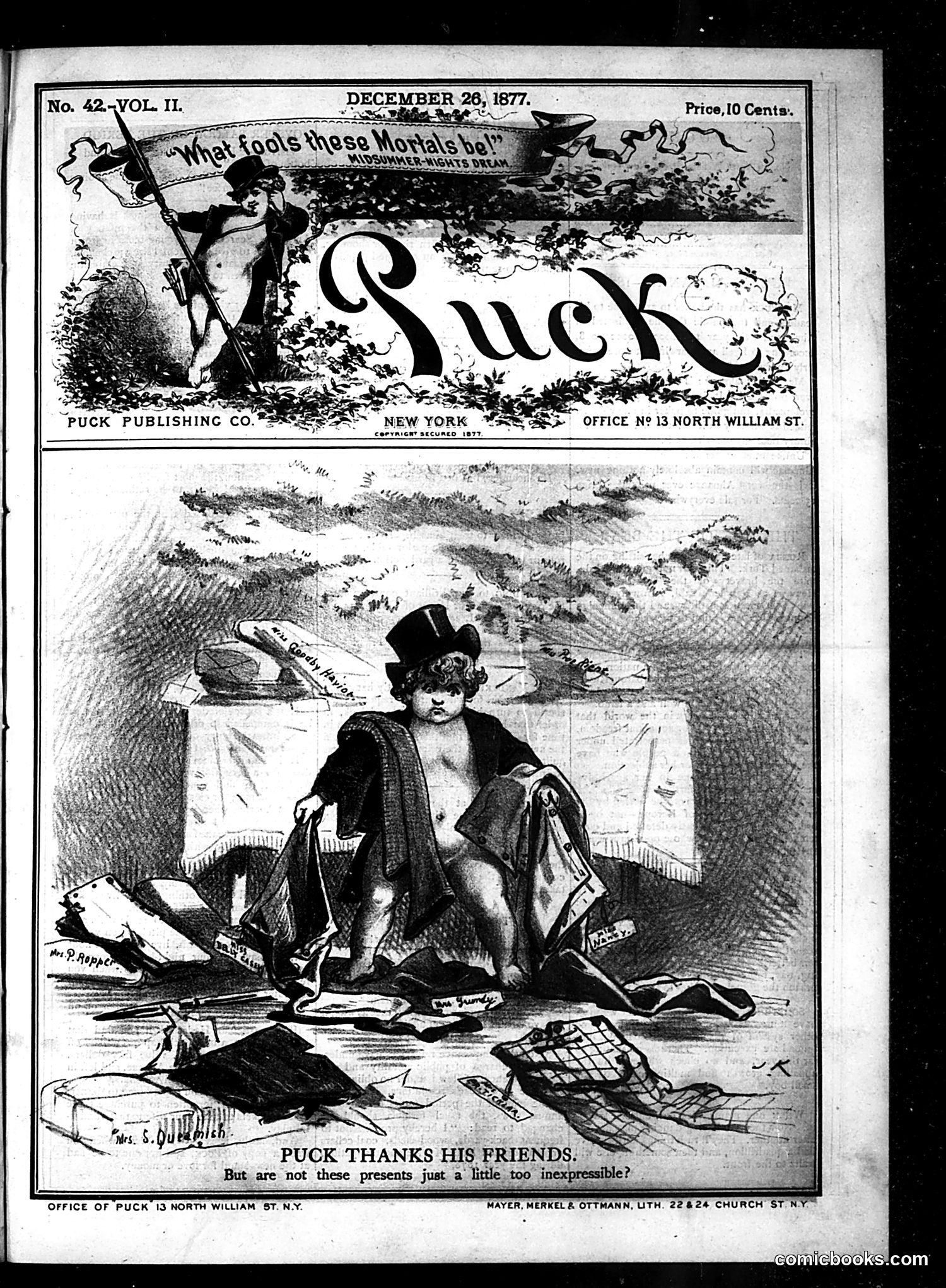
**"Puck Thanks His Friends"** This cartoon depicts Puck (the magazine's mascot character) as a cherub sitting amid a pile of gifts, wearing a top hat. The caption reads: "But are not these presents just a little too inexpressible?" The satire appears to target the excesses of gift-giving or holiday materialism of the era. Several labeled boxes surround Puck, though the specific text on individual gifts is difficult to read clearly in this reproduction. The phrase "inexpressible" likely suggests the gifts are so numerous, extravagant, or absurd that they're beyond adequate description—mocking either the generosity of wealthy patrons or the commercialization of the holiday season. This is a year-end issue, making it a topical seasonal commentary.
This page is primarily **textual content rather than political cartoons**. It contains: 1. **Magazine masthead and subscription information** for Puck, published at 13 North William Street, New York 2. **"Puck's Almanac—1878"** announcement promoting the annual publication as a reliable reference combining Bible, prayer-book, encyclopedia, and poker guide 3. **"The Hug of the Bear"** — a satirical article criticizing Russia's military actions against Turkey, characterizing Russia's aggression as hypocritical given its claims of civilization. The piece argues Russia uses "government" as pretext for imperial conquest, comparing Russian power to predatory force rather than enlightened statecraft 4. **Various satirical columns** on New Year's resolutions and social commentary The page lacks identifiable political cartoons or caricatures. It's primarily opinion-based satire targeting Russian imperialism through written commentary rather than visual humor.
This page contains three distinct satirical pieces rather than a single cartoon: 1. **"Resolutions"** — A humorous essay on New Year's resolutions, mocking how people make grand promises they won't keep. It satirizes the male habit of resolving to avoid late Saturday nights, suggesting such pledges are inherently false. 2. **"My Grandfather"** — A nostalgic narrative about a Revolutionary War veteran who later became a successful businessman in New Jersey and New York, ultimately dying peacefully at home. This appears celebratory rather than satirical. 3. **"Where to Go in the Evenings"** — A comedic dialogue between "Judge" and "Other Young Man" about affordable evening entertainment options (church, concerts, theaters, oysters), poking fun at limited leisure activities available to young working-class men. The page prioritizes written humor over visual satire.
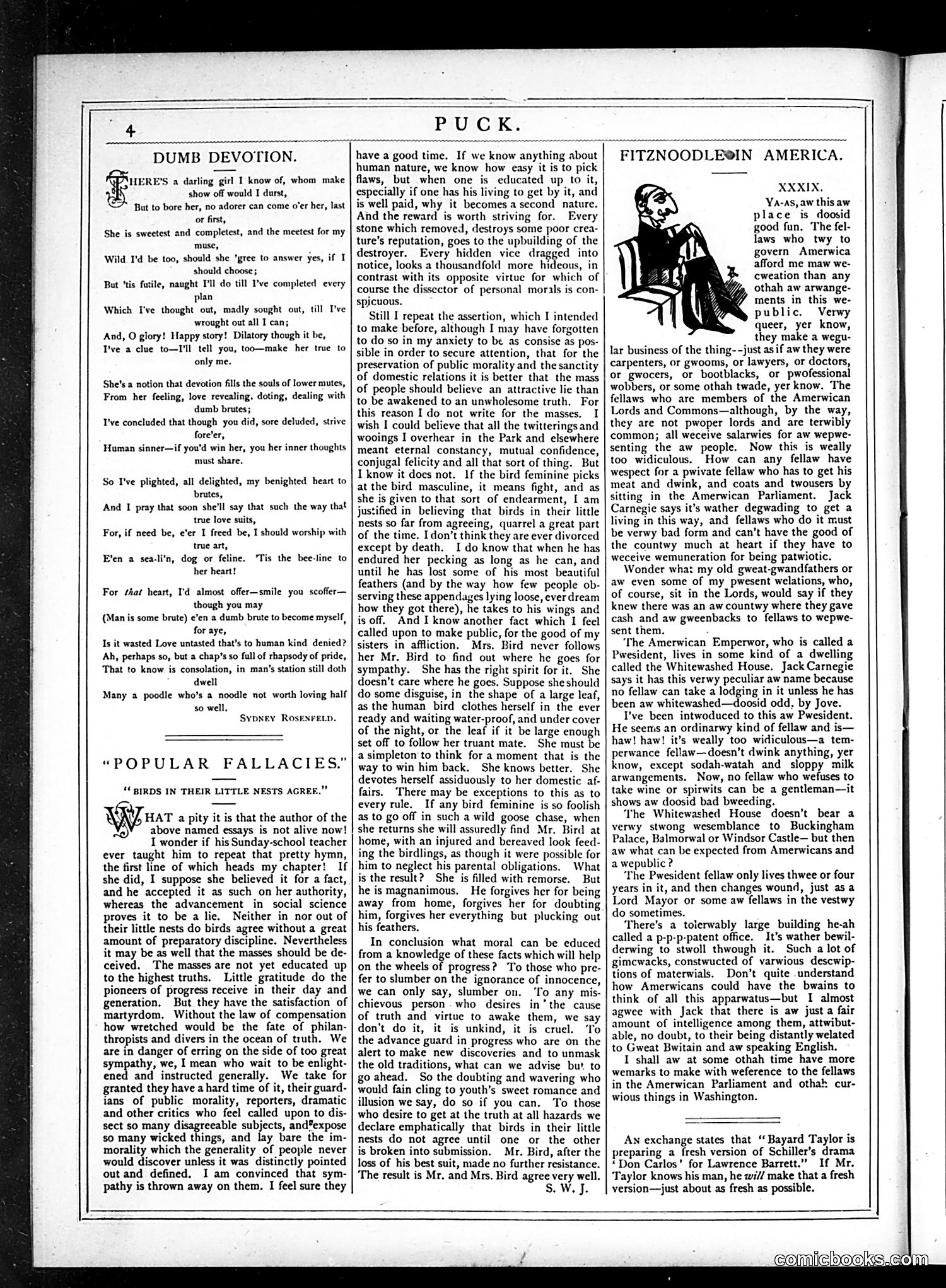
This page contains three distinct pieces: "Dumb Devotion" (a poem about a devoted woman), "Popular Fallacies: Birds in Their Little Nests Agree" (a satirical essay debunking the myth that birds live harmoniously), and "Fitznoodle in America" (a illustrated column). The "Fitznoodle" cartoon depicts a caricatured figure—likely representing a type rather than a specific person—seated and gesturing. The accompanying text discusses American public figures, politicians, and society, mocking what appears to be pretentious or hypocritical behavior among American elites and government officials. The satire focuses on social pretense and the gap between public morality and private conduct, typical of Puck's satirical approach to American politics and society.
This satirical poem depicts a metaphorical battle between **Book Agents** and **Lightning Men** (Sewing Machine salesmen) competing for dominance in a city. The "Mayor" appears as a bewildered authority figure unable to control the chaos. The satire targets **aggressive door-to-door salesmanship** culture of the era—a common social complaint. Book agents armed with their products clash against sewing machine representatives, with both groups wielding their goods as "weapons." The poem mocks how merchants terrorized citizens with high-pressure sales tactics, treating commercial competition as literal warfare. The ghostly victim "Todd" and graveyard imagery suggest these salesmen metaphorically destroy peace and sanity. This reflects Gilded Age anxieties about commercialism overtaking civic order and public space.
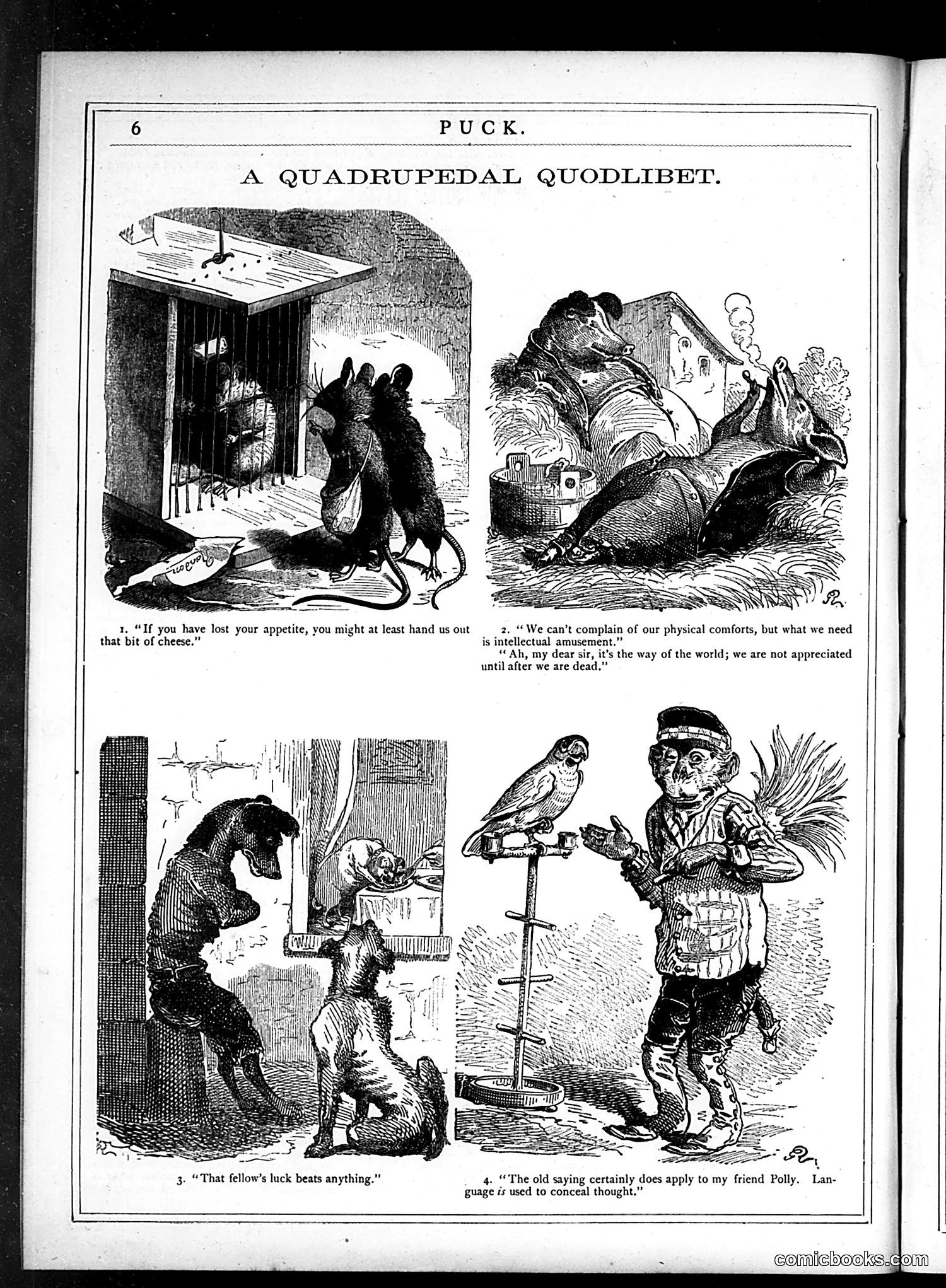
This Puck page presents four anthropomorphic animal vignettes, each illustrating a sardonic observation about human nature and society: 1. **Imprisoned appetite**: Mice outside a cage jest about lost appetites and cheese—likely satirizing how deprivation or constraint affects desire. 2. **Philosophical resignation**: Large animals discuss unappreciated comforts in life, suggesting we only value things after losing them—a commentary on human ingratitude. 3. **Luck and fortune**: A character claims another's "luck beats anything," mocking how people attribute success to chance rather than merit. 4. **Concealers of thought**: A figure with a parrot comments on an old saying about language concealing thought, suggesting hypocrisy or deception in communication. The "quodlibet" (medieval Latin for "whatever") title suggests these are loosely connected observations on universal human follies.
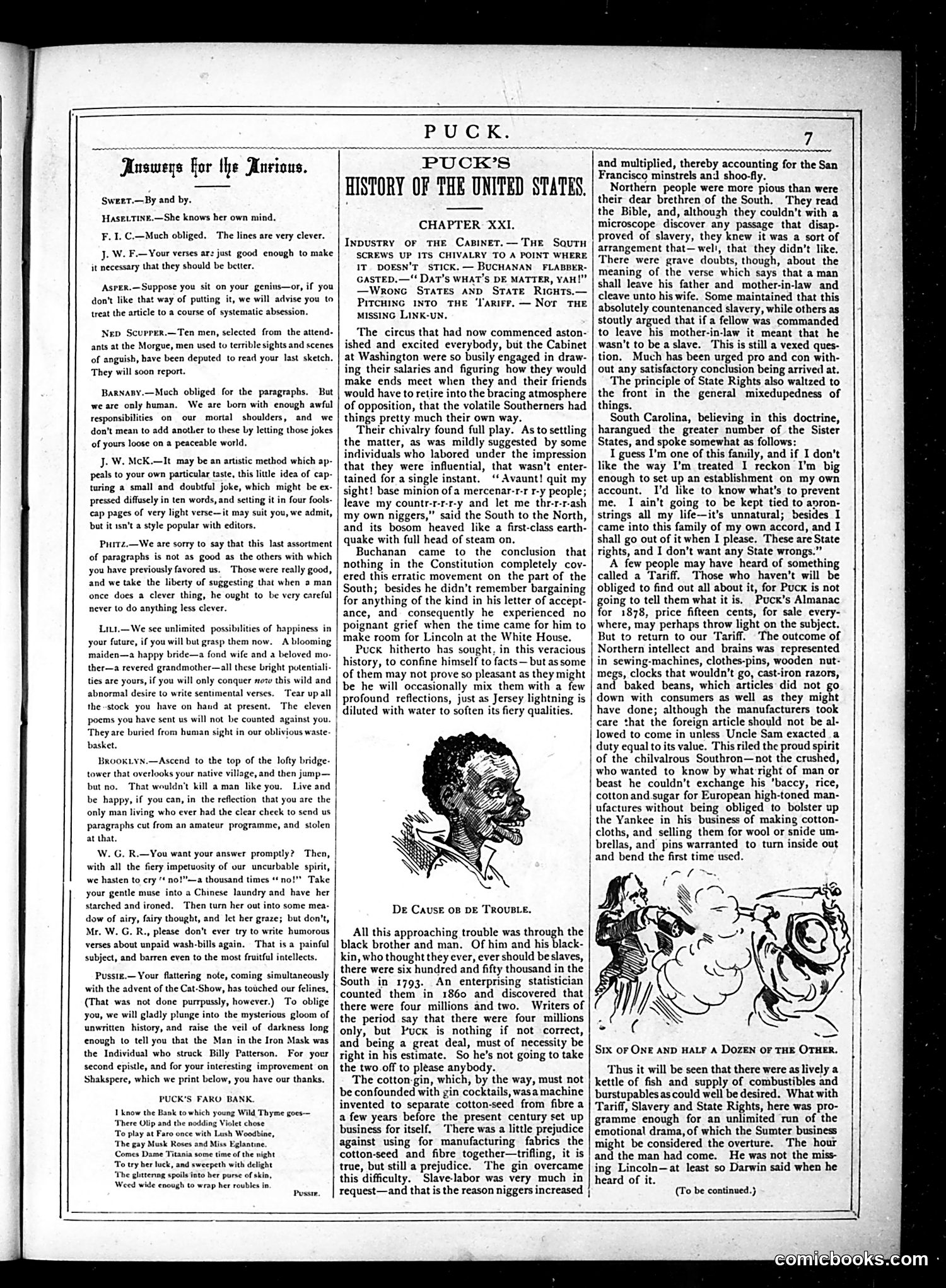
This page from Puck magazine contains Chapter XXI of "Puck's History of the United States," focusing on pre-Civil War industrial and political tensions. The main cartoon, titled "De Cause or De Trouble," depicts a caricatured Black face in profile—a deeply offensive racial stereotype common to 19th-century American satire. The accompanying text discusses slavery's economic role, cotton production, and sectional conflict between North and South. The cartoon appears to blame enslaved people themselves for national discord, reflecting the racist "logic" some used to justify slavery. The grotesque imagery served Puck's satirical purpose, though the exact intended critique—whether condemning slavery or mocking abolitionism—remains ambiguous from this page alone.
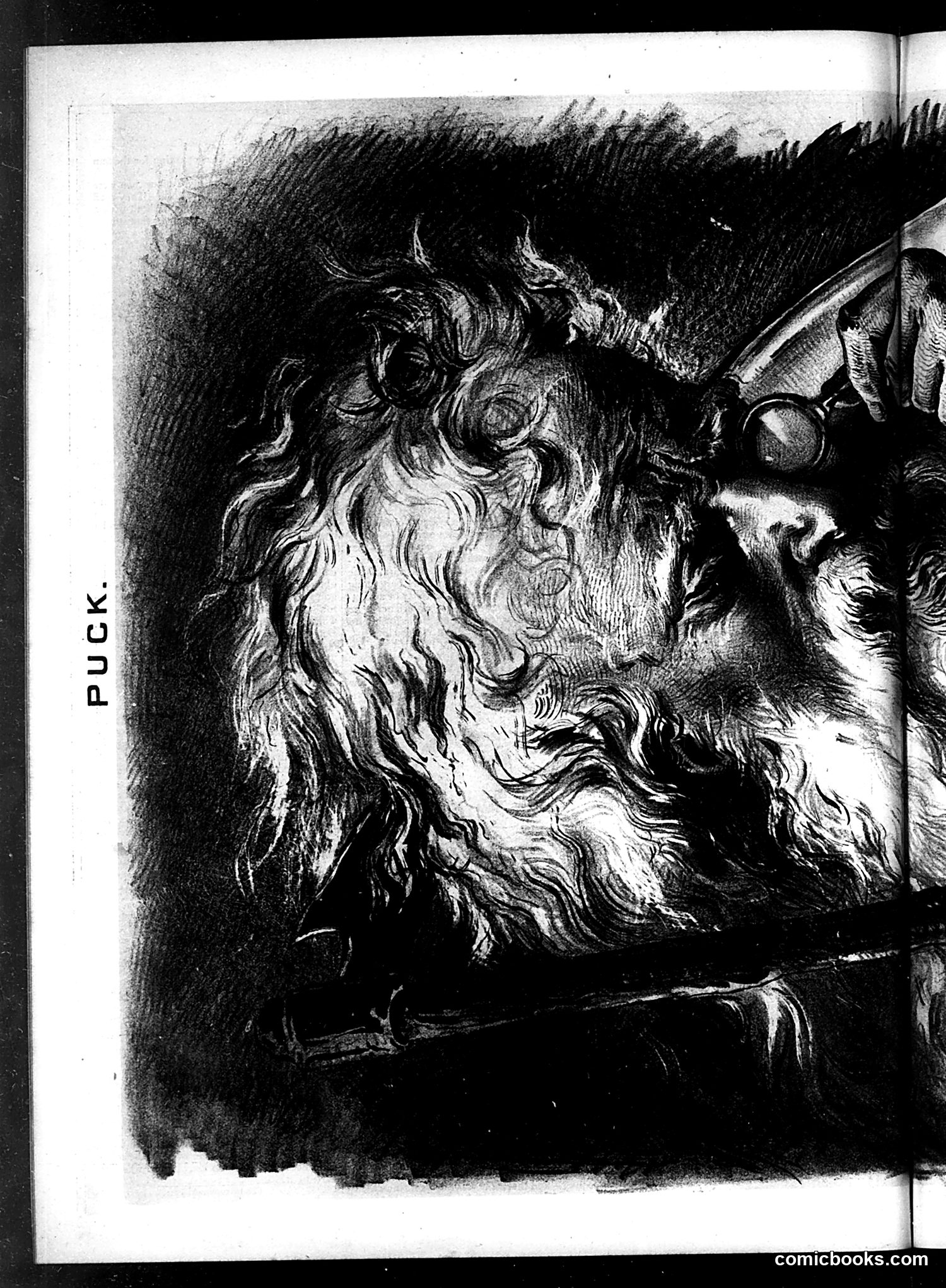
This appears to be an engraved illustration from Puck magazine showing a bearded man's head in profile, rendered in a classical style with elaborate curly hair and facial hair. The figure has exaggerated features typical of 19th-century caricature work. The artist has employed heavy cross-hatching and detailed line work characteristic of period engraving techniques. Without clearer text or additional context on this page, I cannot definitively identify the specific political or social figure being caricatured or the particular issue being satirized. The classical treatment suggests this may reference a historical or mythological figure used allegorically in political commentary, but the specific target and satirical message remain unclear from the image alone.
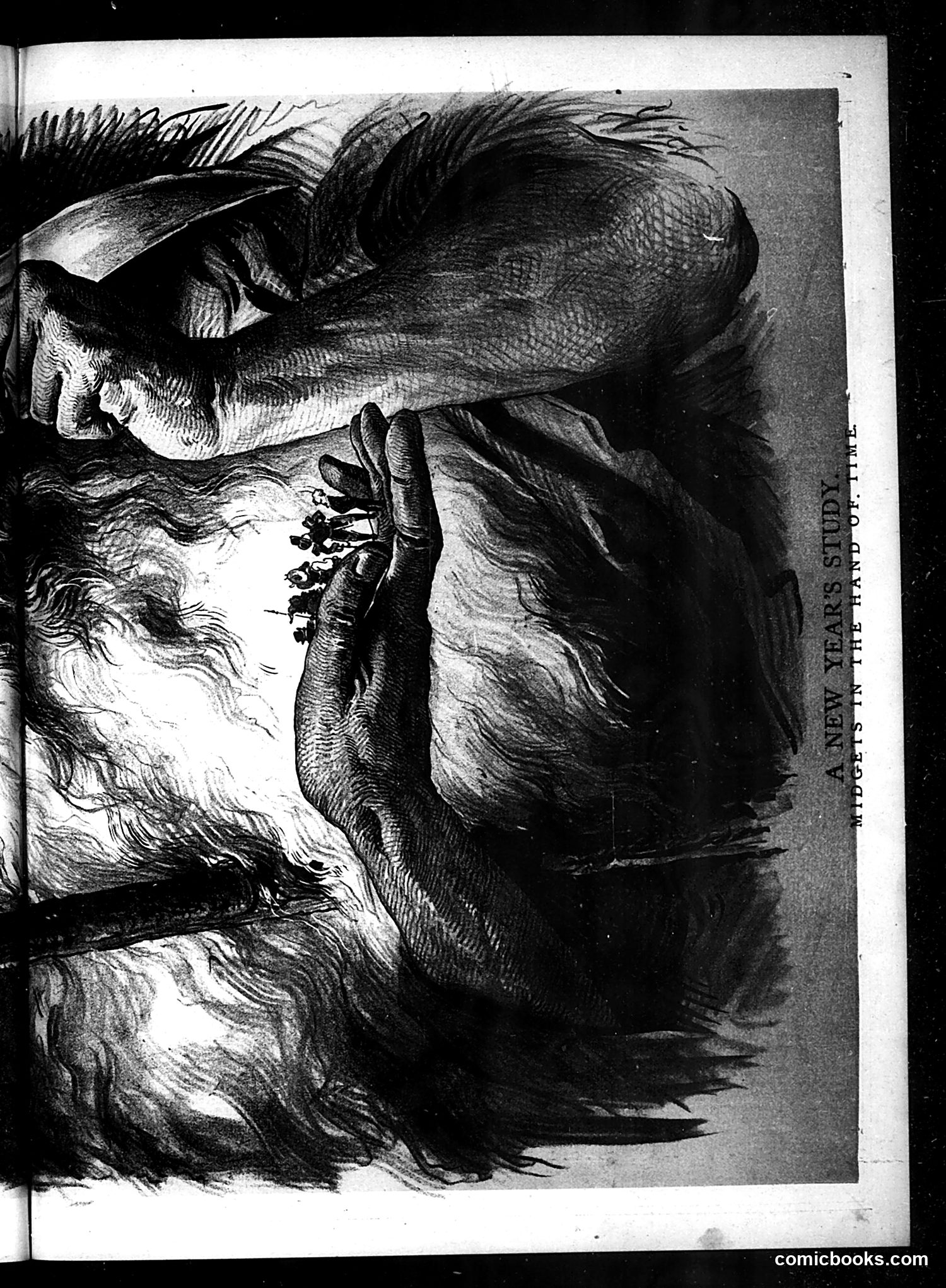
This appears to be a portrait-style engraving rather than a political cartoon. The image shows a bearded man in profile, rendered in detailed cross-hatching technique typical of 19th-century wood or steel engraving. The figure has flowing hair and beard, and appears to be wearing period clothing. However, without legible text identifying the subject or accompanying satirical commentary visible in this reproduction, I cannot definitively determine who is depicted or what political or social point, if any, is being made. The OCR text provided contains no readable content to explain the context. To properly analyze this as political satire, I would need either clearer identifying text or visible captions that are not legible in this image quality.
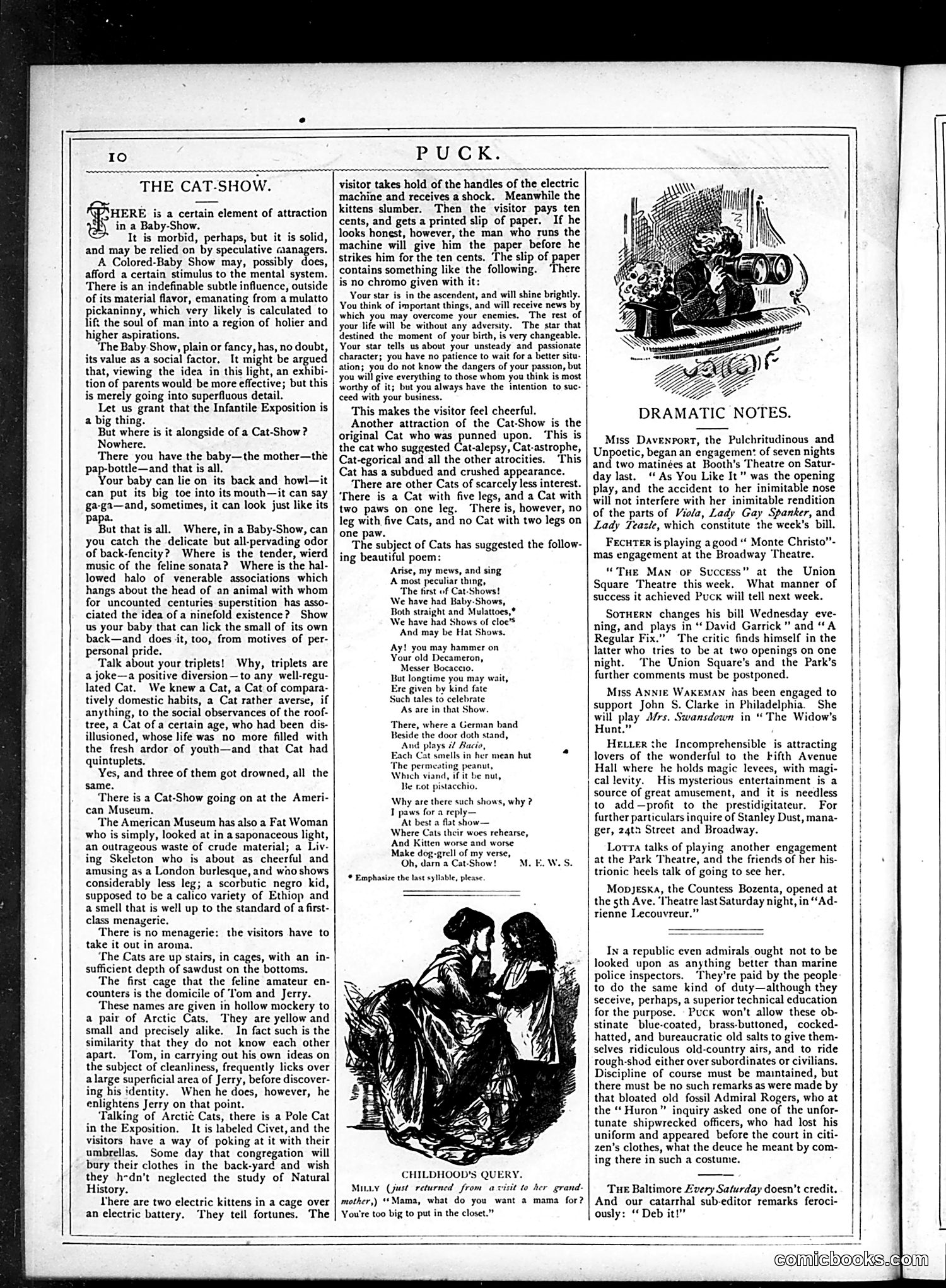
This page contains a satirical article about the attractions and absurdities of a Baby Show and Cat Show exhibition. The author mocks the pretension surrounding these events, particularly: **The Main Critique:** The article ridicules the pseudo-scientific appeal of these shows—visitors are drawn to exhibits by grandiose claims (like fortune-telling machines and electrical attractions) rather than genuine interest in the animals themselves. **The Satire:** The piece humorously catalogs various dubious attractions (a "Fat Woman," "Living Skeleton," calico cats claimed to be from Ethiopia) that exploit visitor curiosity. **The Point:** Puck uses the Cat Show as a vehicle to mock the era's fascination with spectacle over substance, and the American public's gullible attraction to carnival-style exhibitions and manufactured wonder. The accompanying illustrations support this satirical tone, depicting visitors engaged with these questionable attractions.
This page contains **no political cartoon**. Instead, it presents literary content: "To a Butterfly" (a poem), and the continuation of "Two Knaves and a Queen," an English short story by John De Morgan. The story section (Chapter XXXIX) depicts a fencing duel between characters named de Gaillefontaine and René over a masked woman. The narrative focuses on sword-fighting skill, honor, identity revelation, and romantic rivalry—typical melodramatic fiction of the era. Without visible illustrations accompanying the text, and given the purely narrative content, this appears to be a **literature-focused page** rather than satirical commentary. Puck, while primarily known for political cartoons, also published serialized fiction for its readers.
This page is primarily text—a continuation of "Chapter XL" of serialized fiction titled "Puck's Retinges," along with scattered brief satirical news items and social commentary in the margins. The central illustration shows a figure in period dress (appears to be 18th or 19th century) in a reclined or dramatic pose, though details are unclear from this reproduction. The text includes typical Puck content: humorous observations on contemporary American life—medicines, church contributions, baby toys, wives, tall men, whiskey drinking, and political figures like Senator Davis. References appear to satirize consumer products, social pretensions, and public figures of the era, though specific identities require additional context beyond what this page alone reveals. This is primarily a literary/satirical commentary page rather than a political cartoon page.
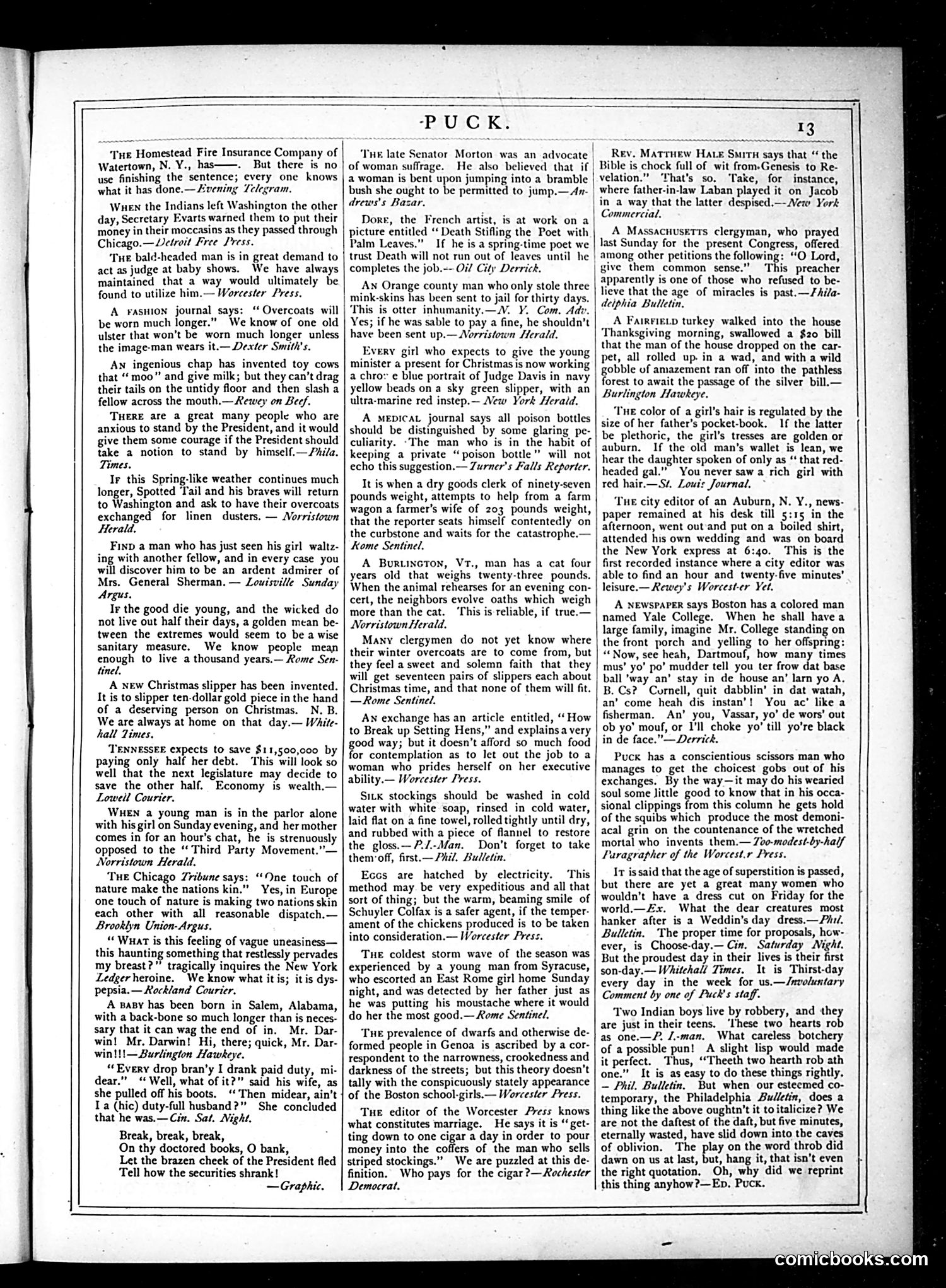
This page consists entirely of **text-based satirical commentary**, not visual cartoons. It's a collection of brief humorous anecdotes and social observations from various newspapers, organized in a column format. The jokes target typical late-19th/early-20th century American subjects: bureaucratic absurdity (fire insurance company policies), domestic humor (wives' behavior), rural simplicity, and gender roles. References include a "French artist" painting religious subjects, political commentary about the President, and social observations about fashion, marriage, and propriety. The page functions as **Puck's editorial commentary**—reprinting and mocking news items and conventional wisdom from other publications to highlight societal contradictions and human folly. No specific identified political figures appear in this particular page.
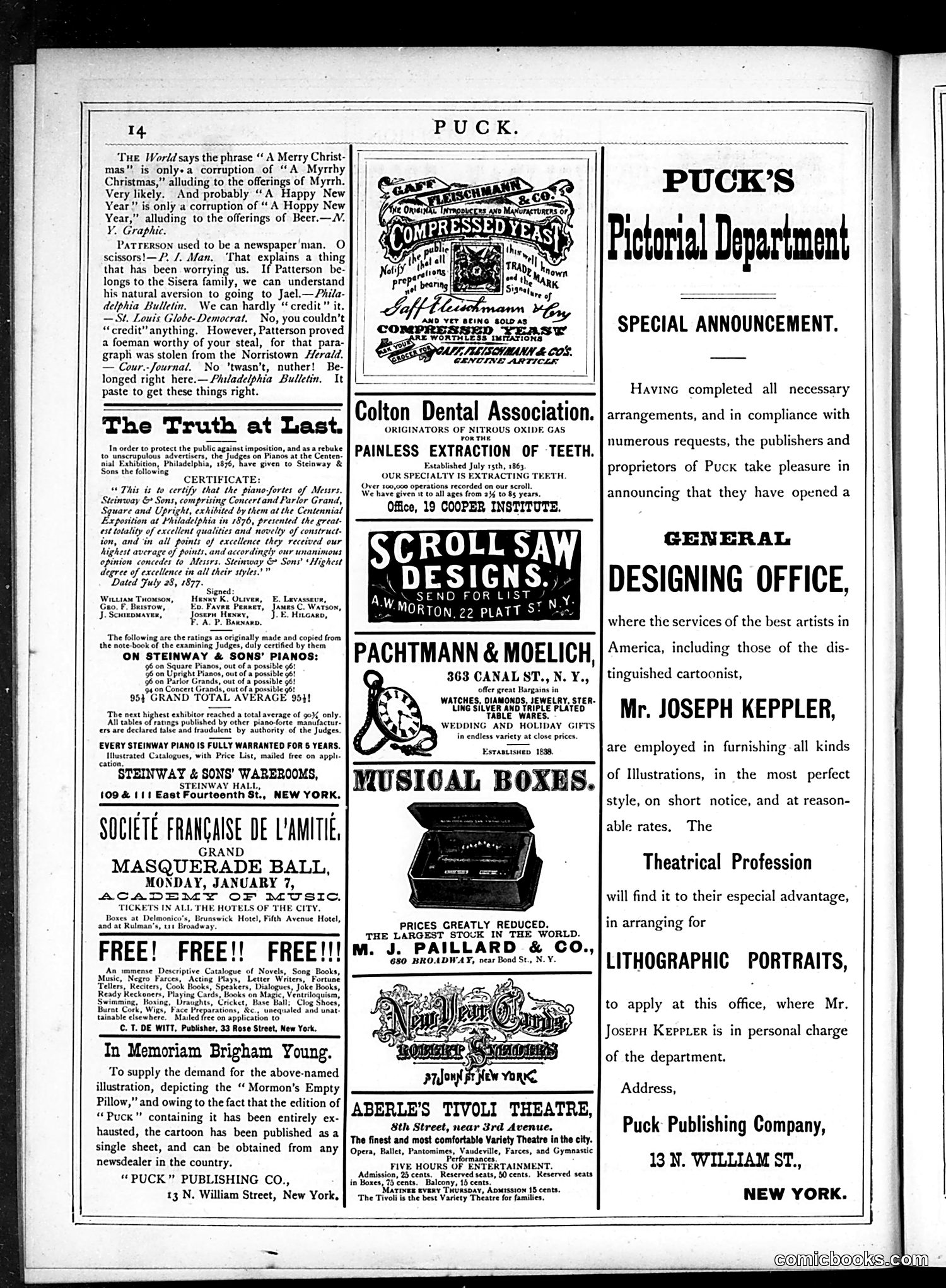
This page is **primarily advertising** for Puck Publishing Company's services and various commercial enterprises (dental extraction, musical boxes, lithographic portraits, theatrical venues). The only editorial content visible is a brief section titled "The Truth at Last," which appears to be a humorous debunking of common phrase origins. It argues that "A Merry Christmas" derives from "A Myrthy Christmas," and "A Happy New Year" from "A Hoppy New Year"—presenting absurd etymologies as corrections to what The World newspaper claimed. This is light satirical humor poking fun at language pretension. The page includes an announcement of Puck's new General Designing Office featuring cartoonist Joseph Keppler. Otherwise, it's a standard 19th-century magazine back-matter page dominated by advertisements.
This is primarily an **advertising page** from Puck magazine, not a satirical cartoon page. The layout contains multiple advertisements for 1870s-era goods and services: - Cassimere hat manufacturer - Puck's English Almanac (15 cents) - French dolls and dolls' outfits at Bloom's - Gentlemen's hats (Dunlap & Co.) - Portrait studios (Kurtz, Nicoll the tailor) - Champagne and wine importers - Hungarian wines - Patent filing covers for Puck - Information on back issues The page serves as **revenue generation** through classified advertising rather than editorial content. While Puck was known for political satire, this particular page demonstrates how 19th-century magazines funded operations through paid advertisements targeting middle and upper-class consumers with luxury goods.
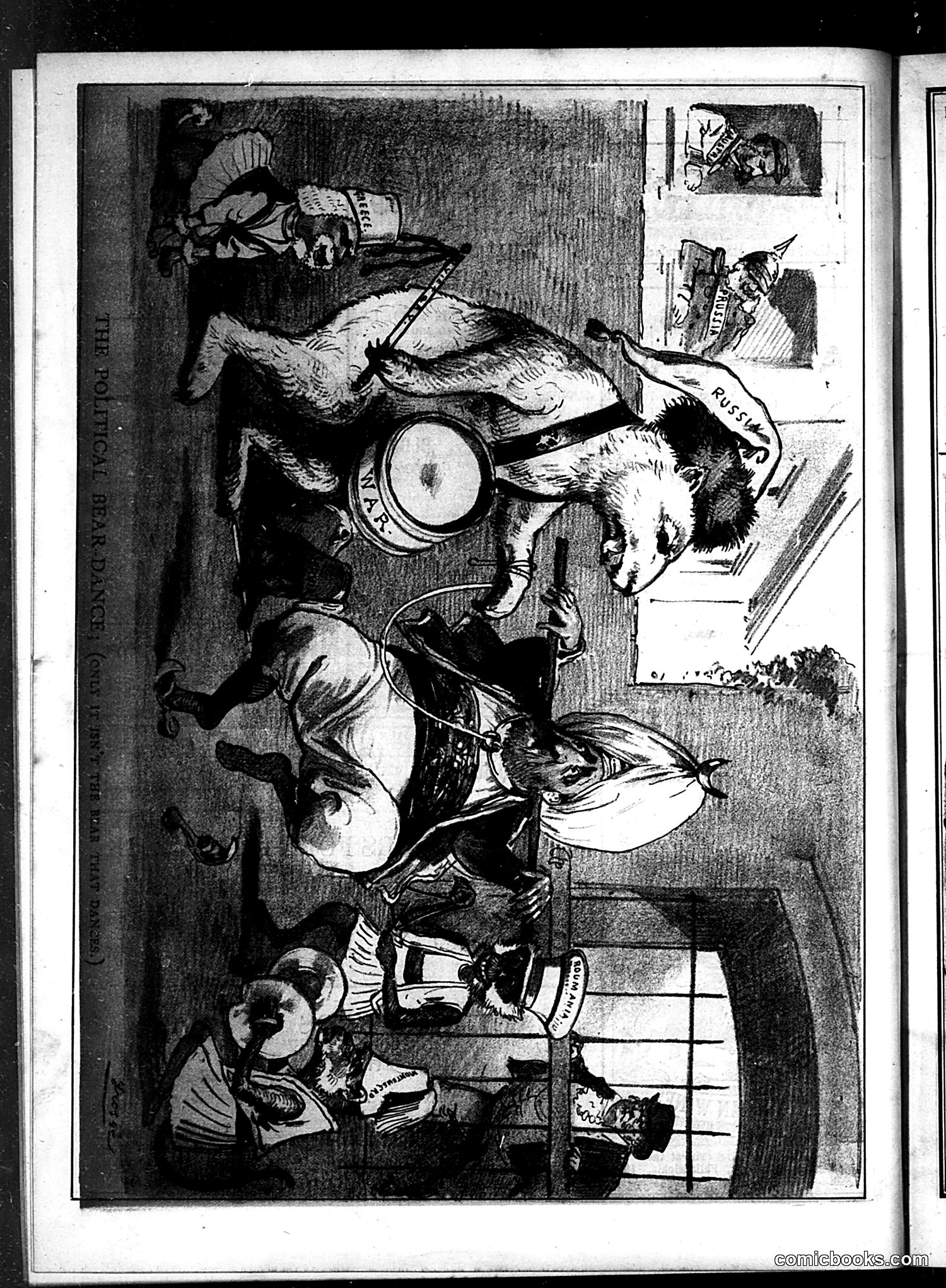
This appears to be a political cartoon from Puck magazine, though the OCR text provided is largely illegible. The image shows what appears to be a satirical scene rotated 90 degrees, depicting figures in what looks like a domestic or political setting. There's a dog present, and what appears to be caricatured figures in period dress (possibly late 19th century). Without legible text or clearer identification of the specific figures depicted, I cannot confidently identify the particular political figures, events, or satirical targets this cartoon addresses. The artistic style and composition suggest social or political commentary typical of Puck's satirical approach, but the specific meaning and context remain unclear from this reproduction. More information about the publication date and caption would be needed for accurate interpretation.