
Puck, 1877-12-26 · page 7 of 16
Puck — December 26, 1877 — page 7: what you’re looking at
What you’re looking at
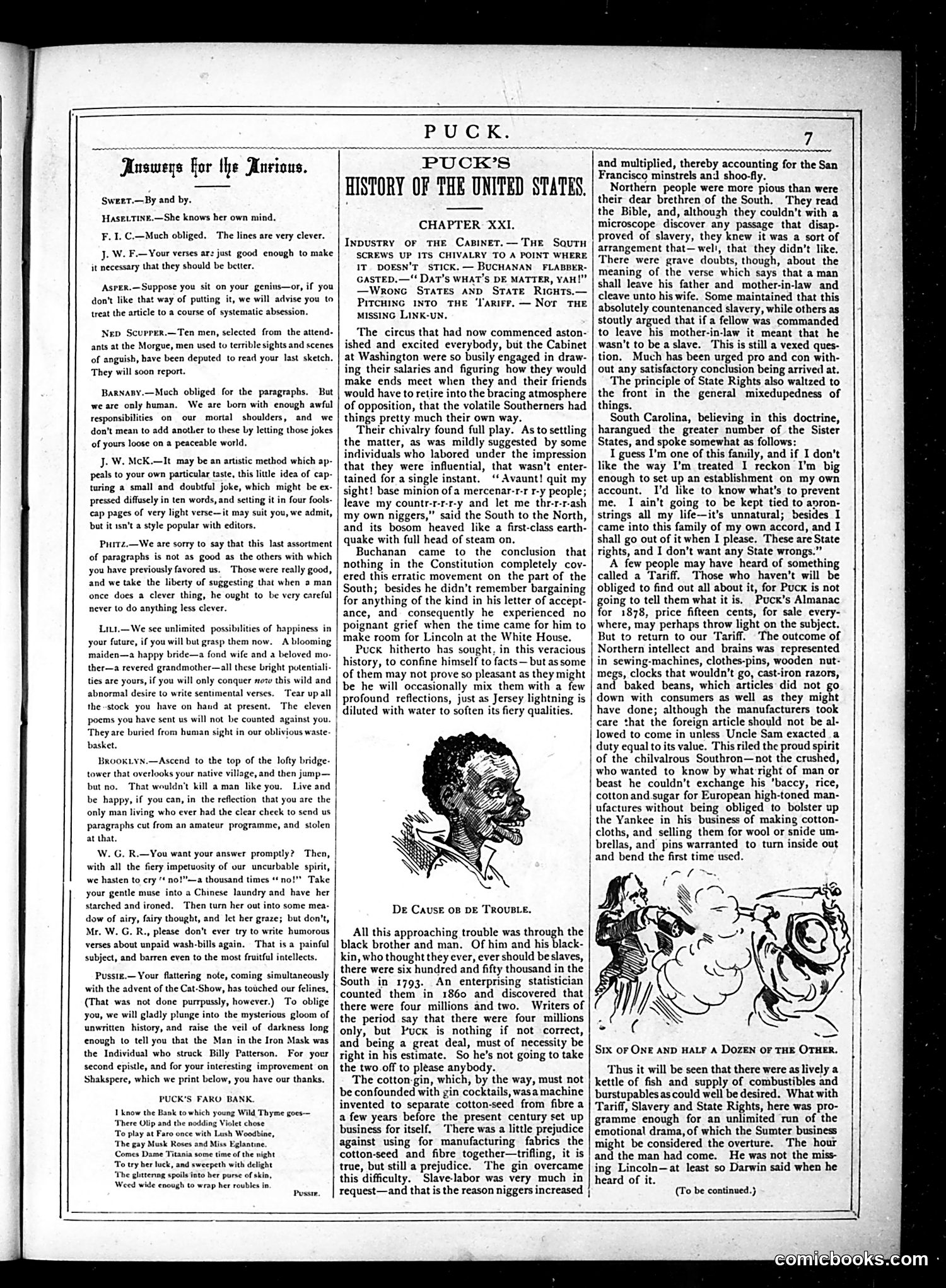
This page from Puck magazine contains Chapter XXI of "Puck's History of the United States," focusing on pre-Civil War industrial and political tensions. The main cartoon, titled "De Cause or De Trouble," depicts a caricatured Black face in profile—a deeply offensive racial stereotype common to 19th-century American satire. The accompanying text discusses slavery's economic role, cotton production, and sectional conflict between North and South. The cartoon appears to blame enslaved people themselves for national discord, reflecting the racist "logic" some used to justify slavery. The grotesque imagery served Puck's satirical purpose, though the exact intended critique—whether condemning slavery or mocking abolitionism—remains ambiguous from this page alone.
📄 Transcribed text from this page (OCR, searchable)
Machine-transcribed from the original scan — historical spelling and the odd misread are preserved.
~ Pnsweys for the Anrious. She knows her own mind. uch obliged. The lines are very clever. J. W. F.—Your verses ar: just good enough to make it necessary that they should be better. Asrer.—Suppose you sit on your genins—or, if you don't like that way of putting it, we will advise you to treat the article to a course of systematic absession. Nep ScurreR.—Ten men, selected from the attend ants at the Morgue, men used to terrible sights and scenes of anguish, bave been deputed to read your last sketch. They will soon report, Barnany.—Much obliged for the paragraphs. But we are only human. We are Lor with enough awful responsibilities on our mortal shoulders, and we don’t mean to add another to these by letting those jokes of yours loose on a peaceable world. J. W. McK.—It_ may be an artistic method which ap- peals to your own particular taste, this little idea of cap- turing a small and doubtful joke, which might be ex- pressed diffusely in ten words, and setting it in four fools- cap pages of very light verse—it may suit you, we admit, but it isn't a style popular with editors. Purrz.—We are sorry to say that this last assortment of paragraphs is not as good as the others with which you have previously favored us. ‘Those were really good, and we take the liberty of suggesting that when 9 man once does a clever thing, he ought to be very careful never to do anything less clever. LILI.—We sce unlimited possibilities of happiness in your future, if you will but grasp them now. A blooming maiden—a happy bride—a fond wife and a beloved mo- ther—a revered grandmother—all these bright potentiali- ties are yours, if you will only conquer nozw this wild and abnormal desire to write sentimental verses. Tear up all the--stock you have on hand at present. The eleven poems you have sent us will not be counted against you. ‘They are buried from human sight in our oblivious waste. basket. BRoOKLYN.—Ascend to the top of the lofty bridge. tower that overlooks your native village, and then jump— but no, That wouldn't kill a man like you. Live and be happy, if you can, in the reflection that you are the only man living who ever had the clear cheek to send us paragraphs cut from an amateur programme, and stolen at that. W. G, R.—You want your answer promptly? Then, | with all the fiery impetuosity of our uncurbable spirit, | we hasten to cry “no!”—a thousand times no!" Take your gentle muse into a Chinese laundry and have her starched and ironed. Then turn her out into some mea- dow of airy, fairy thought, and let her graze; but don't, Mr. W. G. R., please don't ever try to write humorous verses about unpaid wash-bills again. That is a painful subject, and barren even to the most fruitful intellects. Pussiz.— Your flattering nole, coming simultaneously with the advent of the Cat-Show, has touched our felines, (That was not done purrpussly, however.) To oblige you, we will gladly plunge into the mysterious gloom of unwritten history, and raise the veil of darkness long enough to tell you that the Man in the Iron Mask was the Individual who struck Billy Patterson. For your second epistle, and for your interesting improvement on Shakspere, which we print below, you have our thanks. PUCK’S FARO BANK. I know the Bank to which young Wild Thyme goes— “There Ulip and the nodding Violet chose To play at Faro once with Lush Woodbine, ‘The gay Musk Roses and Miss Eglantine. Comes Dame Titania some time of the night To try her luck, and sweepeth with delight ‘The glttenng spoils isto her purse of skin, Weed wide enough to wrap her roubles in PUCK. ars 7 PUCK’S HISTORY OF THE UNITED STATES. CHAPTER XXI. InpustRY OF THE CaBineT.— THE Sautn SCREWS UP ITS CHIVALRY TO A POINT WHERE IT DOESN'T STICK.— BUCHANAN FLABBE! GasTED.—“ Dat’s WHAT'S DE MATTER, YAH —Wronc States AND StaTE RiGHTs.— PITCHING INTO THE ‘l'ariFrF, — Nor THE MISSING LINK-UN, The circus that had now commenced aston- ished and excited everybody, but the Cabinet at Washington were so busily engaged in draw- ing their salaries and figuring how they would make ends meet when they and their friends would have to retire into the bracing atmosphere of opposition, that the volatile Southerners had things pretty much their own way. Their chivalry found full play. As to settling the matter, as was mildly suggested by some individuals who labored under the impression that they were influential, that wasn’t enter- tained for a single instant. ‘‘ Avaunt! quit my sight! base minion ofa mercenar-r-r r-y people; leave my countr-r-r-r-y and let me thr-r-r-ash my own niggers,” said the South to the North, and its bosom heaved like a first-class earth- quake with full head of steam on, Buchanan came to the conclusion that nothing in the Constitution completely cov- ered this erratic movement on the part of the South; besides he didn’t remember bargaining for anything of the kind in his letter of accept- ance, and consequently he experienced no poignant grief when the time came for him to make room for Lincoln at the White House. Puck hitherto has sought, in this veracious history, to confine himself to facts — but as some of them may not prove so pleasant as they might be he will occasionally mix them with a few profound reflections, just as Jersey lightning is diluted with water to soften its fiery qualities. De Cause o8 DE TROUBLE. All this approaching trouble was through the black brother and man. Of him and his black- kin, who thought they ever, ever should beslaves, there were six hundred and fifty thousand in the South in 1793. An enterprising statistician counted them in 1860 and discovered that there were four millions and two. Writers of the period say that there were four millions only, but Puck is nothing if not correct, and being a great deal, must of necessity be right in his estimate. So he’s not going to take the two off to please anybody. The cotton-gin, which, by the way, must not be confounded with gin cocktails, wasa machine invented to separate cotton-seed from fibre a a few years before the present century set up business for itself. ‘There was a little prejudice against using for manufacturing fabrics the cotton-seed and fibre together—trifling, it is true, but still a prejudice. The gin overcame this difficulty. Slavelabor was very much in request—and that is the reason niggers increased and multiplied, thereby accounting for the San Francisco minstrels and shoo-fly. Northern people were more pious than were their dear brethren of the South. They read the Bible, and, although they couldn’t with a microscope discover any passage that disap- proved of slavery, they knew it was a sort of arrangement that—wel!, that they didn’t like. There were grave doubts, though, about the meaning of the verse which says that a man shall leave his father and mother-in-law and cleave unto his wife. Some maintained that this absolutely countenanced slavery, while others as stoutly argued that if a fellow was commanded to leave his mother-in-law it meant that he wasn't to be aslave. This is still a vexed ques- tion. Much has been urged pro and con with- out any satisfactory conclusion being arrived at. The principle of State Rights also waltzed to the front in the general mixedupedness of things. South Carolina, believing in this doctrine, harangued the greater number of the Sister States, and spoke somewhat as follows: I guess I’m one of this family, and if I don't like the way I’m treated I reckon I’m big enough to set up an establishment on my own account. I'd like to know what’s to prevent me. I ain’t going to be kept tied to apron- strings all my life—it’s unnatural; desides I came into this family of my own accord, and I shall go out of it when I please. These are State tights, and I don’t want any State wrongs.” "A few people may have heard of something called a Tariff. Those who haven't will be obliged to find out all about it, for Puck is not going to tell them what it is. Pucx’s Almanac for 1878, price fifteen cents, for sale every- where, may perhaps throw light on the subject. But to return to our Tariff. The outcome of Northern intellect and brains was represented in sewing-machines, clothes-pins, wooden nut- , clocks that wouldn’t go, cast-iron razors, and baked beans, which articles did not go down with consumers as well as they might have done; although the manufacturers took | care that the foreign article should not be al- lowed to come in unless Uncle Sam exacted a duty equal to its value. This riled the proud spirit of the chilvalrous Southron—not the crushed, who wanted to know by what right of man or beast he couldn’t exchange his 'baccy, rice, cotton and.sugar for European high-toned man- ufactures without being obliged to bolster up the Yankee in his business of making cotton- cloths, and selling them for wool or snide um- brellas, and pins warranted to turn inside out and bend the first time used. Srx or ONE AND HALF A DOZEN OF THE OTHER. ‘Thus it will be seen that there were as lively a kettle of fish and supply of combustibles and burstupables as could well be desired. What with Tariff, Slavery and State Rights, here was pro- gramme enough for an unlimited run of the emotional drama, of which the Sumter business might be considered the overture. The hour and the man had come. He was not the miss- ing Lincoln—at least so Darwin said when he heard of it. (To be continued.)