
Puck, 1877-12-26 · page 10 of 16
Puck — December 26, 1877 — page 10: what you’re looking at
What you’re looking at
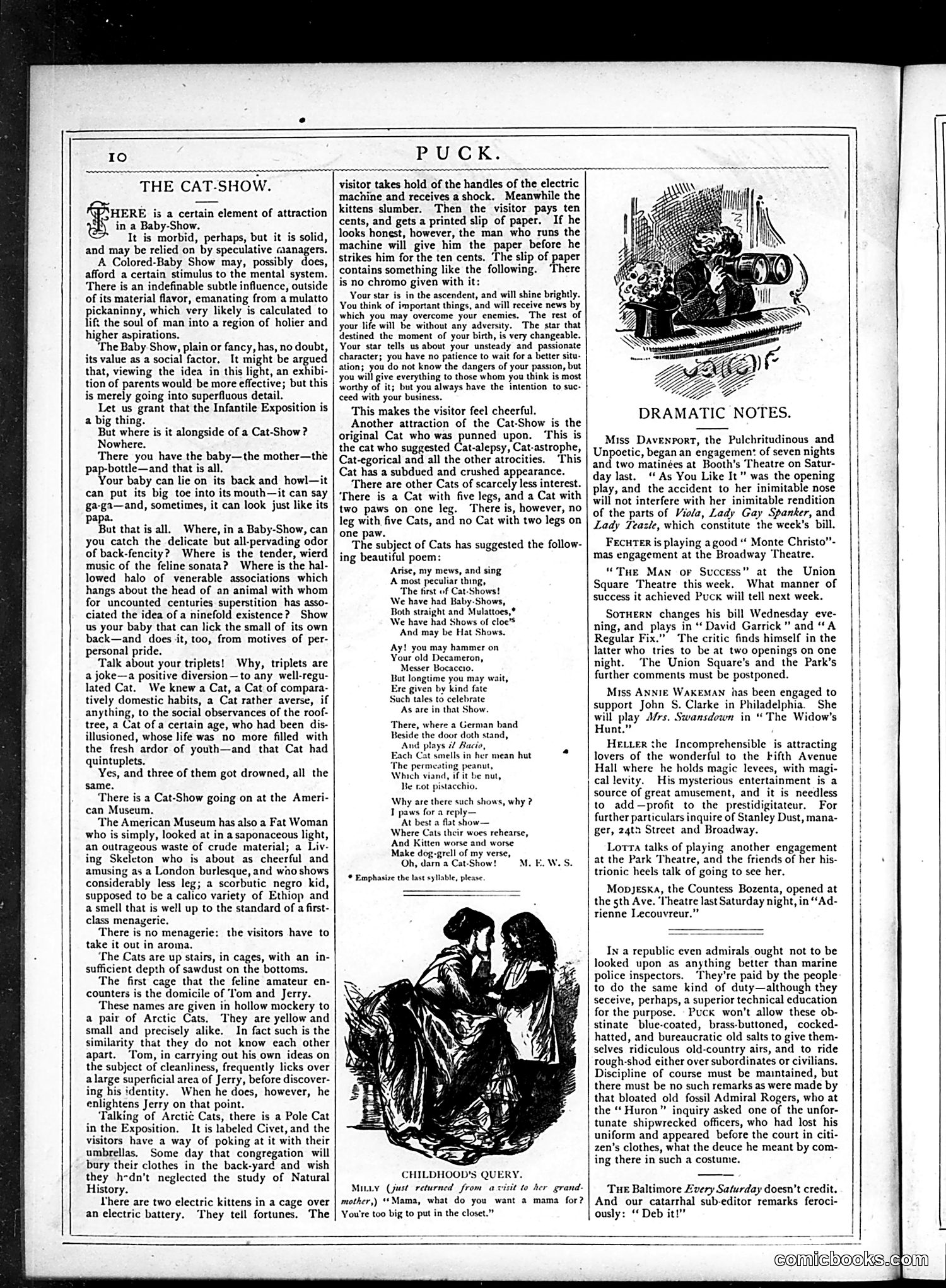
This page contains a satirical article about the attractions and absurdities of a Baby Show and Cat Show exhibition. The author mocks the pretension surrounding these events, particularly: **The Main Critique:** The article ridicules the pseudo-scientific appeal of these shows—visitors are drawn to exhibits by grandiose claims (like fortune-telling machines and electrical attractions) rather than genuine interest in the animals themselves. **The Satire:** The piece humorously catalogs various dubious attractions (a "Fat Woman," "Living Skeleton," calico cats claimed to be from Ethiopia) that exploit visitor curiosity. **The Point:** Puck uses the Cat Show as a vehicle to mock the era's fascination with spectacle over substance, and the American public's gullible attraction to carnival-style exhibitions and manufactured wonder. The accompanying illustrations support this satirical tone, depicting visitors engaged with these questionable attractions.
📄 Transcribed text from this page (OCR, searchable)
Machine-transcribed from the original scan — historical spelling and the odd misread are preserved.
Io PUCK. THE CAT-SHOW. HERE is a certain clement of attraction in a Baby-Show. It is morbid, perhaps, but it is solid, and may be relied on by speculative caanagers. A Colored-Baby Show may, possibly does, afford a certain stimulus to the mental system. There is an indefinable subtle influence, outside of its material flavor, emanating from a mulatto ickaninny, which very likely is calculated to if. the soul of man into a region of holier and higher aspirations. "The Baby Show, plain or fancy, has, no doubt, its value as a social factor. It might be argued that, viewing the idea in this light, an exhibi- tion of parents would be more effective; but this is merely going into superfluous detail. Let us grant that the Infantile Exposition is a big thing. But where is it alongside of a Cat-Show? Nowhere. There you have the baby—the mother—the pap-bottle—and that is all. Your baby can lie on its back and howl—it can put its big toe into its mouth—it can say ga-ga—and, sometimes, it can look just like its papa. But that is all. Where, in a Baby-Show, can you catch the delicate but all-pervading odor of back-fencity? Where is the tender, wierd music of the feline sonata? Where is the hal- lowed halo of venerable associations which hangs about the head of an animal with whom for uncounted centuries superstition has asso- ciated the idea of a ninefold existence? Show us your baby that can lick the small of its own back—and does ‘it, too, from motives of per- personal pride. Talk about your triplets! Why, triplets are a joke—a positive diversion—to any well-regu- lated Cat. We knew a Cat, a Cat of compara- tively domestic habits, a Cat rather averse, if anything, to the social observances of the roof- tree, a Cat of a certain age, who had been dis- illusioned, whose life was no more filled with the fresh ardor of youth—and that Cat had quintuplets. Yes, and three of them got drowned, all the same. ‘There is a Cat-Show going on at the Ameri- can Museum. The American Museum has also a Fat Woman who is simply, looked at in a saponaceous light, an outrageous waste of crude material; a Liv- ing Skeleton who is about as cheerful and amusing as a London burlesque, and wao shows considerably less leg; a scorbutic negro kid, supposed to be a calico variety of Ethiop and a smell that is well up to the standard of a first- class menagerie. ‘There is no menagerie: the visitors have to take it out in aroma. ‘The Cats are up stairs, in cages, with an in- sufficient depth of sawdust on the bottoms. The first cage that the feline amateur en- counters is the domicile of ‘Yom and Jerry. These names are given in hollow mockery to a pair of Arctic Cats. They are yellow and small and precisely alike. In fact such is the similarity that they do not know each other apart. ‘Tom, in carrying out his own ideas on the subject of cleanliness, frequently licks over a large superficial area of Jerry, before discover- ing his identity. When he does, however, he enlightens Jerry on that point. Talking of Arctic Cats, there is a Pole Cat in the Exposition. It is labeled Civet, and the visitors have a way of poking at it with their umbrellas. Some day that congregation will bury their clothes in the back-yard and wish they h-dn’t neglected the study of Natural History. Vhere are two electric kittens in a cage over an electric battery. They tell fortunes. The visitor takes hold of the handles of the electric machine and receives a shock. Meanwhile the kittens slumber. Then the visitor pays ten cents, and gets a printed slip of paper. If he looks honest, however, the man who runs the machine will give him the paper before he strikes him for the ten cents. The slip of paper contains something like the following. ‘There is no chromo given with it: Your star is in the ascendent, and will shine brightly. You think of important things, and will receive news by which you may overcome your enemies, The rest of your lie will be without exy adverity. The par that destined the moment of your birth, is very changeable. Your star tells us about your unsteady and passionate character; you have no patience to wait for a better situ ation; you do not know the dangers of your passion, but you will give everything to those whom you think is most worthy of it; but you always have the intention to suc- ceed with your business. This makes the visitor feel cheerful. Another attraction of the Cat-Show is the original Cat who was punned upon. This is the cat who suggested Cat-alepsy, Cat-astrophe, Cat-egorical and all the other atrocities. This Cat has a subdued and crushed appearance. There are other Cats of scarcely less interest. ‘There is a Cat with five legs, and a Cat with two paws on one leg. ‘There is, however, no leg with five Cats, and no Cat with two legs on one paw. The subject of Cats has suggested the follow- ing beautiful poem: Arise, my mews, and sing A most peculiar thing, ‘The first of Cat-Shows! We have had Baby-Shows, Both straight and Mulattoes,* We have had Shows of cloe’S And may be Hat Shows. Ay! you may hammer on Your old Decameron, Messer Bocaccio. But longtime you may wait, Ere given by kind fate Such tales to celebrate As are in that Show. There, where a German band Beside the door doth stand, ‘And plays i Bacio, Each Cat smells in her mean hut The permeating peanut, Which viand, if it be nut, Be rot pistachio. Why are there such shows, why ? T paws for a reply— ‘At best a flat show— Where Cats their woes rehearse, And Kitten worse and worse Make dog-grell of my verse, Oh, darn a Cat-Show! © Emphasize the last syllable, please. M.E.W Minny (just returned from a visit to her grand- mother,) “Mama, what do you want a mama for? You're too big to put in the closet.” Miss Davenport, the Pulchritudinous and Unpoetic, began an engagement of seven nights and two matinées at Booth’s Theatre on Satur- day last. “As You Like It” was the opening play, and the accident to her inimitable nose will not interfere with her inimitable rendition of the parts of Viola, Lady Gay Spanker, and Lady Teazle, which constitute the week's bill. Fecuter is playing agood “ Monte Christo”- mas engagement at the Broadway Theatre. “THe Man or Success” at the Union Square Theatre this week. What manner of success it achieved Puck tell next week. Sotuern changes his bill Wednesday eve- ning, and plays in “David Garrick” and “A Regular Fix.” The critic finds himself in the latter who tries to be at two openings on one night. The Union Square's and the Park’s further comments must be postponed. Miss ANNIE WakeMAN has been engaged to support John S. Clarke in Philadelphia. She will play A/rs. Swansdown in “The Widow's Hunt.” HELLER the Incomprehensible is attracting lovers of the wonderful to the Fifth Avenue Hall where he holds magic levees, with magi- cal levity. His mysterious entertainment is a source of great amusement, and it is needless to add—profit to the prestidigitateur. For further particulars inquire of Stanley Dust, mana- ger, 24tn Street and Broadway. Lorta talks of playing another engagement at the Park Theatre, and the friends of her his- trionic heels talk of going to see her. Mopjeska, the Countess Bozenta, opened at the sth Ave. ‘Theatre last Saturday night, in “Ad- tienne Lecouvreur.” In a republic even admirals ought not to be looked upon as anything better than marine police inspectors. ‘They're paid by the people to do the same kind of duty—although they seceive, perhaps, a superior technical education for the purpose. Puck won't allow these ob- stinate blue-coated, brass-buttoned, cocked- hatted, and bureaucratic old salts to give them- selves ridiculous old-country airs, and to ride rough-shod either over subordinates or civilians. Discipline of course must be maintained, but there must be no such remarks as were made by that bloated old fossil Admiral Rogers, who at the “Huron” inquiry asked one of the unfor- tunate shipwrecked officers, who had lost his uniform and appeared before the court in citi- zen's clothes, what the deuce he meant by com- ing there in such a costume. Tue Baltimore Every Saturday doesn't credit. And our catarrhal sub-editor remarks feroci- ously: “ Deb it!”