
Puck, 1877-12-26 · page 3 of 16
Puck — December 26, 1877 — page 3: what you’re looking at
What you’re looking at
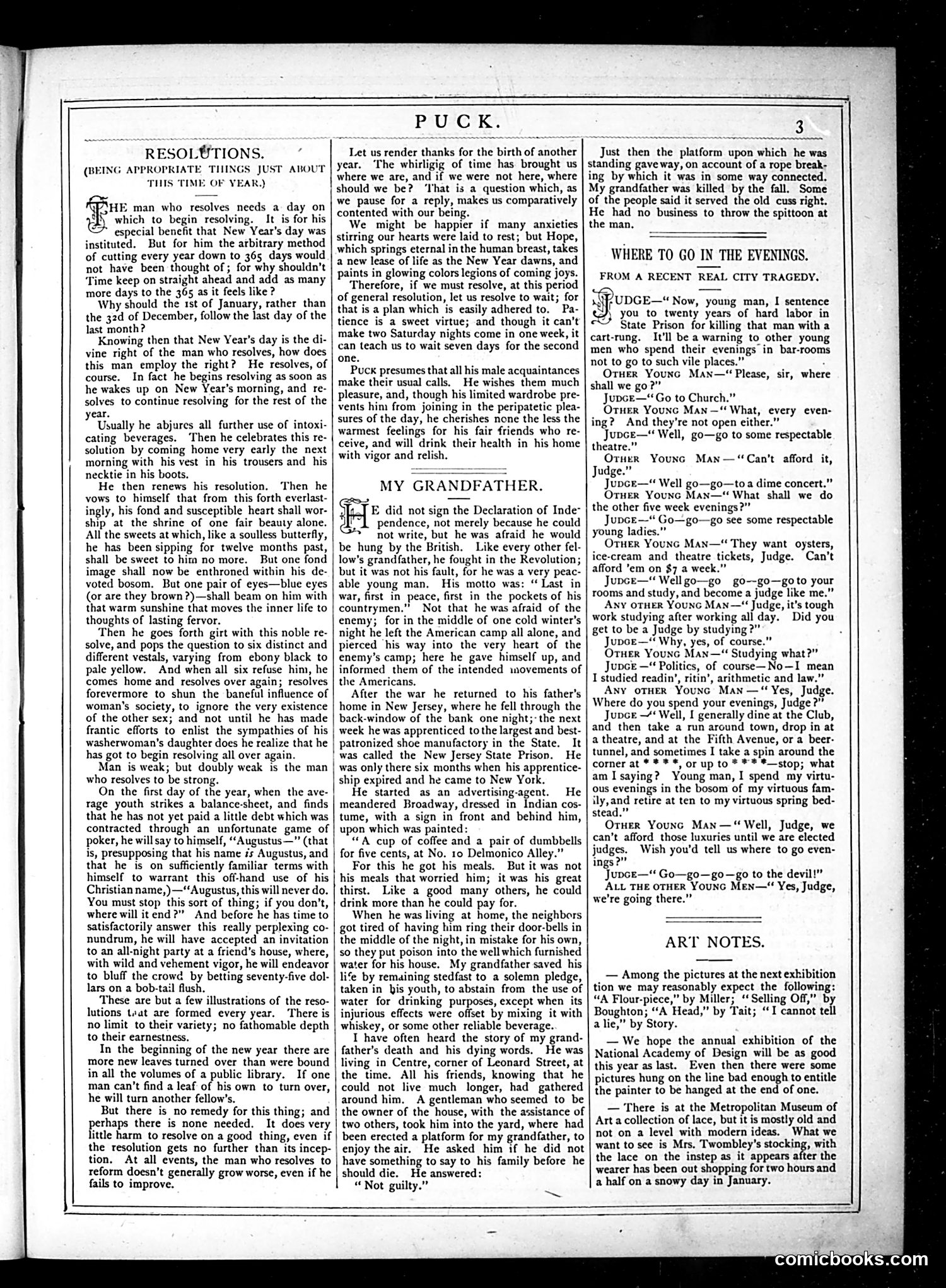
This page contains three distinct satirical pieces rather than a single cartoon: 1. **"Resolutions"** — A humorous essay on New Year's resolutions, mocking how people make grand promises they won't keep. It satirizes the male habit of resolving to avoid late Saturday nights, suggesting such pledges are inherently false. 2. **"My Grandfather"** — A nostalgic narrative about a Revolutionary War veteran who later became a successful businessman in New Jersey and New York, ultimately dying peacefully at home. This appears celebratory rather than satirical. 3. **"Where to Go in the Evenings"** — A comedic dialogue between "Judge" and "Other Young Man" about affordable evening entertainment options (church, concerts, theaters, oysters), poking fun at limited leisure activities available to young working-class men. The page prioritizes written humor over visual satire.
📄 Transcribed text from this page (OCR, searchable)
Machine-transcribed from the original scan — historical spelling and the odd misread are preserved.
RESOLUTIONS. (BEING APPROPRIATE THINGS JUST ABOUT THIS TIME OF R.) AAHIE man who resolves needs a day on . which to begin resolving. It is for his <—" especial benefit that New Year's day was instituted. But for him the arbitrary method of cutting every year down to 365 days would not have been thought of; for why shouldn't ‘Time keep on straight ahead and add as many more days to the 365 as it feels like? Why should the 1st of January, rather than the 32d of December, follow the last day of the last month? Knowing then that New Year's day is the di- vine right of the man who resolves, how does this man employ the right? He resolves, of course. In fact he begins resolving as soon as he wakes up on New Year's morning, and re- solves to continue resolving for the rest of the ear. q Usually he abjures all further use of intoxi- cating beverages. ‘Then he celebrates this re- solution by coming home very early the next morning with his vest in his trousers and his necktie in his boots. He then renews his resolution. Then he vows to himself that from this forth everlast- ingly, his fond and susceptible heart shall wor- ship at the shrine of one fair beauty alone. All the sweets at which, like a soulless butterfly, he has been sipping for twelve months past, | shall be sweet to him no more. But one fond image shall now be enthroned within his de- voted bosom. But one pair of eyes—blue eyes (or are they brown ?)—shall beam on him with that warm sunshine that moves the inner life to thoughts of lasting fervor. Then he goes forth girt with this noble re- solve, and pops the question to six distinct and different vestals, varying from ebony black to pale yellow. And when all six refuse him, he comes home and resolves over again; resolves forevermore to shun the baneful influence of woman's society, to ignore the very existence of the other sex; and not until he has made frantic efforts to enlist the sympathies of his washerwoman’s daughter does he realize that he has got to begin resolving all over again. Man is weak; but doubly weak is the man | who resolves to be strong. On the first day of the year, when the ave- rage youth strikes a balance-sheet, and finds that he has not yet paid a little debt which was contracted through an unfortunate game of poker, he will say to himself, ““Augustus—” (that | is, presupposing that his name és Augustus, and that he is on sufficiently familiar terms with himself to warrant this off-hand use of his Christian name,)—‘‘Augustus, this will never do. You must stop this sort of thing; if you don’t, where will itend?” And before he has time to satisfactorily answer this really perplexing co- nundrum, he will have accepted an invitation to an all-night party at a friend’s house, where, with wild and vehement vigor, he will endeavor to bluff the crowd by betting seventy-five dol- lars on a bob-tail flush. These are but a few illustrations of the reso- lutions tvat are formed every year. ‘There is no limit to their variety; no fathomable depth to their earnestness. In the beginning of the new year there are more new leaves turned over than were bound in all the volumes of a public library. If one man can’t find a leaf of his own to turn over, he will turn another fellow’s. But there is no remedy for this thing; and perhaps there is none needed. It does very little harm to resolve on a good thing, even if the resolution gets no further than its incep- tion. At all events, the man who resolves to reform doesn’t generally grow worse, even if he fails to improve. | countrymen.” PUCK. Let us render thanks for the birth of another year. The whirligig of time has brought us where we are, and if we were not here, where should we be? ‘That is a question which, as we pause for a reply, makes us comparatively contented with our being. We might be happier if many anxieties stirring our hearts were laid to rest; but Hope, which springs eternal in the human breast, takes a new lease of life as the New Year dawns, and paints in glowing colors legions of coming joys. Therefore, if we must resolve, at this period of general resolution, let us resolve to wait; for that is a plan which is easily adhered to. Pa- tience is a sweet virtue; and though it can’t make two Saturday nights come in one week, it can teach us to wait seven days for the second one. Puck presumes that all his male acquaintances make their usual calls, He wishes them much pleasure, and, though his limited wardrobe pre- vents him from joining in the peripatetic plea- sures of the day, he cherishes none the less the warmest feelings for his fair friends who re- ceive, and will drink their health in his home with vigor and relish. MY GRANDFATHER. E did not sign the Declaration of Inde- pendence, not merely because he could > not write, but he was afraid he would be hung by the British. Like every other fel- low's grandfather, he fought in the Revolution; but it was not his fault, for he was a very peac- able young man. His motto was: “ Last in war, first in peace, first in the pockets of his Not that he was afraid of the enemy; for in the middle of one cold winter's night he left the American camp all alone, and pierced his way into the very heart of the enemy’s camp; here he gave himself up, and informed them of the intended novements of the Americans. After the war he returned to his father’s home in New Jersey, where he fell through the back-window of the bank one night; the next week he was apprenticed tothe largest and best- patronized shoe manufactory in the State. It was called the New Jersey State Prison. He was only there six months when his apprentice- ship expired and he came to New York. He started as an advertising-agent. He meandered Broadway, dressed in Indian cos- tume, with a sign in front and behind him, upon which was painted: “A cup of coffee and a pair of dumbbells for five cents, at No. 10 Delmonico Alley.” For this he got his meals. But it was not his meals that worried him; it was his great thirst. Like a good many others, he could drink more than he could pay for. When he was living at home, the neighbors got tired of having him ring their door-bells in the middle of the night, in mistake for his own, so they put poison into the well which furnished water for his house. My grandfather saved his life by remaining stedfast to a solemn pledge, taken in bis youth, to abstain from the use of water for drinking purposes, except when its injurious effects were offset by mixing it with whiskey, or some other reliable beverage. I have often heard the story of my grand- father’s death and his dying words. He was living in Centre, corner of Leonard Street, at the time. All his friends, knowing that he could not live much longer, had gathered around him. A gentleman who seemed to be the owner of the house, with the assistance of two others, took him into the yard, where had been erected a platform for my grandfather, to enjoy the air. He asked him if he did not have something to say to his family before he should die. He answered: “Not guilty.” Just then the platform upon which he was standing gave way, on account of a rope break- ing by which it was in some way connected. My grandfather was killed by the fall. Some of the people said it served the old cuss right. He had no business to throw the spittoon at the man, WHERE T0 GO IN THE EVENINGS. FROM A RECENT ‘REAL CITY TRAGEDY, SSPuDGE—« Now, young man, I sentence =), you to twenty years of hard labor in © State Prison for killing that man with a cart-rung. It'll be a warning to other young men who spend their evenings in bar-rooms not to go to such vile places.” : Oruer Younc Man—“ Please, sir, wher shall we go?” Jupce—‘Go to Church.” Orner Younc Man —" What, every even- ing? And they’re not open either.” Jupce—“ Well, go—go to some respectable theatre.” Orner Younc Man—‘Can't afford it, Judge.” Jup “« Well go—go—to a dime concert.” Orner Younc Man—‘ What shall we do the other five week evenings?” Jupce— Go—go—go see some respectable young ladies. OrTHER YouNG Man—“ They want oysters, ice-cream and theatre tickets, Judge. Can't afford ’em on $7 a week.” Jupce—“ Well go—go go--go—goto your rooms and study, and become a judge like me.” ANY OTHER Younc Man—“ Judge, it’s tough work studying after working ali day. Did you get to be a Judge by studying ?” : Jupoe—“ Why, yes, of course.” Otner Younc Man—“ Studying what?” Jupce — Politics, of course—No—I mean I studied readin’, ritin’, arithmetic and law.” Any oTHER YounG Man —“‘ Yes, Judge. Where do you spend your evenings, Judge ?”” Juvce —* Well, I generally dine at the Club, and then take a run around town, drop in at a theatre, and at the Fifth Avenue, or a beer- tunnel, and sometimes I take a spin around the corner at * * * *, or up to * ** *—stop; what am I saying? Young man, I spend my virtu- ous evenings in the bosom of my virtuous fam- ily, and retire at ten to my virtuous spring bed- stead.” Orner Younc Man—“ Well, Judge, we can’t afford those luxuries until we are elected judges. Wish you'd tell us where to go even- ings?” ‘Jupce—* Go—go—go—go to the devil!” ALL THE OTHER YouNG Men—“ Yes, Judge, we're going there.” ART NOTES. — Among the pictures at the next exhibition tion we may reasonably expect the following: “A Flour-piece,” by Miller; “Selling Off,” b: Boughton; “A Head,” by Tait; “I cannot tel a lie,” by Story. — We hope the annual exhibition of the National Academy of Design will be as good this year as last. Even then there were some pictures hung on the line bad enough to entitle the painter to be hanged at the end of one. — There is at the Metropolitan Museum of Arta collection of lace, but it is mostly old and not on a level with modern ideas. What we want to see is Mrs. Twombley's Ee with the lace on the instep as it appears after the wearer has been out shopping for two hours and a half on a snowy day in January.